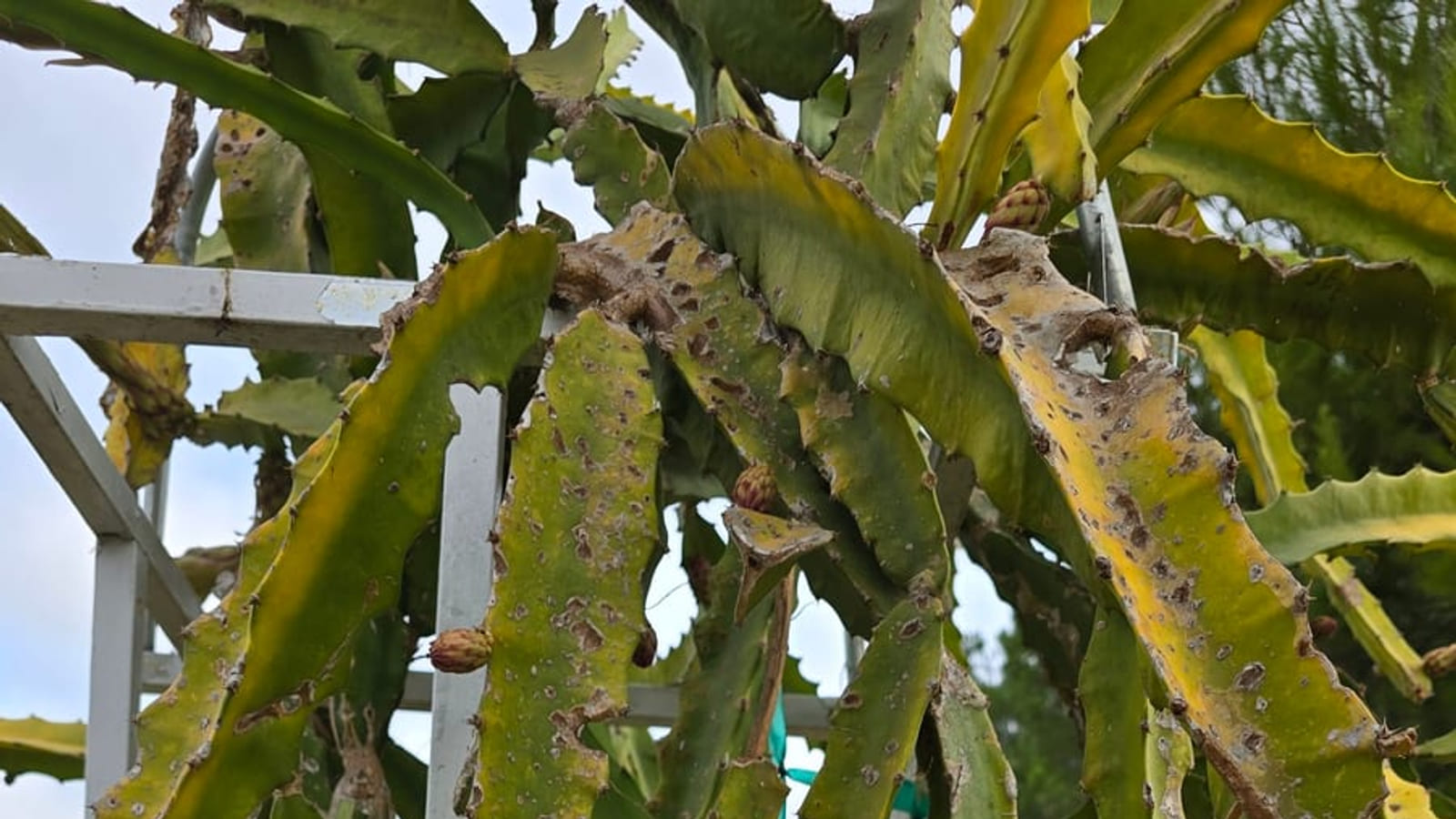
Top Dragon Fruit Varieties for Yield and Flavor
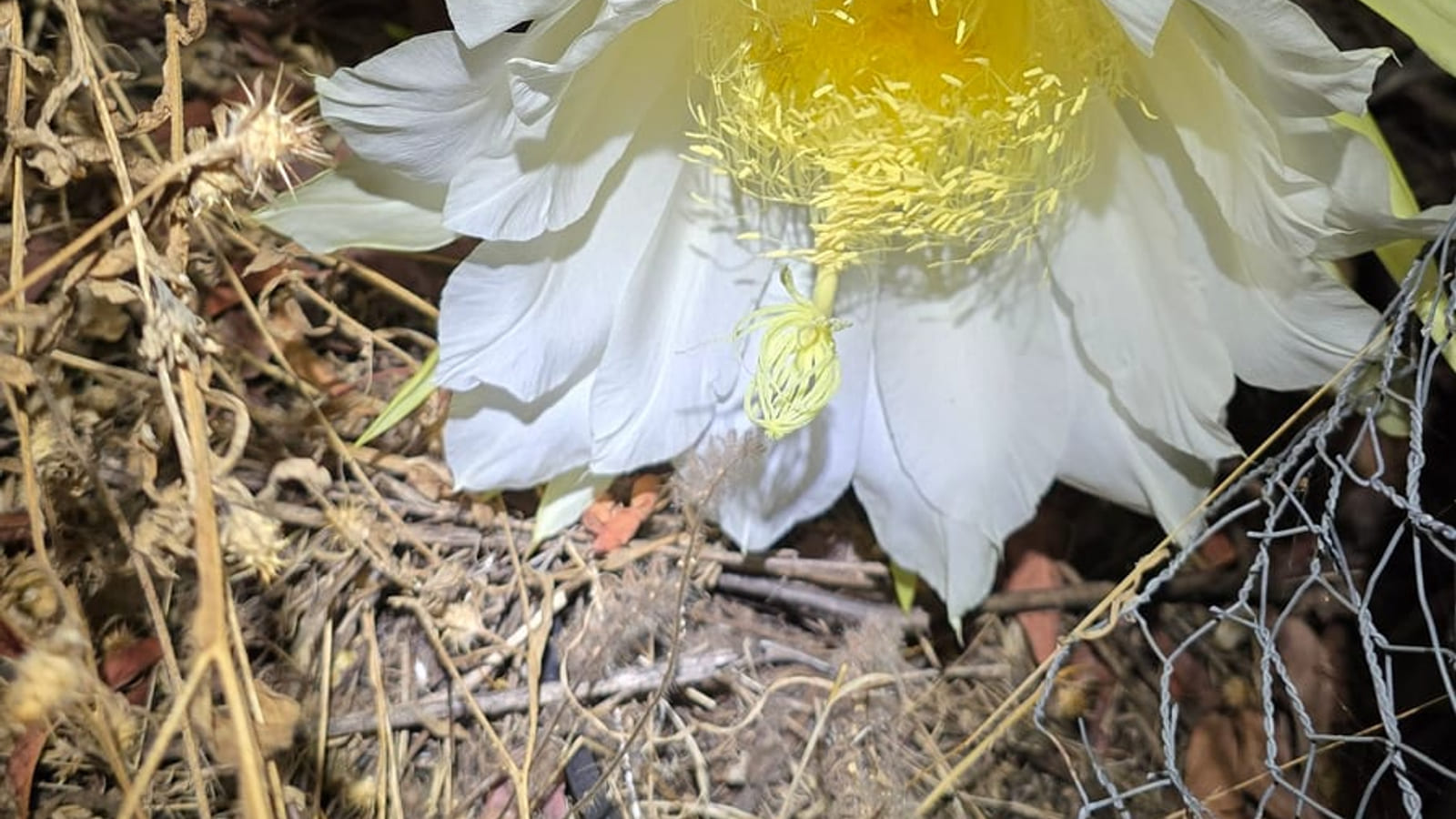
If you are planting dragon fruit for the first time, start with varieties that have proven performance data rather than untested nursery tags. In a five-year trial in Puerto Rico, cultivars N97-17 and N97-15 produced significantly more fruit, while N97-17, N97-20, N97-22 and NOI-13 delivered the highest yields. For growers in southern California, UC ANR field trials identified Physical Graffiti, Valdivia Roja, Haley’s Comet, and Lisa as top performers for both heat and cold tolerance. Physical Graffiti topped the market weight per plant at 23,429 g with 17.93 Brix. Note that yield and sweetness do not always track together. The sweetest group in the Puerto Rico trial included Cosmic Charlie, which had the lowest yield. Always plant two or three different genetic types to ensure cross-pollination and better fruit set. See our dragon fruit cuttings for verified, self-fruitful selections.
Three species behind every variety name
The confusion in the nursery aisle is not just about marketing labels. It is rooted in biology. While you may see dozens of names on a rack, there are only three commercial species in circulation. The taxonomic names on many tags are outdated. The GBIF Backbone Taxonomy now resolves Hylocereus undatus, H. polyrhizus, H. costaricensis, H. megalanthus, H. guatemalensis and H. setaceus as synonyms. The accepted names are Selenicereus undatus, S. costaricensis (often sold as S. monacanthus in red-fleshed trades) and S. megalanthus [9]. Understanding which of these three a plant belongs to tells you more about its behavior than the cultivar name does.
Each species trades against the others on flavor, nutrition and yield. A peer-reviewed comparison found that red-fleshed S. costaricensis is superior in protein, moisture, crude fibre, ash, and minerals like potassium, calcium, iron and zinc. It also contains higher levels of anthocyanins, total carotenoids, vitamin C and total soluble phenolics, resulting in the highest antioxidant activity [5]. In contrast, white-fleshed S. undatus has the highest carbohydrate and energy content. Yellow S. megalanthus stands out for having the highest total soluble sugars [5]. If you want bulk and energy, you look to white. If you want antioxidant density, you look to red. If you want pure sugar, you look to yellow.
| Species | Primary Strength | Key Limitation |
|---|---|---|
| S. undatus (White) | Highest carbohydrate and energy content | Lower antioxidant profile than red |
| S. costaricensis (Red) | Superior protein, minerals, and antioxidants | Often lower sugar content than yellow |
| S. megalanthus (Yellow) | Highest total soluble sugars | Thorny stems; chilled-susceptible fruit |
The yellow species behaves differently in the garden and the fridge. Pitahaya is a non-climacteric fruit, meaning it keeps no sugar reserve to ripen on after picking. Ripeness for eating and ripeness for harvest are the same call [6]. The fruit is borne on thorny stems, requiring careful handling. Its flowers open from about 5 pm to 9 am the next morning. Storage recommendations differ sharply by species: Hylocereus fruit is stored at 10 C, but yellow pitahaya is chilled-susceptible and requires 6 C at 85-90% humidity [6]. If you are growing yellow, you are managing a different post-harvest protocol entirely.
Choosing the wrong species is a long-term commitment. Three- to four-year-old plants may produce about 220 lb (100 kg) of fruit per year, and the productive life of a planting is estimated at about 20 years [1]. A wrong variety choice is a multi-decade error rather than a lost season. This is why the lack of reliable variety information is such a major obstacle. A survey of southern California growers found up to 70 different clones being sold with no performance data attached, while only five clones were grown commercially anywhere at the time [3].
Climate limits are narrow across all three species. Optimum temperatures for growth are 65-77 F. Plants tolerate cool or warm climates provided temperatures stay below 100 F. Exposure below 31 F of long duration causes damage, though plants recover rapidly from light freezing injury [1]. In high-insolation areas, about 30% shading is recommended for the first three to four months after planting. Too much shade, however, gives low production and poor-quality fruit [1]. You cannot shade your way to a sweet harvest if you block too much light.
Information on self-incompatibility of named cultivars is not well documented. This makes variety recommendations difficult and potentially unreliable. A nursery tag is not a guarantee of fruit set [1]. Always check which dragon fruit varieties are self-fertile and which need a pollination partner before planting a single clone.
What the yield trials actually measured
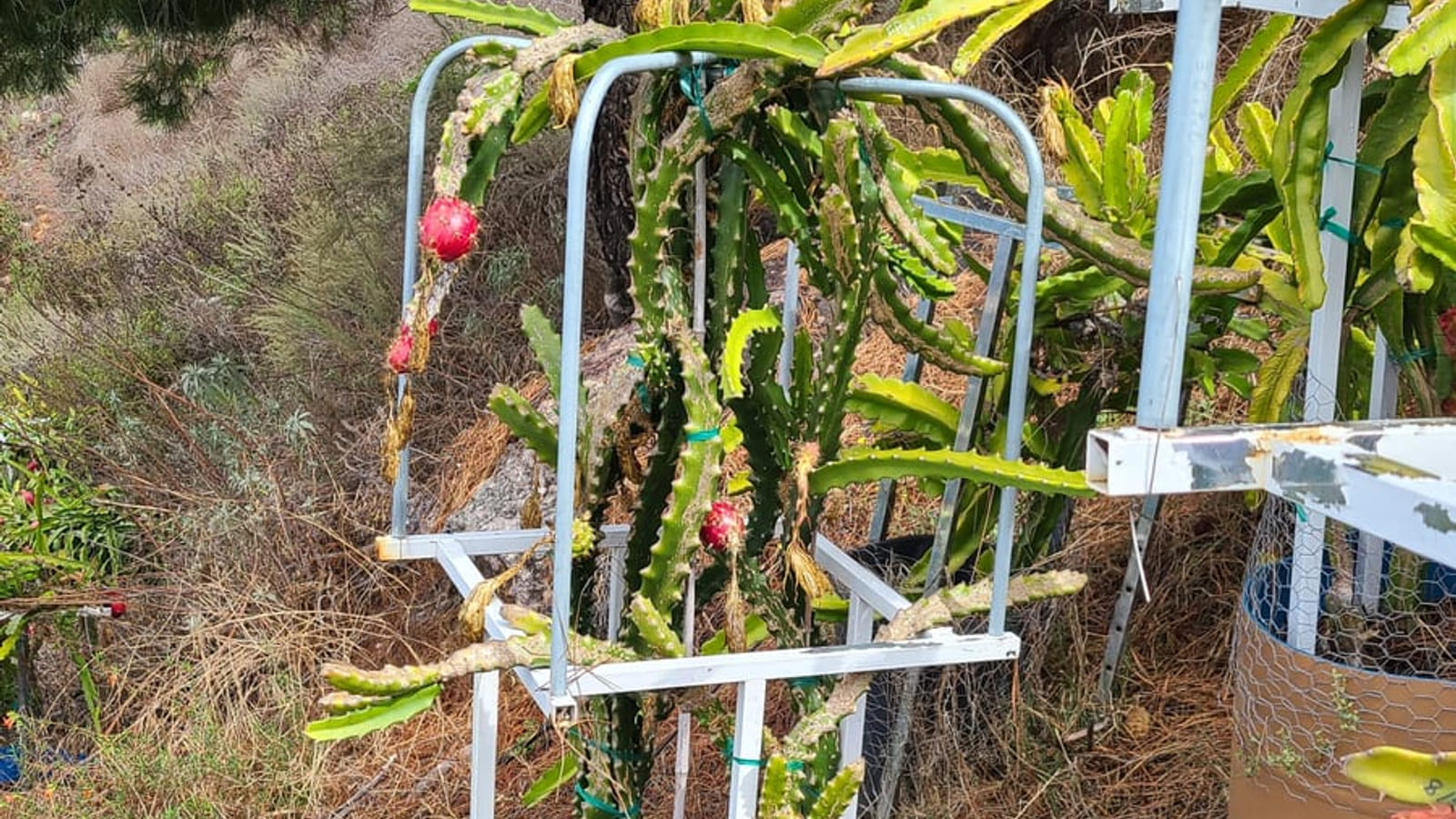
Numbers tell a different story than marketing blurbs. The five-year replicated trial at Isabela, Puerto Rico, evaluated 12 cultivars on an Oxisol under intensive management. The researchers found significant differences among the clones in both fruit number and yield per hectare. Yield rose from 2010 to 2013, then levelled off or declined[2].
Two cultivars stood out for sheer volume. N97-17 and N97-15 produced significantly more fruit, averaging 74,908 fruit per hectare. Four cultivars delivered the highest total weight: N97-17, N97-20, N97-22 and NOI-13 averaged 17,002 kg per hectare[2].
The spread between winners and losers was massive. Cosmic Charlie, often praised for flavor, had the lowest fruit yield in the same trial at 25.1 kg per hectare. That is roughly 677 times less than the top four cultivars. This gap is the source of the "700-fold" difference growers talk about[2].
Yield and sweetness do not move together. Individual fruit weight was significantly higher in N97-20 and NOI-13 at 346.3 g. But soluble solids were significantly higher in NOI-16, N97-18 and Cosmic Charlie at 17.4%. The sweetest group included the worst yielder[2].
| Metric | Top Performers | Result |
|---|---|---|
| Fruit Number | N97-17, N97-15 | 74,908 fruit/ha |
| Total Yield | N97-17, N97-20, N97-22, NOI-13 | 17,002 kg/ha |
| Fruit Weight | N97-20, NOI-13 | 346.3 g |
| Sweetness (SS) | NOI-16, N97-18, Cosmic Charlie | 17.4% |
California trials focused on practicality. Most clones in the UC ANR field trial set fruit without hand pollination. Bees and other insects did the work. Most varieties produced well without shade, though some benefited from it. The trial deliberately concentrated on self-fruitful selections with good yield, fruit, and flavor characteristics[3]. This makes them easier to manage for small-scale growers. See our guide on which dragon fruit varieties are self-fertile and which need a pollination partner for more on this dynamic.
Climate resilience was also measured. Ramiro Lobo identifies 8-S, Valdivia Roja, Physical Graffiti, Haley’s Comet and Lisa as varieties that tolerate both heat and cold well. The yellow clone Colombiana handles neither. The published trial table backs this up. Physical Graffiti scored 4.5/4.5 for cold/heat tolerance. Valdivia Roja scored 5/4.5. Colombiana scored 1/1[3].
Grower Note: High yield does not guarantee high flavor. Cosmic Charlie had the lowest yield but high soluble solids. Choose your priority before you plant.
The California cultivar table you can actually buy
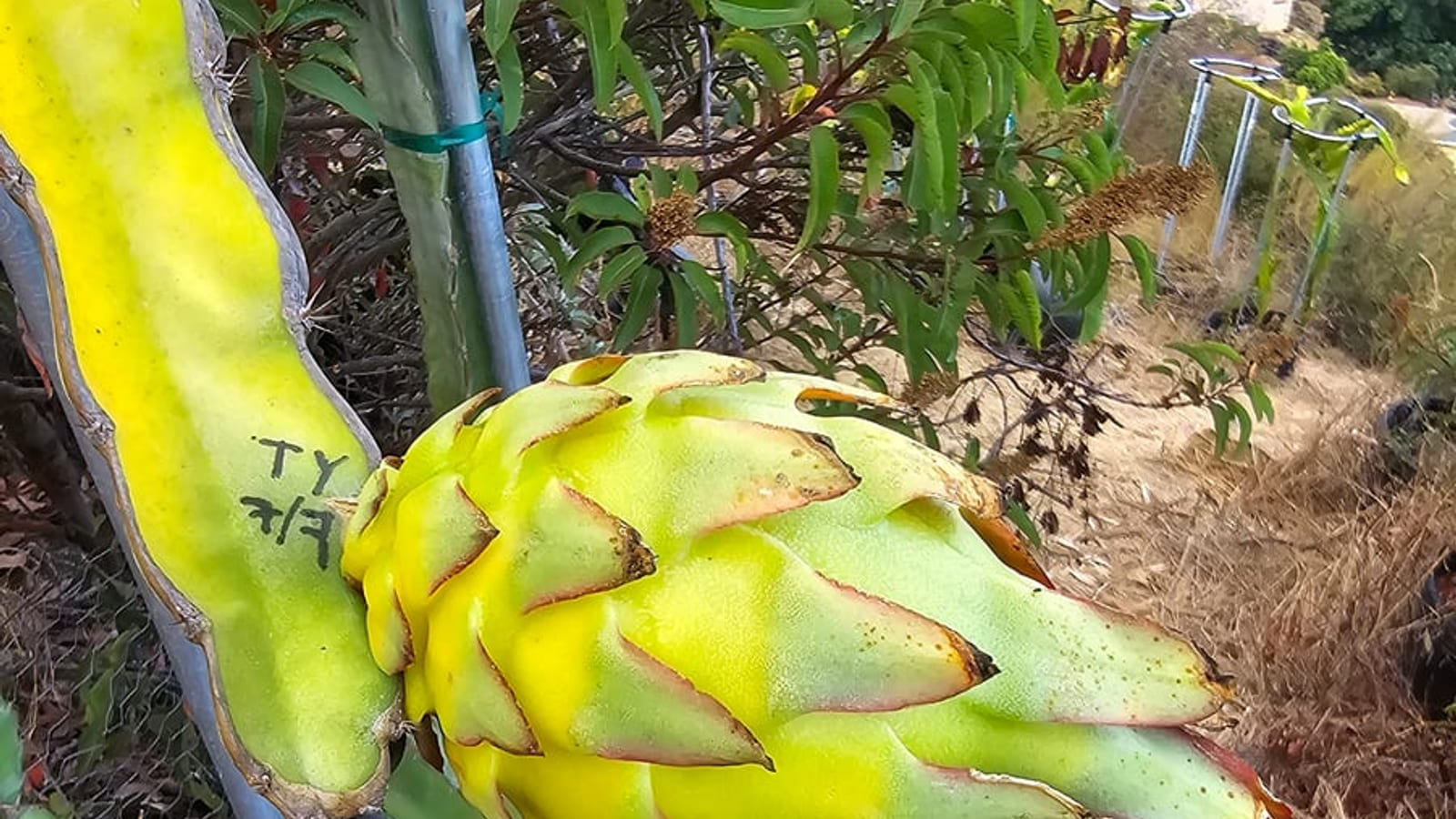
Commercial dragon fruit production in the United States is concentrated in just three states: California, Florida, and Hawaii. A UC ANR survey placed California acreage at 100 to 200 acres, mostly in the south, while Hawaii held about 200 acres and Florida exceeded 400 acres[10]. Despite this limited footprint, domestic demand outstrips supply. In August 2014, ten pounds of imported red dragon fruit from Nicaragua and Vietnam sold wholesale in Los Angeles for $23.50 to $33, whereas ten pounds of California-grown organic red fruit commanded $57.50[10]. Farmers-market growers reported prices of $7 to $8 per pound, reflecting the premium for local, fresh product[10].
For growers looking to enter this market, the UC ANR field trial data provides a clear ranking of performance. The table below details the top performers based on market weight per plant, sweetness, and climate resilience. Note that physical size does not always correlate with sugar content; some high-yielders are moderate in Brix, while smaller fruits can pack intense sweetness.
| Cultivar | Market Weight (g/plant) | Brix | Cold/Heat Score |
|---|---|---|---|
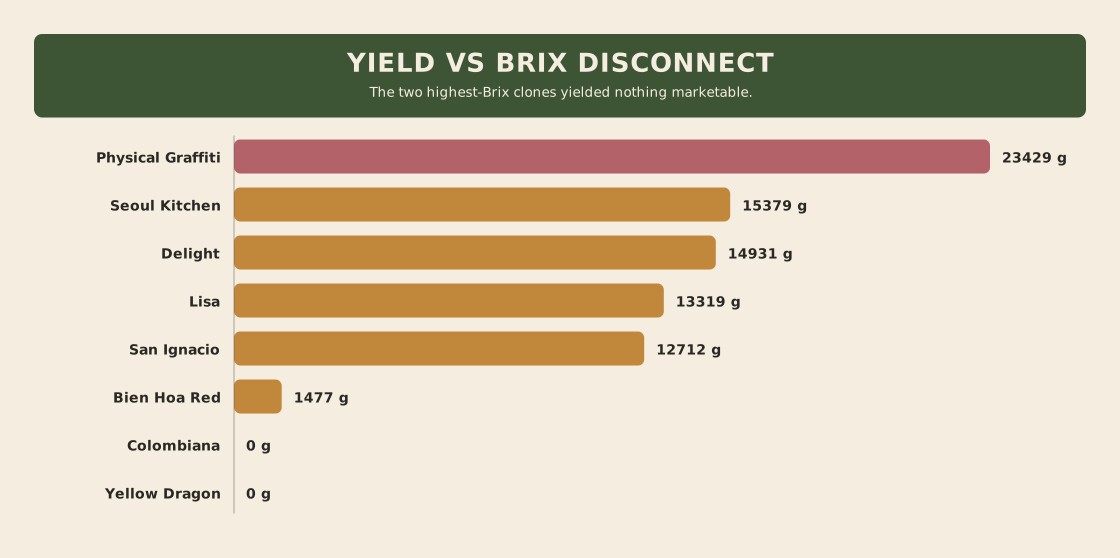
| Physical Graffiti | 23,429 | 17.93 | 4.5 / 4.5 |
| Seoul Kitchen | 15,379 | 12.18 | 4 / 4 |
| Delight | 14,931 | 18.08 | Not listed |
| Lisa | 13,319 | 17.02 | 3.75 / 4 |
| San Ignacio | 12,712 | 15.6 | 3.75 / 4 |
| Valdivia Roja | 8,588 | 17.9 | 5 / 4.5 |
| Haley’s Comet | 5,979 | 16.7 | 4.5 / 4.25 |
Physical Graffiti stands out as the top yielder in the trial, producing over 23 kg of marketable fruit per plant with a respectable 17.93 Brix[3]. Valdivia Roja offers the highest cold tolerance score of 5, making it a resilient choice for areas with occasional frost, though its yield is lower at 8,588 g[3]. Delight matches Physical Graffiti in sweetness with 18.08 Brix but yields slightly less[3]. If you are prioritizing flavor, American Beauty scored the highest Brix at 18.51, though its market weight was lower at 5,566 g[3].
Yellow Pitahaya: The Off-Season Play
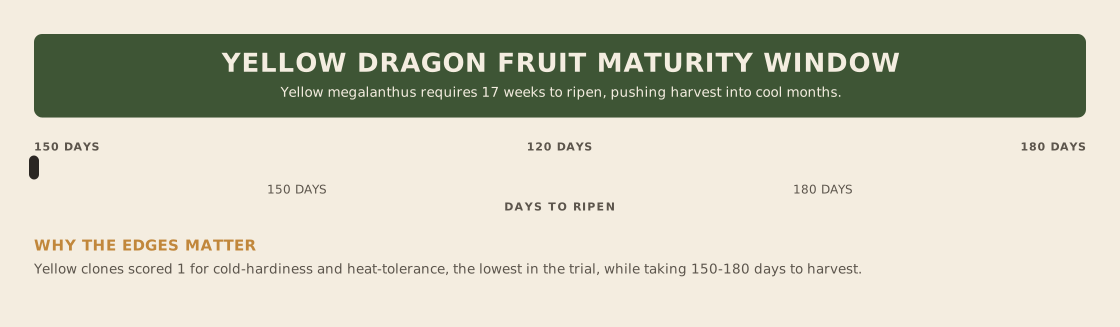
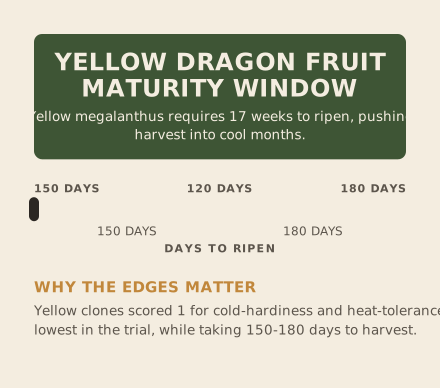
Yellow varieties like Colombiana and Yellow Dragon scored the lowest in climate tolerance (1/1) and produced no marketable weight in the California trial[3]. However, they offer a strategic advantage: they bear fruit in the November-through-February window, when red varieties are dormant[10]. Yellow pitahaya begins bearing about 14 months after planting, and its fruit takes 13 to 14 weeks to develop in summer and 20 to 22 weeks in winter, compared to 30 to 40 days for red fruits[6]. This long fill period is the cost of capturing the off-season market.
Most clones in the trial set fruit without hand pollination, relying on bees and other insects[3]. However, self-incompatibility varies by type. For a deeper look at which dragon fruit varieties are self-fertile and which need a pollination partner, consult our pollination guide.
Flavour and sweetness: where Brix comes from
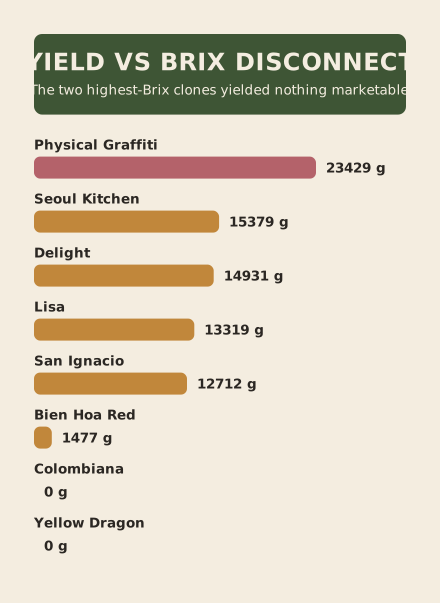
Growers often assume that a high-yielding plant will automatically produce the sweetest fruit. The data says otherwise. In the UC ANR field trials, Physical Graffiti delivered the highest market weight per plant at 23,429 g with a respectable 17.93 Brix, but it was not the sweetest clone in the group. Bien Hoa Red produced only 1,477 g per plant yet hit 18.9 Brix, while American Beauty managed 18.51 Brix on a modest 5,566 g yield[3]. If you are chasing pure sugar, you are often trading away bulk.
Sweetness is a genotypic trait with a hard biochemical limit. It is underpinned by the dominance of cleavage-direction sucrose synthase activity, which controls how sugars are partitioned into the fruit[8]. You cannot fertilize a low-Brix clone into a high-Brix one. The genetics are locked in the cutting you buy. If a variety tests at 12 Brix, it will not become a 18 Brix variety because you fed it extra potassium.
| Cultivar | Brix | Market Weight (g/plant) | Fruit Weight (g) |
|---|---|---|---|
| Bien Hoa Red | 18.9 | 1,477 | 360 |
| American Beauty | 18.51 | 5,566 | 380 |
| Delight | 18.08 | 14,931 | 371 |
| Physical Graffiti | 17.93 | 23,429 | 374 |
| Valdivia Roja | 17.9 | 8,588 | 250 |
| Lisa | 17.02 | 13,319 | 465 |
| Haley's Comet | 16.7 | 5,979 | 482 |
| Sin Espinas | 16.5 | 3,527 | 393 |
| Armando | 16.11 | 4,881 | 390.5 |
| Rosa | 16.05 | 7,217 | 384 |
| Orejona | 15.78 | 4,598 | 438 |
| Cebra | 15.75 | 8,746 | 468 |
| San Ignacio | 15.6 | 12,712 | 552 |
| Seoul Kitchen | 12.18 | 15,379 | 518 |
| Bien Hoa White | 11.85 | 7,394 | 388 |
| Colombiana | 20.90 | 0 | N/A |
| Yellow Dragon | 21.15 | 0 | N/A |
Numbers on a refractometer do not tell the whole story of taste. In blind sensory panels where tasters could not see the pulp color, Physical Graffiti, Sin Espinas and Lisa were rated highest for flavor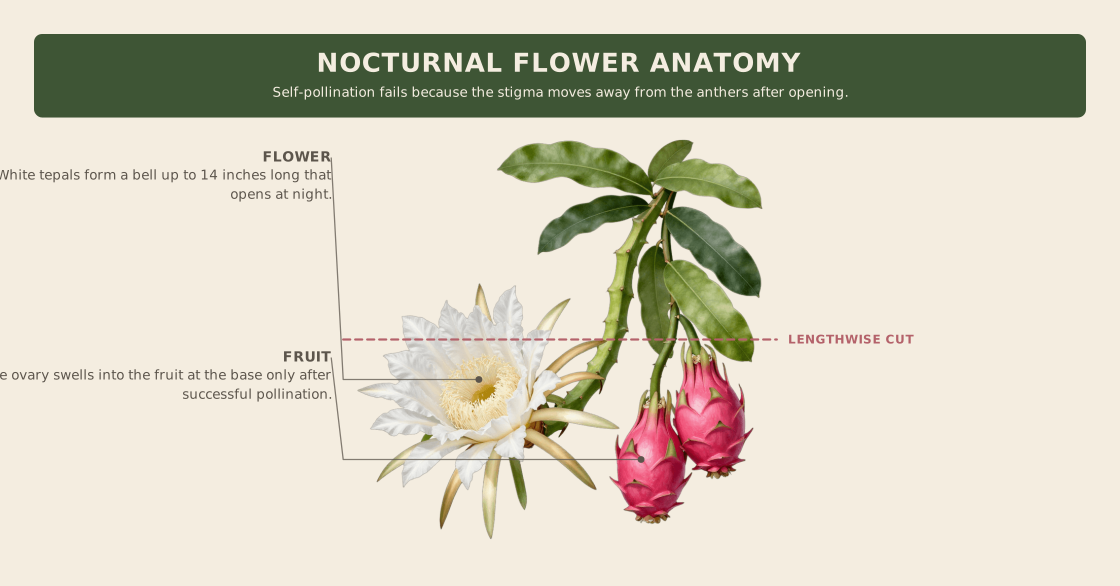
Pollination: the reason a labelled variety still fails
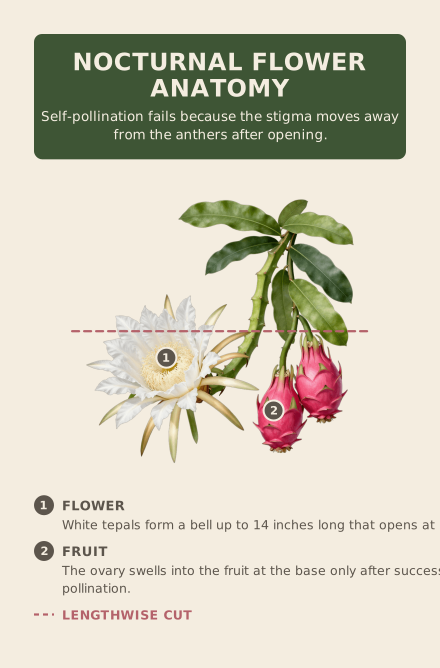
A nursery tag tells you what a plant is supposed to do. It does not guarantee what it will do in your garden. The gap between expectation and harvest often comes down to pollination biology, which varies wildly even within the same species. A two-year study conducted under subtropical conditions in India highlighted this risk clearly. The white-fleshed variety NDFW-1 (Selenicereus undatus) was found to be self-compatible, meaning it could set fruit with its own pollen. However, when researchers manually cross-pollinated it, the resulting fruit was significantly heavier. Self-compatibility is not the same as self-sufficiency. The plant produced, but it produced better when helped along.[2]
The red-fleshed clone tested in the same study, NDFR-1, behaved very differently. It was strictly self-incompatible. Without cross pollen from a different genetic type, it set no fruit at all. This is the nightmare scenario for a solo planting. You wait years for a vine to mature, only to find that the flowers drop because there is no compatible partner nearby. If you are unsure about the compatibility of your specific clones, our guide on which dragon fruit varieties are self-fertile and which need a pollination partner breaks down the biological requirements.
Timing is just as critical as compatibility. The same Indian study measured pollen viability and stigma receptivity to define the reliable pollination window. It runs from four hours before anthesis (the moment the flower opens) to twelve hours after. Within this window, the flower is receptive. Outside of it, you are wasting your time. Researchers also noted post-anthesis floral bending, a physical movement consistent with delayed self-pollination. While this mechanism exists, the study concluded it is not sufficient to produce commercial-grade fruit on its own. Relying on the flower’s natural movement is a gamble. Relying on a compatible neighbor is a strategy.
Do not assume the tag is right. Variety identity in the dragon fruit trade is unstable. Cuttings are passed around, renamed, and rebranded. Many cultivars go by several names, and growers still argue over whether selections sold under different labels are actually the same plant. A recurring example is the debate over whether Bien Hoa Red and American Beauty are one clone or two. If you buy two plants with different names, you might be buying two copies of the same self-incompatible clone. You will get flowers, but you will not get fruit.
This instability is why we recommend planting two or three different genetic types. It is not just about diversity for the sake of it. It is about insurance. If one clone is self-incompatible, the other provides the pollen it needs. If both are self-compatible, cross-pollination often results in larger, heavier fruit, as seen with NDFW-1. The biology is messy, but the solution is simple: diversify your pollination partners.
| Scenario | Pollination Outcome | Grower Action |
|---|---|---|
| Self-compatible clone (e.g., NDFW-1) | Sets fruit alone, but heavier with cross-pollen | Plant a partner for size, not just set |
| Self-incompatible clone (e.g., NDFR-1) | No fruit without cross-pollen | Must have a compatible partner |
| Unknown clone | Unpredictable | Plant with two other distinct types |
Cold, heat and where you live
Climate limits for dragon fruit are narrow. Optimum growth happens between 65 and 77 F. The plants can handle cool or warm weather as long as temperatures stay below 100 F. Long exposure to temperatures below 31 F causes damage, though plants often recover quickly from light freezing. You need to match your specific microclimate to the right clone. A variety that thrives in a protected urban courtyard might fail in an exposed rural field.
The UC ANR field trial in southern California measured cold-hardiness and heat tolerance for each cultivar. The scores separated the varieties sharply. Valdivia Roja scored a perfect 5 for cold and 4.5 for heat. Physical Graffiti scored 4.5 for both. Haley’s Comet managed 4.5 for cold and 4.25 for heat. Seoul Kitchen and Armando both scored 4 for cold and 4 for heat. Lisa and San Ignacio scored 3.75 for cold and 4 for heat. These numbers tell you which plants will survive a frost or a heatwave without dying back to the ground.
At the other end of the spectrum, Bien Hoa Red scored 1.75 for cold and 1.75 for heat. The yellow clones, Colombiana and Yellow Dragon, scored 1 for both categories. These were the lowest scores in the entire trial. If you live in an area with occasional frost or intense summer heat, avoid these varieties. They lack the resilience of the top performers. Ramiro Lobo from UC ANR specifically notes that Colombiana handles neither heat nor cold well, which aligns with its 1/1 score.[11]
| Cultivar | Cold Score | Heat Score |
|---|---|---|
| Valdivia Roja | 5 | 4.5 |
| Physical Graffiti | 4.5 | 4.5 |
| Haley’s Comet | 4.5 | 4.25 |
| Seoul Kitchen | 4 | 4 |
| Armando | 4 | 4 |
| Lisa | 3.75 | 4 |
| San Ignacio | 3.75 | 4 |
| Bien Hoa Red | 1.75 | 1.75 |
| Colombiana | 1 | 1 |
| Yellow Dragon | 1 | 1 |
Microclimate matters. A south-facing wall can raise the effective hardiness zone by a full step. If you are on the edge of your zone, choose a variety with a cold score of 4 or higher. Physical Graffiti and Valdivia Roja offer the best insurance against unexpected freezes.
Shade management also plays a role in heat tolerance. The trial found that most clones produced well without shade, though some benefited from it. Too much shade, however, leads to low production and poor fruit quality. You need to balance protection with light exposure. If you are planting in a hot, dry inland valley, prioritize heat-tolerant clones like Physical Graffiti or Valdivia Roja. If you are in a cooler coastal zone, you have more flexibility, but you still want to avoid the low-scoring yellow varieties unless you have a protected microclimate.
Remember that variety choice is a long-term commitment. Plants can live for about 20 years. Choosing a clone that is poorly suited to your local climate means you will spend years fighting the plant instead of harvesting fruit. Check your local frost dates and summer highs. Match them to the scores above. If you are unsure, start with the high-scoring varieties. They are more forgiving of mistakes and environmental fluctuations. For more on ensuring your plants set fruit once they are established, see our guide on which dragon fruit varieties are self-fertile and which need a pollination partner.
Harvest timing: build a season, not a variety
You are not just picking a flavor profile when you choose a clone. You are choosing when that flavor arrives. The standard US fresh market window runs June through September, with August and September serving as the peak months for most red and white varieties[10]. If your goal is to have fruit on the table year-round, or to catch the high-price windows when local supply is thin, you need to think about phenology before you think about Brix.
The yellow species, *Selenicereus megalanthus*, is the primary tool for extending your season. While red and white types dominate the summer harvest, yellow pitahaya typically bears in the November-through-February window[10]. This makes a yellow vine the essential off-season play in a mixed planting plan. However, this comes with a biological cost. Yellow fruit development is slow. In summer, it takes roughly 13-14 weeks from pollination to harvest; in winter, that stretches to 20-22 weeks[6]. Compare this to the 30-40 days typical for red cultivars, and you see the trade-off. You buy off-season availability at the price of a much longer fruit-fill period[6].
Because yellow pitahaya is non-climacteric, it does not ripen after picking. The sugar reserves are fixed at harvest. You must wait for the full development window. A single yellow vine often carries ripe fruit, young fruit, open flowers, and fresh buds simultaneously, creating a continuous harvest rather than a single mass pick[6]. This requires a different management rhythm. You are not clearing a trellis once a month; you are making selective cuts every few days.
If you want to force fruit outside these natural windows, you can manipulate the environment. Supplemental light delivered to pitaya orchards in winter has been shown to induce flowering out of season. This works by promoting phytohormone biosynthesis, specifically cytokinin dynamics in the flower buds[7]. This is the mechanism behind forcing an off-season crop under lights. It allows you to decouple flowering from the natural short-day or dry-season triggers.
Getting to that first harvest depends on how you start your cuttings. Propagation numbers are well established. Stem cuttings of 6-15 inches should be cured for 7-8 days in a dry, shady place before planting[1]. Once planted, they take 4-6 months to build a good root system in pots. After that, growth is rapid, often reaching about 1.2 inches per day[1]. Many plants will fruit 6-9 months after planting. Longer cuttings reach the trellis support sooner than short ones, which accelerates the timeline to your first marketable fruit[1].
Plan for overlap. If you plant only summer-bearing reds, you have a glut in August and nothing in January. If you plant only yellows, you wait months for fruit fill. A strategic mix ensures you are always harvesting something, spreading your labor and your market risk across the year.
Remember that flowering onset is often linked to environmental cues like early summer rains, which act as a floral inducer[4]. Microclimate manipulation, such as fogging or sprinklers, can extend the reproductive window of a planting[4]. But water management is critical. A dry period in winter and early spring is required for abundant bloom induction, yet once plants flower, drought causes poor production[1]. You need consistent water from flowering through harvest, while excess soil moisture at other times drives bacterial and fungal disease[1].
Finally, consider the labor of harvest. Thorny pitayas are harder to harvest than thornless ones. Leather gloves with long sleeves are recommended[1]. Fruit should be cut from the plant with the peduncle trimmed flush to avoid a stub that damages neighboring fruit[1]. If you are growing yellow varieties, remember that their stems are thorny, adding another layer of difficulty to the off-season harvest.
| Goal | Strategy | Key Constraint |
|---|---|---|
| Summer Peak | Red/White varieties | Market saturation in Aug/Sept |
| Winter/Early Spring | Yellow varieties | 13-22 week fruit fill |
| Off-Season Force | Supplemental lighting | Energy costs; light pollution |
| Continuous Yield | Mixed species planting | Complex pollination management |
For more
Naming chaos: buy the clone, not the story
The nursery aisle is a minefield of inconsistent labels. A survey of southern California growers found up to 70 different clones being sold with no performance data attached, while only five clones were grown commercially anywhere at the time[3]. This lack of reliable variety information is the major obstacle to commercial production[3]. The problem is not just marketing spin. It is rooted in how the plants are propagated and renamed.
Many cultivars go under several names, and growers still argue over whether selections sold under different names are the same plant[11]. The recurring example is the debate over whether Bien Hoa Red and American Beauty are one clone[11]. This instability comes from the passing-around and renaming of cuttings. Paul Thomson, co-founder of the California Rare Fruit Growers, made a series of pitaya crosses he labelled 1-S through 9-S, the S standing for seedling[11]. 8-S was later renamed Sugar Dragon by a San Diego County grower, 1-S became Physical Graffiti through a Florida nursery, and 3-S became Delight[11].
You are buying a genetic line, not a brand. The tag on the pot matters less than the behavior of the vine. UC ANR’s Ramiro Lobo identifies 8-S, Valdivia Roja, Physical Graffiti, Haley’s Comet and Lisa as the varieties that tolerate both heat and cold well[11]. This matches the measured scores in the published trial table, where Physical Graffiti scored 4.5/4.5 for cold/heat tolerance and Valdivia Roja scored 5/4.5[11]. In contrast, the yellow clone Colombiana handles neither, scoring 1/1[11].
The long-running grower consensus is that every seasoned southern California grower recommends 8-S to someone who will plant only one variety[11]. American Beauty is the usual second choice because it is self-fertile, highly productive and good to eat[11]. The noted drawback of 8-S is that its fruit is smaller than most others[11]. When you buy a cutting, you are buying a specific set of traits. If the name on the tag changes, the traits do not.
Taxonomic names on nursery tags are also out of date. The GBIF Backbone Taxonomy resolves Hylocereus undatus, H. polyrhizus, H. costaricensis, H. megalanthus, H. guatemalensis and H. setaceus as synonyms[9]. The accepted names are Selenicereus undatus, S. costaricensis and S. megalanthus[9].
Do not rely on a nursery tag as a guarantee of fruit set. Information on self-incompatibility of named cultivars and selections is not well documented, which makes variety recommendations difficult at best and potentially unreliable[1]. Always verify the pollination needs of your specific clone. See our guide on which dragon fruit varieties are self-fertile and which need a pollination partner.
A two- and three-plant starter plan
Once you have selected varieties that match your climate and flavor goals, the next decision is how many to plant. UF/IFAS extension guidance is clear on this point: self-incompatibility has been reported in several cultivars sold by nurseries, and growers should plant two or three different genetic types rather than the same clone twice[1]. This is not a suggestion for better pollination; it is a requirement for fruit set in many common selections.
Cross-pollination between distinct genetic types in the planting assures better fruit set and larger fruit size[1]. If you plant two identical cuttings from the same mother plant, you have effectively planted one variety. You will get vegetative growth, but you may get zero commercial-grade fruit. The nursery tag might say "self-fertile," but extension notes warn that information on self-incompatibility of named cultivars is not well documented, making variety recommendations difficult and potentially unreliable[1]. A tag is not a guarantee.
Why two or three? Two types ensure a pollination partner if one is self-incompatible. Three types provide redundancy. If one clone fails to set fruit due to incompatibility or poor pollen viability, the other two can still cross-pollinate. This insurance policy costs little extra in space or care but protects your multi-decade investment.
When choosing your starter trio, consider mixing species to diversify your harvest window and risk. A white-fleshed Selenicereus undatus clone might pair well with a red-fleshed S. costaricensis for antioxidant density, or a yellow S. megalanthus for off-season sugar. Remember that yellow pitahaya bears in a different window (November through February) and requires different post-harvest handling, so it is a distinct management commitment[10]. For a beginner, sticking to two red or white clones with known cross-compatibility is often simpler.
Check our guide on which dragon fruit varieties are self-fertile and which need a pollination partner to verify the compatibility of your chosen clones before you buy. If you cannot find documented compatibility data, the safest bet is to plant three genetically distinct types from different sources. This maximizes the chance that at least two of them will successfully cross-pollinate.
FAQ
Growers often ask whether they can rely on a nursery tag to guarantee fruit set. The short answer is no. Self-incompatibility has been reported in several cultivars sold by nurseries, and information on the self-compatibility of named selections is not well documented [1]. A red-fleshed clone in a recent study was strictly self-incompatible and needed cross pollen to set any fruit at all, while a white-fleshed variety was self-compatible but still produced significantly heavier fruit under manual cross-pollination [4]. This is why planting two or three different genetic types is standard advice. If you are unsure about your specific stock, see our guide on which dragon fruit varieties are self-fertile and which need a pollination partner.
Another common question involves sweetness. Can you fertilize a low-Brix clone into a high-Brix one? No. Sweetness in pitaya is a genotypic trait with a defined biochemical basis, driven by the dominance of cleavage-direction sucrose synthase activity [8]. You cannot change the sugar potential of a clone through soil amendments alone. This explains why the sweetest group in the Puerto Rico trial included Cosmic Charlie, which had the lowest yield. Yield and sweetness do not track together, so you must decide which trait matters more for your market or family table.
Timing your harvest Most varieties peak in August and September, but yellow Selenicereus megalanthus types bear in the November-through-February window [10]. This makes a yellow vine a strategic off-season play, though it requires a different post-harvest protocol. Yellow fruit is chilled-susceptible and needs storage at 6 C at 85-90% humidity, unlike Hylocereus fruit stored at 10 C [6].
What about the cost of entry? Commercial production in the US is limited to California, Florida and Hawaii, with demand exceeding domestic supply [10]. Farmers-market growers have reported prices of $7-8 per pound [10]. However, importing fruit to compete is expensive due to irradiation requirements . For a home grower, the investment is in time. A wrong variety choice is a multi-decade error because the productive life of a planting is estimated at about 20 years [1].
Can you force fruit out of season? Yes. Supplemental light delivered to pitaya orchards in winter induces flowering out of season by promoting phytohormone biosynthesis [7]. Additionally, microclimate manipulation such as fogging or sprinklers can extend the reproductive window, as flowering onset is linked to early summer rains acting as a floral inducer [4]. This allows for more flexible harvest schedules, though it requires careful management of the dry period needed for bloom induction.
References
- Pitaya (Dragonfruit) Growing in the Florida Home Landscape (HS303; Crane, Balerdi, Majid, rev. Nov 2016 and Dec 2019), UF/IFAS Extension, University of Florida (2019).
- Yield and Fruit Quality Traits of Dragon Fruit Cultivars Grown in Puerto Rico (Goenaga, Marrero, Perez; HortTechnology 30(6):803-808), American Society for Horticultural Science (2020).
- Pitahaya / Dragon Fruit Research - Results to Date: 19-cultivar field trial table of cold hardiness, heat tolerance, average fruit weight, Brix, market weight per plant and days to harvest (Lobo; UC Small Farm Program / UCCE San Diego County, Pitahaya Production Seminar and Field Day, with companion text on Nicaraguan, Colombian and Vietnamese production), University of California Agriculture and Natural Resources / UC Cooperative Extension San Diego County (2013).
- Floral and pollination biology of dragon fruit reveals strategies for enhancing productivity through pollination management and reproductive window extension (Sci Rep; PMC12552510), Scientific Reports, Springer Nature (2025).
- Comparative analysis of nutrient composition and antioxidant activity in three dragon fruit cultivars (PeerJ; PMC11246028), PeerJ (2024).
- Yellow Pitahaya (Selenicereus megalanthus Haw.): The Less Known of the Pitahayas (Foods 14(2):202; PMC11765378), MDPI Foods (2025).
- Light Supplementation in Pitaya Orchards Induces Pitaya Flowering in Winter by Promoting Phytohormone Biosynthesis (Int J Mol Sci 25(9):4794; PMC11083671), MDPI International Journal of Molecular Sciences (2024).
- Sucrose synthase cleavage dominance underpins high-sugar phenotype in pitaya (Hylocereus spp.): a multi-genotype study integrating morphology, spatial sugar profiling, and enzyme activities (Front Plant Sci; PMC13189814), Frontiers in Plant Science (2026).
- GBIF Backbone Taxonomy name resolution for Hylocereus undatus, H. polyrhizus, H. costaricensis, H. megalanthus, H. guatemalensis, H. setaceus and Selenicereus megalanthus, Global Biodiversity Information Facility (2026).
- Dragon Fruit commodity profile (US acreage from Lobo et al. 2013, marketing channels, June-September season with November-February yellow window, $7-8/lb farmers-market pricing, 2014 Los Angeles wholesale comparison), Agricultural Marketing Resource Center (USDA-funded, Iowa State University) (2022).
- Growing dragon fruit in Southern California (Paul Thomson's 1-S to 9-S seedling crosses, renaming to Sugar Dragon / Physical Graffiti / Delight, single-variety recommendations, Lobo's heat- and cold-tolerant list; used for variety history and grower consensus only, never for a measured number), Greg Alder, Southern California Food Gardener (2025).