Dragon Fruit Ripeness Chart: When to Pick
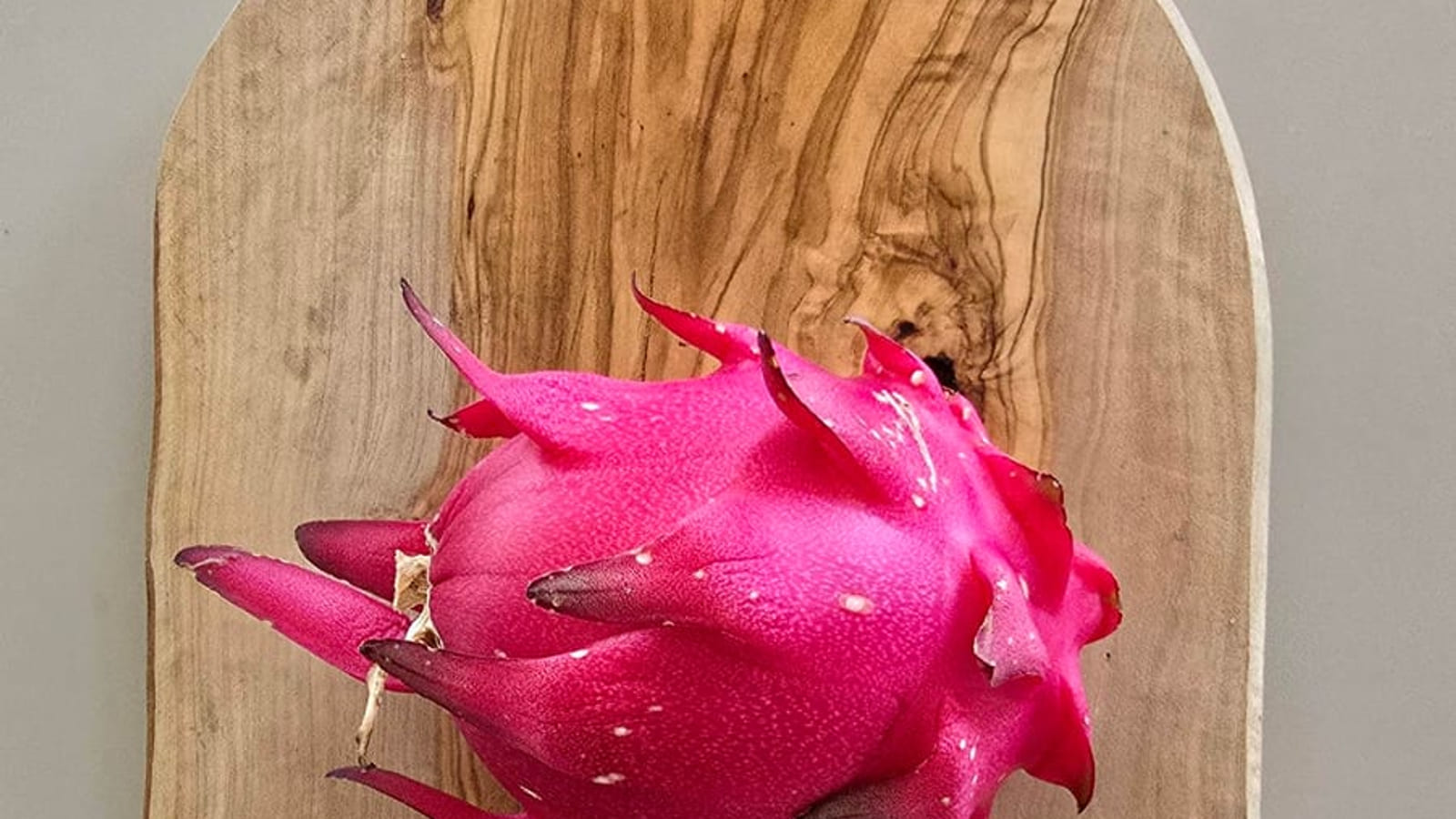
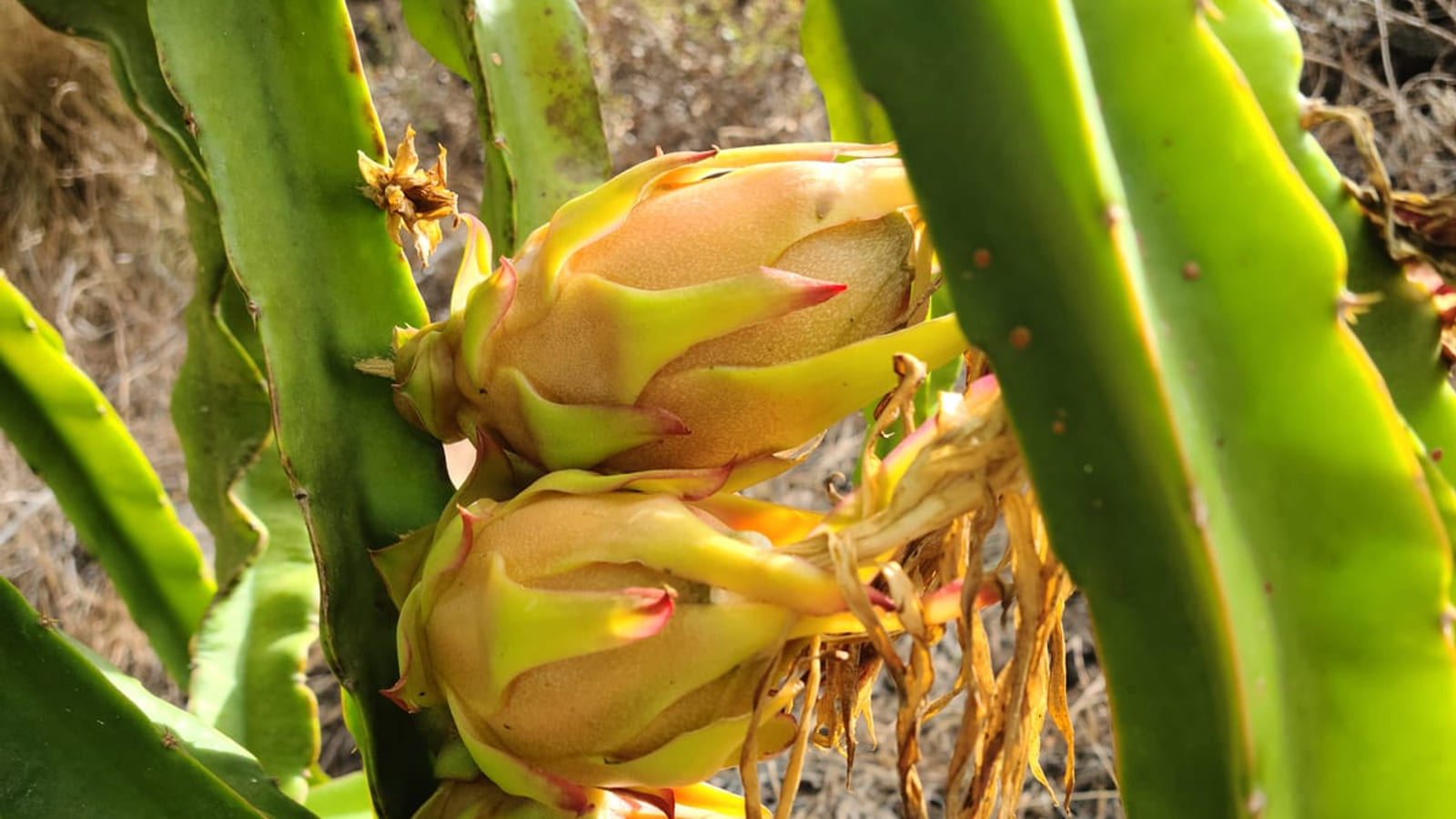
Use a dragon fruit ripeness chart to stop guessing when to pick. The two-signal rule is simple: peel color tells you the sugar level, and scale color tells you the freshness. A fruit is ready when the skin has turned fully red (or fully yellow for yellow-skinned types) while the scale tips remain green. This usually happens 30 to 38 days after the flower opened, depending on use. Dragon fruit does not ripen after picking. If you wait too long, the skin splits or the flesh turns water-soaked. If you pick too early, it stays bland.
Dragon Fruit Ripeness Chart
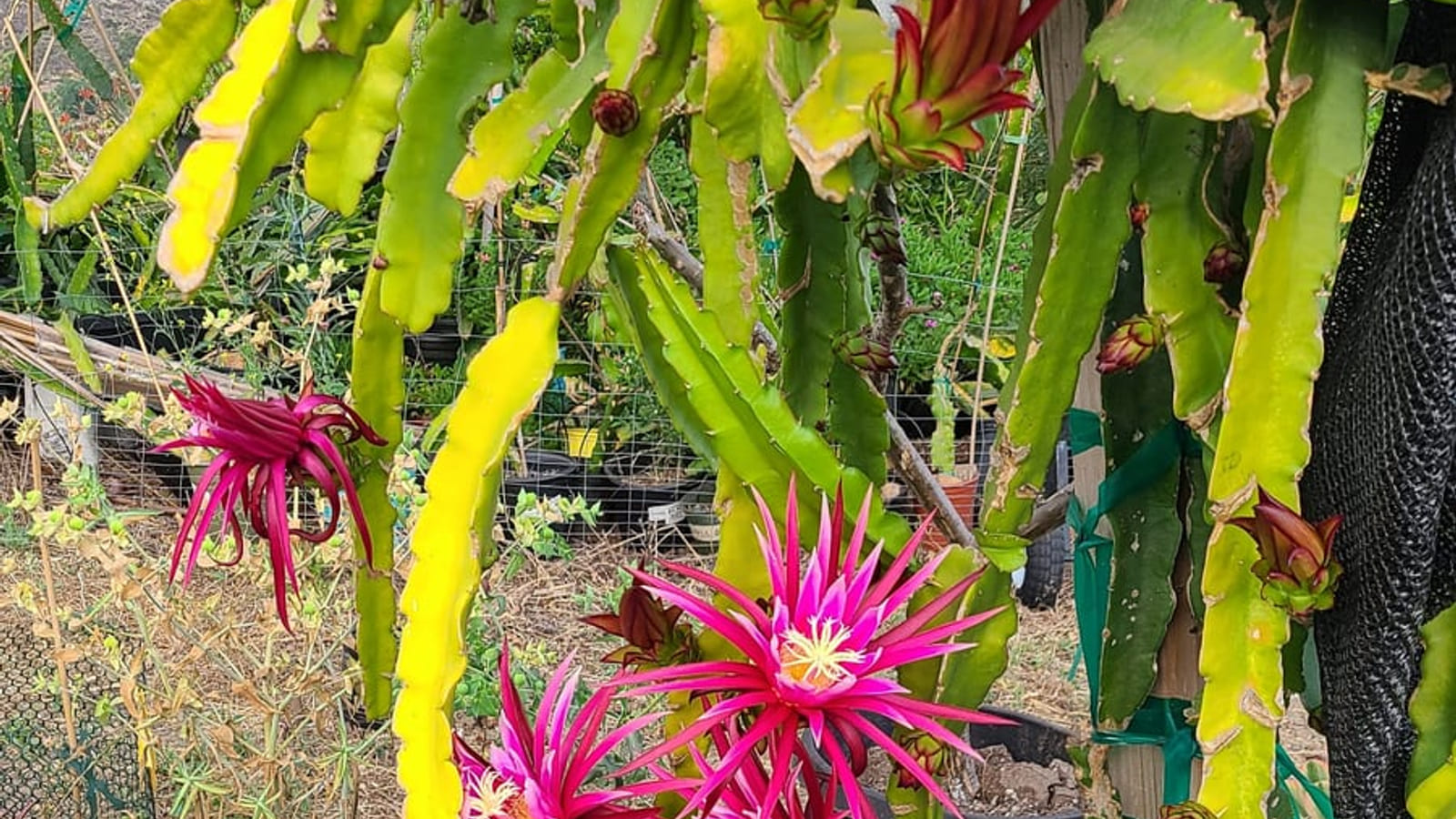
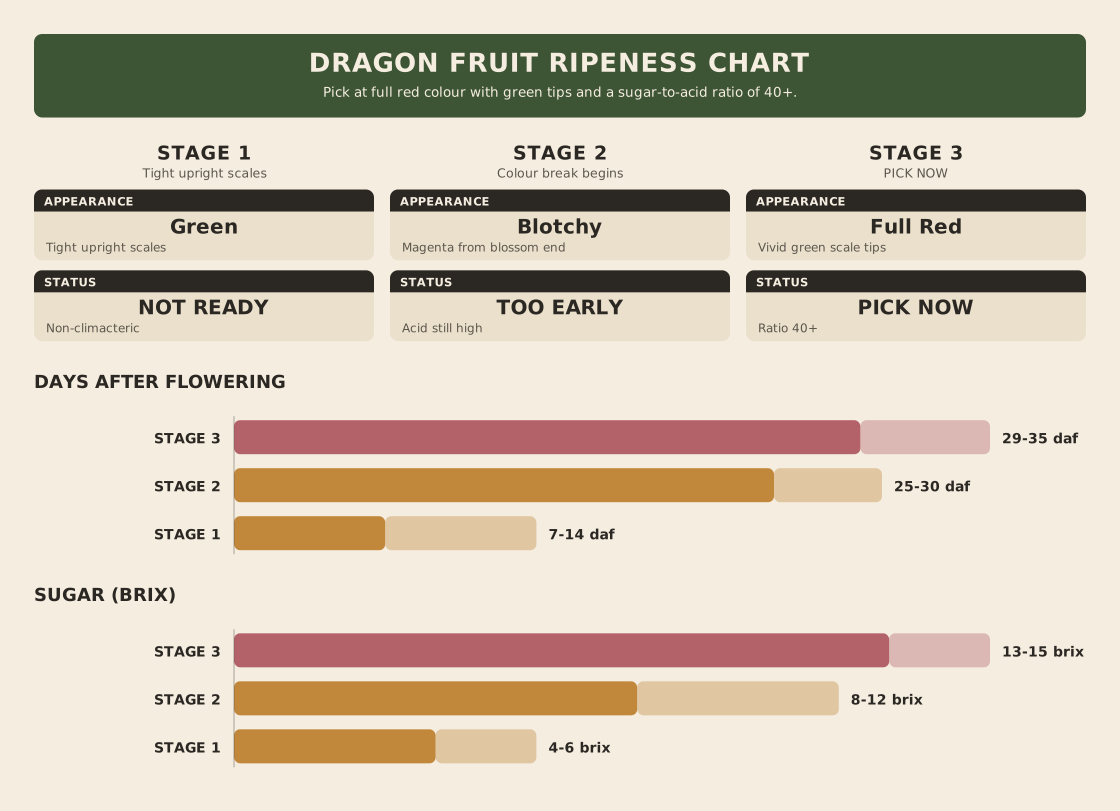
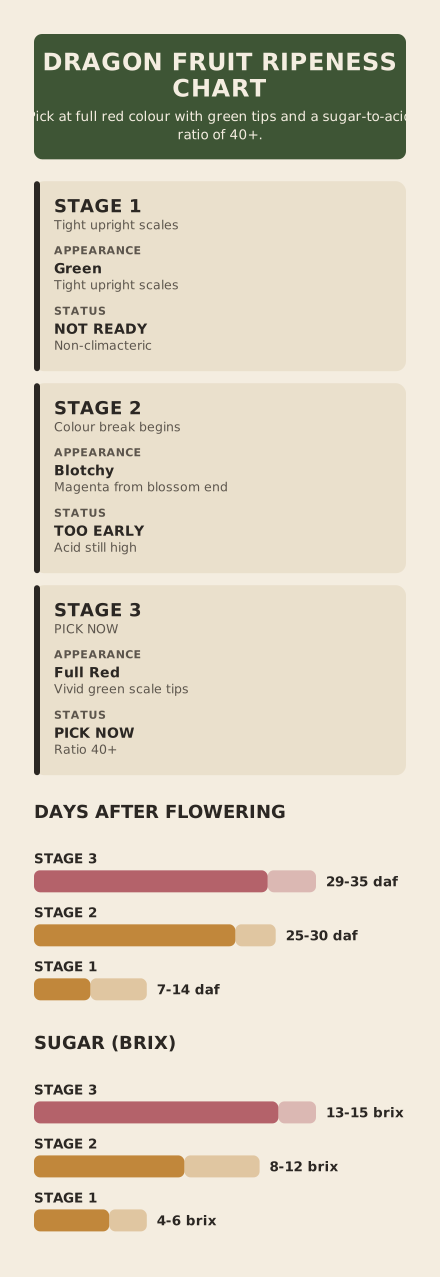
This table is the core tool for your harvest window. It maps visual cues to sugar levels and timing so you can pick with confidence. Remember that the night the flower opens is day 0 on this chart. The day ranges below assume a mean growing temperature of 28.1 C. If you garden in cooler coastal Southern California, expect these timelines to stretch longer.
| Stage | Peel colour | Scale/bract tips | Days after flowering | Typical sugars | What to do |
|---|---|---|---|---|---|
| 1. Green and hard | Green | Tight | 7-14 DAF | under 5 Brix | Leave it |
| 2. Colour break | First pink blush | Green | 25-30 DAF | rising sugars | 4-6 days from picked |
| 3. Full colour | Full red or yellow | Green | 30 to 38 days | over 13 Brix | Pick or buy now |
| 4. Full colour, aging | Full red or yellow | Browning or drying from base | Harvested | Eating-quality decline | Eat within a day or two |
| 5. Split or cracked | Dull, blotchy | Wilted, brown | Over-ripe | Fermented smell | Compost or cook |
Temperature note: Assumes 28C mean temp. Cooler weather slows sugar accumulation and colour development, so adjust your harvest window accordingly.
Why Colour Is the Only Test That Matters
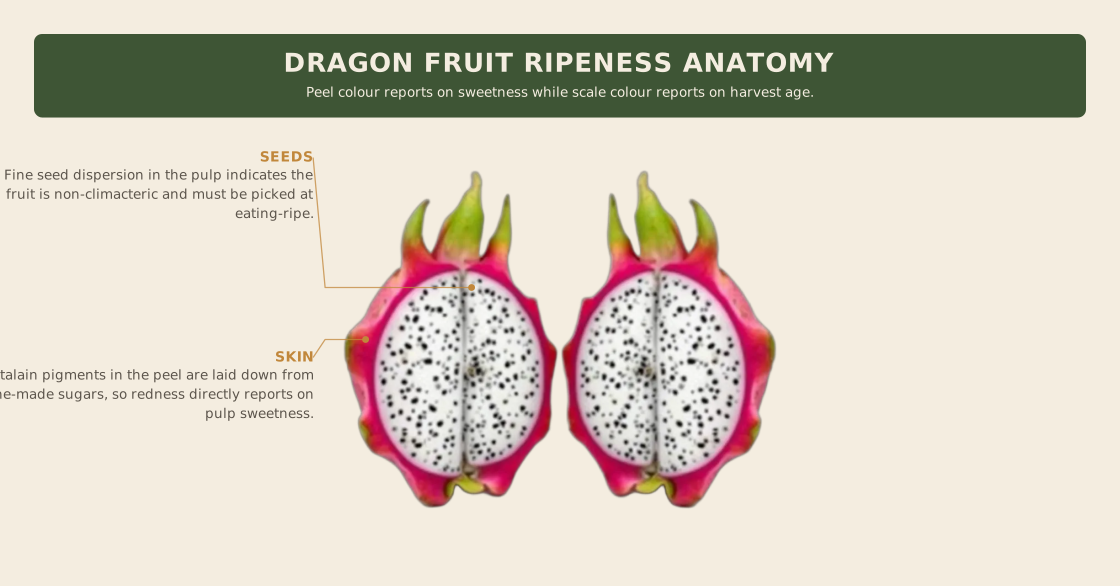
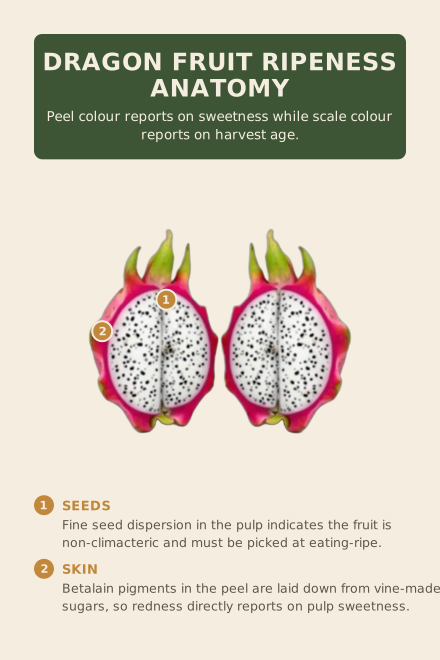
Dragon fruit is non-climacteric. The fruit does not produce an ethylene surge after it is cut from the vine. Unlike a banana or an avocado, which continue to ripen on your counter by converting starches into sugars and softening their flesh, a dragon fruit is metabolically static once harvested. Its sugar content, acidity, and flavour profile are locked in the moment you clip it. If you buy a pale, green-tinged fruit, it will not sweeten up in your kitchen. It will simply lose water and age its scales.
The plant builds the fruit’s chemistry while it is still attached. Sugars and acids accumulate on the vine, and the peel changes colour as chlorophyll breaks down and betalain pigments take over. This colour shift is not just cosmetic; it is a direct signal of the pulp’s internal readiness. Research validates skin colour as a reliable harvest indicator because the visual change correlates tightly with the chemical peak[5].
The Counter Test: Place a dragon fruit on your counter for a week. A banana will get softer and sweeter. A dragon fruit will get duller, the scales will brown, and the flesh will remain exactly as sweet as it was on day one. If it wasn’t sweet enough then, it won’t be now.
Research confirms that the flavour build is steep and happens before you see the final colour. In trials, red-pulp fruit saw sugar levels jump from under 5 Brix to over 14 Brix in just a few weeks, while acidity dropped sharply to create that sweet-tart balance[1]. Once the fruit is detached, this process stops dead. There is no post-harvest accumulation of sweetness. The only thing that changes is quality degradation. The red pigments in the peel break down at room temperature, causing the fruit to look blotchy and dull rather than ripe[8].
This is why growers and researchers agree on the same rule: harvest at or close to eating-ripe. UC Davis postharvest guidance and the APEC pitaya maturity protocol both state that fruit must be picked when it is already mature[1][2]. For home gardeners, UF/IFAS advises harvesting only well-coloured fruit[6]. If you wait for a green fruit to turn red on your counter, you are waiting for it to rot, not ripen. Trust the colour you see on the vine. It is the only honest read on what is inside.
What Happens Week by Week on the Vine
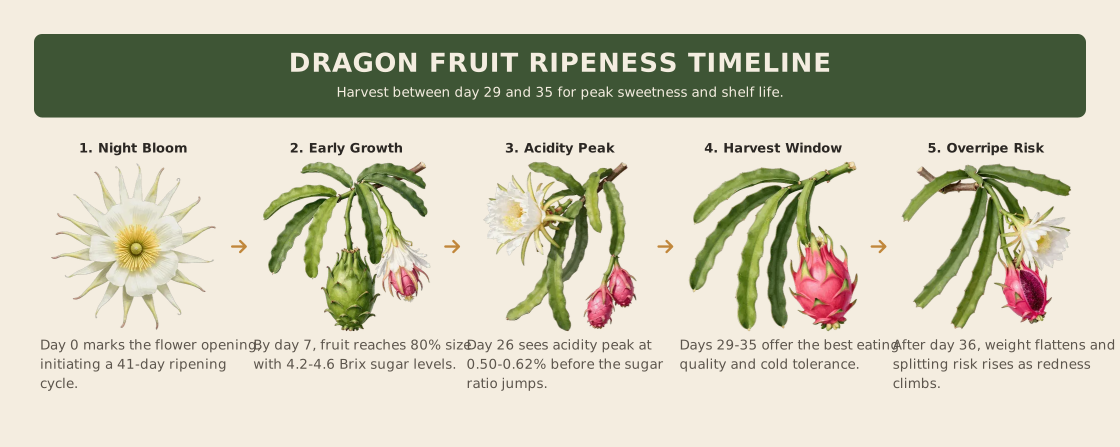
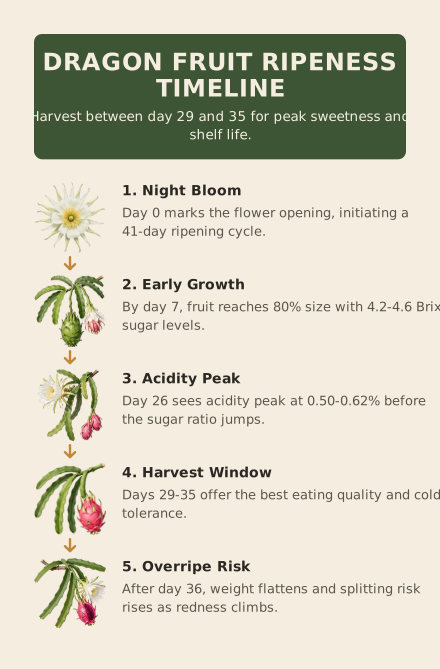
Most growers watch for colour, but the heavy lifting happens long before the skin changes. About 80% of the fruit’s size, weight, and pulp fill is finished before you see the first blush of red or yellow.[3] The growth curve flattens out, and the fruit looks like it is done growing. It is not. The final phase is purely chemical.
Sugars begin their climb early. In trial data, red-pulp fruit started at roughly 4.5 Brix just a week after flowering.[3] By day 31, those levels had surged to over 14 Brix.[3] White-pulp varieties follow a similar trajectory, rising from about 4 Brix to 13 Brix in the same window.[3] If you pick at week two, you get a large, firm, and completely bland fruit. The volume is there, but the flavour is missing.
Acidity is the other half of the equation, and it does most of the work. Titratable acidity peaks around day 26, then collapses sharply by day 31.[3] This drop is what flips the taste profile from flat and sour to sweet. The sugar-to-acid ratio more than doubles in that final week.[3] A mature fruit tastes sweet primarily because the acid has fallen out, not just because the sugar went up. You are waiting for the acid to leave, not just for the sugar to arrive.
Visual cues lag behind the internal chemistry. The pulp changes colour three to five days before the peel does.[2] This means the skin is a lagging signal. If you wait for the peel to turn fully red, the fruit inside has already been ripe for several days. Redness increases dramatically in the final days, moving from a dull pink to a deep magenta. While this visual change is dramatic, it happens after the peak eating quality has passed.
The Splitting Risk: The last week of development is also when splitting risk begins. As the peel loses elasticity and the pulp continues to swell, the skin can crack. This is especially common after heavy rain. A split fruit is prone to rot and loses market value immediately. Harvesting at the first sign of full colour, rather than waiting for maximum redness, protects the fruit.
Timing is driven by temperature. At a mean growing temperature of 28.1 C, the window from flowering to colour break is 25 to 30 days.[2] Full colouration arrives four to five days after the first change is visible.[2] In cooler climates, this timeline stretches. In hotter, drier conditions, it compresses. Watch the fruit, not just the calendar. The peel tells you when the acid has dropped, but the scale tips tell you if it is still fresh. Pick when the skin is fully coloured but the scales are still tight and green.
The Tests Growers Actually Use
Reading the chart is step one. Confirming the pick is step two. Home growers often overthink the harvest, but the most reliable checks are physical and immediate. You do not need a lab coat, just your eyes, your hands, and a bucket of water.
| Test | What you look for | What it proves | Where it fails |
|---|---|---|---|
| Peel & Scale Colour | Full red/yellow skin; bright green scale tips | Sugar accumulation is complete; freshness is high | Does not detect internal water-soaking or fermentation |
| Days From Flower | 35-38 days for eating; 32-34 for travel | Chemical maturity has been reached | Temperature swings can stretch or compress the timeline |
| Pressure & Twist | Slight yield to thumb; clean separation from peduncle | Flesh is firm but not hard; abscission layer is formed | Hard fruit may be under-ripe; soft fruit may be over-ripe |
| Water Displacement | Fruit sinks to the bottom | Specific gravity has crossed 1.0 | Requires a deep container; not practical for single-fruit checks |
1. The Visual Check: Colour and Scales
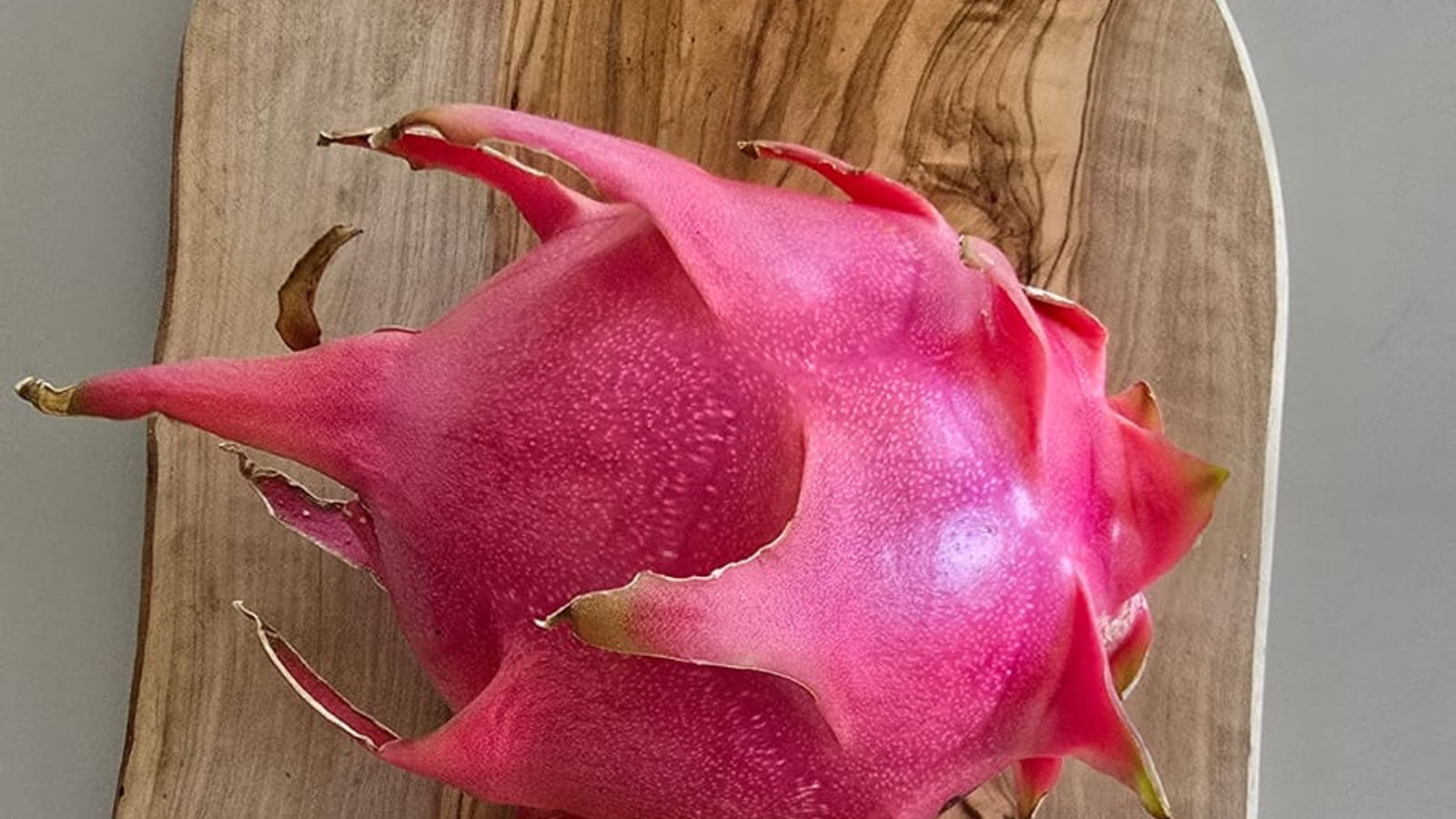
As noted in the chart, the peel must be fully colored, and the scale tips must remain green. If the scales are browning or drying from the base, the fruit is aging, even if the skin looks perfect. This visual cue correlates tightly with the chemical peak, meaning if the eye sees it, the sugar is there. Size is a poor indicator. A large green fruit is just a large green fruit, not a sweet one.
2. The Calendar: Days After Anthesis
Counting days is the most objective method you have. The APEC pitaya protocol sets minimum harvest maturity at 30 to 32 days after anthesis (DAA). For fruit you plan to eat immediately, aim for 35 to 38 DAA. If you are sending fruit to a friend or storing it for a few days, pick at 32 to 34 DAA. This window ensures the soluble-solids-to-acid ratio hits the commercial benchmark of 40. Neither Brix nor acidity is reliable on its own, but the ratio tells you the fruit has balanced sweetness and tartness. Keep a tally of your flowers. If you are in a cooler climate, add a few days to these counts.
Pro Tip: A refractometer, which measures Brix, costs less than a bag of cuttings. If you want to verify your harvest index, a quick squeeze of juice on the prism will confirm if you have hit that 40 ratio. It is a small investment for consistent quality.
3. The Hand Test: Pressure and Twist
Touch the fruit. It should yield slightly to thumb pressure, like a ripe peach, but not feel mushy. If it is rock hard, it is under-ripe. If it feels hollow or spongy, it is over-ripe. Then, try the twist. A truly ripe dragon fruit will separate cleanly from the peduncle with a gentle twist. If you have to tug or use clippers to force it off, the abscission layer has not fully formed, and the fruit may not be at peak sweetness. This tactile feedback is immediate and requires no tools.
4. The Physics Test: Specific Gravity
There is a non-destructive physics test. Mature dragon fruit has a specific gravity greater than 1.0, meaning it sinks in water. Under-ripe fruit, with a specific gravity below 1.0, will float. Trials show red pulp fruit shifts from 0.98 at 26 days to 1.08 at 31 days, while white pulp goes from 1.02 to 1.12 over the same period[3]. Drop a suspect fruit into a bucket of water. If it sinks, it is chemically mature. If it floats, leave it on the vine. This test is particularly useful for yellow-skinned varieties where color cues can be subtle.
Red, White and Yellow Skins Read Differently
The single most common mistake in the garden is treating all dragon fruit like the red-skinned varieties you see in supermarkets. You wait for a bright magenta blush on a yellow-skinned fruit, or you toss a perfectly ripe yellow pitaya because its scales turned brown. The visual cues shift depending on the species. A yellow fruit does not turn red, and its scales behave differently as it matures. If you apply the red-fruit rule to a yellow clone, you will either miss the harvest window entirely or discard good fruit.
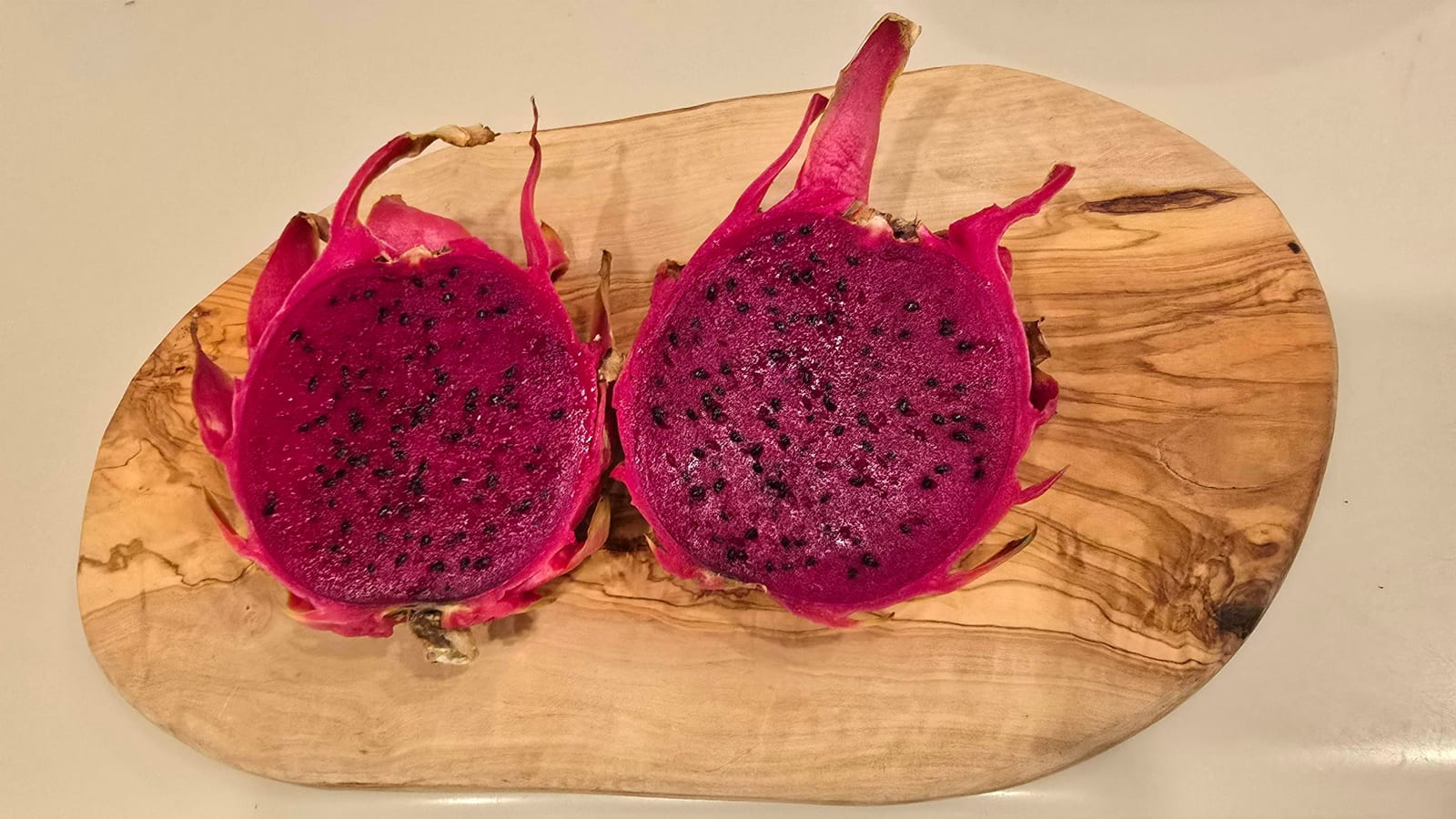
Each type has its own ripeness signature. White-pulp H. undatus follows the standard rule: bright red peel, green tips. Red-pulp varieties like H. polyrhizus and H. ocamponis go deeper, often turning purple, and they tend to hold firmer flesh and higher sugars. Yellow-skinned fruits, whether Selenicereus megalanthus or yellow H. undatus clones, are the outliers. Their peel turns cream to yellow, and their bracts tan and dry out sooner. That browning is a normal part of ripening for these types, not a defect. Because the scale color is ambiguous on yellow fruit, you must rely on the twist test and the smell to confirm readiness.
| Type | Peel at ripe | Normal scale behaviour | Storage temperature | Notes |
|---|---|---|---|---|
| White pulp H. undatus |
Bright red-magenta | Green tips remain | 10 C (50 F) | Up to about 14 days. Standard visual cues apply. |
| Red pulp H. polyrhizus, H. ocamponis |
Deep red to purple | Green tips remain | 10 C (50 F) | Often higher sugars and firmer flesh. Same storage limits as white pulp. |
| Yellow skin Selenicereus megalanthus, yellow H. undatus |
Cream to yellow | Bracts tan sooner (normal) | 6 C (43 F) | Colder-tolerant. Browning scales are ambiguous; use twist test and smell. |
Storage needs also diverge. Red and white-skinned fruits prefer 10 C (50 F). Yellow pitaya, including Selenicereus megalanthus, tolerates colder conditions and stores better at 6 C (43 F)[1]. If you store a yellow fruit at the same temperature as a red one, you risk chilling injury. If you store a red one at the yellow fruit’s colder temperature, you risk the same problem. Match the fridge setting to the skin type.
Do not wait for red on a yellow fruit. A yellow-skinned dragon fruit will never turn magenta. If you wait for a color change that will not happen, the fruit will over-ripen and split on the vine. When the peel is fully yellow and the scales have begun to tan, check for a slight give under thumb pressure and a sweet scent. If it twists off the vine with a gentle turn, it is ready.
Under-Ripe, Over-Ripe and Chilled: Symptom to Cause
The chart told you what to look for on the vine, but now you are staring at a dragon fruit that does not match the ideal picture. Maybe the scales are brown, maybe the flesh looks glassy, or maybe it just tastes like wet cardboard. Because dragon fruit is non-climacteric, you cannot fix the sugar content. You can only manage the texture and flavor that remain.
| Symptom | Cause | Fix or Use |
|---|---|---|
| Pale pink peel with hard green scales | Picked before colour break. Low sugar. | Nothing fixes it. Eat as a crunchy slaw or use for pickles. |
| Sweet but flat, low acidity | Picked before the acid drop. | Add lime juice or pair with tart fruits to balance the flavor. |
| Split or cracked skin | Left on the plant too long past full colour, plus a water pulse. | Refrigerate immediately. Eat within 24 hours to avoid decay. |
| Water-soaked translucent flesh | Chilling injury from 5-6 C storage, worse on fruit picked early at 31 DAA. | Discard if texture is slimy. If firm, use in smoothies where texture is masked. |
| Brown dry scales with firm flesh | Three-plus days at ambient temperature. Flesh is still edible. | Cut the scales off. The flesh inside is often still good. |
| Fermented or off smell with soft flesh | Over-mature plus decay starting at the scale base. | Compost it. The flavor is gone and the texture is failing. |
| Dull blotchy browning peel | Betalain degradation at room temperature. Cosmetic first, then real. | Check the flesh. If firm, eat it. If soft, toss it. |
The Acid Trap: A fruit picked between 26 and 30 days after flowering may look colored but taste flat. This is not under-ripe in the traditional sense; it is chemically incomplete. The acidity has not yet dropped enough to let the sugars shine. You cannot add acidity back in, so you must add it externally with citrus or vinegar-based dressings.
When you see water-soaked flesh, you are looking at cellular collapse. This often happens when fruit picked early (around 31 days after anthesis) is stored in a fridge that runs too cold. The cells rupture, releasing juice that looks like glass under the skin. It is not dangerous, but the texture is unpleasant. If the fruit was picked late, splitting is the primary failure mode. The skin cannot stretch further as the internal pressure builds from water uptake or continued growth. Once the skin splits, decay organisms enter quickly. Do not try to save a split fruit for later. Eat it now or lose it.
Browning scales are the most common complaint for home growers. The scales are the first part of the fruit to lose turgor pressure. They dry out and turn brown while the flesh inside remains firm and sweet. This is a cosmetic issue for the first few days. Cut the scales off and inspect the flesh. If the flesh is firm and smells fresh, the fruit is still good. If the browning has spread to the peel itself, the fruit is aging rapidly. The red pigments in the peel break down at room temperature, causing the dull, blotchy look. This is not ripening; it is degradation. Eat these fruits immediately or compost them if the flesh has softened.
How Long It Keeps, Counter vs Fridge
On a warm kitchen counter, the green scales are the first casualty. They begin yellowing and wilting within three days of harvest[9]. By day seven, rot typically sets in at the base of the scales and spreads into the flesh[9]. An unbagged white-fleshed fruit sitting at ambient temperature generally lasts about 15 days before quality drops off a cliff[7].
Cold air extends life, but a bag stops drying. In a recent postharvest trial, bagged fruit held at 4 C (about 39 F) reached roughly 52 days of shelf life with less than 1% weight loss[7]. Without that bag, the same fruit would have shriveled and spoiled far sooner.
However, not all dragon fruit like the same cold. Red-skinned varieties like Hylocereus undatus prefer 10 C (50 F) for up to two weeks[1]. Yellow pitaya (Selenicereus megalanthus) tolerates 6 C (43 F)[1]. Chilling injury can develop if red-skinned fruit sits at 5 to 6 C for too long, which is why the back wall of a very cold fridge is often worse than the door shelf[1].
Maturity at the moment of picking also dictates how well the fruit survives storage. Fruit harvested at 33 to 35 days after anthesis (DAA) can store for three weeks at 5 C and still hold nine days of shelf life at room temperature afterward[4]. Fruit picked early at 31 DAA often develops water-soaked flesh translucency, the classic sign of chilling injury, after the same three weeks in cold storage[4]. If you store fruit at 13 C, expect about two weeks of good quality, followed by 3 to 5 days of remaining shelf life[4].
| Condition | Days | What goes wrong first |
|---|---|---|
| Ambient counter | 3 | Scales yellow and wilt |
| Ambient counter | 7 | Rot starts at scale base |
| Ambient counter | 15 | Unbagged fruit spoils |
| 10 C (Red skin) | 14 | Quality decline |
| 6 C (Yellow skin) | 14 | Quality decline |
| 4 C (Bagged) | 52 | Minimal weight loss |
Practical conclusion for a SoCal kitchen: Store fruit loose in the warmest part of the fridge or in the crisper drawer. Use a perforated bag to maintain humidity without trapping too much moisture. Aim to eat within 10 to 14 days. Never push the fruit against the back wall where temperatures drop lowest.
Buying One at the Store
You cannot ripen a dragon fruit on your counter, so the supermarket shelf is a gamble on how fresh the fruit was when it arrived. Because the sugar content is locked in at harvest, a pale or green-tinged fruit will never become sweet. It will only dry out. Most commercial fruit is picked at full colour to meet quality standards, so the peel color is rarely the problem. The variable you actually control is the remaining life of the scales.
| Check This | Look For | Walk Away If |
|---|---|---|
| Peel Colour | Even, fully developed red or yellow | Blotchy, dull, or green patches |
| Scales (Bracts) | Turgid, firm, and green | Straw-dry, black at the base, or wilted |
| Surface Integrity | Smooth skin, no cracks | Wet soft spots, mould in scale axils, insect holes |
| Weight & Feel | Heavy for its size, slight give | Light, hollow, or mushy |
The scales are the most honest indicator of age. Check for fresh green scales; browning indicates age. They begin to yellow and wilt within a few days of harvest at room temperature, and rot often starts at the base of the scale before spreading into the flesh[9]. If the tips are brown or the base is black, the fruit is past its prime. A heavy fruit indicates good pulp fill and water content, while a light one suggests dehydration. Press gently; you want a slight give, not the squish of over-ripe flesh.
What if you already bought a green one? Do not put it in a paper bag with bananas. Dragon fruit is non-climacteric, meaning it does not respond to ethylene gas by producing more sugar or softening into edibility[1]. The bag will only speed up water loss and scale decay. Treat a green fruit as a mild, cucumber-textured vegetable. It will not get sweeter, so use it in salads or smoothies where the texture matters more than the sugar content.
Frequently Asked Questions
Will dragon fruit ripen after being picked?
No. Dragon fruit is non-climacteric, meaning it lacks the ethylene surge that triggers ripening in bananas or avocados. Once cut, its sugar content, acidity, and flavor profile are locked in place. A picked fruit will not get sweeter or softer on your counter; it will only lose water, dull its peel color, and age its scales. Harvest at eating-ripe or accept a bland fruit.
When is dragon fruit ripe?
Most red-skinned varieties reach peak maturity 30 to 35 days after the flower opens. Yellow Palora takes about 120 days from pollination to ripe fruit. Timing shifts with temperature; cooler weather slows sugar accumulation and color development, stretching the window. Always verify ripeness by checking for full peel color and green scale tips rather than relying on the calendar alone.
What does an unripe dragon fruit look like?
Unripe fruit appears green and hard, with tight scales and no color break. It may reach nearly 80% of its final size before any pink or yellow blush appears. Size alone is a poor indicator. Wait for the peel to turn fully red or yellow while the scale tips remain green. If the skin is pale or blotchy, the fruit is not ready and will not sweeten off the vine.
Should dragon fruit be soft?
Ripe dragon fruit yields slightly to gentle thumb pressure but should remain firm overall. It does not soften like a peach or avocado. If the fruit feels mushy or the flesh is water-soaked, it is overripe or suffering from chilling injury. A firm texture with full color is the goal. If the fruit resists twisting off the vine, leave it a few more days to develop proper sugar balance.
How do you know a yellow dragon fruit is ripe?
For yellow-skinned types like Yellow Palora, look for a uniform, bright yellow peel with no green patches. The spines should still be green and firm, not brown or wilted. Check for slight give under pressure and ensure the fruit twists off easily before harvesting.
Why is my dragon fruit flesh translucent or split?
Translucent, water-soaked flesh indicates overripeness or chilling injury from improper storage. Splitting usually happens when the fruit stays on the vine too long, especially after heavy rain or inconsistent watering. Both signs mean the fruit has passed its peak. Overdue fruit loses sugar, develops off-odors, and fails in texture. Harvest promptly once full color and green scales appear to avoid these defects.
References
- Dragon Fruit - Postharvest Facts Sheet (maturity indices, quality indices, optimum temperature and chilling injury), UC Davis Postharvest Research and Extension Center, Produce Facts Sheets (2024).
- Pitaya Fruit Maturity Index Implementation (maturity indices, DAA thresholds, SSC:TA 40 harvest index, colour-break timing), APEC Forest Products and E-commerce Development (FLows) project, Bioresources Circulation and Utilization Center, National Taiwan University (2020).
- Maturity determination of red and white pulp dragon fruit (TSS, TA, TSS:acid ratio, fruit weight, specific gravity and heat units at 7-41 DAF), Journal of Horticultural Sciences 17(1):157-165, Deep, Narayana, Karunakaran, Rao, Anand, Rao, Ranjitha, ICAR-IIHR, Bengaluru (2022).
- Harvest maturity affects the quality and storage behavior of white-fleshed dragon fruit (Hylocereus undatus) harvested at 31, 33 and 35 DAA and stored at 5 C and 13 C, Food Research 6(2):423-433, Franco, Esguerra, Tababa, Castro, Postharvest Horticulture Training and Research Center, University of the Philippines Los Banos (2022).
- Changes in the physical and physico-chemical characteristics of red-pulp dragon fruit during its development (skin colour and external appearance as harvest-point indicators), Scientia Horticulturae 253:180-186, Magalhaes, da Silva, Ramos, Salles Pio, Pasqual, Vilas Boas, de Melo (2019).
- Pitaya (Dragonfruit) Growing in the Florida Home Landscape, HS303 (harvest method, cut peduncle flush, harvest only well-colored mature fruit, Florida season), UF/IFAS Extension, Crane and Balerdi, EDIS publication HS303 (2023).
- Studies on shelf life and quality of dragon fruits as influenced by postharvest treatments (4 C + LDPE bag reached 52 days with 0.84% weight loss; ambient control 15.44 days; red-fleshed 13.80 Brix), Bangladesh Journal of Nuclear Agriculture 39(2):63-76, Kazem, Akhther, Hassan, Alam, Roy, Bangladesh Institute of Nuclear Agriculture (2025).
- Comparative Analysis of Shelf-Life, Antioxidant Activity and Quality of Dragon Fruit (ambient-storage betalain degradation, discoloration and browning), MDPI Horticulturae 10(10):1048 (2024).
- Advances in the Understanding of Postharvest Physiological Changes and the Storage and Preservation of Pitaya (scale yellowing and wilting within 3 d ambient, scale-base rot by 7 d, controlled-atmosphere delays), PMC11083964, peer-reviewed postharvest review of pitaya (2024).