Dragon Fruit Varieties Chart: 5 Key Columns
A good dragon fruit varieties chart needs five columns: species or flesh-color class, measured Brix, fruit weight, days from flower to harvest, and pollination requirement. The UC San Diego trial provides hard numbers, measuring 19 cultivars with Brix ranging from 11.85 to 18.9 and weights between 250 and 552 grams. Yellow Palora specifically takes about 120 days from pollination to ripe fruit. Fertility columns are grower-reported because cultivar self-incompatibility data is poorly documented. See our care guide for planting tips.
How many types of dragon fruit are there?
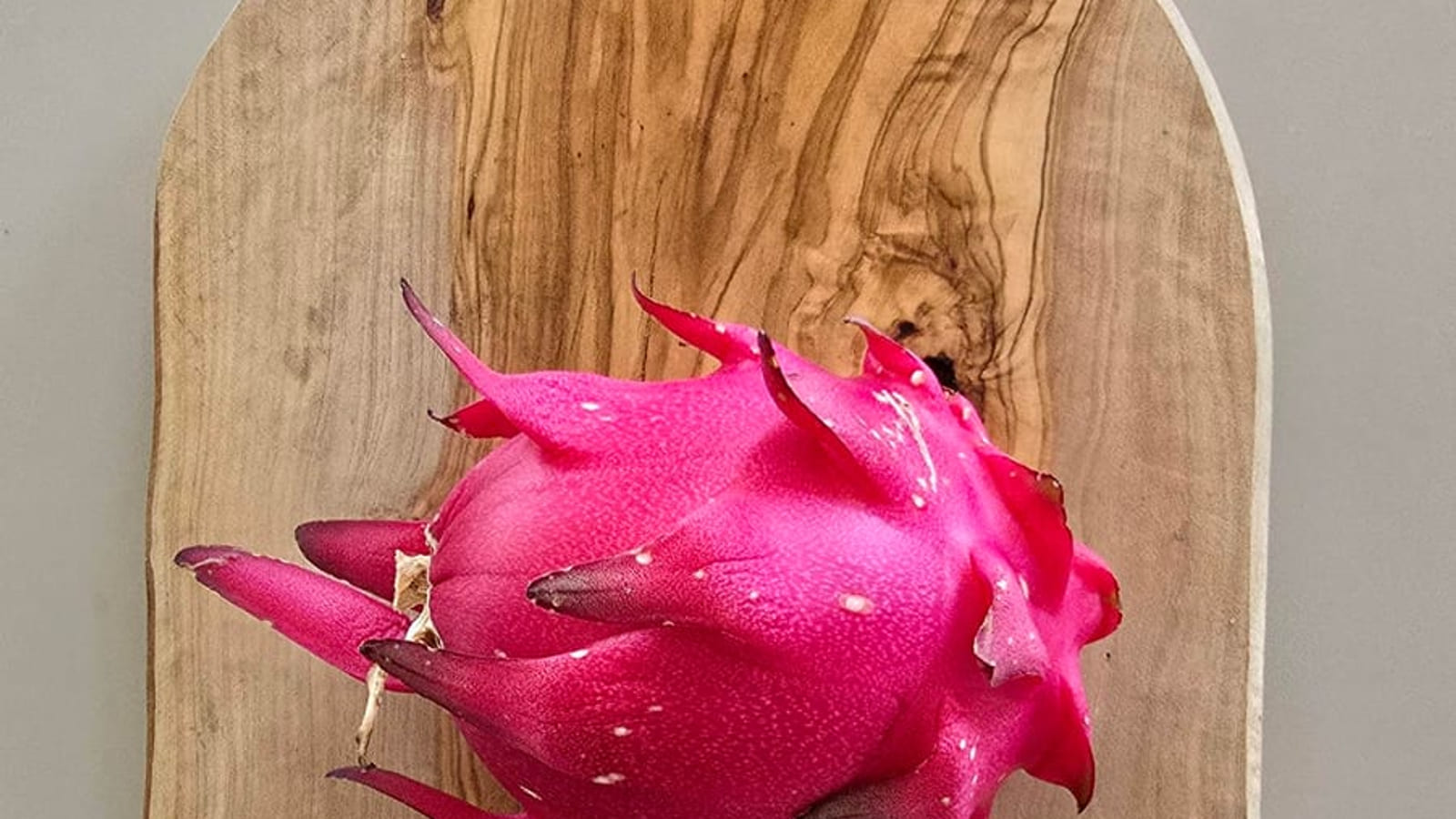
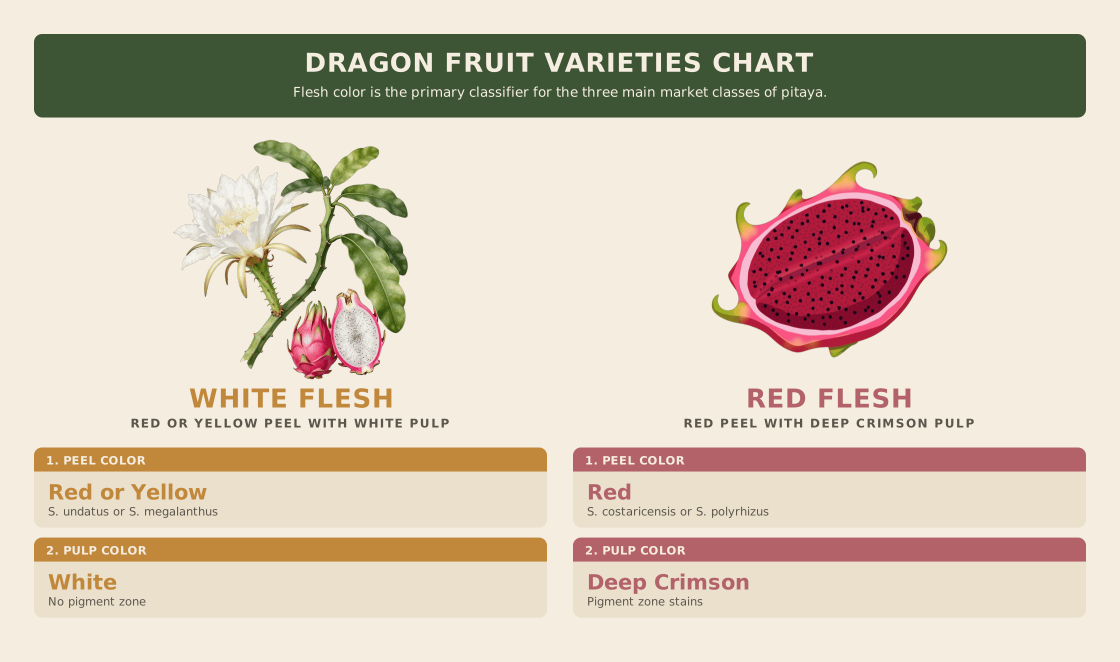
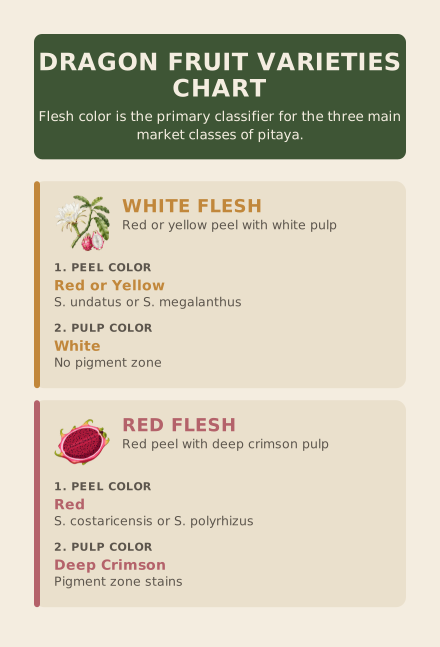
Botanists recognize up to 29 species and forms within the genus Selenicereus, but commercial production rests on a handful of them.[8] For practical growing, sort the market into three simple buckets based on what the fruit looks like when you cut it open. Extension services classify pitaya by these peel and pulp combinations, and those three categories form the spine of any reliable varieties chart.[1]
Species map to color classes like this. Note that nursery tags often still use the older genus name Hylocereus, even though the plant is unchanged and the current accepted name is Selenicereus.[7]
| Species (Current Name) | Old Tag Name | Peel Color | Pulp Color | Where You Meet It |
|---|---|---|---|---|
| Selenicereus undatus | Hylocereus undatus | Red/Pink | White | Supermarkets, global export |
| Selenicereus costaricensis | Hylocereus costaricensis | Red/Pink | Red/Magenta | Nurseries, specialty markets |
| Selenicereus polyrhizus | Hylocereus polyrhizus | Red/Pink | Red/Magenta | Nurseries, specialty markets |
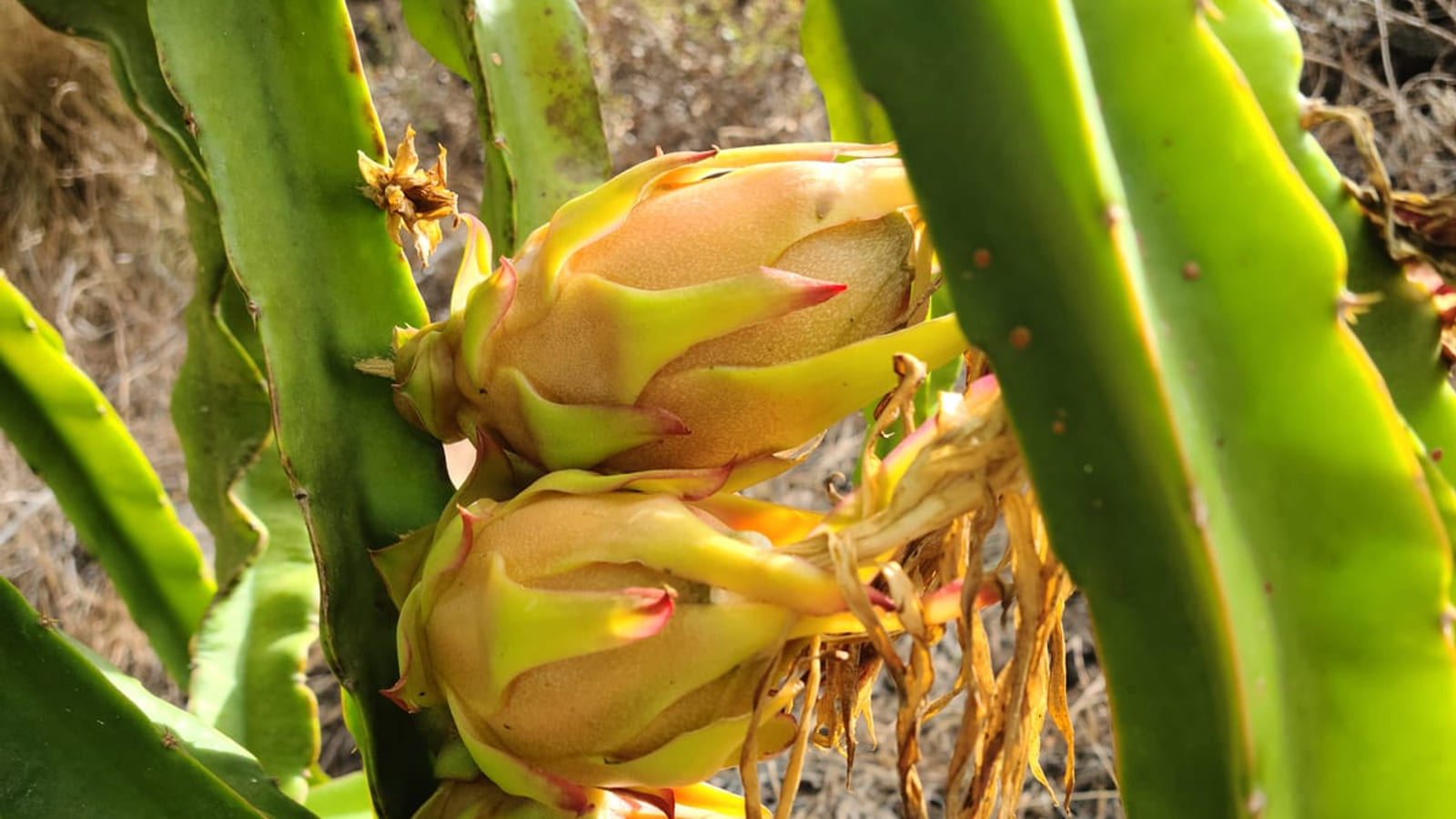
| Selenicereus megalanthus | Hylocereus megalanthus | Yellow | White | Specialty growers, high-end markets |
| Selenicereus triangularis | Hylocereus triangularis | Yellow | White | Specialty growers, high-end markets |
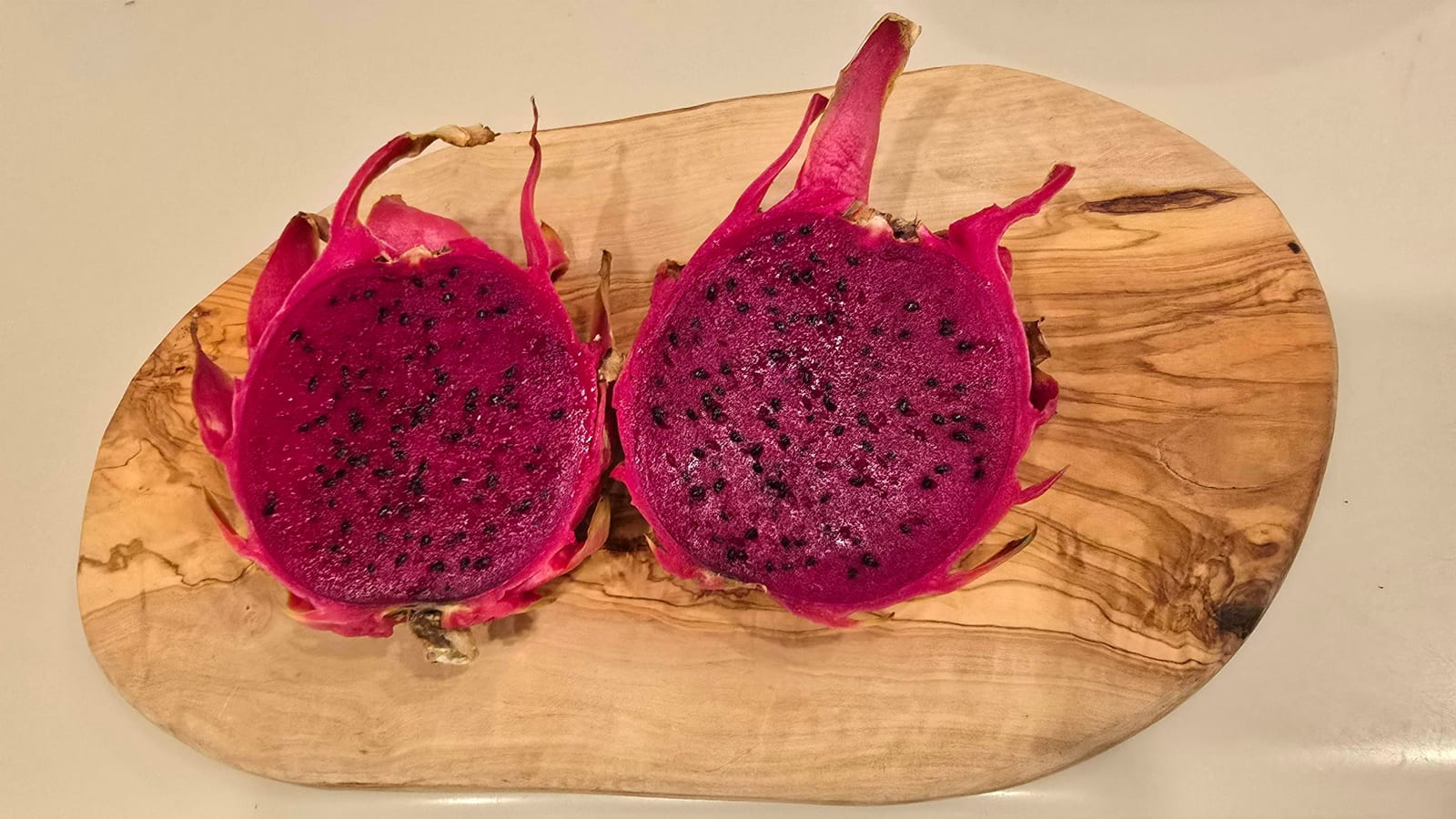
Flesh color is a pigment story. Red-fleshed varieties like S. polyrhizus contain betacyanins, with pulp measured at 30.87 mg/100 g and juice at 21.11 mg/100 g in some trials.[5] White-fleshed S. undatus has none detected.[5] Red pulp also carries higher total phenolics, measured at 49.67 mg gallic acid equivalent per 100 g compared to 27.87 for white.[5] Anthocyanins are also present in red types, with S. costaricensis showing the highest levels in peer-reviewed comparisons.[4]
Tag confusion is normal. If you buy a plant labeled Hylocereus undatus, you are buying Selenicereus undatus. The reclassification happened in botanical circles, but the nursery trade moves slowly. The plant itself has not changed.[1]
The chart: measured numbers for the cultivars people actually buy
This table pulls directly from the University of California Cooperative Extension San Diego County field trial, which measured 19 cultivars under Southern California conditions.[2] Treat these figures as site-specific benchmarks. Soil, irrigation, and local climate will shift the numbers, but the relative performance of these clones is a reliable starting point for your selection.
How to read the Brix column: A score under 13 reads bland to most palates. The 15 to 18 range is dessert-quality fruit, sweet enough to eat fresh without hesitation. Anything above 18 is exceptional and often commands a premium price. Note that yellow varieties trade sweetness for tiny fruit and a long ripening period.
| Cultivar | Class | Brix | Fruit Weight (g) | Days Bloom to Harvest | Marketable Yield (g/plant) | Cold / Heat Score (1-5) | Origin |
|---|---|---|---|---|---|---|---|
| Bien Hoa Red | Red | 18.9 | 360 | Not listed | Not listed | Not listed | Vietnam |
| American Beauty | Red | 18.51 | 380 | Not listed | Not listed | Not listed | USA |
| Delight | Red | 18.08 | 371 | Not listed | 14,931 | Not listed | USA |
| Physical Graffiti | Red | 17.93 | 374 | Not listed | 23,429 | 4.5 / 4.5 | USA |
| Valdivia Roja | Red | 17.9 | 250 | Not listed | Not listed | Not listed | Chile |
| Lisa | Red | 17.02 | 465 | Not listed | 13,319 | 3.75 / 4 | Nicaragua |
| Haley's Comet | Red | 16.7 | 482 | Not listed | Not listed | 4.5 / 4.25 | USA |
| Sin Espinas | Red | 16.5 | 393 | Not listed | Not listed | Not listed | Central America |
| Armando | Red | 16.11 | 390.5 | Not listed | Not listed | 4 / 4 | Central America |
| Rosa | Red | 16.05 | 384 | Not listed | Not listed | Not listed | Nicaragua |
| Orejona | Red | 15.78 | 438 | Not listed | Not listed | Not listed | Nicaragua |
| Cebra | Red | 15.75 | 468 | Not listed | Not listed | Not listed | Nicaragua |
| San Ignacio | Red | 15.6 | 552 | Not listed | Not listed | Not listed | Nicaragua |
| Vietnamese Giant | White | 15.6 | 338 | Not listed | Not listed | Not listed | Vietnam |
| Mexicana | Red | 14.04 | 495 | Not listed | Not listed | Not listed | Mexico |
| Seoul Kitchen | White | 12.18 | 518 | Not listed | 15,379 | Not listed | Korea |
| Bien Hoa White | White | 11.85 | 388 | Not listed | Not listed | Not listed | Vietnam |
| Yellow Dragon | Yellow | Not listed | Not listed | Not listed | 0 | 1 / 1 | Colombia |
| Yellow Palora | Yellow | Not listed | Not listed | ~120 | 0 | 1 / 1 | Ecuador |
The yield column reveals a distinction: sweetness and productivity are separate traits. Physical Graffiti produced the highest marketable yield at 23,429 grams per plant, despite not having the absolute highest Brix score.[2] Conversely, the yellow cultivars yielded zero marketable grams in this specific trial, largely due to their extreme sensitivity to the local climate and long ripening window.[2]
Cold and heat scores are rated on a 1 to 5 scale, where 5 indicates superior tolerance. The yellow types scored a 1 for both, making them risky choices for variable climates.[2] Physical Graffiti and Haley's Comet showed strong resilience, scoring above 4 in both categories, which explains their popularity in commercial settings where weather fluctuations are common.[2]
Which dragon fruit variety is the sweetest?
For pure sugar content, look at the red-fleshed cultivars. In the UC San Diego trial, Bien Hoa Red measured 18.9 Brix, the highest recorded. American Beauty followed at 18.51, and Delight at 18.08.[2] These numbers are high, but they do not tell the whole story of what you will actually harvest.
A simple sweetness ranking hides significant agronomic tradeoffs. The yellow varieties that top the Brix column are the same ones that produced zero marketable yield in the field trial.[2] They also scored the lowest possible hardiness ratings for both cold and heat tolerance, making them risky investments for many growers.[2] You are trading volume and speed for a higher sugar reading.
Prioritize nutrition over taste? A peer-reviewed comparison found that red-fleshed Hylocereus costaricensis contained the highest levels of anthocyanins, total carotenoids, vitamin C, and total soluble phenolics.[4] This cultivar also demonstrated the strongest antioxidant activity.[4] In contrast, yellow-skinned H. megalanthus was lowest in anthocyanins among the tested cultivars.[4] The sweetest fruit and the most nutrient-dense fruit are often different plants.
| Priority | Best Choice | Tradeoff |
|---|---|---|
| Highest Brix | Bien Hoa Red | Lower yield than Physical Graffiti |
| Highest Antioxidants | Red-fleshed H. costaricensis | Lower sugar than yellow types, though still high (18+ Brix) |
| Commercial Viability | Physical Graffiti / Delight | High yield and hardiness, but Brix is slightly lower than yellow |
Remember that a variety choice is a two-decade commitment. Productive plants can yield about 220 lb (100 kg) of fruit per year, and a planting is estimated to last about 20 years.[1] Do not plant a low-yielding, fragile yellow clone solely for its Brix score if you have limited space or a harsh climate.
Why is white dragon fruit less sweet and is red-flesh healthier?
Red-fleshed pitaya is not inherently sweeter than white. When you look at peer-reviewed composition data, the lines blur significantly. In fact, one study found that yellow-skinned *Selenicereus megalanthus* had the highest total soluble sugar content, while white-fleshed *Selenicereus undatus* carried the highest carbohydrate and energy levels.[4]
The difference in perceived sweetness often comes down to acidity and texture rather than raw sugar content. Red pulp had higher total sugar (8.45%) than white in one comparison, but white varieties are not inherently low-sugar fruits.[5] The "healthier" argument for red flesh is stronger because of pigment density, not necessarily because it is a better source of energy or simple sugars.
Here is how the three main commercial classes compare based on measured lab data. Note that values vary by cultivar and growing conditions, but these figures represent typical ranges found in comparative studies.
| Metric (per 100 g fresh pulp) | Red Flesh (e.g., *S. polyrhizus*) |
White Flesh (e.g., *S. undatus*) |
Yellow Skin/White Flesh (e.g., *S. megalanthus*) |
|---|---|---|---|
| Betacyanins (Red pigment) | 30.87 mg | None detected | None detected |
| Total Phenolics | 49.67 mg GAE | 27.87 mg GAE | Lower than red |
| Anthocyanins | 120.15 mg/g (in *S. costaricensis*) | Lower than red | 12.67 mg/g |
| Total Carbohydrates | Lower than white | 17.02 g | Not highest |
| Energy (Calories) | Lower than white | 69.74 kcal | Not highest |
| Total Soluble Sugar | 8.45% | Lower than yellow | 8.72 g (Highest) |
| Ascorbic Acid (Vit C) | 19.83 mg | 25 mg | 4 mg |
| Fiber | Not listed | 0.3 g | 0.5 g |
Grower Note: Do not choose a variety based on "health" claims alone. Red-fleshed types are superior for antioxidant pigments (betacyanins and anthocyanins), but white-fleshed types are not nutritionally void. Yellow-fleshed types often have the highest perceived sweetness due to soluble sugar content, despite having lower vitamin C levels than white or red varieties.
The data shows that red-fleshed *S. polyrhizus* and *S. costaricensis* dominate in antioxidant capacity due to their pigment load. Red pulp contains betacyanins at 30.87 mg/100 g, which are completely absent in white pulp.[5] This pigment is what gives the fruit its deep magenta color and is linked to higher total phenolic content.[5]
However, if you are looking for energy density, white-fleshed *S. undatus* actually provides more carbohydrates and calories per 100 g than red-fleshed types.[4] If you are looking for immediate sweetness, yellow-skinned *S. megalanthus* measured the highest total soluble sugar in comparative trials.[4]
This means your choice depends on what you value in the fruit. Red varieties are the best source of specific antioxidants. White varieties are a better source of quick energy and are often more productive in commercial settings.
Why the fertility column on every chart is a guess
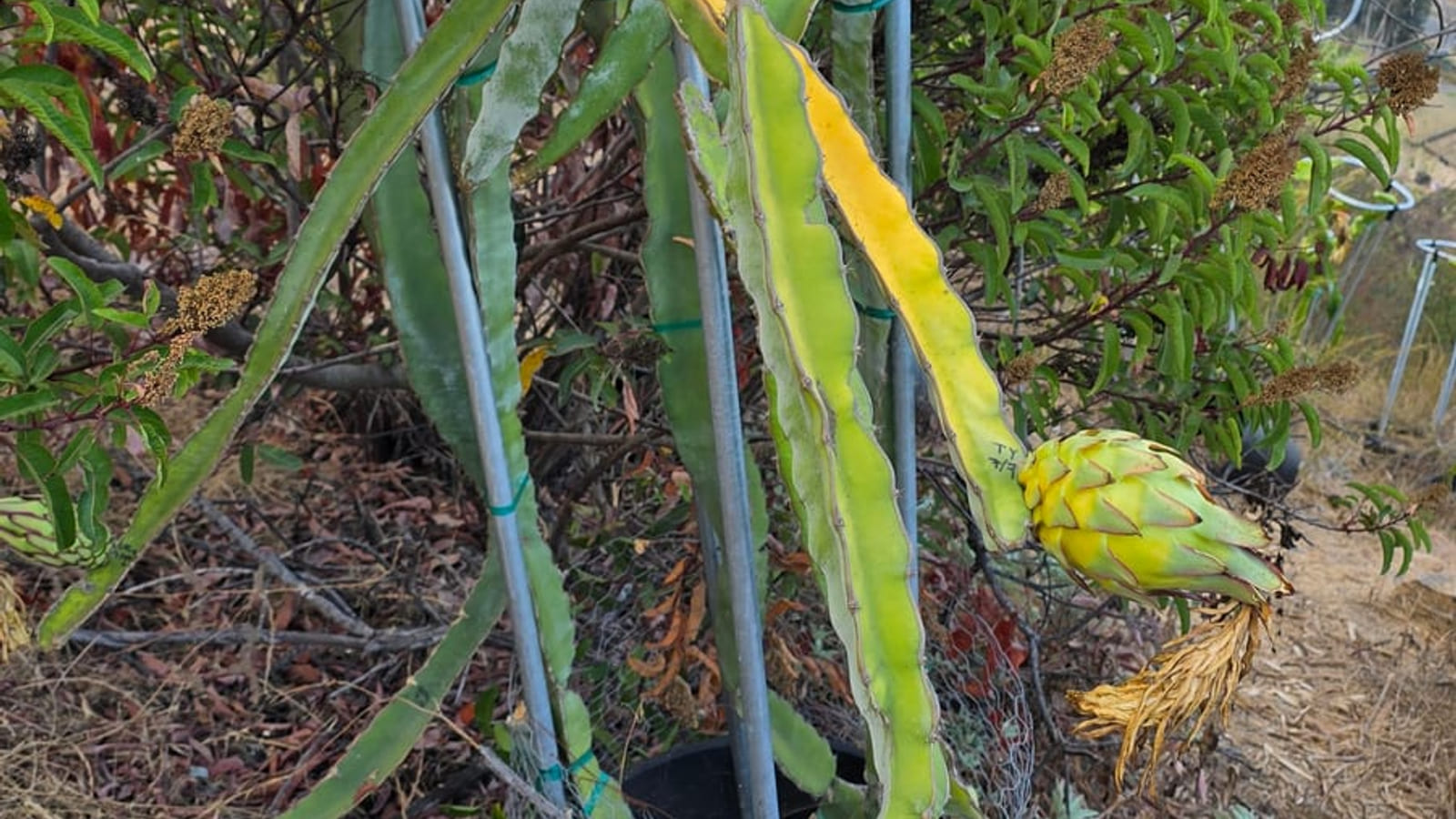
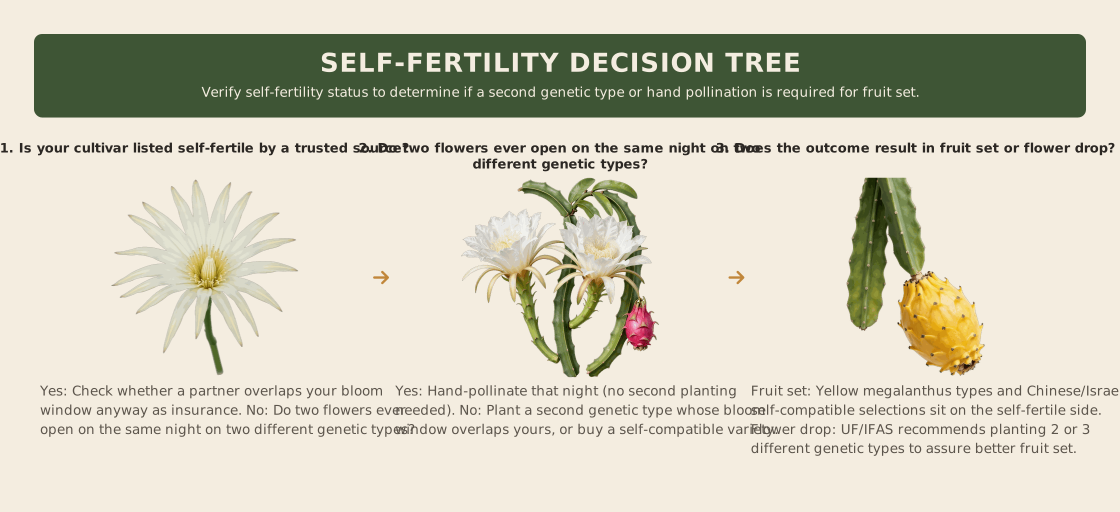
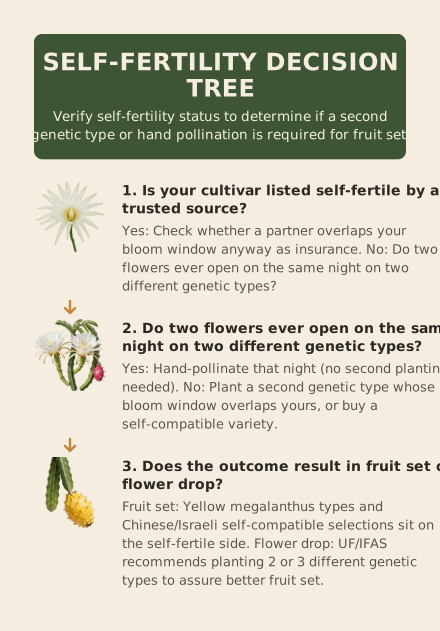
Experienced growers point to pollination requirements as the most confusing column. It is the most relied-upon and least documented data. Extension services state plainly that self-incompatibility has been reported in several cultivars sold by nurseries, and they recommend planting two or three different genetic types to ensure better fruit set and size.[1] This advice is sound. It masks complex biology that varies wildly by clone.
The mechanism behind this requirement is partly floral and partly genetic. Most pitaya genotypes are partly self-incompatible, and their flowers exhibit pronounced approach herkogamy.[7] This means the stigma sits well above the anthers when the flower opens. This structure blocks self-pollination. This structural barrier makes hand pollination expensive and labor-intensive because the work must be done at night when the flowers are open. However, the blanket claim that all dragon fruit must be hand pollinated is false. The UC trial found that most of its selections set fruit without any human intervention, relying instead on bees and other insects.[2]
Breeding programs have actively worked to break these barriers. In China, widely planted commercial varieties are now mostly self-compatible because this reduces labor costs significantly.[8] Self-compatible genotypes like 'Royal Red' exist specifically to allow for easier cultivation under protected conditions.[8] Yet, despite these advances, information on the self-incompatibility of named cultivars remains poorly documented, making variety recommendations difficult at best.[3]
A pattern does emerge from grower reports, however. Specific cultivars like Alice, Bloody Mary, Costa Rican Sunset, L.A. Women, and Red Jaina are listed as requiring cross-pollination. Because the data is so sparse, we treat our own fertility column as grower-reported experience rather than measured fact. If you are looking for specific strategies to manage this, see our guide on dragon fruit pollination.
| Cultivar | Fertility Status (Grower-Reported) | Notes |
|---|---|---|
| Alice | Needs Partner | Listed as requiring cross-pollination |
| Bloody Mary | Needs Partner | Listed as requiring cross-pollination |
| Costa Rican Sunset | Needs Partner | Listed as requiring cross-pollination |
| L.A. Women | Needs Partner | Listed as requiring cross-pollination |
| Red Jaina | Needs Partner | Listed as requiring cross-pollination |
| David Bowie | Self-Fertile | Does not require cross-pollination |
| Delight | Self-Fertile | Does not require cross-pollination |
| Physical Graffiti | Self-Fertile | Does not require cross-pollination |
| Seoul Kitchen | Self-Fertile | Does not require cross-pollination |
| Yellow Dragon | Self-Fertile | Does not require cross-pollination |
Two cultivars, one plant: the duplicate-name problem
A chart is only as good as its names. In the dragon fruit trade, names are often unreliable. DNA analysis conducted during the UC San Diego trial revealed that several distinct labels on nursery tags actually represent the same genetic clone. This disrupts the assumption that unique names equal unique plants. If you buy two cuttings under different names, you might be buying the same genotype twice, which defeats the purpose of planting multiple varieties for cross-pollination.
The genetic overlap is significant. The testing confirmed that Bien Hoa Red and American Beauty are the same plant. Similarly, Yellow Dragon and Colombiana are identical. The situation with red-fleshed types is murkier. Lisa, Rosa, and Cebra are possibly the same, while Seoul Kitchen, Vietnamese Giant, Bien Hoa White, and Mexicana are very closely related. Delight, Haley's Comet, and Physical Graffiti also show close genetic ties.[2]
Buyer beware: A chart keyed to names can double-count your genetic diversity. If you plant "Bien Hoa Red" and "American Beauty" thinking they are two different red-fleshed varieties, you have planted one clone. This limits your pollination options and leaves you vulnerable to a single pest or disease profile.
Do not rely on tag names alone to determine genetic diversity. When selecting plants for a pollination group, you must verify that the varieties are genetically distinct. If a nursery sells "Lisa" and "Cebra" as separate options, you may be paying for the same plant twice. The safest approach is to ask your supplier for genetic verification or to choose varieties that are known to be distinct species, such as mixing a red-fleshed S. costaricensis with a white-fleshed S. undatus, rather than relying on similar-sounding red-fleshed clones.
Same variety, different numbers: why Brix moves
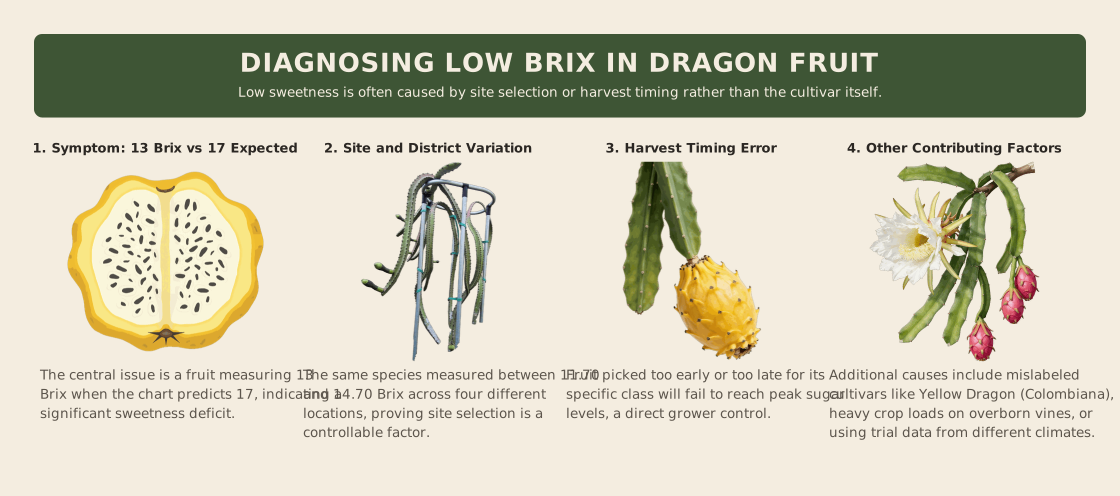
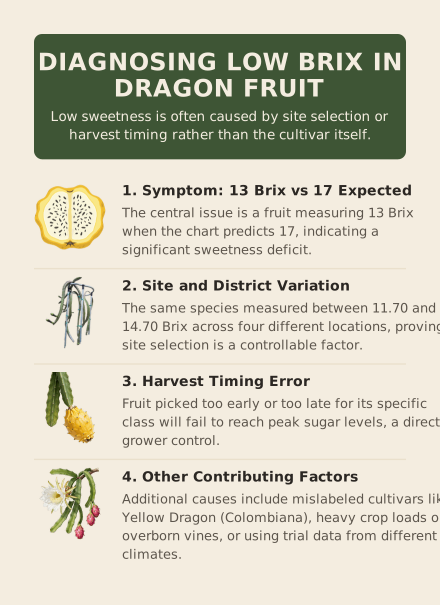
A single chart number is a snapshot. The same species can taste completely different depending on where it grows. Researchers measured Hylocereus polyrhizus fruit across four districts in Nepal and found Brix readings ranging from 11.70 to 14.70, with pH levels shifting between 4.5 and 5.47.[6] Moisture content also varied, sitting between 84.68% and 86.81%. These are not random errors. They result from soil composition, local rainfall, temperature swings, and sun exposure. If you buy a cutting labeled 18 Brix, you are buying genetic potential, not a guaranteed sweetness score for your specific backyard.
Read charts as ranges, not constants. A site-specific reading in a trial does not predict your harvest. Your local microclimate will push the number up or down. Focus on the relative ranking of varieties rather than the absolute value.
Harvest timing is another major variable. Dragon fruit is non-climacteric, meaning it does not continue to ripen or sweeten significantly after you cut it from the vine. You must pick only fully colored fruit. If you harvest early to avoid birds or split skin, you lock in a lower Brix reading. Waiting for the peel to show full color and the scales to begin drying slightly is the only way to ensure you get the sweetness the variety is capable of producing.
Weather during ripening dictates quality. A dry, sunny stretch before harvest concentrates sugars, pushing Brix higher. A period of heavy rain just before picking dilutes the fruit, lowering sweetness and raising pH. This is why two growers with the exact same clone can report different flavor profiles. One site may have had a dry spell, while the other received irrigation or rainfall. Genetics provide the blueprint. The environment writes the final score.
Using the chart to choose: climate, space, pollination
Translate chart columns into your backyard constraints. Data shows potential. Your site determines reality. Start with your location limits.
Cold tolerance is the first filter
If temperatures drop near freezing, the cold-hardiness score on the chart is non-negotiable. Pitaya is injured by prolonged exposure below 31 F (-2 C), though plants recover quickly from light freezing.[1] In the UC San Diego trial, the two yellow cultivars scored a 1 for cold hardiness, the lowest rating in the entire dataset.[2] This means yellow varieties are poor choices for marginal climates without significant protection. Red-fleshed types like Physical Graffiti scored 4.5, indicating much greater resilience.[2] Check the score before you check the Brix.
Space and support: a 20-year commitment
Dragon fruit is a heavy, long-lived vine. A productive 3- to 4-year-old plant can yield about 220 lb (100 kg) of fruit per year, and a planting is estimated to last about 20 years.[1] This is a permanent structure. You need a trellis capable of holding that weight plus the vegetative mass. The chart’s yield column is a proxy for the structural load you must support.
Pollination: buy two genetic types
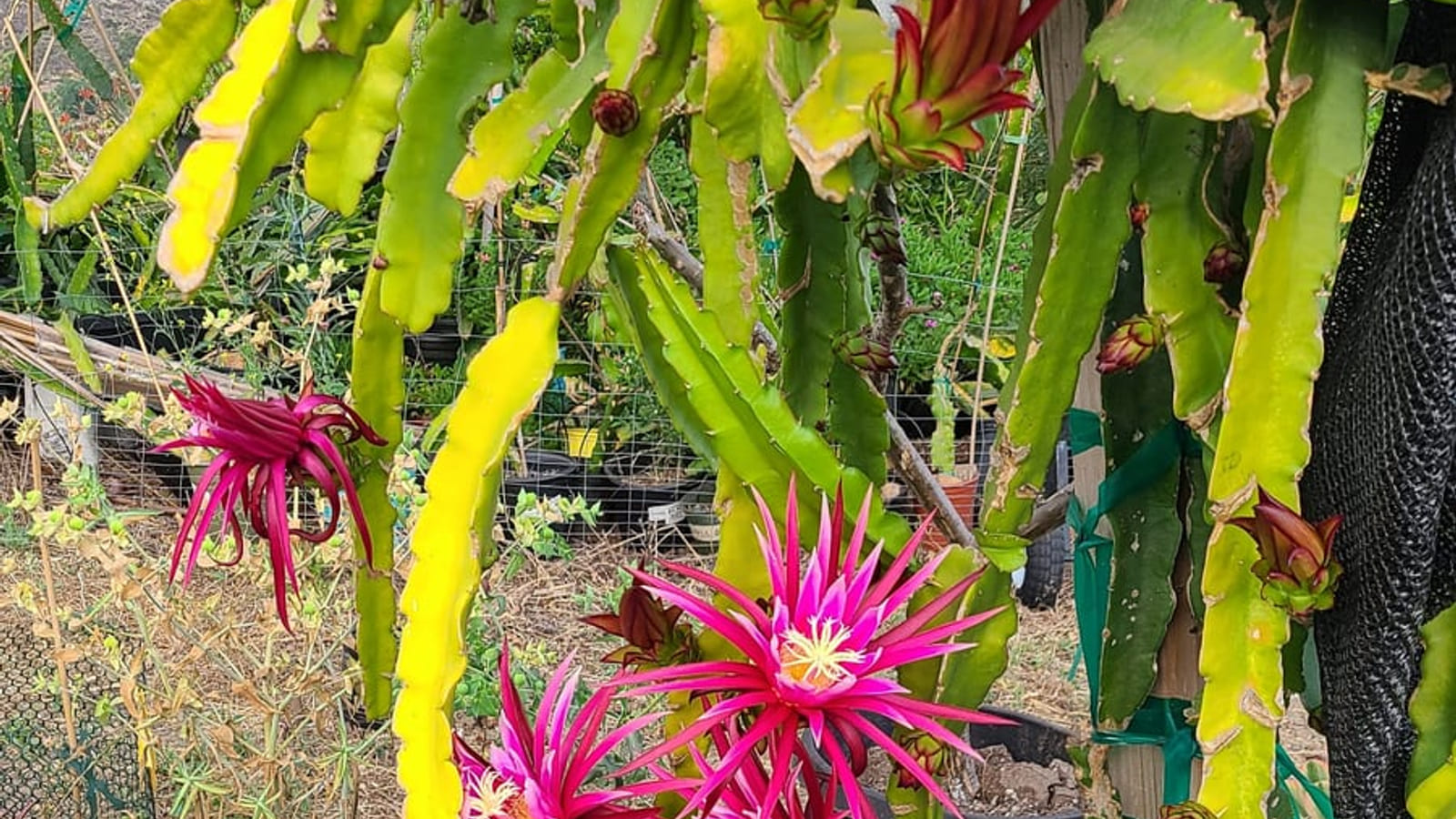
Do not rely on one plant. UF/IFAS states plainly that self-incompatibility has been reported in several cultivars sold by nurseries, and recommends planting 2 or 3 different genetic types (not the same clone or variety) so cross-pollination assures better fruit set and fruit size.[1] While the UC trial found that most selections set fruit without hand pollination, relying on natural pollinators is a gamble.[2] Pitaya flowers are hermaphroditic, nocturnal, and extremely fragrant, with moths and bats as the effective natural pollinators because the flowers open at night when bees are not active.[1] Buy two genetically distinct plants unless you confirm self-fertility. See our pollination guide for details on hand-pollinating at night.
Frequently Asked Questions
How many dragon fruit varieties are there?
Botanists recognize up to 29 species and forms within the genus Selenicereus, but commercial production relies on a handful of clones. For practical growing, sort the market into three buckets based on flesh color: white, red, and yellow. These categories form the spine of any reliable varieties chart. Most nursery tags still use the older genus name Hylocereus, though the plant itself is unchanged. [8]
Which dragon fruit variety is the sweetest?
Scores above 18 are exceptional and often command premium prices. However, sweetness is site-specific. Soil, irrigation, and local climate shift these numbers, so treat chart figures as benchmarks rather than universal constants. [2]
Which varieties have red flesh?
Red-fleshed types primarily belong to Selenicereus costaricensis and Selenicereus polyrhizus. These varieties contain betacyanins, pigments absent in white-fleshed S. undatus. Red pulp also carries higher total phenolics and anthocyanins, contributing to deeper color and antioxidant activity. If you want magenta pulp, look for cultivars labeled under these species, though nursery tags may still list the older Hylocereus genus. [5]
Do I need two plants for pollination?
Not always. The UC trial found most selections set fruit without hand pollination, aided by bees and other insects. However, self-incompatibility is poorly documented across cultivars. Planting two or three genetically distinct types ensures better fruit set and size. Check specific variety notes: some, like Alice and Bloody Mary, require cross-pollination, while others like Delight do not. [3]
| Variety | Pollination Need |
|---|---|
| Alice, Bloody Mary | Cross-pollination required |
| Delight, Physical Graffiti | Self-compatible reported |
What do the chart columns mean?
A useful chart lists species or flesh color, measured Brix, fruit weight, days from flower to harvest, and pollination requirements. Brix indicates sweetness, with 15 to 18 being dessert-quality. Fruit weight shows market potential. Days to harvest helps plan your season. Pollination notes guide planting strategy. Treat fertility columns as grower-reported experience, as self-incompatibility data is often incomplete. [2]
Why does my fruit test lower than the chart number?
Brix is a site-specific reading, not a fixed trait. The same cultivar can vary significantly based on local conditions. For example, Hylocereus polyrhizus measured 11.70 to 14.70 Brix across different districts in one study. Soil health, water stress, and temperature all influence sugar accumulation. A single chart number is a snapshot from one location, not a guarantee for your garden. [6]
From our own rows
These numbers are benchmarks. We grow these cultivars in the ground in North San Diego County. When we sell a cutting or a grafted plant, we are shipping a clone that has survived our local weather, our soil, and our irrigation schedule. The chart is a buying guide for what we actually ship.
We keep Lisa, Cebra, Sin Espinas, Physical Graffiti, American Beauty, Delight, Seoul Kitchen, and yellow Colombiana/Palora types in our production rows. Watching them fruit year after year gives us a practical view of performance outside a university plot.
Know the data source. The Brix scores, fruit weights, and days to harvest in the main table are UC San Diego trial data. They are site-specific measurements from a different location. Our own observations cover hardiness, growth habit, and how easy a plant is to manage in a home garden. We do not have a refractometer in every row. We do not publish our own Brix numbers. We rely on the trial data for sweetness and weight.
Sweetness and productivity are separate traits. In the trial, Physical Graffiti produced 23,429 g per plant, while Seoul Kitchen yielded 15,379 g and Lisa 13,319 g.[2] High yield does not always mean the highest sugar content. We see this in our own rows. A plant can be a heavy producer with moderate sweetness, or a lighter producer with exceptional flavor.
Our on-farm notes matter for climate tolerance. The trial scored cold hardiness and heat tolerance on a 1-5 scale. The two yellow cultivars scored 1 for both, the lowest ratings in the study.[2] Physical Graffiti scored 4.5 for both, while Lisa scored 3.75 for cold and 4 for heat.[2] In our nursery, we see the yellow types struggle more in our local microclimates than the red-fleshed varieties. They require more protection. We sell them. We recommend them for growers who can manage their sensitivity.
Flavor preference is subjective. In a UC blind flavor panel, Bien Hoa Red, American Beauty, Physical Graffiti, Sin Espinas, and Lisa rated highest.[2] The same group rated highest on external appearance.[2] We agree. They are reliable performers in our rows. If you want a plant that looks and tastes good, these are safe choices.
Our guarantee: Every cutting and plant we ship is a verified clone from our own stock. We do not sell seedlings. Seedlings can take up to 7 years to bear fruit, while a cured cutting commonly fruits 6-9 months after planting.[1] We sell clones. We know what they do.
References
- Pitaya (Dragonfruit) Growing in the Florida Home Landscape, HS1068 / HS303 (Crane & Balerdi, UF/IFAS Department of Horticultural Sciences; original 2005, revised Nov 2016 and Dec 2019). Species Table 1, nutrition Table 3, University of Florida IFAS Extension (EDIS) (2019).
- Pitahaya Production in California: A Research Update. Variety trial results table: 19 cultivars with measured Brix, average weight, days to harvest, marketable weight per plant, cold and heat scores, plus DNA relationships (Lobo, Bender, Tanizaki, UCCE San Diego County; Fernandez de Soto, UC Hansen REC; seminar San Marcos CA), University of California Agriculture and Natural Resources / UC Cooperative Extension San Diego County (2013).
- Pitaya Species and Named Varieties (reproduces the named-variety table removed from UF/IFAS HS1068, with cross-pollination need, fruit weight, peel and pulp color and landscape recommendation per cultivar), Growables, Inc. (nonprofit tropical fruit education, from UF/IFAS Tropical Research and Education Center material) (2021).
- Comparative analysis of nutrient composition and antioxidant activity in three dragon fruit cultivars (Yasmin et al., PeerJ 12:e17719; doi 10.7717/peerj.17719). Anthocyanins, carotenoids, vitamin C, phenolics, DPPH and soluble sugar by cultivar, PeerJ (PubMed Central) (2024).
- A comparative analysis of red and white dragon fruit pulp and juice characteristics (Lande, Kshirsagar, Aralkar, Agarkar, Patil, Suryawanshi; Journal of Applied Horticulture 26(2): 244-247). Betacyanin, total phenolics, sugar, protein, ascorbic acid by pulp and juice, Journal of Applied Horticulture (2024).
- Physico-Chemical Characteristics of Dragon Fruit Hylocereus polyrhizus (Weber) Britton and Rose from Different Locations of Nepal (Budhathoki et al.; Environment and Ecology 41(4C): 2853-2858, doi 10.60151/envec/JFTT4959). TSS 11.70-14.70 Brix and pH 4.5-5.47 by district, Environment and Ecology (2023).
- Floral and pollination biology of dragon fruit reveals strategies for enhancing productivity through pollination management and reproductive window extension (Scientific Reports, s41598-025-21168-2). Taxonomic reclassification to Selenicereus undatus, partial self-incompatibility, approach herkogamy, night hand-pollination cost, Nature Portfolio / Scientific Reports (2025).
- Evaluation of Different Procedures to Pollinate Self-Compatible 'Royal Red' Pitaya Under Protected Cultivation (PMC12526123). Self-incompatibility across genotypes, herkogamy, plastid-marker species delimitation up to 29 Selenicereus species and forms, commercially important species list, PMC / MDPI Horticulturae (2025).