Why Your Dragon Fruit Won't Flower
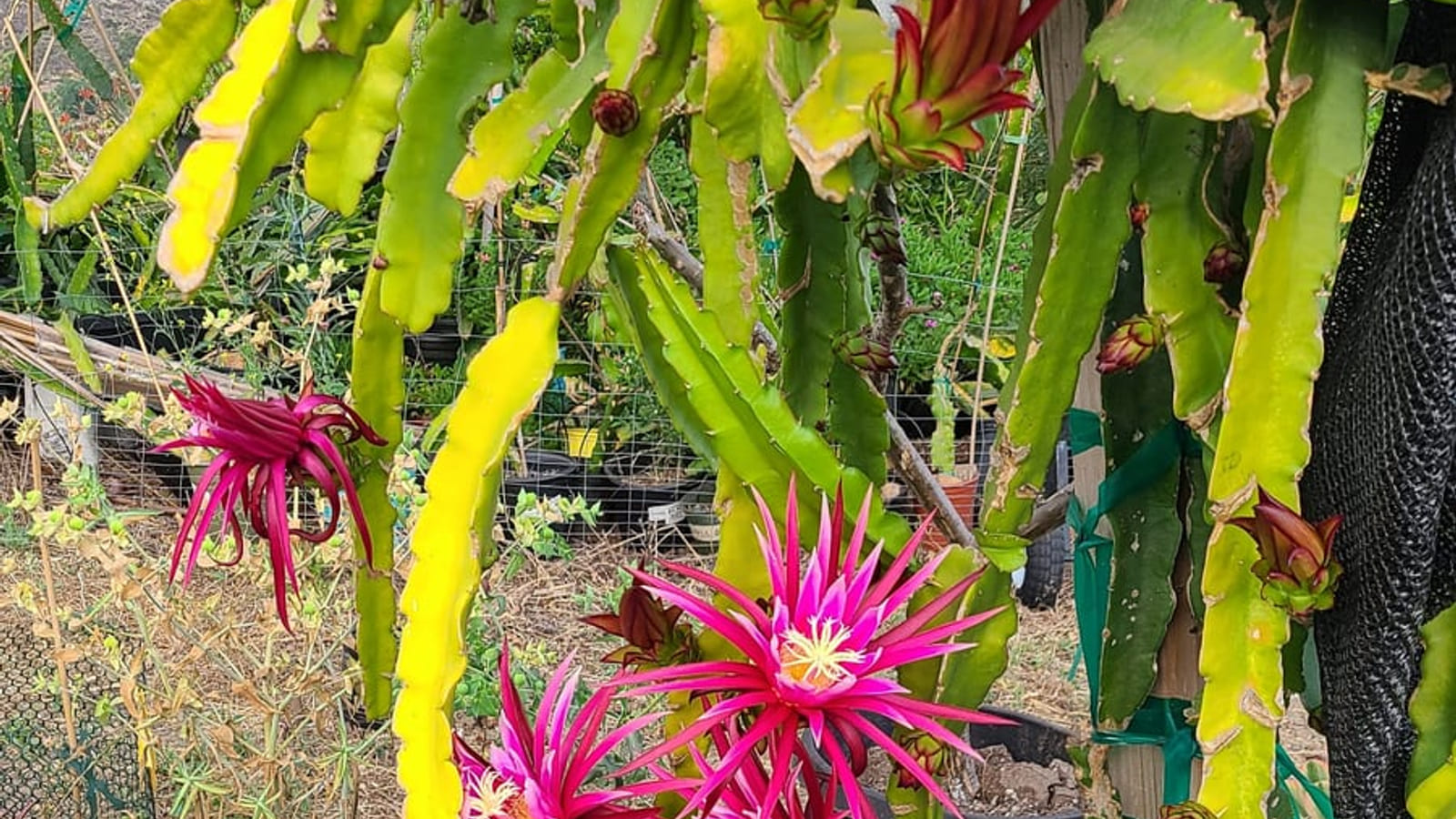
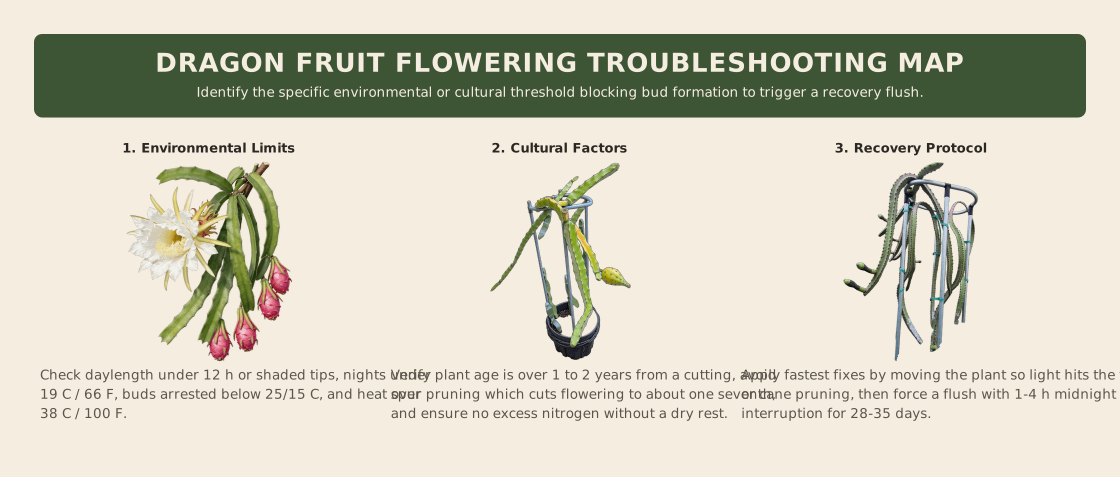
Your dragon fruit is not flowering because it lacks one of five specific conditions. First, check the light dose on the stem tips. Dragon fruit is a long-day plant with a critical daylength of about 12 hours. Second, verify your temperature. Buds only emerge at 29/19 C (84/66 F) or warmer, even under perfect daylength. Third, assess plant age and which wood you are waiting on. Plants from cuttings take 1 to 2 years to flower, while seedlings need 2 to 3 years. Fourth, review your pruning method. Cane pruning encourages flowering, while spur pruning can cut it to one seventh. Fifth, examine your feeding and water. A dry period in early spring triggers flowering, while excessive nitrogen suppresses it. We grow 50+ varieties in Escondido, zone 13a, and we lose flushes for exactly these reasons. See our [dragon fruit care guide] for detailed protocols.
Run the 60-second check before you change anything
Before you buy a new grow light or dump a bag of fertilizer, look at the plant. Different failures look different. A pale stem needs a different fix than a bud that aborts. If you guess, you might spend a season chasing the wrong problem. Walk the trellis and match what you see to the table below.
| What you see | Likely cause | The fix | Lead time |
|---|---|---|---|
| Thin, pale stems | Light starvation at the tips | Prune overhead shade; add supplemental light | Weeks to months |
| Leafy shoots from lower areoles only | Short days or low temp | Night break or wait for spring warmth | 3 to 12 weeks |
| Buds appear then abort | Heat stress or water shock | Shade cloth; steady moisture | Next flush |
| Flowers but no fruit | Pollination failure | Hand-pollinate at dusk | Immediate |
| Plant in first two seasons | Immature wood | Wait; prune laterals only | 1 to 2 years |
Look at the stem tips first. If they are thin and pale, the plant is not getting enough light to trigger the hormonal switch for flowering. Dragon fruit reads daylength through its growing tips. If those tips are shaded by other branches or nearby trees, the plant stays in vegetative mode. Clear the canopy. If you are in a short-day season, you may need to interrupt the night with light to force the signal. This is not about brightness; it is about the duration of the dark period.
Next, check where the growth is happening. If you see new leafy shoots emerging from the lower areoles while the tips remain bare, the plant is confused by the photoperiod. In trials, shortening summer days to 8 hours pushed lower areoles into leafy growth instead of flower buds[1]. This is a classic sign that the plant is reading the current daylength as "winter." You cannot fix this with fertilizer. You need to either wait for longer days or use a night-break protocol to trick the clock.
If you see small buds that appear and then abort, look at your temperature and water. Buds need a specific thermal window to survive. If daytime temperatures spike above 38 C (100 F), flowering is inhibited even if the daylength is correct[6]. Conversely, if nights drop below 19 C (66 F), bud development stalls. A sudden shift from dry to wet can also shock the plant into dropping buds. Stabilize your irrigation. If you are in a hot inland site, you may need shade cloth to keep the canopy cool enough for buds to hold.
Flowers without fruit are a different problem entirely. If the plant is flowering but not setting, the issue is pollination, not induction. Many white-fleshed varieties are self-incompatible, meaning they need pollen from a different variety to set fruit[6]. Even self-compatible plants set better with cross-pollination. Hand-pollinate at dusk when the flowers are fresh. Waiting for bees is often not enough in a backyard setting.
Finally, consider the age of the wood. If your plant is less than two years old from a cutting, it may simply be immature. No amount of light or fertilizer will force a juvenile plant to flower before it is ready. Check your how long a cutting takes to reach first fruit timeline. If you are within that window, stop tinkering. Let the plant mature. If you are past that window, look at your pruning. Spur pruning can cut flowering to one-seventh of the potential yield by removing the wrong wood[7]. Switch to cane pruning to encourage the right kind of growth.
Pro tip: Do not mix fixes. If you have a light problem, adding fertilizer will not help. If you have a pollination problem, adding light will not help. Diagnose first, then act.
Cause 1: the stem tips are not getting the daylength signal
Dragon fruit reads the calendar through its growing tips. The plant is a long-day species with a critical daylength threshold of about 12 hours. If the light does not reach the distal areoles for long enough, the hormonal switch to flowering never flips. The plant stays in vegetative mode, pushing out green shoots instead of buds. This is the most common reason for a stalled trellis in shaded yards or coastal Southern California sites.
The mechanism is strict. In a photoperiod trial in Taiwan, red pitaya flowered between May and October and produced only vegetative shoots between November and May. When researchers artificially shortened summer days to 8 hours, floral bud formation stopped at the distal areoles. The plant did not just pause; it redirected energy. The proximal areoles, which are closer to the main stem, threw leafy shoots instead of flowers. This confirms that the signal must land on the tips of the last season’s stems. If those tips are in shadow, the plant assumes it is winter, even in July.
Check the shadow map. Light has to land directly on the areoles at the tips. An east or north wall, an eave, or a neighboring tree can block the necessary duration. Stems trained below the wire often sit in the shade of the upper canopy. The matted inner canopy, which nobody thins, creates a light-starved zone where tips receive only filtered, short-day light.
Once the signal is received, the plant does not flower all at once. The same research showed that areoles on older shoots can be induced after the spring equinox. Floral bud formation then arrives in two to three waves from May to October. This staggered approach protects the plant. If you miss the first wave because your tips were shaded, you might still catch the second or third, provided the light conditions improve. But if the tips remain in the shade of the canopy or a nearby structure, the plant will continue to produce leafy growth from the lower areoles, mistaking the short days for a season that requires survival rather than reproduction.
Cause 2: temperature, from both directions
Long days start the bud, but warmth finishes it. You can have perfect photoperiod and still see nothing if the plant is too cool. In a controlled phytotron experiment with white-fleshed pitaya held at an inductive 14-hour photoperiod, temperature acted as a hard gate on development. Plants kept at 23/13 C (73/55 F) arrested their buds at the pre-flower stage. They never emerged. Raise the temperature to 25/15 C (77/59 F), and more buds reach stages 2 and 3, but none break through. The threshold for emergence is 29/19 C (84/66 F). Even at this minimum, plants needed 9 weeks of holding at that temperature to finally push a flower out. At 32/22 C (90/72 F), the optimum, emergence happened in just 3 to 4 weeks[4].
This is why a cool, cloudy April in Escondido often delays a flush that a warm May produces instantly. The daylength signal is already there. The plant is waiting for the thermal permission slip. If your nights are hovering around 13 C, the buds are stuck in limbo. They are not dead; they are paused.
| Temp (Day/Night) | Result |
|---|---|
| 23/13 C (73/55 F) | Buds arrested pre-flower |
| 25/15 C (77/59 F) | Buds reach stages 2-3, none emerge |
| 29/19 C (84/66 F) | Minimum for emergence (takes 9 weeks) |
| 32/22 C (90/72 F) | Optimum (emergence in 3-4 weeks) |
| 38 C (100 F) | Flowering inhibited in red pitaya |
| 39 C (102 F) | Unsuitable |
| 18-27 C (64-81 F) | Thrival band |
Heat blocks flowering from the other direction, too. In vine pitaya crops grown in the Jordan Valley, high summer temperatures inhibited flower production in two Hylocereus species[5]. This matches what we see in inland California. A July spike over 38 C (100 F) can blank a flush outright. The plant may have started the process, but the heat stress causes the buds to abort before they open. Red pitaya flowering is specifically inhibited at 38 C, while 32 to 34 C encourages it[6].
The shade cloth trade-off. In dry heat above 37 C (99 F), you need protection to prevent sunburn. Use 50 to 75% black shade cloth. However, heavy shade costs you. It reduces bud formation and lowers fruit quality. Balance is critical. You want enough cover to keep the canopy from cooking, but enough light to keep the hormonal signal strong.
For most growers in zone 13a, the solution is patience in the spring and protection in the summer. Do not force the plant when it is cold. Do not let it bake when it is hot. If you are waiting on a cutting to flower, remember that how long a cutting takes to reach first fruit is also tied to these thermal windows. A plant that spends its first year in a cool, shaded corner will mature slower than one in a warm, sunny spot.
Cause 3: the plant is too young, or you are watching the wrong wood
Age is a hard biological floor, not a suggestion. If you planted a standard 20 to 70 cm cutting last spring, it is on schedule, not failing. Plants propagated from cuttings typically take 1 to 2 years to flower for the first time, while seedlings require 2 to 3 years[6]. Before you blame your fertilizer or light schedule, check your calendar. A juvenile plant simply lacks the physiological maturity to respond to flowering triggers. No amount of supplemental lighting will force a young plant to flower before it is ready. For a detailed breakdown of timelines, see our guide on how long a cutting takes to reach first fruit.
Once the plant has aged enough, the next question is which stems you are watching. Not all wood is created equal. Buds are induced in areoles on older shoots, specifically after the spring equinox. In production trials, floral bud formation arrives in two to three waves from May to October[1]. If your canopy consists entirely of upright, bright green first-year fingers, you are looking at a canopy of leaves, not a canopy of future flowers. These young shoots are still in a vegetative growth phase. They are building structure, not reproductive capacity.
At Sky Botanicals, we follow a simple rule of thumb: a stem earns its keep once it has ripened, darkened, and begun to arch over the wire. Young, upright stems are often too vigorous and too short to hold the hormonal balance required for flowering. They are busy extending. Older, darker wood that has started to droop or arch has slowed its vertical growth and is primed to respond to the photoperiod and temperature cues discussed in the previous sections. If your plant is old enough but still all upright green fingers, it may be growing too fast due to excess nitrogen or water, keeping it in a perpetual state of vegetative youth.
Check your wood. Look for stems that have turned from bright green to a duller, darker green and have started to bend or arch. These are your flowering candidates. Upright, rigid, bright green stems are likely still juvenile or overly vigorous. Patience is often the only fix for age-related non-flowering.
Cause 4: your pruning method
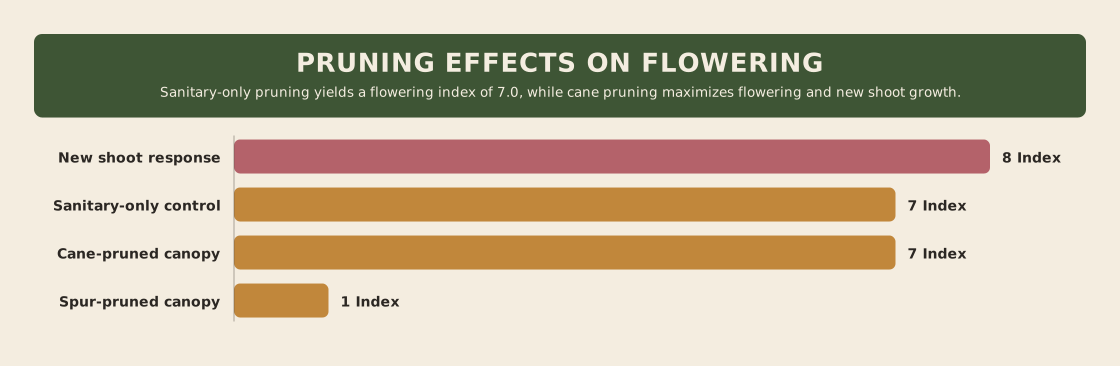
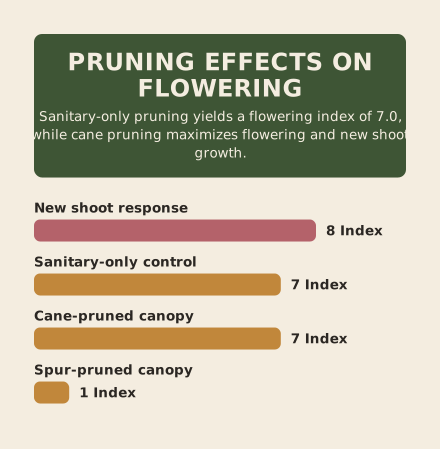
How you prune determines how many flowers you get. In a field trial of annual fruiting pruning in white-fleshed pitaya, spur pruning cut flowering to about one seventh of the unpruned sanitary-only control and produced no flush of new growth. Cane pruning gave the greatest flowering together with about 8% more new shoots than the control. Combined pruning was intermediate and the authors judged it uninteresting [7].
The mechanism is straightforward. Spur pruning leaves short stubs with few mature areoles and no fresh shoots. Cane pruning removes old fruiting wood and forces the new flush that will carry the next waves of buds. You want the plant to keep producing vigorous new stems because that is where the flowers will emerge.
| Pruning Method | Flowering Result | New Growth |
|---|---|---|
| Sanitary-only (Control) | Baseline | Baseline |
| Spur pruning | About 1/7 of control | No new flush |
| Cane pruning | Greatest flowering | About 8% more shoots |
| Combined pruning | Intermediate | Not worth doing |
Related work from the same line reports better yield characteristics with cane pruning at roughly 12 to 15 fruiting cladodes left per metre of trellis [7]. This stocking target keeps the canopy balanced and lets light into the tangled middle, which is essential for induction.
Pruning schedule and year-one rule
Mature plants are pruned about three times a year and young plants once, always with clean tools. The stated purposes are balancing the plant on the trellis, letting light into the canopy, and inducing flowering [6].
In year one, remove every lateral stem along the main stem until the plant reaches the trellis, then tie it to the post. This forces energy into vertical growth rather than premature branching. If you are still waiting for that first bloom, check how long a cutting takes to reach first fruit to ensure you are not pruning too early or too aggressively.
Cause 5: feeding and water, including the dry rest
Nitrogen builds stems. Potassium and phosphate build flowers. If your plant is leafing out vigorously but refusing to bud, you are likely feeding it the wrong way. Published fertility programs are potassium-weighted, not nitrogen-heavy. A standard recommendation runs 170 to 300 g of nitrogen per plant, or a fertilizer program of 1.2 kg per plant per year at an N:P:K:Mg ratio of 9.6:4.8:17.6:2.4, plus 12 kg of compost per plant per year [6]. The high potassium content in that ratio is intentional. It supports reproductive growth rather than endless vegetative expansion.
Foliar feeding can force the issue when soil feeding alone is too slow. Trials showed that weekly sprays for three months induced flowering in significant percentages of plants. The results varied by product: Box-Flower at 1% v/v induced flowering in 38.0% of plants, 1% potassium nitrate reached 33.2%, Folar-K at 0.1% v/v hit 27.7%, and 1% mono-potassium phosphate came in at 18.7% [6]. These numbers prove that direct leaf application of potassium and phosphate can push a reluctant plant into bloom.
Water management is just as critical as fertilizer choice. Dragon fruit needs 25 to 50 inches of rain a year, or careful twice-weekly irrigation [6]. Overwatering is a common mistake. Excessive moisture causes root rot, fungal disease, and fruit drop [6]. A wet root system signals the plant to keep growing leaves, not flowers.
Conversely, withholding water is a documented flowering trigger. Precocious flowering in pitaya is induced by withholding water in early spring [6]. The plant interprets the dry spell as a stress signal that prompts reproduction. In our Mediterranean-summer climate, this aligns with the natural dry season. You want to mimic that rhythm.
The Wet-Dry Rhythm Stop watering in late winter or early spring. Let the soil dry out completely. Resume regular irrigation once you see bud initiation or when spring warmth arrives. This dry period breaks vegetative growth and encourages the plant to switch to flowering mode.
| Goal | Action | Why |
|---|---|---|
| Build Flowers | Use K-heavy fertilizer | Potassium supports reproductive structures |
| Force Bloom | Foliar spray weekly | Direct nutrient uptake triggers flowering |
| Trigger Induction | Withhold water in spring | Dry stress signals the plant to reproduce |
| Prevent Drop | Avoid overwatering | Wet roots cause rot and fruit loss |
If you are starting from a cutting, remember that maturity matters. No amount of potassium or dry stress will force a juvenile plant to flower. Check how long a cutting takes to reach first fruit to ensure your plant is old enough to respond to these cues.
Cause 6: everything looks right and it still will not flower
You have pruned correctly. You have waited out the juvenile phase. The light hits the tips, and the nights are warm enough. Yet the plant stays vegetative. This is where the mechanism matters. Dragon fruit does not just "see" light; it measures night length through a circadian clock. Transcriptome work in red dragon fruit identified clock genes, including a GIGANTEA homolog and CONSTANS-like genes, that run in daily patterns[10]. The plant uses these genes to decide if the current night is short enough to signal spring.
The clock converts that measurement into hormones. In orchards given supplemental winter light, cytokinin levels rose first during bud differentiation, then fell as gibberellin, auxin, salicylic acid, and jasmonic acid increased[8]. This hormonal shift is the actual trigger. If your plant is stuck, its internal hormone balance may be wrong, even if the external conditions look perfect.
The Gibberellin Brake Gibberellin (GA) suppresses flowering. Applying GA3 to pitaya induced bud dormancy and lowered floral identity genes like LFY and FLOWERING LOCUS T[9]. In field trials, GA3 delayed flowering and cut total flower yield, while a synthetic cytokinin sped it up[9]. If you are using heavy seaweed or kelp tonics, check the label. These products are often high in gibberellins. Stop them when you want flowers.
Shade is another hidden brake. CONSTANS-like genes, which drive photoperiod flowering, are broadly expressed in buds and respond to gibberellin treatment[9]. When areoles are shaded, they behave as if it is a short day, regardless of the actual time of year. A dense canopy creates a micro-environment of high gibberellin and low flowering signal. Keep the middle of your trellis open. Light penetration is not just about photosynthesis; it is about keeping the hormonal state permissive for flowers.
The sequence that works is dry rest, then long day, then warm nights. This mimics the natural transition from winter to spring. In Escondido, zone 13a, mature plants receive this signal naturally every spring without artificial lighting[12]. If you are forcing a flush, you are trying to replicate this hormonal cascade.
| Factor | Effect on Flowering | Action |
|---|---|---|
| High Gibberellin | Induces dormancy; suppresses floral genes | Stop kelp/seaweed tonics; avoid heavy nitrogen |
| High Cytokinin | Triggers bud differentiation | Use supplemental light; ensure canopy is open |
| Shaded Areoles | Reads as short day; blocks signal | Prune for light penetration |
There is no single switch. Flowering behavior varies significantly by genotype. In trials, 23 different genotypes all responded to supplemental lighting, but the time to induction ranged from 33 to 48 days depending on the variety and temperature[3]. This variability is why we grow over 50 varieties. Some are early, some are late, and some are stubborn. If your plant is not flowering, it may simply be a genotype that requires a longer or more specific hormonal push. Check how long a cutting takes to reach first fruit for more on age-related delays.
Buds but no fruit: the flower problem hiding inside the flowering problem
You might think the hard part is over once you see buds. It is not. A committed bud takes 20 to 25 days to reach anthesis in summer, stretching to 27 to 30 days in the autumn rainy season[6]. Yellow-skinned species can take over 40 days[6]. The real bottleneck is the night the flower opens. Flowers break open about an hour after sunset and remain functional for only 8 to 10 hours[6]. If you miss that window, you lose the crop.
Pollination is a race against the clock. Natural pollination by bees, ants, wasps, and moths is largely complete by 2 am[6]. If you are hand-pollinating, the window is tight. Flowers pollinated 12 hours after opening set no fruit at all[11]. Timing matters as much as action. In field studies, hand pollination within 6 hours of anthesis resulted in 75% higher fruit set and 42.4% heavier fruit compared to open pollination[11]. An evening pass also outperformed a morning pass by 23% in yield[2].
Compatibility check: Many white-fleshed cultivars are self-incompatible and require pollen from a different variety[6]. Several red- and yellow-fleshed types are self-compatible, but cross-pollination still boosts set and weight[6]. If you have only one variety, you may need to source a compatible mate or accept lower yields.
Do not rely on luck. For the specific night-by-night procedure to ensure you catch the flowers while they are fresh, see our guide on how long a cutting takes to reach first fruit and the associated pollination protocols.
How to force a flush: the night-break protocol
Dragon fruit reads daylength through its growing tips, but you do not need to lengthen the day to trigger flowering. You can interrupt the dark period instead. This method, known as night breaking, tricks the plant into thinking the night is shorter than it actually is. The signal must reach the stem tips, so position your light source to illuminate the canopy evenly. Red-rich light is particularly effective for this hormonal switch, though blue and far-red spectra also play a role in the overall response .
Timing inside the night matters as much as duration. Trials show that lighting around midnight produces the best flower bud differentiation and yield, while lighting at dusk or dawn is significantly less effective [3]. Place your light on a timer to activate in the middle of the night. A smart plug on an outdoor outlet is all you need to automate this. The light must be bright enough to reach the tips; production trials have used everything from 20 to 35 W LED fixtures to 100 W incandescent bulbs and 23 W compact fluorescents [3].
Do not overdo it. The commercial standard of a 4 to 6 hour break often causes over-flowering, requiring you to thin the crop later. A shorter, targeted break is more efficient for home growers. The required treatment length varies by season and temperature, ranging from 33 to 48 days to successful induction [3]. Cool weather slows the process because buds still need a minimum of 29/19 C (84/66 F) to emerge, even if the light signal is perfect.
| Season | Break Duration | Treatment Length | Time to 50% Flowering |
|---|---|---|---|
| Late Autumn | ~1 hour (23:30 to 00:30) |
4 weeks | ~35 days |
| Early Spring | ~4 hours (22:00 to 02:00) |
3 months (cool weather) |
~28 days |
| Commercial Standard | 4 to 6 hours | Variable | Over-flowers; requires thinning |
Night breaking is applicable from about the September equinox to the following March equinox [1]. In late autumn, a one-hour break is sufficient to promote flowering in four weeks. In early spring, shoots are more responsive, but the cooler temperatures require a longer treatment period of three months to achieve the same result. If you are in a warm zone, you may see results faster, but the plant will still stall if night temperatures drop below the bud-emergence threshold.
Pro tip: Midnight lighting (22:30 to 02:30) outperformed evening and early-morning lighting in trials for bud differentiation and yield [3]. Aim for the middle of the night, not just after sunset.
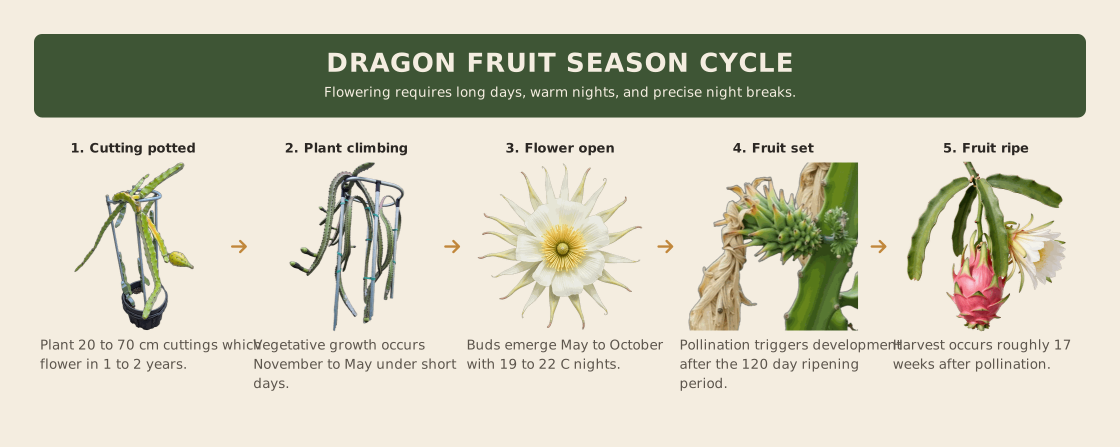
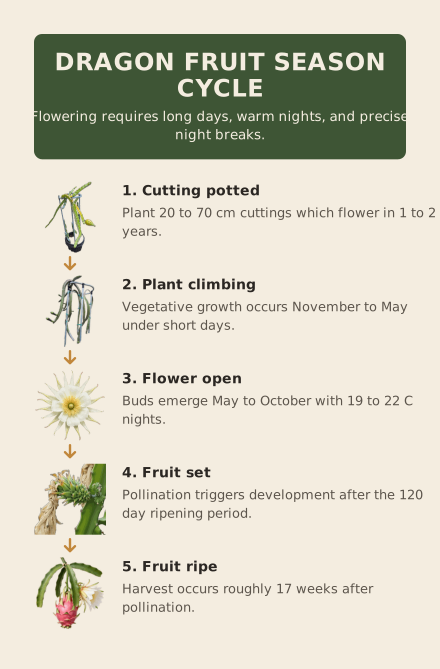
A year on the farm: what should be happening when
Here in Escondido, zone 13a, our calendar is dictated by the equinoxes. We do not fight the season; we work with it. If you are wondering why your plant is silent, compare your timeline to ours. A mature plant with no buds by early June here has a light, wood, or feeding problem, not a season problem.
From November through February, the days are short. The plant enters a natural dry rest. We stop heavy irrigation and withhold nitrogen. This is not a time for growth; it is a time for dormancy. If you see leafy shoots emerging from lower areoles during this window, the plant is confused by the short days. It is reading the current photoperiod as winter. Do not panic. Do not fertilize. Wait.
As the spring equinox passes, daylength crosses the critical 12-hour threshold. This is the signal. The plant switches from vegetative mode to reproductive mode. We resume watering and begin cane pruning to open the canopy. Light must reach the stem tips. If the tips are shaded, the hormonal switch fails. Buds only emerge when temperatures hit 29/19 C (84/66 F) or warmer[4]. In our zone, we hit these temperatures naturally in late spring. You do not need lights yet.
From May or June through October, we expect flush waves. Floral bud formation arrives in two to three waves during this period[1]. If you have a mature plant and no buds by early June, check your wood. Are you waiting on juvenile stems? Plants from cuttings take 1 to 2 years to flower[6]. If the wood is old enough, check your pruning. Spur pruning can cut flowering to one seventh of the potential[7]. We prune for cane structure to maximize light penetration.
July brings a specific risk: heat blanking. If daytime temperatures spike above 38 C (100 F), flowering is inhibited even if the daylength is perfect[6]. In our inland site, we sometimes lose the peak summer flush to heat. If you see buds aborting in July, it is likely thermal stress, not a lack of induction. Shade cloth can help, but too much shade impairs fruit output[6]. Balance is key.
By September, the days shorten again. The natural signal fades. This is when we turn on the lamps. We use a night-break protocol to trick the clock. The treatment has to run longer in cool weather. Four weeks of night breaking promotes flowering in late fall, while three months are required in winter and early spring[1]. We aim for about 1 hour of night break in late autumn and about 4 hours in early spring[2]. Timing inside the night matters. Midnight lighting (22:30 to 02:30) gives the best flower bud differentiation[3]. Evening lighting comes second. Early-morning lighting is the worst.
San Diego County Calendar
| Month | What to Expect | Action |
|---|---|---|
| Nov - Feb | Dry rest. Short days. No buds. | Withhold water. No nitrogen. |
| Mar - Apr | Daylength passes 12 hours. Temperatures rise. | Resume water. Cane prune. |
| May - Jun | First buds emerge. Flush wave 1. | Steady moisture. Monitor heat. |
| Jul - Aug | Peak flowering. Risk of heat blanking. | Shade if >38 C. Hand-pollinate at dusk. |
| Sep - Oct | Days shorten. Natural signal fades. | Start night-break lighting. |
If you are forcing an off-season wave with a lamp, remember that the plant is reading the dark period, not the brightness. This is a hormonal signal, not a lighting fixture issue. Cytokinin concentrations rise at bud differentiation under supplemental light[8]. Gibberellin is the brake. Applying GA3 suppresses flower bud formation[9]. Keep your fertilizer potassium-weighted, not nitrogen-heavy. Excessive nitrogen suppresses flowering. A dry period in early spring is a trigger, not a stress to avoid[6].
By October, the natural flush ends. We continue the lamp protocol if we want a late crop. If you see no buds by early June on a mature plant, do not wait for the season to change. The season is already here. Fix the light, the pruning, or the feeding. See <
FAQ
How long does it take for dragon fruit to flower?
Plants from cuttings take 1 to 2 years to flower, while seedlings need 2 to 3 years. Immature wood simply cannot respond to light or fertilizer signals yet. Check your planting date before troubleshooting other causes.
What month does dragon fruit flower?
Flowering occurs from May to October in the Northern Hemisphere, driven by long days and warm nights. Red pitaya makes vegetative shoots between November and May in photoperiod trials. The plant reads daylength through its stem tips[1].
How do I make my dragon fruit flower?
Ensure light hits the tips, use cane pruning, apply potassium, and give a dry rest in early spring. Then trigger a night break if needed. Excessive nitrogen suppresses flowering, so switch to a potassium-weighted feed[6].
Does dragon fruit need full sun?
Full sun to light shade is ideal, but desert heat requires 50 to 75% shade cloth to prevent sunburn. Shade on the areoles costs buds, so protect the canopy without blocking the tips. Too much shade impairs fruit output[6].
Can you force dragon fruit to flower?
Yes, a 1 to 4 hour midnight interruption works. This takes 28 to 35 days to reach flowering depending on season. The treatment must run longer in cool weather, up to three months in winter[1].
Why do my dragon fruit buds fall off?
Buds abort due to heat above 38 C, uneven water, overwatering, or hormone imbalance. A sudden shift from dry to wet shocks the plant into dropping buds. Stabilize irrigation and shade the canopy if temperatures spike.
What temperature stops dragon fruit flowering?
Bud emergence stalls below 29/19 C, and induction is inhibited above 38 C. Plants held at 23/13 C keep buds arrested even under long days. You need warm nights and moderate days for successful induction[6].
Fix the light and the pruning first
You have diagnosed the problem. Now you need to execute the fix in the right order. If you change too many variables at once, you will not know which intervention worked. Follow this sequence. It prioritizes the two factors that most often block flowering in established plants: light signal at the tips and canopy structure.
Why order matters
Pruning before you fix the light wastes energy. The plant will push new vegetative growth into the shade you have not yet cleared. Clear the light path first, then prune to direct that light into the wood that will flower.
The two-week reset plan
- Take a light reading at the stem tips. Do not measure brightness at the soil. Measure at the growing tips. If they are shaded by other branches or nearby trees, the plant is not receiving the long-day signal it needs. Dragon fruit reads daylength through its tips, not its roots. Clear overhead shade now. If you are in a short-day season, plan for supplemental light or night breaking.
- Cane prune. Remove old, unproductive wood. Cane pruning encourages flowering and new shoot production, while spur pruning can cut flowering to about one seventh of the unpruned control [7]. Leave roughly 12 to 15 fruiting cladodes per meter of trellis. This opens the canopy and lets light reach the areoles that will become buds.
- Cut nitrogen. Stop feeding nitrogen-heavy fertilizer. Nitrogen pushes leafy growth and suppresses flowering. Switch to a potassium-weighted feed or stop feeding entirely during the rest period.
- Withhold water for a defined rest. A dry period in early spring triggers flowering [6]. Let the soil dry out completely. Do not water until the top few inches are bone dry. This stress signals the plant to shift from growth to reproduction.
- Resume water and feed potassium. After the rest, water deeply and feed potassium. Potassium supports bud development and fruit set. Avoid nitrogen until buds are visible.
Watch for buds within a few weeks. If the plant is mature and the light is right, you should see floral buds emerging. If not, check your temperature. Buds only emerge at 29/66 F or warmer, even under perfect daylength [4]. Light and pruning alone will not fix a cold plant.
Do not prune young wood
If your plant is less than two years old from a cutting, do not cane prune. The wood is immature. Wait until the plant reaches the trellis and has established fruiting wood. See how long a cutting takes to reach first fruit for age benchmarks.
On our farm in Escondido, we follow this exact sequence every spring. We clear the canopy, cane prune, cut nitrogen, and withhold water until the first warm nights. Then we resume irrigation and feed potassium. The result is a uniform flush of buds across the trellis. If you follow these steps and still see no flowering, the issue is likely temperature or plant age, not light or pruning.
References
- The Photoperiod-regulated Bud Formation of Red Pitaya (Hylocereus sp.) - O. Arakawa, C.-C. Lin, Y.-S. Horng, HortScience 47(8):1063-1067, American Society for Horticultural Science (2012).
- Seasonal response of night-breaking on floral bud formation in red pitaya (Hylocereus sp.) in a noninductive period, Scientia Horticulturae 270:109420, Elsevier (2020).
- Physiological effects and technical strategies of LED supplemental lighting for pitaya cultivation: a review - R. Chen, Y. Ding, W.-K. Liu, X. Zhan, K.-X. Lin, K.-F. Lian, W. Chen, K. Wang, S. Lin (PMC12335236), PeerJ 13:e19720 (2025).
- Regulation of floral bud development and emergence by ambient temperature under a long-day photoperiod in white-fleshed pitaya (Hylocereus undatus), Scientia Horticulturae 271:109479, Elsevier (2020).
- High summer temperatures inhibit flowering in vine pitaya crops (Hylocereus spp.) - A. Nerd, Y. Sitrit, R. Kaushik, Y. Mizrahi, Scientia Horticulturae 96(1-4):343-350, Elsevier (2002).
- Pitaya Nutrition, Biology, and Biotechnology: A Review - K. Shah, J. Chen, J. Chen, Y. Qin (South China Agricultural University; PMC10530492), International Journal of Molecular Sciences 24(18):13986, MDPI (2023).
- Comparing Different Methods for Pruning Pitaya (Hylocereus undatus) - E. Arredondo, F. M. Chiamolera, M. Casas, J. Cuevas, Horticulturae 8(7):661, MDPI (2022).
- Light Supplementation in Pitaya Orchards Induces Pitaya Flowering in Winter by Promoting Phytohormone Biosynthesis - M. Wang, J.-X. Li, T. Li, S. Kang, S. Jiang, J.-Q. Huang, H. Tang (PMC11083671), International Journal of Molecular Sciences 25(9):4794, MDPI (2024).
- Gibberellin-3 induced dormancy and suppression of flower bud formation in pitaya (Hylocereus polyrhizus) - K. Shah, X. Zhu, T. Zhang, J.-Y. Chen, J.-X. Chen, Y.-H. Qin (PMC11726943), BMC Plant Biology 25:47 (2025).
- Identification and expression profiling of genes involved in circadian clock regulation in red dragon fruit (Hylocereus polyrhizus) by full-length transcriptome sequencing (HpGIGANTEA, HuTIMELESS CONSTANS-like), with companion: Transcriptomic analysis of flower induction for long-day pitaya by supplementary lighting in short-day winter season (BMC Genomics 21, PMC7680327), Plant Signaling & Behavior 16(1):1907054, Taylor & Francis (companion DOI: https://doi.org/10.1186/s12864-020-6726-6) (2021).
- Floral and pollination biology of dragon fruit reveals strategies for enhancing productivity through pollination management and reproductive window extension - P. K. Jadhav et al., ICAR-National Institute of Abiotic Stress Management (PMC12552510), Scientific Reports 15, Nature Portfolio (2025).
- USDA Plant Hardiness Zone Map 2023, ZIP 92026 Escondido California: zone 13a, winter minimum 25 to 30 F (-6 to -1 C), USDA (map) via UC ANR / PLACES lab planScape zone lookup (2023).