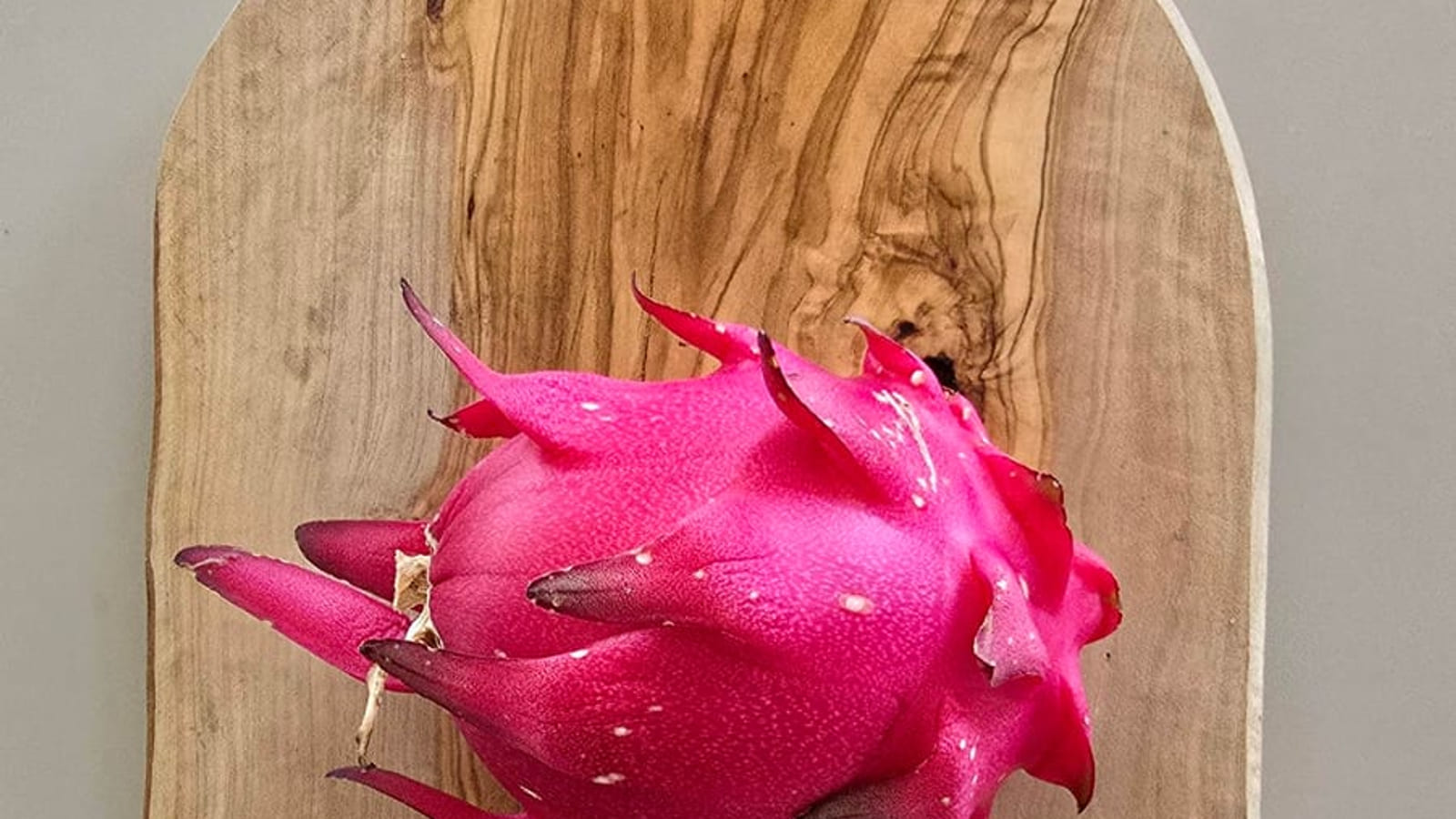
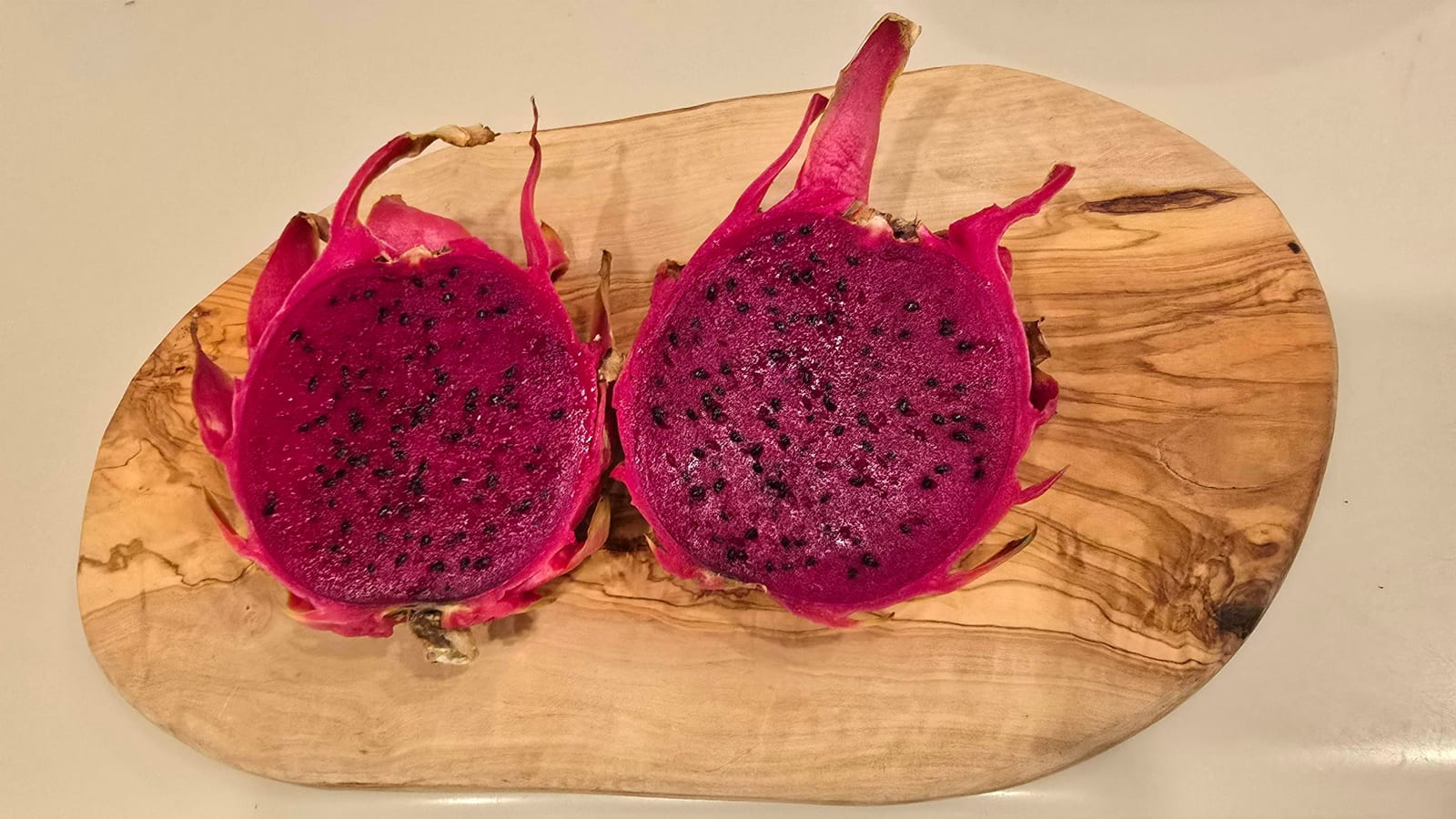
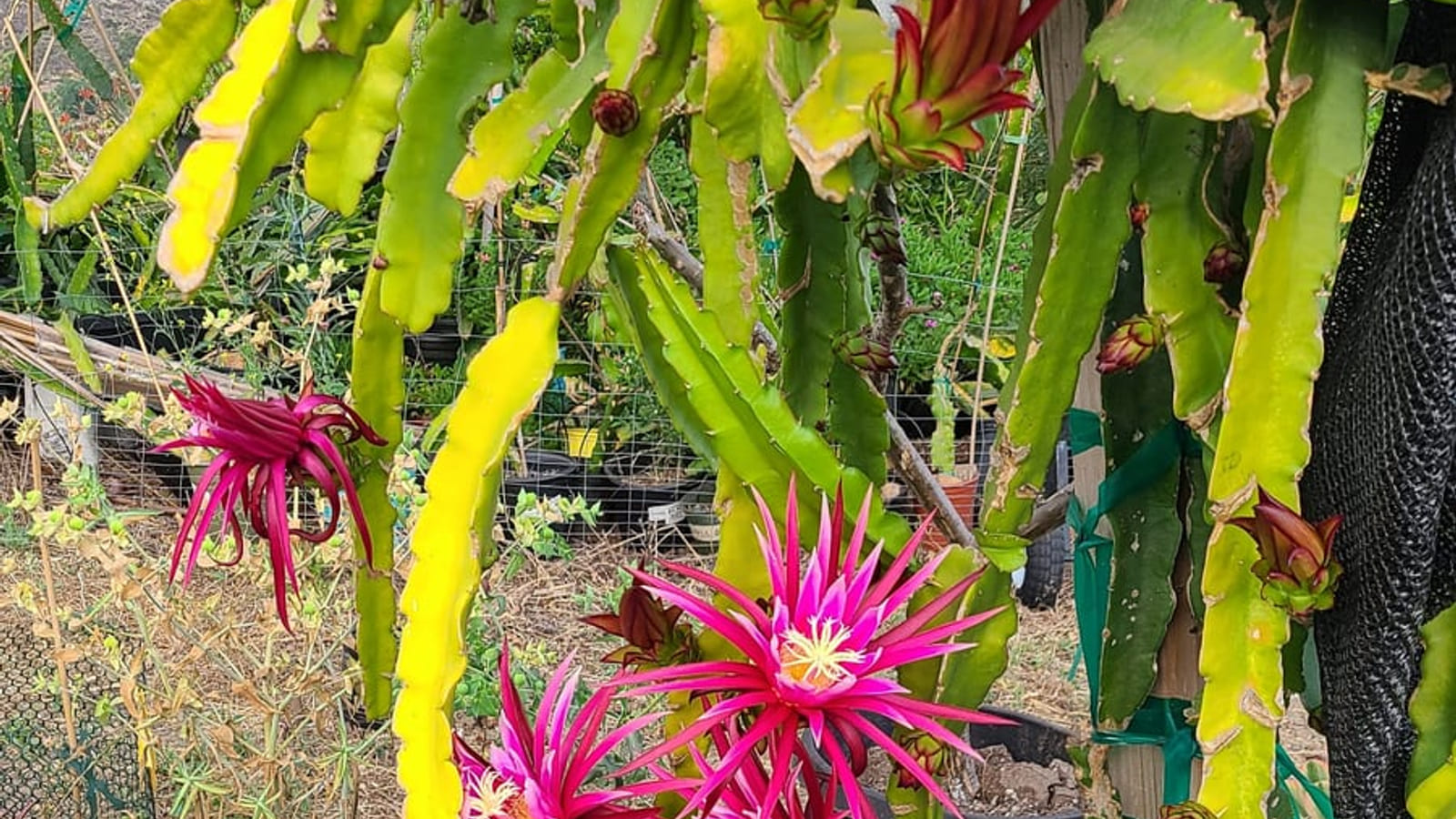
Growing Dragon Fruit in Pots: A Practical Guide
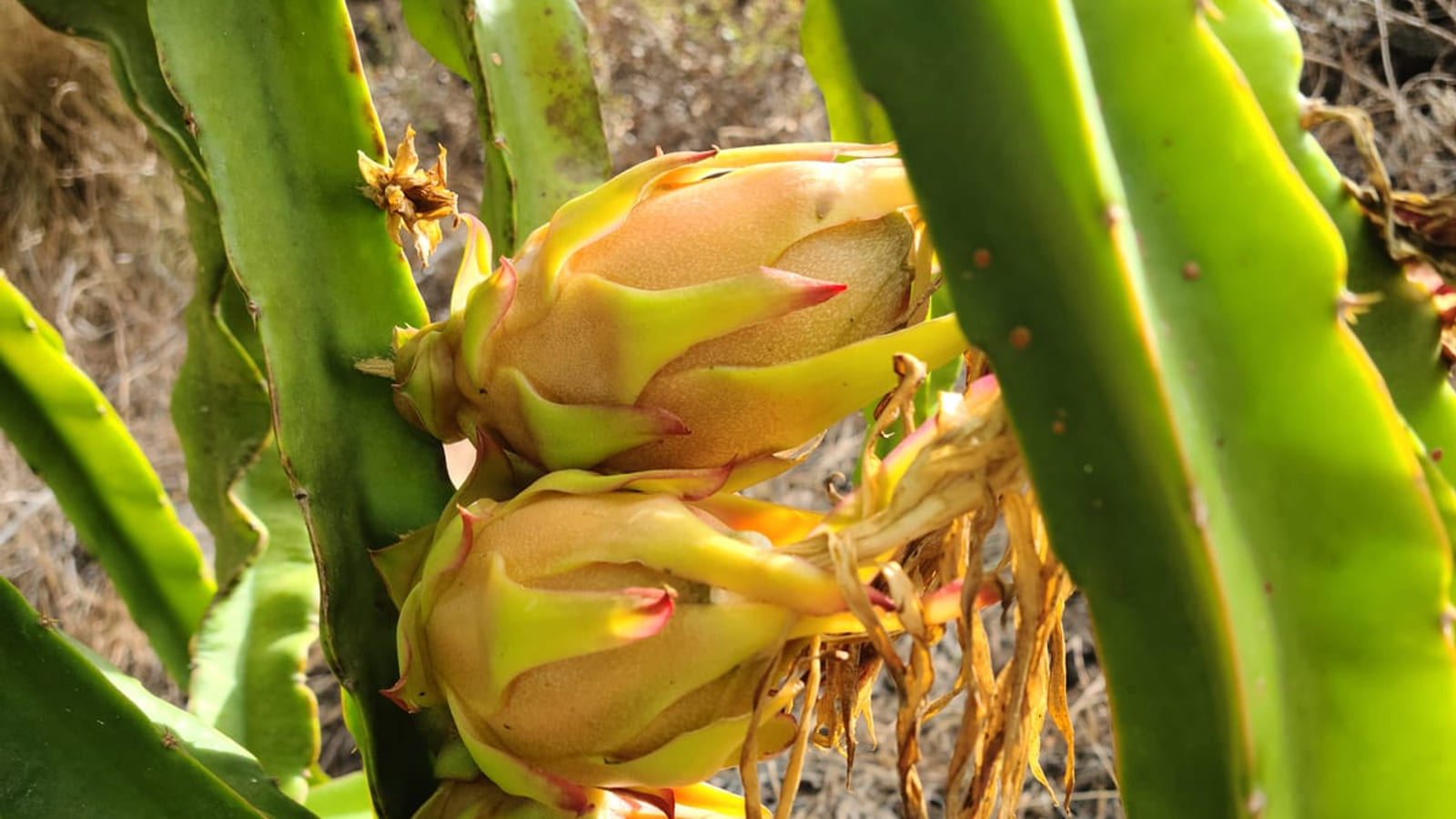
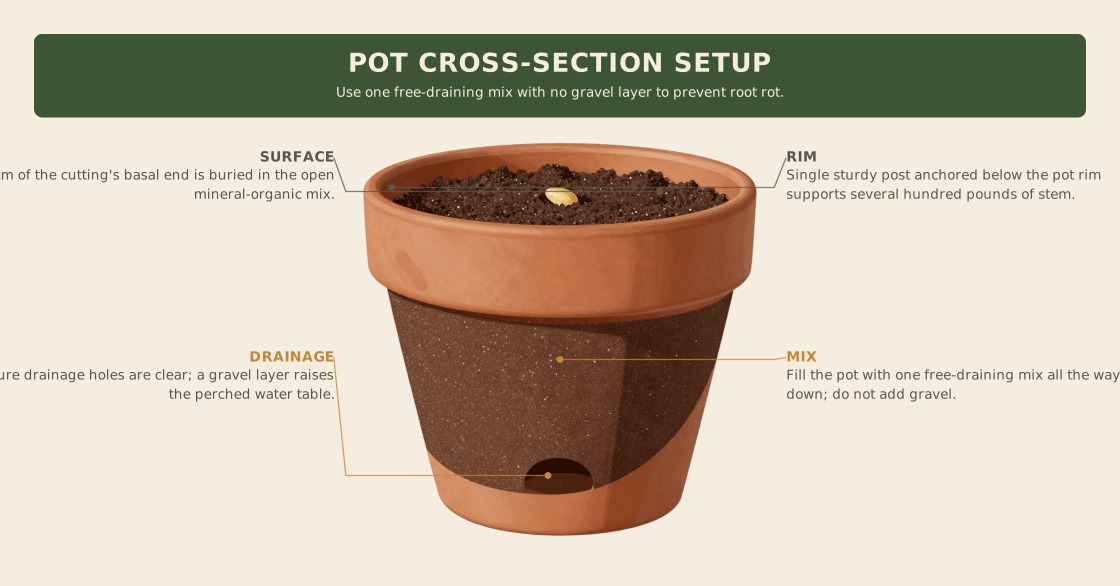
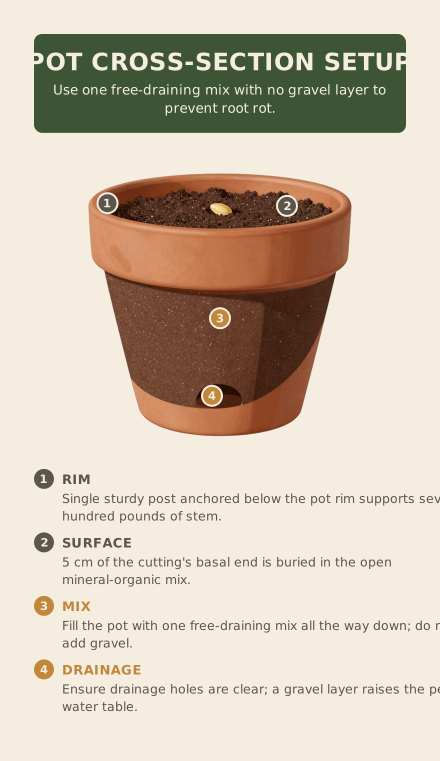
Grow dragon fruit in pots by using a large, heavy container with a drainage hole, filled with a fast-draining mix closer to cactus soil than standard potting soil. Do not put gravel, stones, pot shards or any "drainage layer" in the bottom of a pot: it raises the perched water table and keeps the mix above it wetter. Fill the pot with one free-draining mix all the way down. Provide a sturdy trellis tall enough to support heavy, sprawling stems, and place the pot in full sun where temperatures stay above freezing. Water deeply until a significant amount drains out to flush salts, using the leaching fraction formula to adjust run times. Feed the plant like the heavy-feeding cactus it is. For fruit, plant two genetically different types and hand-pollinate the night-blooming flowers. Learn more about night-time hand pollination to maximize your harvest.
Why pots are harder for dragon fruit than for most plants
Dragon fruit is a climbing cactus, not a compact shrub, with stems that can reach about 20 feet long.[1] In the ground, a mature plant supports several hundred pounds of stem weight and can produce roughly 220 pounds of fruit per year.[1] It also lives for about 20 years.[1] When you move that same biology into a container, you are asking a heavy, long-lived vine to survive in a finite box with no room to spread its roots.
Dragon fruit has a high water requirement but suffers from excessive soil moisture, which causes root rot and decline.[1] In the ground, the surrounding earth acts as a buffer. It absorbs excess water during heavy rain and holds moisture during dry spells. A pot has no such buffer. The finite rooting volume means a single missed watering can stress the plant, while a single overwatering can drown the roots.[5] You are managing a plant that is adapted to well-drained soils but needs consistent moisture, all within a confined space where errors are magnified.[1]
| Factor | In-Ground | Container |
|---|---|---|
| Root Volume | Unlimited spread | Finite, fixed |
| Watering Error Tolerance | High (soil buffers) | Low (rapid drying/wetting) |
| Winter Mobility | Fixed | Moveable (but heavy) |
| Repotting Difficulty | N/A | High (root-bound mass) |
Temperature swings are also sharper in containers. The soil in a pot heats up faster in the sun and cools down faster at night than the ground does. Dragon fruit prefers temperatures between 65 and 77 degrees Fahrenheit for optimal growth.[1] In a small pot, midday sun can overheat the root zone, while a cold snap can chill it quickly. This stress reduces the plant’s ability to flower and fruit. Container roots heat and cool faster than ground soil, so monitor root zone temperature closely.
Do not underestimate the root mass. A dragon fruit plant in a pot will eventually become root-bound. Unlike smaller houseplants, you cannot easily repot a mature dragon fruit because the root system is dense and the stems are heavy. Plan for a permanent home from the start.
Pot size and pot type: what actually holds a mature plant
We recommend a large, heavy container because extension guides focus on in-ground spacing. In-ground plantings are spaced 15 to 25 feet apart to accommodate their large, spreading habit.[1] A mature plant supports hundreds of pounds of stem weight and can produce roughly 220 pounds of fruit per year.[1] With a lifespan estimated at 20 years, the plant will outlive any temporary "grow-on" pot.[1]
Use a large, heavy container with a drainage hole. Anything smaller restricts root development and increases the risk of tipping. A half-barrel or a large fabric pot is often better because it provides the stability needed to anchor the heavy canopy. While extension notes mention using pots for propagation, these are typically smaller vessels used for the first 4 to 6 months before the plant is moved to the ground or a larger container.[1] Do not expect to repot a mature plant; the root mass becomes too dense and the stems too heavy to move safely.
Material matters: fabric, terracotta, and plastic
The pot material dictates how you manage water and salt, two of the biggest threats to container-grown pitaya. Dragon fruit is moderately sensitive to salinity, and salt buildup can damage roots and reduce vigor.[2]
| Material | Water Dynamics | Best For |
|---|---|---|
| Fabric | High evaporation through porous walls; air-prunes roots; prevents circling. | Growers who can water frequently. Excellent for preventing root rot in hot climates. |
| Terracotta | Porous walls allow moisture loss; heavy enough to stay put. | Stability in windy areas. Requires more frequent watering than plastic. |
| Plastic | Non-porous; retains moisture; lightweight. | Humid climates or growers who prefer less frequent watering. Needs extra weight (rocks) to prevent tipping. |
Fabric pots offer the best root health by air-pruning the roots and preventing the dense, circling mass that makes repotting impossible. However, they dry out faster, which can be a challenge given the plant's high water requirement.[1] Terracotta provides the weight needed to keep a top-heavy plant upright but shares the drying issue of fabric. Plastic is the most forgiving regarding moisture retention but is the least stable.
Regardless of material, the finite rooting volume means you have little buffer against errors. A single missed watering in a small pot can stress the plant, while a single overwatering can drown it.[5] Start with the largest pot you can physically manage and commit to it for the long haul.
The mix: build for air, not for moisture
Dragon fruit tolerates a wide range of soils, but only if they drain freely. In the ground, heavy clay or low-lying areas cause waterlogging, which invites root rot and causes the plant to drop its flower buds.[3] In a pot, you control the entire root environment, so you must replicate the open structure of the plant’s native habitat. Soils in the center of origin for pitaya contain about 7% organic matter, far higher than the 1-2% found in typical Mediterranean soils.[3] This high organic content supports microbial life and nutrient holding, but it must be balanced with coarse material to prevent the mix from compacting into a dense, wet sponge.
Propagation media often rely on sand or perlite with some organic matter to ensure the cutting roots without rotting.[3] You can apply this logic to your mature plant. A successful potting mix needs three components: structure to hold air, water-holding capacity to keep roots moist, and nutrient-holding capacity to feed the plant. The ratio is an inference from these constraints rather than a single published specification, but the goal is clear: the mix must stay open and free-draining.
| Component | Role | Failure Mode |
|---|---|---|
| Coarse sand, perlite, or pumice | Structure and air pockets | Too little: Roots suffocate and rot from lack of oxygen. |
| Composted bark or coco coir | Water holding | Too much: Mix stays wet too long, promoting fungal disease. |
| Compost or worm castings | Nutrient holding | Too little: Plant starves despite frequent feeding. |
Fill the pot with one uniform, free-draining mix from the drainage hole to the top.
Watch your pH and salts. Dragon fruit prefers acidic to neutral soil, ideally between 5.5 and 6.5.[8] While alkaline soils do not stop development, they can lead to minor element deficiencies.[1] The plant is also sensitive to salinity, particularly when sodium is a large share of the salt.[8] In a container, tap water and many fertilizers are the primary sources of sodium. If you live in an area with hard water, consider using rainwater or filtered water to prevent salt buildup that can damage roots and inhibit flowering.
Step 1: start from a cutting that is big enough to win
Most potted dragon fruit failures start before the plant ever hits the soil. You are not just rooting a stem; you are choosing a head start. Small, weak cuttings struggle to establish in a container where resources are limited and mistakes are magnified. A robust cutting carries its own fuel supply, giving it the best chance to survive the transition from a nursery bench to your patio.
Size matters more than most hobbyists realize. While you can root segments as small as 6 inches, research suggests that cuttings between 15 and 25 cm (about 6 to 10 inches) are optimal for propagation. [3] These mid-sized segments strike a balance: they hold enough carbohydrate reserves and natural rooting hormones (auxins) to push out roots quickly, but they are not so large that they rot before they can drink. Longer cuttings do have one advantage: they reach your trellis faster, saving you months of waiting. [1]
Where you cut the stem is just as important as how long the piece is. Always take cuttings from the base of an older mother plant. These basal cladodes are darker green, tougher, and physically denser than the light-green, soft stems at the top of the plant. [3] Young stems under one year old root poorly and often fail. Remember that a cutting keeps the "age" of the mother plant. If you take a basal cutting from a mature, fruiting plant, your new pot will be developmentally ready to flower much sooner than if you start from a juvenile tip.
Cutting Selection: Do vs. Don't
| Feature | Do Choose | Don't Choose |
|---|---|---|
| Location on Mother | Basal (bottom) stems | Upper, light-green tips |
| Age of Stem | Over 1 year old | Young, soft growth |
| Length | 15-25 cm (6-10 in) | Under 6 inches |
| Color/Texture | Dark green, tough, rigid | Pale green, soft, limp |
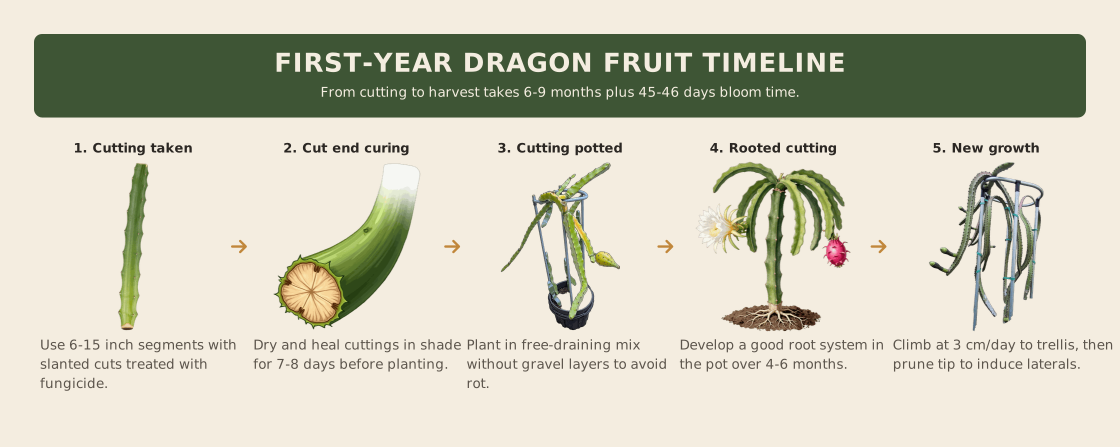
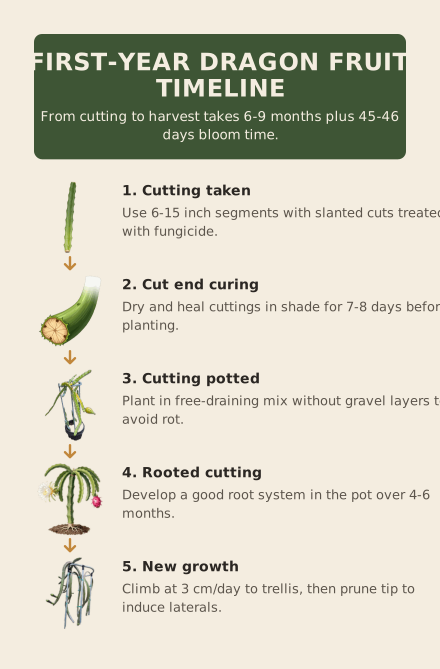
Once you have the right piece, prepare it correctly. Make a slanted cut at the base to increase the surface area for rooting and to help water shed off the wound. Treat the cut with a fungicide to prevent infection, then cure the cutting in dry shade for 7 to 8 days. [1] This drying period allows the wound to callus over, which is critical for preventing rot when you plant it. Some growers use Bordeaux paste or cinnamon powder to protect the wound during this phase. [3]
Plant the cured cutting by burying the basal end about 5 cm (2 inches) deep in a mix of sand, perlite, and a little organic matter. [3] Keep the medium moist but never soggy, and place the pot in 50% shade while it roots. [3] Cooler seasons will slow this process down, so be patient. Expect 4 to 6 months for a solid root system to develop. [1] Once rooted, the plant can grow very fast, adding about 3 cm (1.2 inches) per day, and may produce its first fruit 6 to 9 months after planting. [1]
Virus Check: Start with certified, clean stock. A 2011 UC ANR survey found that approximately 90% of tested pitaya samples in California were positive for Cactus Virus X. [7] This virus spreads mechanically through tools and handling. If you buy from a nursery, ask about their sanitation protocols. If you take cuttings from a friend, disinfect your knife between plants. [3]
Step 2: support, because a potted plant cannot lean on anything
In the ground, a dragon fruit plant has roots that spread wide and deep, anchoring the heavy biomass above. In a pot, you lose that anchor. The container is a finite box. If you simply stick a stake in the soil, the first strong gust will tip the whole system over, or the weight of the growing stems will pull the post right out of the dirt. You need to treat the support structure as a separate engineering problem from the pot itself.
A mature dragon fruit plant supports several hundred pounds of stem weight.[1] A weak trellis will buckle under this load, and a weak anchor will fail long before the plant reaches maturity. For a container setup, do not rely on the root ball to hold the post. Instead, secure the post to the pot’s base or, better yet, drive it into the ground or a fence behind the pot. This transfers the mechanical stress away from the soil and into a stable structure.
Wind is a major threat. Dragon fruit is listed as wind-intolerant.[2] Wind does more than just rock the plant; it physically removes flowers and twigs, scarring stems and delaying or preventing flowering entirely.[2] If your patio is exposed, a lightweight pot on a wheeled caddy is a liability. Anchor the support structure firmly to something immovable.
For the home landscape, extension guides recommend a single-post trellis with a support structure at the top, or an arbor-type trellis.[1] You can also grow the plant on a short tree or a pile of rocks or blocks.[1] The key is that the plant must be able to climb and drape without its stems being cut or damaged by the support material.
Never run bare wire through the canopy. Dragon fruit stems are fleshy and prone to injury. Bare wire acts like a cheese cutter, slicing into the stems as the plant sways or grows heavier.[1] If you use wire for support, it must be covered. Slide a piece of plastic hose or garden tubing over the wire to protect the plant tissue.[1]
How to anchor a pot-and-post system
Think of the pot and the trellis as two separate objects that need to be married together securely. Here is a practical approach for a container setup:
- Choose a heavy pot. Use a large, heavy container. The weight of the pot and the wet soil helps resist tipping, but it is not enough on its own.
- Install a sturdy post. Use a 4x4 wooden post or a heavy-duty metal pipe. It must be tall enough to allow the plant to drape down without touching the ground.
- Anchor the post independently. Do not just push the post into the potting mix. Drive the post into the ground behind the pot, or bolt it to a deck or fence. If you are on a balcony where you cannot drive a post, use a heavy-duty planter with a built-in trellis or a freestanding arbor that is weighted down with sandbags or water-filled bases.
- Secure the pot to the anchor. Use straps, brackets, or a heavy base to keep the pot from sliding away from the post. The goal is to ensure that if the wind blows, the pot does not become a projectile.
- Protect the stems. Where the stems rest on the top of the trellis or on any wire, ensure there is padding. Use hose-covered wire or a smooth, rounded cap on the post to prevent abrasion.
Support options for containers
| Option | Pros | Cons |
|---|---|---|
| Post driven into ground | Most stable; handles heavy wind and stem weight | Requires ground access; pot must be placed near post |
| Freestanding arbor | Movable; good for patios | Must be heavily weighted; can still tip in strong wind |
| Wall-mounted bracket | Strong; saves space | Requires secure wall attachment; pot placement is fixed |
| Stake in pot only | Simple | Unstable; high risk of tipping or root disturbance |
Remember that dragon fruit is a climbing cactus. It will seek out support. If your support is flimsy, the plant will pull it down. If your support is strong but the pot is light, the wind will knock it over. Solve both problems at once by anchoring the post to the earth or a structure, and keeping the pot stable. This setup allows the plant to focus its energy on growth and fruiting, rather than fighting gravity and wind.
Step 3: water on a drainage test, not on a schedule
Dragon fruit is a cactus, but do not treat it like a desert plant. It has a fairly high water requirement, and excessive soil moisture reduces growth and can cause root rot and plant decline.[1] In a pot, you lose the natural buffer of the ground. A single overwatering event can drown the roots, while a single missed watering can stress the plant. The goal is moderate, consistent moisture. You must avoid both extended drought and saturation.[3]
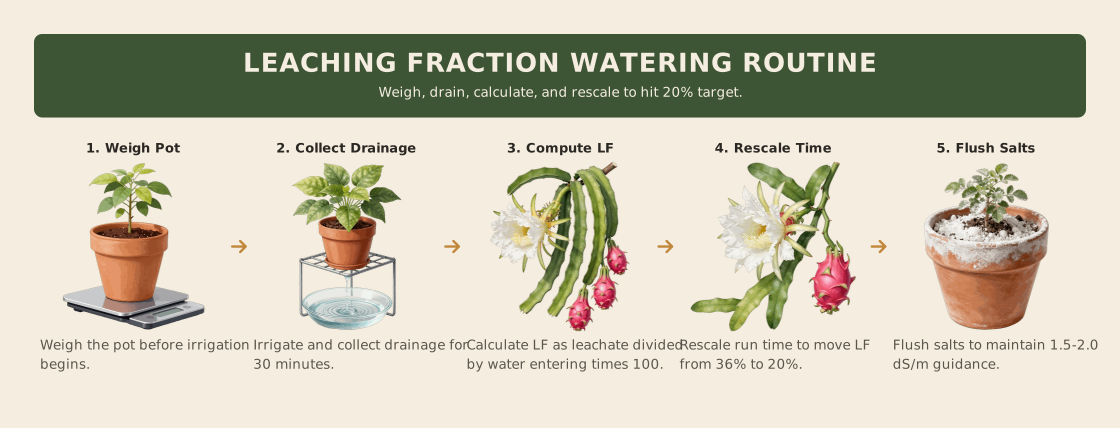
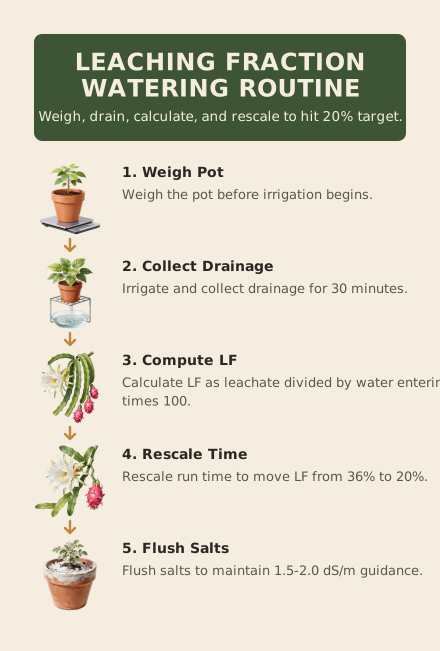
Timer-run lawn sprinklers are a common way to kill potted pitayas.[1] They often deliver too much water too often. Instead, water thoroughly until a specific percentage of the water drains out. This is called the leaching fraction. It flushes salts from the mix. Dragon fruit is moderately sensitive to salinity, and salt buildup can damage roots.[2] Water until a significant amount drains out to flush salts, using the leaching fraction formula to adjust run times.
To manage this precisely, use the weighing method. Place a catch tray under the pot. Water the plant and measure how much water you put in. Then measure how much water drains into the tray. Calculate the leaching fraction: (drainage volume / input volume) x 100. If your leaching fraction is too high, reduce your watering time. If it is too low, increase it. You can adjust your irrigation run time using this formula: desired run time = (100 - measured LF) / (100 - desired LF) x measured run time.[5] For example, if your current 12-minute run produces a 36% leaching fraction, and you want a 20% target, the new run time should be 9.6 minutes.[5]
Keep an eye on the soil surface. A white crust indicates salt accumulation. If you see this, flush the pot with extra water to push the salts out. Dragon fruit is moderately tolerant of flooding, but a week of saturated soil can injure or kill the plant.[2] Waterlogging also increases the risk of Phytophthora and Fusarium diseases and causes flower buds and young fruit to drop.[3] For irrigation water, a salinity level between 1.5 and 2.0 dS/m is a safe working range.[3] If your tap water is saltier, you may need to increase the leaching fraction to prevent damage.[5]
Do not rely on the top inch of soil alone. In a small pot, the entire root zone can dry out or stay wet based on surface feel. The drainage test is the only reliable way to know if the roots are getting enough air and not too much water.
| Symptom | Diagnosis | Action |
|---|---|---|
| Yellowing stems, mushy base | Too much water / root rot | Stop watering, improve drainage |
| Thin, wrinkled cladodes | Too little water | Increase run time or frequency |
| White crust on soil surface | Salt buildup | Flush with extra water |
| Dropping buds or small fruit | Waterlogging or drought stress | Check leaching fraction, stabilize moisture |
Step 4: feed a shallow-rooted cactus that fruits 4-7 times a year
Dragon fruit is a heavy feeder, but in a pot, you are managing a finite volume of soil that drains freely. This creates a specific challenge: frequent irrigation leaches nutrients out of the container faster than they can be replenished by the mix. You cannot rely on a single annual dose of slow-release fertilizer. Instead, split your feeding into smaller, more frequent applications to match the plant’s rapid growth and repeated flowering cycles.
For the first year, the goal is vegetative establishment. Apply a balanced fertilizer every two months. A quarter-pound (118 g) of a 6-6-6 or 8-4-12 (palm special) formula per plant is sufficient for a young container plant.[1] Look for formulas containing 2-3% magnesium, as dragon fruit has a high demand for this nutrient. Alongside the synthetic feed, top-dress the surface with well-decomposed manure or compost. This mimics the organic-rich soils of the plant’s native habitat, which contain about 7% organic matter.[3] Keep the compost a few inches away from the main stem to prevent rot.
Once the plant is established, usually after the first year, it enters a production phase where it can produce 4 to 7 flowering flushes per year.[3] The intensity of these flushes is directly tied to nutrition. Mature plants require about one pound (0.45 kg) of balanced fertilizer per application, scaled by age, plus 4 pounds (1.2 kg) of manure or compost around the base.[1] In a container, you may need to increase the frequency of these applications because the leaching fraction is higher than in the ground.
Pot-specific adjustment: Because container mixes drain quickly, nutrients wash out before roots can absorb them. If you see pale stems or stalled growth, increase the frequency of your liquid feedings rather than the concentration. A weak weekly tea is often better than a strong monthly dose in a pot.
Potassium is the most critical nutrient for fruit quality, sugar content, and shelf life.[3] Nutrient accumulation in the cladodes (stems) ranks potassium above calcium, nitrogen, and phosphorus.[3] When the plant sets fruit, it exports potassium at the highest rate of any macronutrient.[3] If your plant flowers but drops fruit, or if the fruit is small and bland, you are likely under-supplying potassium. Switch to a fertilizer with a higher middle number (the K value) as soon as flower buds appear.
Micronutrients are just as important as the big three. Boron is essential for pollen tube germination and fertilization; without it, you get poor fruit set and small fruit.[3] Calcium stabilizes cell walls and ensures fruit integrity.[3] If your potting mix is high-pH or calcareous, the plant may struggle to access iron. Drench the soil with 0.25 to 0.5 ounces (7-15 g) of chelated iron per plant.[1] Additionally, apply 4 to 6 foliar sprays of minor elements (manganese, zinc, and others) during the warm part of the year to correct deficiencies before they impact flowering.[1]
| Season | Focus | Action |
|---|---|---|
| Spring | Vegetative Growth | Balanced feed (6-6-6) + compost top-dress. Foliar micronutrients. |
| Summer | Flowering/Fruiting | High-K feed. Chelated iron if pH is high. Frequent light doses. |
| Fall | Recovery | Balanced feed. Reduce frequency as growth slows. |
| Winter | Dormancy | Minimal or no feed. Keep dry to prevent root rot. |
Remember that mineral nutrition interacts with photoperiod and temperature to determine flowering duration.[3] Optimized fertilization keeps anthesis rates high and minimizes flower abscission.[3] In a pot, you have more control over the root zone, so you can adjust your feeding calendar based on how the plant responds. If the stems are dark green and thick, you are feeding well. If they are thin and yellowing, increase your potassium and micronutrient supply.
Step 5: sun, heat and cold: the three ways a patio plant dies
Dragon fruit is a full-sun crop in its native range, but young plants are vulnerable to the harshness of a patio environment. For the first three to four months after planting, provide about 30% shade if sunlight levels are damaging. This prevents severe stem sunburn, which is common in regions with low humidity or high altitude. Too much shade, however, results in low production and poor-quality fruit, so remove the shade cloth once the plant establishes.
The container advantage: Unlike plants in the ground, you can move a potted dragon fruit. Use this mobility to dodge extreme weather. Roll the pot onto an unheated porch or into a garage doorway during a frost, and pull it into shade during a heatwave.
Temperature management is critical because pitaya has a narrow comfort zone. UF/IFAS lists the optimum growth temperature as 65 to 77 degrees Fahrenheit (18 to 25 degrees Celsius) based on native growing areas[1]. A separate UF/IFAS quick guide for subtropical fruits lists a slightly broader optimum of 68 to 86 degrees Fahrenheit (20 to 30 degrees Celsius)[2]. These ranges are consistent: the plant thrives in warm, stable conditions and struggles when temperatures swing outside this band.
The heat ceiling and flowering failure
Heat is the silent killer of fruit production. While the plant can tolerate temperatures up to 100 degrees Fahrenheit (38 degrees Celsius), prolonged exposure above this point inhibits floral induction and promotes bud abscission[3]. The absolute lethal high range is 93 to 104 degrees Fahrenheit (34 to 40 degrees Celsius)[2]. A plant can survive 104 degrees Fahrenheit only if its roots have water, but flowering stops outright above 100 degrees Fahrenheit[8].
The physiological reason for this failure is CAM carbon fixation. Above 82 degrees Fahrenheit (28 degrees Celsius), every additional degree cuts nighttime net CO2 uptake by about 58% and early-morning uptake by about 30%[8]. A heat-stressed plant simply cannot bank the carbon it needs to flower. This is why a hot, reflected-wall patio is a poor location. The radiant heat from brick or concrete pushes the plant into a zone where it survives but does not reproduce. If you see buds dropping in summer, move the pot to a cooler, shaded spot.
The cold floor and frost recovery
Cold is the single greatest limitation on pitaya. The plant can withstand a minimum temperature of about 28 degrees Fahrenheit (-2 degrees Celsius), but 25 degrees Fahrenheit (-4 degrees Celsius) kills it outright[8]. UF/IFAS lists the lethal freeze range as 26 to 29 degrees Fahrenheit (-3 to -2 degrees Celsius)[2]. Damage occurs with below-freezing temperatures of long duration, but the plant recovers rapidly from light freezing injury[1].
Do not panic if a light frost nips the tips of your stems. If the temperature does not drop below 26 degrees Fahrenheit, the plant will likely recover. However, if a hard freeze is forecast, move the pot immediately. An unheated porch or a garage doorway provides enough insulation to keep the root zone above the lethal threshold. Remember that the soil in a pot cools much faster than the ground. A pot sitting on a concrete patio is more vulnerable than one sitting on grass or mulch.
| Condition | Temperature | Effect | Action |
|---|---|---|---|
| Optimum Growth | 65-86 F | Healthy vegetative and reproductive growth | None |
| Heat Stress | >100 F | Flowering inhibited, buds drop | Provide shade, ensure root moisture |
| Lethal High | 93-104 F | Plant death if roots dry out | Move to shade, water deeply |
| Light Freeze | 31 F | Minor damage, rapid recovery | Monitor, no action needed |
| Lethal Freeze | 26-29 F | Plant death | Move to porch or garage |
For gardeners in marginal climates, consider the specific microclimate of your patio. South-facing walls create heat traps that can push summer temperatures above the flowering threshold. In Southern California, for example, many growers find that afternoon shade is necessary to prevent heat stress during peak summer months. You can read more about regional adaptations in our blog on dragon fruit in Southern California.
Getting fruit in a pot: the two things that stop it
You have the right pot, the right mix, and a trellis that holds the weight. The plant is growing vigorously. Yet when the season turns, you get leaves but no flowers, or flowers that drop before they become fruit. This usually comes down to two specific failures: the plant lacks the physiological maturity to flower, or the flowers are not pollinated. Fixing either one requires understanding what the plant actually needs to reproduce.
Cause A: The plant is not ready to flower
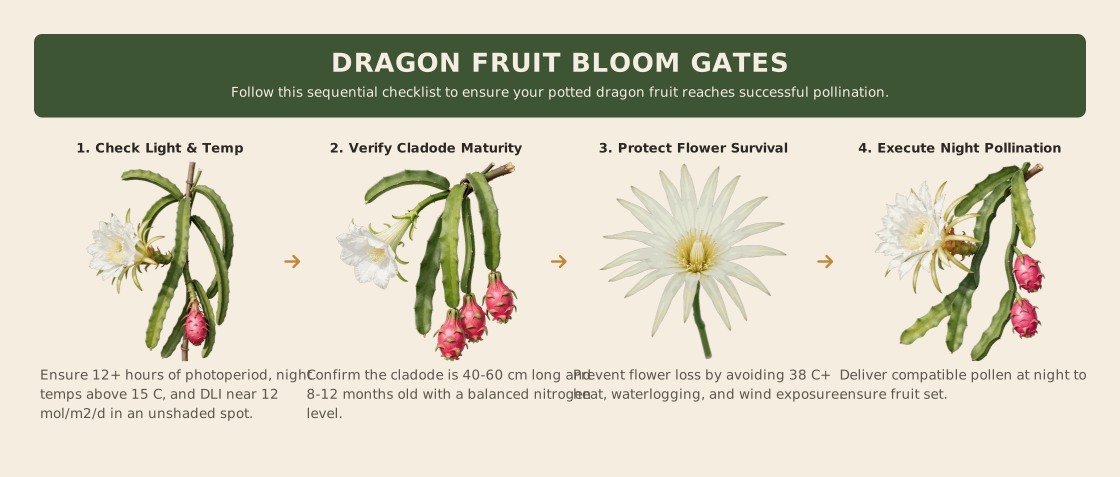
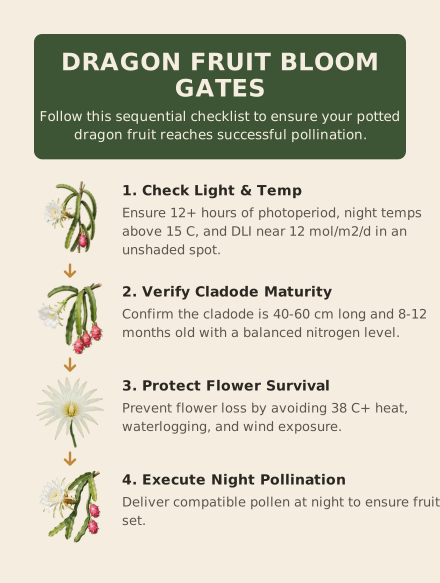
Dragon fruit does not bloom on new growth. It flowers on cladodes (stems) that have reached developmental maturity, which typically takes 8 to 12 months depending on conditions.[3] A young, fast-growing stem is strictly vegetative. It needs time to accumulate carbohydrate reserves, primarily starch, to support the energy-intensive process of flowering.[3] If you are pruning aggressively or feeding heavily with nitrogen, you are keeping the plant in a vegetative state. High nitrogen favors leaf and stem growth and delays the transition to flowering.[3] The plant needs a balance where carbon reserves outweigh nitrogen uptake.
Light and temperature are the other gatekeepers. Flower induction occurs under long-day conditions, with a critical photoperiod threshold of about 12 hours.[3] However, day length alone is rarely sufficient. Floral differentiation only happens when night minimum temperatures consistently exceed 15 C (59 F).[3] If your nights are cool, the plant will not differentiate buds, no matter how long the day is. In Mediterranean climates, this is why natural flowering often shifts to late June or July, when warm nights finally arrive.[3]
For commercially viable yields, the plant needs a minimum daily light integral (DLI) of roughly 12 mol PAR per m² per day.[3] Prolonged cloud cover or excessive shade reduces photoassimilates, keeping the plant vegetative and suppressing flowering.[3] In a pot, this means placement is critical. A shaded corner of a patio may look nice, but it will not produce fruit. The plant needs full sun to build the energy reserves required for bloom.
Cladode length also matters. Stems 40 to 60 cm long show the highest probability of flowering and produce the most fruit per stem.[3] Short stems under 20 cm rarely flower, and thin new growth usually stays vegetative.[3] Well-lit outer cladodes flower better than shaded inner ones, so pruning to open up the canopy can help expose more stems to light.[3] If your plant is dense and shaded inside, it may have plenty of stems but few that are physiologically ready to bloom.
Off-season lighting: In Vietnam, commercial growers use supplemental lighting to force flowering when days are short. Red/far-red focused CFLs can induce bloom if night temperatures stay above 15 C.[3] For home growers, this means you can potentially extend the season, but only if you can keep the plant warm enough at night. Lighting alone will not work if the plant is cold.
Cause B: The flowers are not pollinated
Assume your plant has mature stems, warm nights, and full sun. You see buds. They open. Then they drop, or they set fruit that stays tiny and falls off. This is a pollination failure. Dragon fruit flowers are nocturnal, opening only at night for 8 to 12 hours.[8] In southern Portugal, they start opening around 7 p.m. and are fully open by 11 p.m.[8] This means hand pollination is an evening task, not a morning one.
Most cultivated genotypes are self-incompatible.[3] The flower morphology works against selfing: the stigma sits more than 2 cm away from the stamens (herkogamy).[3] In the Americas, moths and bats are the natural pollinators.[1] In many home gardens, especially in urban areas or regions where local bat species are insectivores, these pollinators are absent or scarce.[8] Without them, you must hand-pollinate. Insufficient pollination frequently produces small fruit even when set occurs, and most cultivated types show low fruit development without cross-pollination.[3]
To ensure fruit set, plant two or three genetically different types.[1] This assures better fruit set and size. When flowers open, collect pollen from the stamens of one plant and dust it onto the stigma of another.[3] You can collect pollen in advance and store it at 4 C for up to five days, which allows you to pollinate flowers that open on different nights.[3] If you miss the window, the flower will not set fruit.
There is one exception. In Selenicereus megalanthus (yellow dragon fruit), the anthers and stigma sit at the same height, which facilitates self-pollination.[8] However, even for self-compatible types, cross-pollination often results in larger, better-formed fruit. Do not assume a single plant will produce a heavy harvest without help.
Weather can also interfere. Excessive rain at bloom causes floral abscission.[8] If a heavy rainstorm hits while flowers are open, they may drop before pollination can occur. In a pot, you can sometimes move the plant under cover to protect blooms, though this is difficult with large, heavy containers. Plan for this risk by ensuring you have multiple flowering flushes throughout the season.
From bloom to harvest: the timeline
Once pollinated, the clock starts. In UC trials, several cultivars take 45 to 46 days from bloom to harvest.[7] This is a useful anchor for what a functioning home plant should be doing. If you see fruit setting but it stays small and drops before this window, it was likely poorly pollinated. If it reaches maturity but tastes bland, it may have been harvested too early or the plant lacked the potassium needed for sugar development.
Yellow Palora dragon fruit (Selenicereus megalanthus) takes about 120 days, roughly 17 weeks, from pollination to ripe fruit. This is significantly longer than most red-fleshed types. If you are growing this variety, patience is required. Do not assume failure if the fruit is still green after two months.
| Stage | What to watch for | Action |
|---|---|---|
| Bud initiation | Small bumps on mature cladodes (40-60 cm) | Ensure night temps >15 C; avoid high N |
| Flower opening | Large, fragrant, bell-shaped flowers at night | Hand-pollinate between 7 p.m. and 11 p.m. |
| Fruit set | Flower wilts, ovary swells | Check for rain damage; ensure cross-pollination |
| Maturation | Fruit color change, slight softening | Harvest 45-46 days after bloom (most types) |
Pruning and keeping one plant on one post
Dragon fruit is a vigorous climber, and without intervention, it becomes a tangled, heavy mass that is difficult to manage in a container. The goal is to train a single main leader up the post, then encourage branching at the top. Strip all lateral shoots from the main stem as it climbs. This directs energy into vertical growth and prevents the plant from wasting resources on branches that will eventually be removed or shaded out. Once the main stem reaches the top of your trellis, cut the tip. This pruning action breaks apical dominance and induces the plant to produce multiple side branches, creating the canopy structure needed for fruit production.
Timing matters. Pruning is not just about shape; it is a tool to manage the plant’s energy reserves and trigger flowering. Perform maintenance pruning at least twice per production cycle. The first window is roughly two months before the expected first flush of flowers. The second is about two weeks after you harvest the fruit. These timings help reset the plant’s growth cycle and prepare it for the next round of blooms.
Not all stems are equal. When you prune, you are making decisions based on the age and length of each cladode (stem segment). Older, mature cladodes are the most productive, while new growth is strictly vegetative. Removing shoots that emerge from already productive cladodes is critical. These new shoots drain photoassimilates from the parent stem, reducing the energy available for fruit development on that same branch.[3]
| Cladode Type | Action | Reason |
|---|---|---|
| Thin new growth | Keep | Strictly vegetative; will not flower yet. |
| 20 cm or less | Keep | Rarely flowers; needs time to mature. |
| 40-60 cm mature | Keep | Highest probability of flowering and fruit set. |
| Damaged/shaded | Cut | Well-lit outer cladodes flower better; remove inner shaded ones. |
| Shoots on productive stems | Cut | Prevents energy drain from fruit-bearing branches. |
Sanitation is non-negotiable. Dragon fruit is susceptible to fungal diseases and viruses that spread mechanically through pruning tools. Disinfect your shears or knives between every plant, and ideally between every cut if you are working with multiple varieties. Uncertified cuttings and unsterile tools are a primary vector for disease dissemination in nursery settings.[3]
Do not let the plant become a dense thicket. Unpruned dragon fruit plants form a very dense mass of stems. This reduces air circulation, increases humidity around the stems, and creates ideal conditions for fungal infections like stem canker. It also shades out the inner branches, which are the ones that need light to flower. Pruning is not optional; it is the difference between a healthy, productive plant and a diseased, unproductive one.[3]
Troubleshooting: symptom to cause
When a potted dragon fruit misbehaves, the plant is usually telling you exactly what went wrong. The finite root volume of a container amplifies every mistake, so symptoms appear faster and more severely than they would in the ground. Use this table to diagnose the issue before you reach for the hose or the fertilizer.
| Symptom | Likely Cause | Immediate Action |
|---|---|---|
| Stems yellowing; base mushy or soft | Overwatering or root rot | Stop watering. Check drainage holes. If the mix is saturated, remove the plant to inspect roots and trim any black, slimy tissue. |
| Thin, wrinkled cladodes | Underwatering | Water deeply until 15-20% drains out. Wrinkles often reverse within a day or two if caught early. |
| White crust on soil surface; brown tips | Salt buildup from fertilizer or hard water | Flush the pot with plain water until the leaching fraction hits your target (usually 20%). Dragon fruit is moderately sensitive to salinity. [2] |
| No flowers at all | Insufficient light, wrong temperature, or immature wood | Check that day length exceeds 12 hours and night temps stay above 59 F. Ensure cladodes are at least 8-12 months old and robust. [3] |
| Flowers open but no fruit sets | Poor pollination or self-incompatibility | Hand-pollinate using pollen from a different genetic type. Most commercial varieties require cross-pollination. [3] |
| Buds drop before opening | Heat stress (>100 F), waterlogging, or wind damage | Provide afternoon shade if temps spike. Ensure the pot is sheltered from strong winds. Avoid saturating the mix during bud development. [3] |
| Flowers fall by morning after rain or overhead spray | Floral abscission from excess moisture | Water at the base only. Keep the canopy dry during bloom. Pitaya is native to wet climates but flowers drop if water sits on the stigma. [3] |
| Orange-rust lesions with black dots | Neoscytalidium dimidiatum canker | Prune out infected stems with disinfected tools. Improve airflow. Fungicide options are limited; sanitation is key. [6] |
| Corky scars or streaked growth | Virus (e.g., Cactus Virus X) | If you have shared tools with other plants, suspect mechanical transmission. Remove and destroy the plant. Buy certified clean stock. [7] |
| Sunken pale spots after a cold snap | Chilling injury | Dragon fruit can be injured by prolonged cold. 41 F is listed as a lethal low chill threshold for some hybrids. Move pots indoors if frost is forecast. |
| Black mush after a freezing night | Frost damage near the -2 C (28 F) floor | Wait to prune. The plant may recover from light freezing, but sustained cold kills tissue. [1] |
| Plant alive but stagnant in hot summer | Heat-blocked induction | Above 100 F, flowering stops. Above 82 F, CAM carbon fixation collapses. The plant cannot bank enough energy to flower. [8] |
Do not guess with fungicides. For canker, registered chemistry is limited. Azoxystrobin and cyprodinil + fludioxonil are capped at four applications per year on dragon fruit. [6] Sanitation and canopy management carry most of the load.
If you are growing in Southern California, remember that most varieties will not set good fruit without hand pollination. [7] If your plant looks healthy but produces nothing, the issue is rarely the pot. It is usually light, temperature, or the lack of a compatible partner nearby. Check your dragon fruit southern california guide for regional timing tips.
Container dragon fruit FAQ
How big a pot do I need?
Start with a large, heavy container and plan to keep the plant in it permanently. In-ground plantings are spaced 15 to 25 feet apart to accommodate their large, spreading habit, which gives a clear signal about the root volume a mature vine actually requires.[1] Extension guides rarely publish a specific container volume for pitaya, likely because commercial production happens in the ground, but we can derive a practical minimum from that spacing data. A mature plant supports hundreds of pounds of stem weight and can produce roughly 220 pounds of fruit per year, so a small pot simply cannot hold the root mass needed to sustain that load.[1] Remember that dragon fruit is a climbing cactus with stems that can reach about 20 feet long, and it is that climbing habit, not the fruit, that drives pot and support size.[1]
How long until I get fruit?
Rooted cuttings grow very fast, about 1.2 inches per day, and many plants produce fruit 6 to 9 months after planting.[1] This timeline assumes you started with a cutting that was already rooted and established in a pot.[1] If you are starting from a fresh cutting, it will take about 4 to 6 months just to develop a good root system and be ready for planting, so factor that establishment period into your expectations.[1]
Can I grow one plant and still get fruit?
Usually no. Most cultivated genotypes show low fruit development from self-incompatibility, making cross-pollination necessary for a real harvest.[3] Flower morphology works against selfing because the stigma sits more than 2 centimeters away from the stamens, a structural barrier that prevents pollen from reaching its own target.[3] Planting two or three genetically different types, not the same clone, assures better fruit set and size.[1] In California plantings, most varieties will not set good fruit without hand pollination, so even if you manage to get a single plant to set a fruit, you will likely be disappointed by the yield.[7]
What about winter care?
Pitayas can be damaged by below-freezing temperatures of long duration, but they recover rapidly from light freezing injury.[1] The lethal freeze range is 26 to 29 degrees Fahrenheit, and the plant can withstand a minimum of about 28 degrees before serious damage occurs.[2] If you are growing in a pot, you have the advantage of mobility. Move the container to a protected area when temperatures threaten to drop below freezing. Keep the soil on the dry side during winter, because cold, wet roots are far more likely to rot than cold, dry ones.
Can I grow on a patio with no wall?
Yes, but you must build the support system yourself. A strong trellis must withstand several hundred pounds of stem weight, and a weak trellis may buckle under a mature plant.[1] For a freestanding patio setup, use a single-post trellis with a support structure at the top, or an arbor-type trellis.[1] The pot itself must be heavy enough to stay put. A lightweight plastic container will tip over when a heavy fruiting branch extends outward or when a strong wind hits the canopy.[1] Anchor the trellis independently of the pot if possible, so the container only needs to hold the roots, not the entire structural load.
Why do my flowers fall off overnight?
Pitaya flowers open only at night, for 8 to 12 hours.[8] In southern Portugal, flowers start opening around 7 p.m. and are fully open by 11 p.m.[8] That nightly window is the whole reason hand pollination is an evening chore, not a morning one.[8] If you find spent flowers on the ground in the morning, it often means pollination did not occur. Excessive irrigation or poor drainage sharply increases the likelihood of flower-bud and young-fruit abscission, so check your watering practices if flowers drop before they even open.[3]
What is the best fertilizer?
First-year plants need frequent light applications every 2 months of a 6-6-6, 8-3-9, or 8-4-12 formula with 2 to 3 percent magnesium.[1] Established plants get about 1 pound of a balanced fertilizer per plant per application, plus 4 pounds of well-decomposed manure or compost around the base, not touching the stem.[1] Boron is essential for pollen tube germination and fertilization, directly impacting fruit set and size, so precise supplementation of boron and calcium is fundamental to reproductive success.[3]
How do I get off-season flowers?
Dragon fruit is photoperiodic and blooms optimally where daytime is longer than nighttime.[4] In Vietnam, from September to March, plants cannot bloom under natural conditions because the day is under 12 hours, which is why virtually all commercial households light their orchards at night.[4] Supplemental lighting is only effective when minimum air temperature stays above 59 degrees Fahrenheit.[3] A 1-hour night interruption can reach a 50 percent bud threshold within five weeks in autumn, while 4 to 6 hours of night-break lighting induces excessive off-season flowering.[3] The effectiveness comes from matching the phytochrome absorption spectrum with red and far-red focused emission, not just any light.[4]
Buy the right starting plant
Starting with a healthy, genetically appropriate plant is the single biggest factor in whether your container dragon fruit survives its first year. A struggling cutting in a pot has no buffer zone. If the stock is diseased or the wrong cultivar, no amount of careful watering will save it.
Look for cuttings that are 15 to 25 cm long. Research indicates this size range is optimal because it carries higher carbohydrate reserves and auxin levels, which drive faster rooting.[3] The source of the cutting matters as much as the size. Basal, darker-green, tougher cladodes taken from older mother plants root significantly faster than light-green upper cladodes or young stems under one year old.[3] A cutting keeps the ontogenetic age of its donor, so an older, established mother plant gives you a head start on maturity.
Source matters for disease control. Uncertified cuttings are a documented risk for spreading pathogens like stem canker and cactus virus X.[3] In California, UC ANR found cactus virus X in an estimated 90% of screened pitahaya samples, noting that the virus moves mechanically through handling and tools.[7] Buying clean, certified stock prevents you from introducing a problem that will eventually kill your plant or spread to your garden. If you are in Southern California, check our blog on dragon fruit in Southern California for notes on local adaptation.
Choose your cultivar based on pollination needs. Most cultivated genotypes are self-incompatible, meaning they will not set good fruit without a genetically different partner.[1] In California trials, most varieties failed to set fruit without hand pollination.[7] If you only have space for one pot, you must select a self-fertile variety or be prepared to hand-pollinate with pollen from a neighbor. Some species, like Selenicereus megalanthus, have anthers and stigmas at the same height, which facilitates self-pollination.[8] Know your plant’s biology before you buy it.
What we sell: Sky Botanicals offers rooted cuttings selected for performance in California and Mediterranean-type climates, based on UC ANR trial contexts. We prioritize disease-free stock and proven rooting habits to give you the best chance of success in a container.
Sources and further reading
The practical advice in this guide draws from university extension publications, peer-reviewed horticultural studies, and field notes from commercial growers. We have listed the primary sources below so you can verify specific numbers or dig deeper into a particular topic.
You may notice slight discrepancies in temperature ranges between the UF/IFAS documents. This is intentional. The crop profile (HS303) provides a broad optimum range of 65 to 77 degrees Fahrenheit based on native habitat estimates. The quick-reference environmental guide (HS1499) lists a wider optimum of 68 to 86 degrees Fahrenheit, alongside specific lethal thresholds for freeze and heat. Both are correct in their context: one describes ideal growth conditions, the other describes survival limits. We have used both to give you a complete picture of what your plant can tolerate.
For those interested in the physiological reasons behind flowering delays or the specific mechanics of hand pollination, the academic papers provide the underlying science. The UC ANR materials are particularly useful for growers in California, offering cultivar-specific data on bloom-to-harvest times and Brix levels that you can compare against your own harvests.
| Source ID | Publication | Key Focus |
|---|---|---|
| UF/IFAS HS303: Dragon Fruit (Pitaya) | Crop profile, trellis specs, irrigation, and fertilization schedules. | |
| UF/IFAS HS1499: Environmental Factors for Subtropical Fruit | Quick-reference table for temperature, wind, and salinity limits. | |
| Plants 15:807: Pitaya Physiology and Management | Floral induction, cladode maturity, and nutrient requirements. | |
| Food Sci Nutr 9:2390-2401: Off-Season Lighting in Vietnam | Photoperiod effects and commercial lighting practices. | |
| UF/IFAS EP529: Monitoring Leaching Fraction | Container irrigation scheduling and salt management. | |
| UF/IFAS PP355: Dragon Fruit Diseases | Identification and management of stem canker and rot. | |
| UC ANR Pitahaya Program | Cultivar trials, virus screening, and California-specific notes. | |
| Plants 12:3212: Pitaya in Mediterranean Climates | Frost tolerance, heat stress physiology, and pollination ecology. |
If you are growing in Southern California, the blog/dragon fruit southern california article offers additional regional context on variety selection and microclimate management.
References
- HS1068/HS303: Pitaya (Dragonfruit) Growing in the Florida Home Landscape. Crane & Balerdi, UF/IFAS Extension (EDIS) (2006).
- HS1499/HS1499: Quick Guide to Environmental Factors Impacting Subtropical and Tropical Fruit Crops in Florida. Crane, Schaffer, Her, Bayabil, Wasielewski & Fraisse, UF/IFAS Extension (EDIS) (2026).
- Pitaya as a New Alternative Crop for Iberian Peninsula: Cultural Practices (Trindade et al., Plants 15(5):807, doi 10.3390/plants15050807; review consolidating Dhiman et al. and primary trials incl. Israel day-length trials, Taiwan night-break work, CAM water-use and salinity studies), MDPI Plants (peer-reviewed review) (2026).
- Modified compact fluorescent lamps improve light-induced off-season floral stimulation in dragon fruit farming (Nguyen, Ngo, Truong, Nguyen & Nguyen, Food Science & Nutrition 9:2390-2401, doi 10.1002/fsn3.2088), Wiley, peer-reviewed (2021).
- EP529/HS1114: Monitoring Leaching Fraction for Irrigation Scheduling in Container Nurseries (C. Contardo, J. P. Contardo, J. H. Contardo, C. G. Wilson, E. H. Simonne & J. Million), UF/IFAS Extension (EDIS) (2015).
- PP355: Stem and Fruit Canker of Dragon Fruit in South Florida. D. X. Wu, S. Son, R. M. Gazis & O. E. Liburd (dragon fruit canker review content also cross-checked against the retrieved full text; related primary: Hong et al. 2020, Plant Disease 104(3), doi 10.1094/PDIS-10-19-2158-RE), UF/IFAS Extension (EDIS) (2025).
- Pitahaya or Dragon Fruit as a New Water Efficient Crop for Southern California Small Scale Farmers (274663; incl. CVX survey data) and Pitaya Variety Trial Results and Nursery List for Southern California (274667) + 2013 Pitahaya Production Seminar & Field Day notes (UCCE San Diego, R. Lobo, G. Bender, G. Tanizaki), San Marcos CA, UC California Agriculture & Natural Resources (peer-reviewed cal/variety data within: Plant Disease 104(3):661-668 doi 10.1094/PDIS-10-19-2158-RE) (2017).
- Pitaya as a New Alternative Crop for Iberian Peninsula: Biology and Edaphoclimatic Requirements (companion review, Plants 12:3212, doi 10.3390/plants12183212; retrieved record PMC10537634), MDPI Plants (peer-reviewed review) (2023).