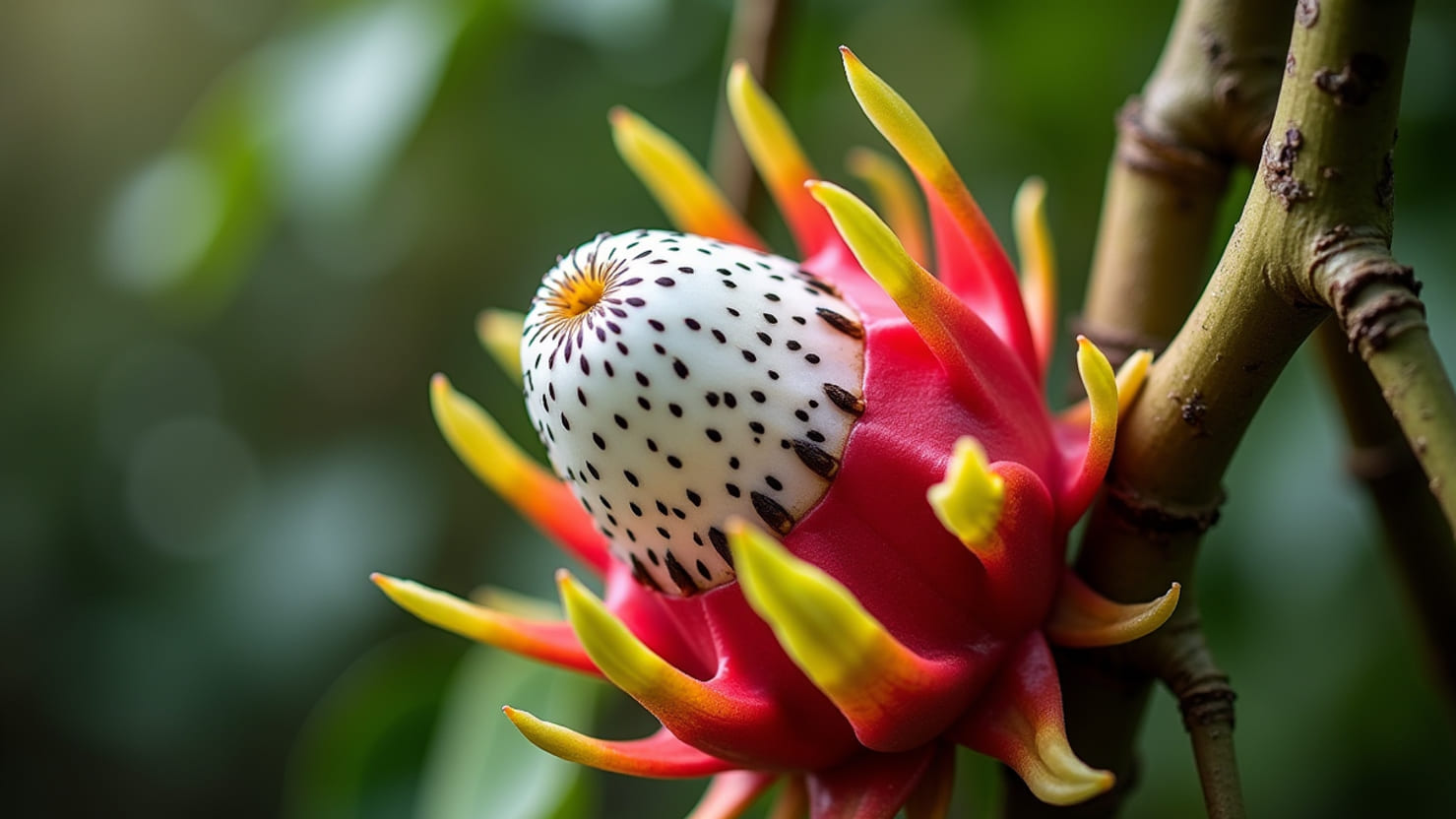
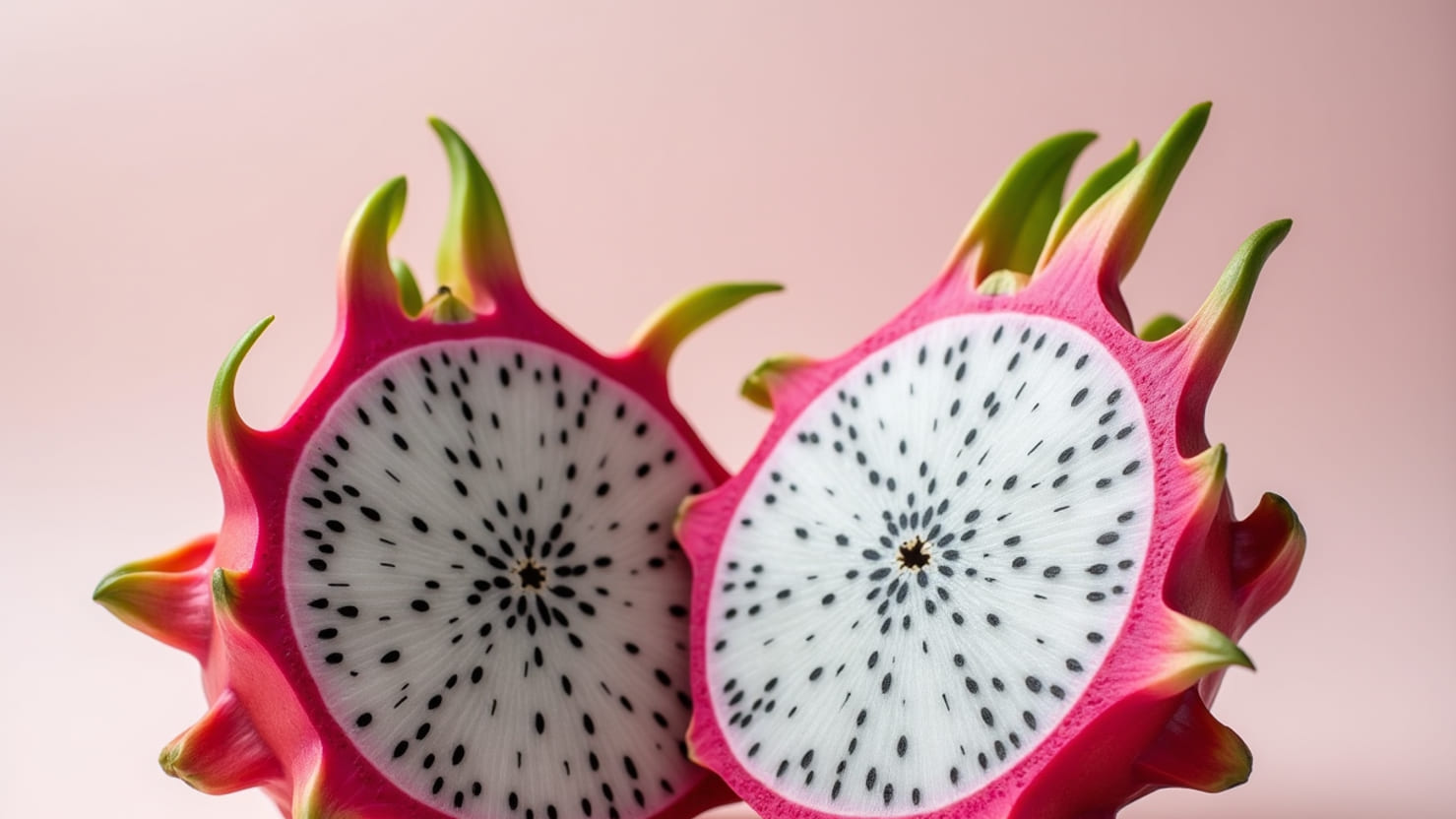
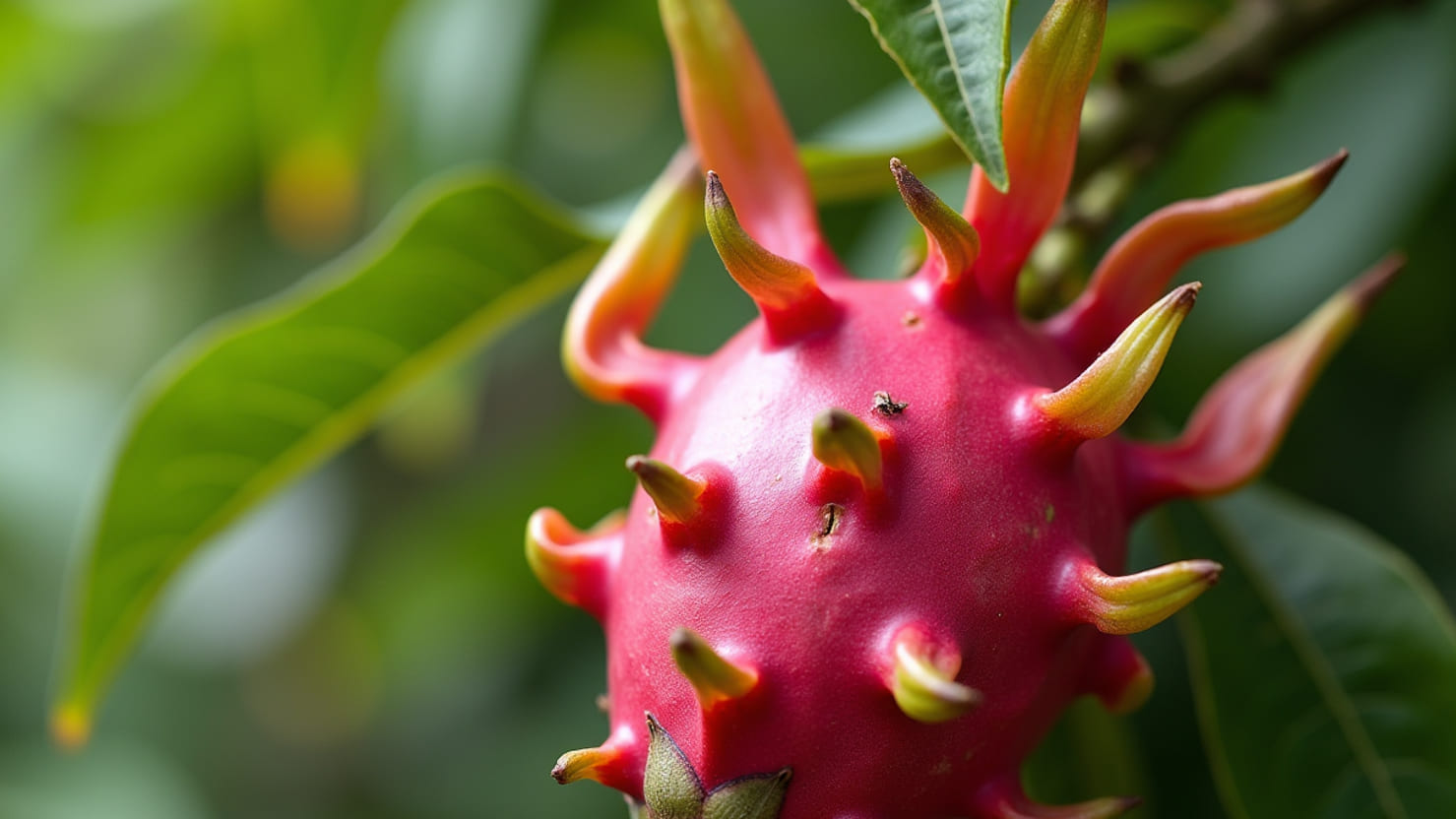
Sandragon Dragon Fruit: Trade Name or Real Cultivar?
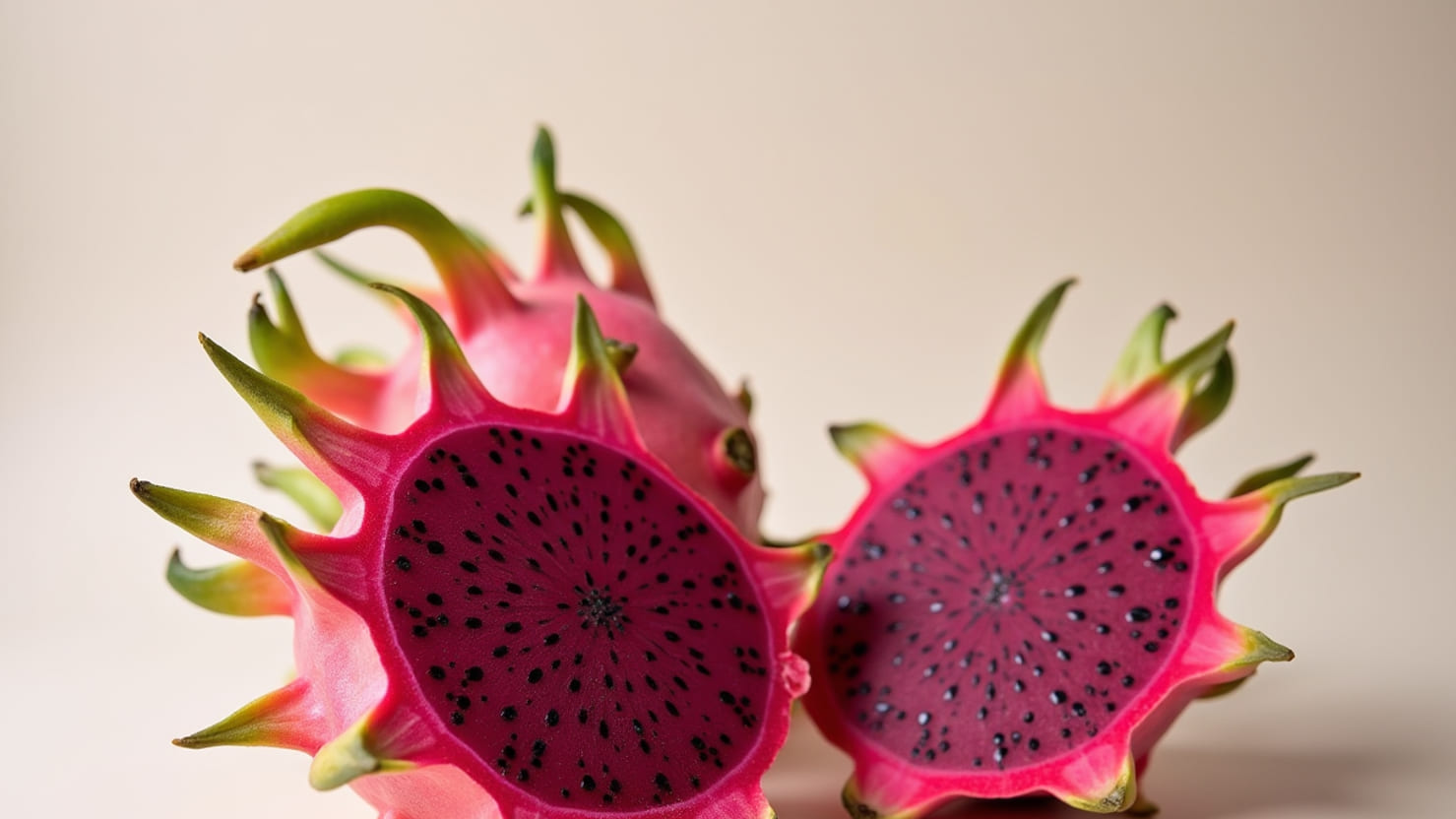
If you are searching for a Sandragon dragon fruit cutting, this name behaves like a nursery trade label rather than a registered cultivar. It appears on Vietnamese-market lists to denote a red-fleshed Selenicereus, but no published data exists for its Brix, fruit weight, or yield. We carry the name in our catalog, yet we have no stock, no photos, and no measured traits for it. The red pigment comes from betacyanins, so the visual appeal is real, but specific performance claims remain unverified.
Buy a red-fleshed variety we can actually photograph and measure. Our red-fleshed collection offers plants with known growth habits and verified fruit quality, ensuring you get a cutting that performs in your garden.
At a glance
Where the name actually stands
We ran the name Sandragon through every major scientific and agricultural index we could access. The institutional record is silent on specific traits, meaning any performance numbers attached to Sandragon are unverifiable claims rather than measured data.
Below is the evidence table showing exactly what we searched and what we found. Note that nursery tags often still use the older genus name Hylocereus, while modern registries use Selenicereus. This naming shift can make older listings look like they refer to different plants, but they are the same species.
| Claim | What we could verify | Source |
|---|---|---|
| Named cultivar description | OpenAlex returned one unrelated 1964 hit out of 175,888 works. | |
| Biomedical/agricultural literature | Europe PMC returned zero hits for Sandragon combined with dragonfruit. | |
| Taxonomic registry | GBIF has no cultivar-level record. Names resolve to Selenicereus monacanthus or S. costaricensis. | |
| Our own catalog | Name only. No active listing, no inventory, no photo. | |
| Vietnamese industry record | FFTC country profile exists but is login-gated. No varietal claim for Sandragon is accessible. |
The silence from Europe PMC and OpenAlex confirms that Sandragon behaves like a trade label, not a registered cultivar. Web searches pairing the name with pitaya, nursery, cutting, and the Vietnamese term thanh long also yield no cultivar description. This is common for nursery names, but it places the burden of proof on the seller. Without a published description, you cannot independently verify sweetness, size, or hardiness. The institutional record for the Vietnamese industry, specifically the FFTC Dragon Fruit Regional Network profile, exists but does not provide open access to varietal claims for Sandragon. Consequently, the specific performance metrics often quoted for this name remain in anecdote, not data.
What red flesh really means
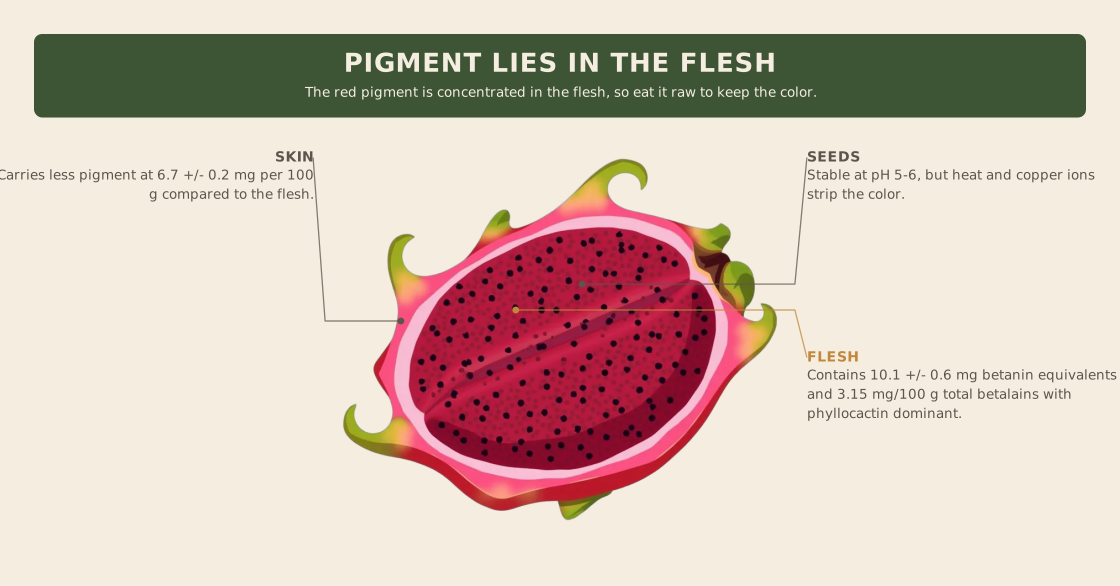
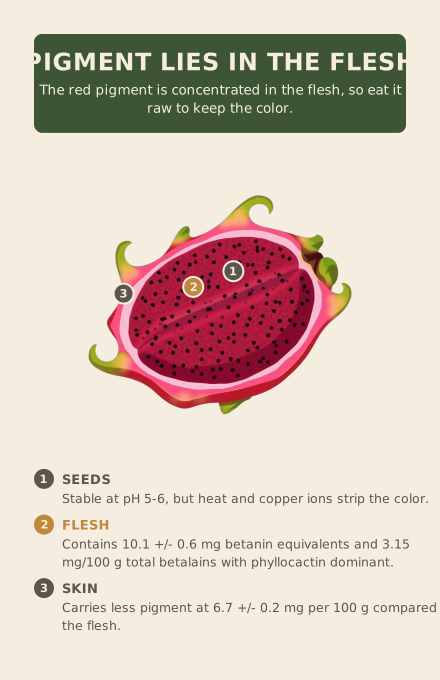
The color in a red-fleshed pitaya is a measurable chemical profile. In tested red pulp, betalain content sits at 3.15 mg per 100 g, with phyllocactin acting as the dominant pigment alongside 4'-O-malonyl-betanin and isophyllocactin.[1] This pigment load is concentrated in the flesh, which holds 10.1 mg per 100 g compared to 6.7 mg per 100 g in the peel.[3]
The chemistry shifts the fruit’s acidity as well. Red pulp is less acidic than white pulp, even though both share similar titratable acidity levels.[1] Red varieties also carry higher total phenolic content, but do not assume this automatically makes them superior for health claims. The antioxidant verdict depends entirely on the test method used. Red pulp outperformed white in ABTS and beta-carotene/linoleic acid assays, yet white pulp scored higher in DPPH radical scavenging tests.[1] "Redder is more antioxidant" is an assay-dependent observation, not a universal fact.
Handling matters. Betacyanins are fragile. They are most stable at pH 5-6 and degrade rapidly with heat. Copper ions accelerate this breakdown, so avoid copper pans when processing. Ascorbic acid protects the pigment up to 0.7%, but higher concentrations turn pro-oxidant.[3]
Because heat destroys the pigment, red-fleshed fruit is best used in cold preparations like smoothies or fresh salads rather than cooked dishes. The visual appeal is tied to chemical stability, so treat the fruit gently and keep it cool to preserve both color and nutritional integrity.
Flesh colour is a variety axis, and it changes what you buy
Colour is a chemical signature that separates varieties into distinct functional groups, not just a marketing hook. A Brazilian study comparing seven pitaya cultivars proved this by measuring pigment profiles and mineral content across different flesh types. The results show that choosing a variety is really choosing a specific nutrient package and kitchen behavior.
The study found that red-fleshed varieties like 'Costa Rica' and 'Nicaragua' dominated in betalain content. Betalains are the pigments responsible for the deep red hue, the same family found in beets and amaranth. In contrast, purple-fleshed varieties such as 'Purple Haze' and 'Physical Graffiti' carried higher levels of phenolics and flavonoids. These compounds drive antioxidant activity, which was measurably higher in the purple-fleshed samples. Both peel and pulp across these varieties showed notable concentrations of potassium and iron, making the skin a valuable part of the harvest rather than waste.
For the gardener, this means your choice of cutting determines what you get in the kitchen. Red-fleshed types offer intense color and betalain richness, while purple-fleshed types deliver higher antioxidant capacity through different chemical pathways. We stock 'Purple Haze' and 'Physical Graffiti' because these varieties offer verified performance and distinct nutritional profiles that differ from standard red-fleshed options.
| Flesh type | Pigment signature | Kitchen implication |
|---|---|---|
| Red ('Costa Rica', 'Nicaragua') | Highest betalain content | Strong natural red dye; ideal for vibrant juices and desserts where color intensity is the goal. |
| Purple ('Purple Haze', 'Physical Graffiti') | Highest phenolics, flavonoids, and antioxidant activity | Richer antioxidant profile; better suited for health-focused smoothies and savory applications where depth of flavor matters. |
| All red/purple types | Notable potassium and iron in peel and pulp | Consider eating the thin inner peel or blending it for mineral density. |
When you buy from us, you are buying a plant with a known chemical identity. We do not sell vague trade names. We sell 'Purple Haze' and 'Physical Graffiti' because we know exactly what their flesh contains and how they perform in the garden and the kitchen.
Growing a red-fleshed pitaya: the parts that are documented
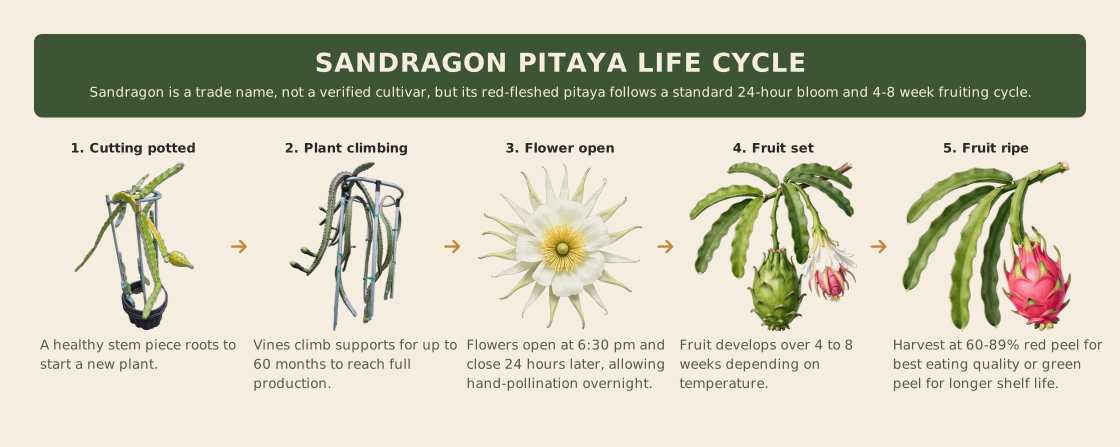
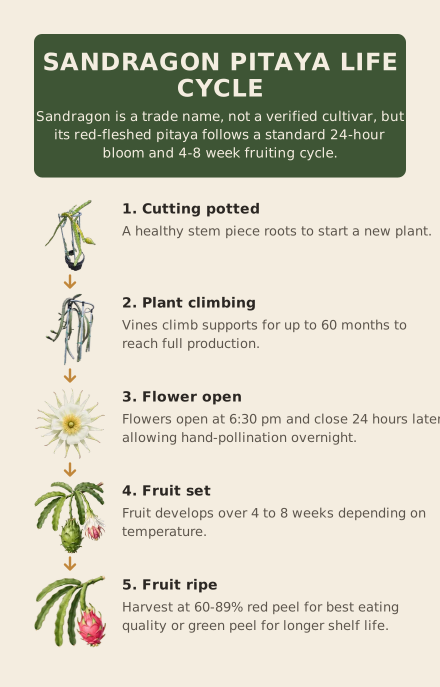
Since the Sandragon label lacks its own data, we look to the biology of red-fleshed pitaya generally. The most critical constraint is the flower. Red-fleshed varieties run a roughly 24-hour anthesis, opening around dusk and closing the next evening.[6] This leaves a single overnight window for pollination. Method matters significantly. In a Malaysian trial, self-pollination, natural pollination, hand pollination, and stingless bees (Tetragonula laeviceps) all set fruit, but bee-pollinated fruit was the heaviest, longest, and thickest.[6] This proves that pollination method changes fruit size even when fruit set succeeds. For more on maximizing set, see our dragon fruit pollination guide.
Once pollinated, the timeline is predictable. Fruit takes 4 to 8 weeks from pollination to harvest, depending on temperature.[9] Healthy plants can flower three to six times a year depending on growing conditions.[9] Cross-pollinating with a second genetically distinct plant generally raises fruit set and quality, even in self-fertile varieties.[9]
Hardiness limits are strict. These plants endure temperatures up to 40 C and short frost periods but do not survive long freezing exposure.[9] They thrive in USDA zones 10-11, though they can survive outdoors in 9a-9b with protection.[9] Propagation is simple: a broken piece of healthy stem can root and become a new plant.[9] Typical fruit is oval, about 10 by 6 cm, weighing 150 to 600 g, with occasional fruit reaching 1 kg.[9] The pulp starts green before ripening to red or yellow depending on the cultivar.[9]
Picking it and keeping it
Harvest timing is not a guessing game. In red-fleshed trials, peel colour directly dictates how long the fruit lasts and how it tastes. You can judge readiness by looking at the skin. The sweetest, highest-quality fruit appears when the peel is 11-40% green and 60-89% red, provided the bracts are still green. If you want maximum storage time, pick earlier. Fruit harvested at the greener stage of 60-89% green peel holds up for 8 days, which is the longest ambient shelf life observed.[5]
The failure mode in storage is rarely a mushy interior. Instead, the bracts yellow and rot while the pulp remains firm. This is why commercial growers focus on bract preservation. Cold storage extends life significantly. Red-fleshed fruit can last 21 days at 5 C and 90% relative humidity, followed by 7 days at 20 C. To achieve this, growers spray bracts with 100 mg/L forchlorfenuron (CPPU) before harvest and use perforated polyethylene bags. This combination keeps bracts green, reduces chilling injury, and cuts decay rates.[4]
CPPU-treated fruit are also measurably larger and firmer. In trials, treated fruit showed thicker bracts and higher firmness than untreated fruit. The visual decline you see in the fridge is almost always bract yellowing, not pulp collapse.[4]
| Peel Colour | Best Use | Expected Shelf Life |
|---|---|---|
| 60-89% green | Long-term storage | 8 days (ambient) |
| 11-40% green / 60-89% red | Immediate eating | Shorter (best quality) |
| Any stage (with CPPU/bags) | Cold storage | 21 days at 5 C + 7 days at 20 C |
Buying decision: Sandragon or a variety with a paper trail
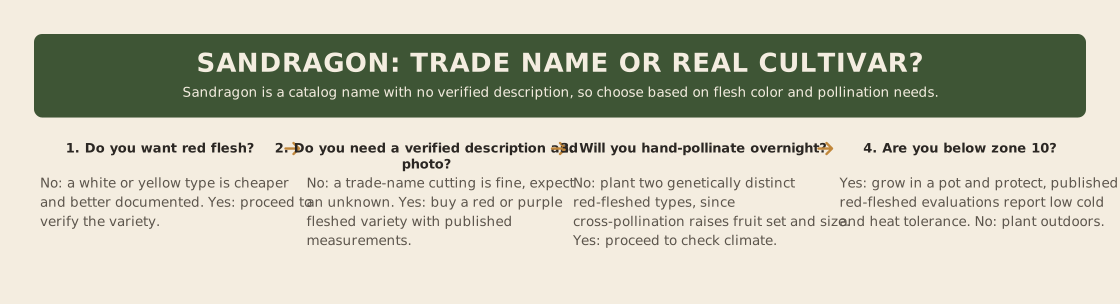
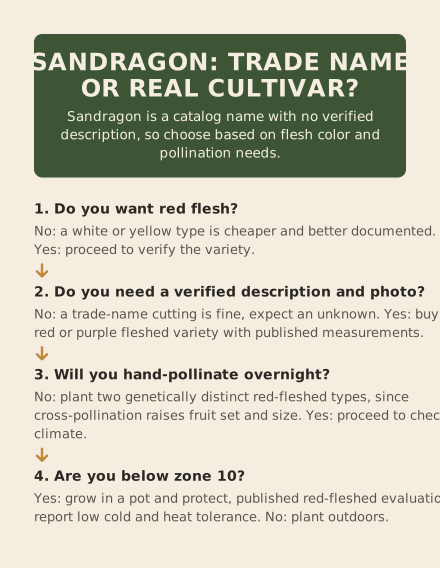
First, do you want red flesh? If yes, you are buying into a specific pigment profile and a different set of care requirements than white-fleshed types. Second, do you need a verified description and photo? If you require certainty about fruit size, sweetness, or growth habit before you plant, skip Sandragon. We carry the name, but we have no stock, no photos, and no measured traits for it, so its fruit traits cannot be verified from plants we grow or photograph.[10]
Third, can you hand-pollinate overnight? Red-fleshed pitaya flowers open around dusk and close the next evening, giving you a single 24-hour window.[6] If you cannot be there to pollinate, plant two genetically distinct red-fleshed types or a self-fertile variety.
Finally, check your zone. If you are in USDA zone 9b or below, red-fleshed varieties often report low cold and heat tolerance. The Nicaraguan red-fleshed Sin Espinas, for example, shows low tolerance to both extremes in Southern California evaluations.[8] You will likely need to pot these plants and protect them from frost and scorching sun.
What we stock instead
We do not carry Sandragon. The name sits in our catalog as a placeholder with no inventory, no photos, and no measured fruit traits to back it up. However, we stock several red- and purple-fleshed varieties that offer the same visual appeal and verified performance. These plants are ready to ship. The table below lists what is currently available and why each is a fair swap for the undefined Sandragon label.
| Variety | Flesh | Stock Status | Why It Is a Fair Swap |
|---|---|---|---|
| Physical Graffiti | Purple | Buy now (5) | Carries higher phenolics and flavonoids than many red types, with strong antioxidant activity.[2] |
| Purple Haze | Purple | Buy now (1) | Named in comparative studies for high phenolic content and robust health markers.[2] |
| Dark Star | Red | Buy now (2) | Proven red-fleshed performer with consistent growth habits and reliable fruit set. |
| Robles Red | Red | Buy now (2) | A dependable red-fleshed option that delivers the betacyanin-rich pulp you are looking for. |
| American Beauty | Red | Buy now (2) | Well-established variety with known hardiness and predictable flowering cycles. |
| Sugar Dragon | Red | Buy now (1) | Offers the sweet, red pulp profile without the mystery of an unverified trade name. |
| Asunta 3 | Red | Buy now (1) | A solid choice for growers wanting a standard red-fleshed plant with clear lineage. |
| Bahamut | Red | Buy now (1) | Reliable red-fleshed stock that performs well in typical pitaya growing conditions. |
Currently out of stock: Albino Ocamponis, Asunta 5, and Box Of Fresh are listed in our catalog but have no active inventory right now. Do not expect to purchase these today.
Choosing a variety with a paper trail means you get a plant that behaves as described. Red and purple flesh comes from betacyanins, the same pigment family found in beets.[9] While Sandragon promises this color, it cannot promise the yield or sweetness. The varieties above are different. We have measured their growth, photographed their fruit, and verified their traits.
Frequently Asked Questions
Is Sandragon red or white flesh? The name is sold as a red-fleshed variety, but no published data confirms this specific trait. Treat the color claim as a marketing label until you see the fruit. Is it the same as the common Vietnamese red thanh long? Likely not. Vietnam is a major producer alongside China and Mexico, but its commercial blocks are dominated by white-fleshed Selenicereus undatus. Red-fleshed names like Sandragon usually signal smaller, specialized plantings rather than mainstream crops.[9] This scarcity explains why you cannot find photos. We have no verified images in our catalog, and the institutional record remains silent on visual traits.
Will one plant fruit? A single cutting can set fruit, but it faces a biological bottleneck. Red-fleshed pitayas have a single overnight flowering window that lasts about 24 hours. Without a second, genetically distinct plant nearby for cross-pollination, or diligent hand-pollination during that brief night, fruit set is unreliable. Even if it sets, the yield may be low. How sweet will it be? Nobody has published a Brix figure for Sandragon. For context, look at our regional benchmark. UC ANR’s San Diego Small Farms evaluation of the red-fleshed Sin Espinas recorded 16.5 Brix, 393 g fruit, and 43 days from bloom to harvest.[8] A credible red-fleshed sweetness benchmark in Southern California sits in the mid-teens Brix. Any specific number a seller quotes for Sandragon is unpublished and unverified.
Buyer’s tip: If sweetness and reliable fruit set are your priorities, choose a variety with published trial data. Sandragon offers mystery; Sin Espinas offers measurements.
References
- Centesimal Composition, Bioactive Compounds, and Antimicrobial Properties of White (Hylocereus undulatus) and Red (Hylocereus polyrhizus) Pitayas, Journal of Food Science (Wiley), PMID 41803624 (2026).
- Bioactive Compounds, Antioxidant Capacity and Mineral Profile of Pulp and Peel from Diverse Selenicereus (Pitaya) Varieties in Brazil, Plant Foods for Human Nutrition (Springer), PMID 42527712 (2026).
- Stability of Betacyanin Pigments from Red Purple Pitaya Fruit (Hylocereus polyrhizus): Influence of pH, Temperature, Metal Ions and Ascorbic Acid, Indonesian Journal of Chemistry 7(3):327-331, Gadjah Mada University (2010).
- Effect of Preharvest Application of CPPU and Perforated Packaging on the Postharvest Quality of Red-Fleshed Pitaya (Hylocereus polyrhizus sp.) Fruit, Horticulturae 7(8):253, MDPI (Pai-Tsang Chang et al.) (2021).
- Effect of Harvest Index on Shelf-Life and Quality of Dragon Fruit (Hylocereus polyrhizus) During Storage, Jurnal Hortikultura 30(1):87-96, Indonesian Tropical Fruits Research Institute (Balitbu Tropika) (2020).
- Flowering Phenology and Evaluation of Pollination Techniques to Achieve Acceptable Fruit Quality of Red-fleshed Pitaya (Hylocereus polyrhizus) in Sabah, East Malaysia, Pertanika Journal of Tropical Agricultural Science 47(3), Universiti Putra Malaysia (Ador, Gobilik, Benedick) (2024).
- GBIF Backbone Taxonomy species records: Selenicereus monacanthus (usageKey 9953409, accepted; Hylocereus polyrhizus listed as synonym) and Selenicereus costaricensis (usageKey 10197024, accepted), GBIF (intergovernmental biodiversity data facility; backbone built on Kew's World Checklist of Vascular Plants) (2026).
- H. Sp. Sin Espinas, dragon fruit variety evaluation sheet (red-fleshed, Nicaragua origin: 393 g, 16.5 Brix, 43 days bloom to harvest, harvest early June to December, low cold and heat tolerance), University of California Agriculture and Natural Resources, San Diego County Small Farms (2026).
- Dragon fruit (pitaya) overview: betacyanin pigments, 4-8 weeks pollination to harvest, 150-600 g fruit, 40 C and frost limits, zones 10-11, 1,100-1,350 plants/ha, 20-30 t/ha, 3-6 flowerings per year, cross-pollination improves set, Wikipedia (reviewed here 2026-11-17; its cultivation and pigment claims cite Morton, New Cronqp of Horticulture/CABI PlantwisePlus species factheet 10.1079/pwkb.species.27317) (2026).
- Sky Botanicals dragon fruit variety master list, record key 'sandragon' (status catalog, in_stock false, inventory none, photo null), Sky Botanicals internal catalog export (workspace/data/knowledge/variety_universe.json, 2026-11-17) (2026).
Illustration generated for this article