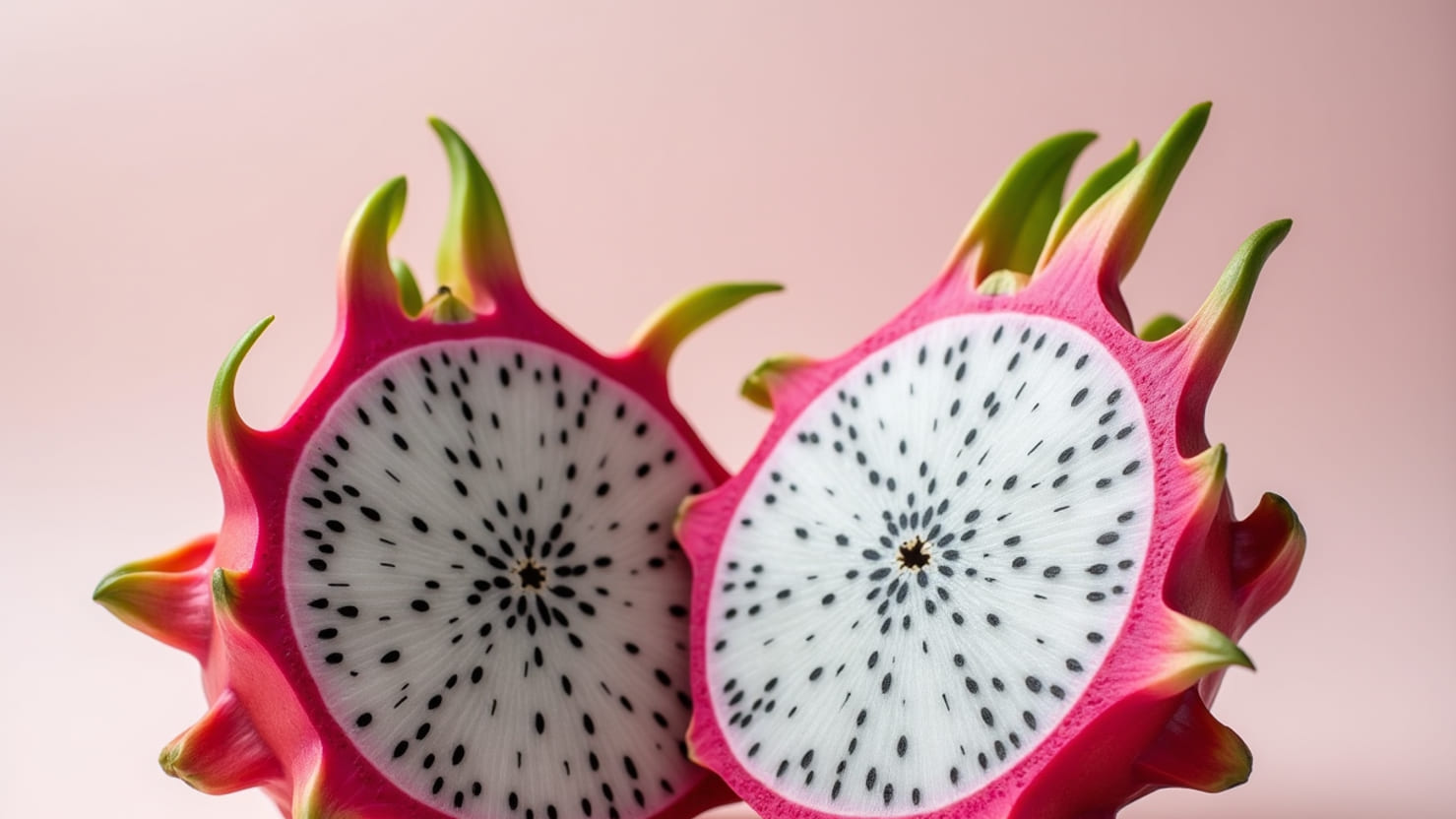
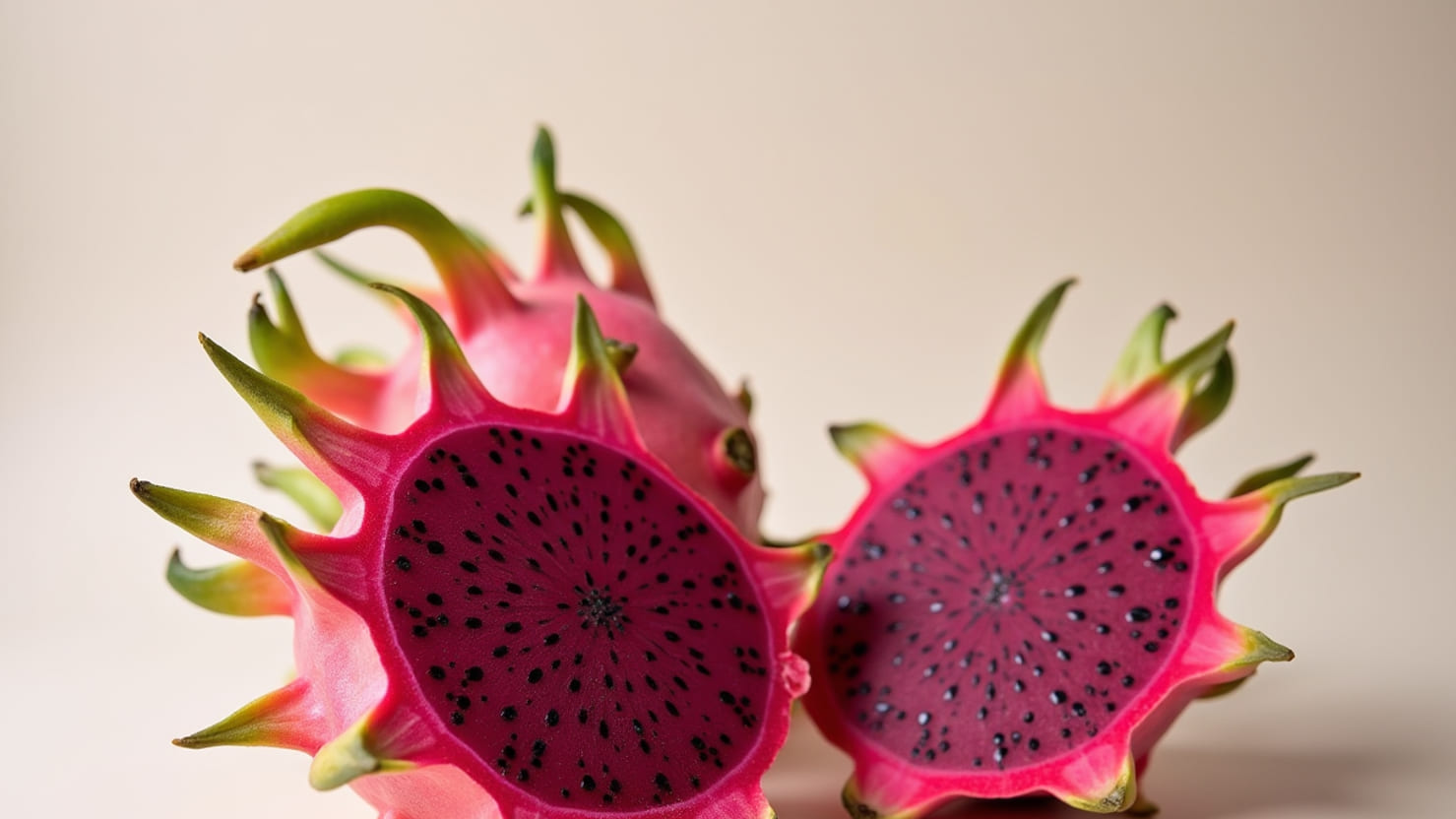
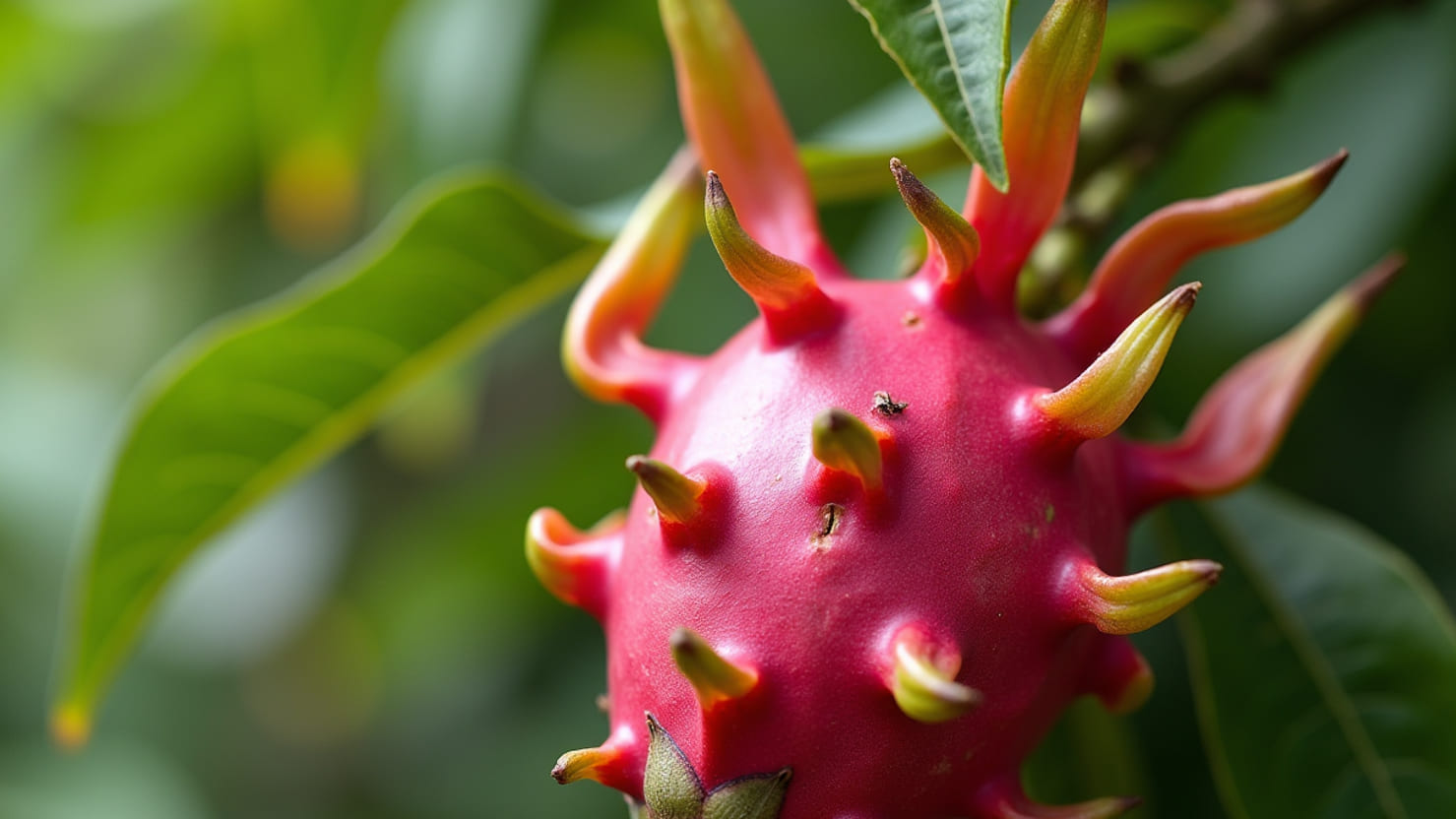
Sufi Dragon Fruit: No Trial Data Found
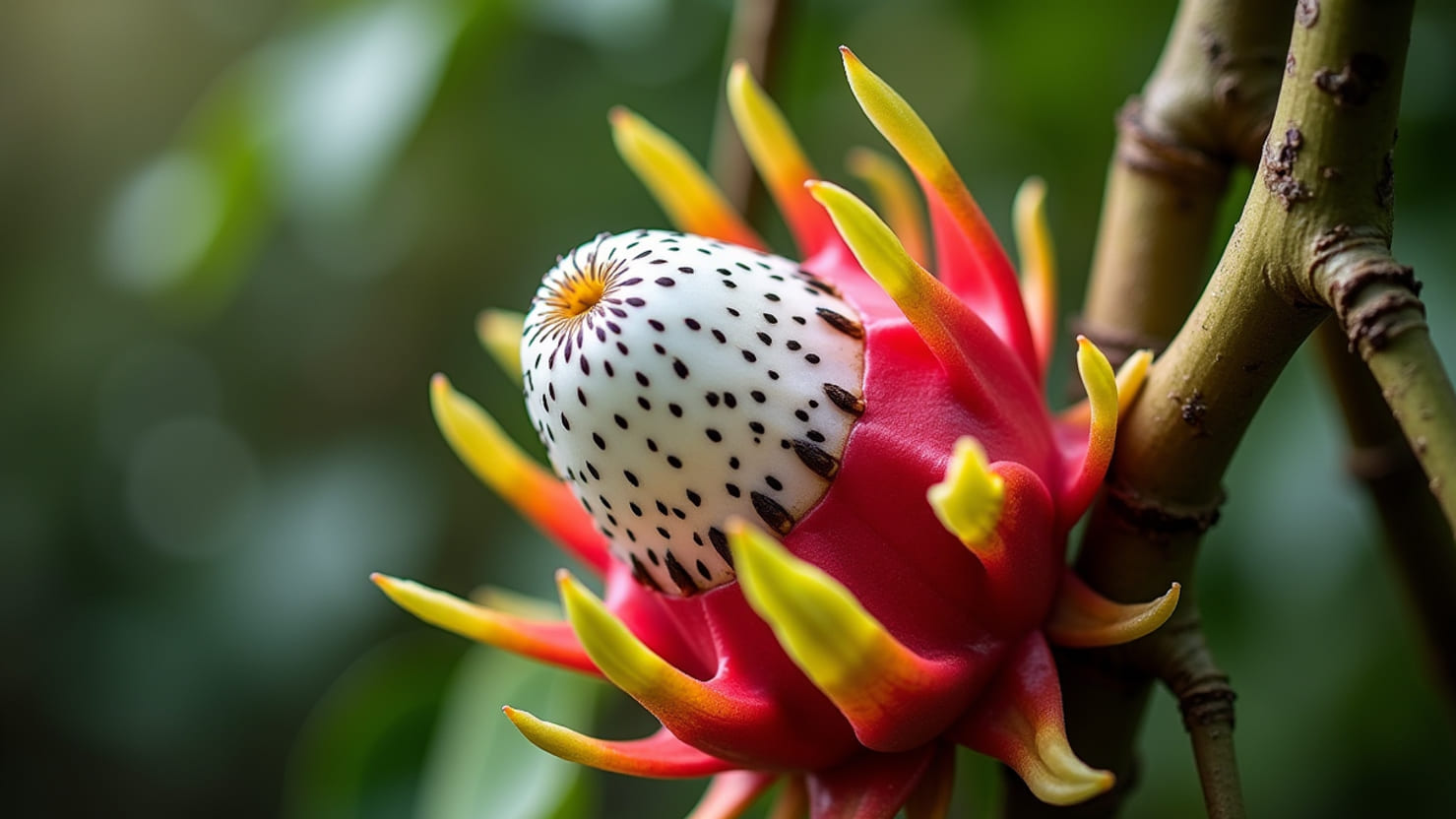
You are looking for a Sufi dragon fruit cutting to grow, but Sky Botanicals does not currently sell it. We list the name in our archive because we have handled it, yet we prefer to offer plants with known performance. It does not appear in major university trials or commercial clone encyclopedias. We will not guess its flavor or pollination needs. If you want a reliable producer, choose a cultivar we stock with measured performance. Our current dragon fruit cuttings come with clear growth habits and proven fruit set.
We looked for it
We did not guess. We searched the primary authorities for naming cacti and commercial clone catalogs. For Sufi, the records are empty.
These are not obscure blogs or social media feeds. They are the reference libraries for this crop. If Sufi were a distinct, recognized clone with a verified genetic identity, it would be listed there.
We also checked the only recent, comprehensive variety trial conducted by a major agricultural extension service. The University of California Cooperative Extension ran a multi-year trial in San Diego County evaluating 19 named pitaya cultivars. They measured fruit weight, Brix, marketable yield, days to harvest, and cold hardiness. They even ran DNA analysis to check if different trade names represented the same genetics. Sufi is not in that trial. It is not in the list of 19. It is not in the DNA results. The trial included well-known names like American Beauty, Delight, and Physical Graffiti, all of which have published performance data. Sufi has none.
Finally, we searched peer-reviewed agricultural journals and extension publications for any mention of Sufi. We found zero. No growth habit description, no pollination study, no yield report, no hardiness rating.
We found zero mentions in peer-reviewed journals or extension publications. Without a registry entry or trial data, you are buying a label, not a verified clone. You cannot know its pollination needs, fruit size, or cold tolerance.
A name with no registry entry and no trial data is not a variety. It is a marketing term with no genetic anchor. Do not assume it behaves like the clones you know.
Why unverified variety names are a real problem in dragon fruit
The University of California San Diego trial did something rare in the nursery trade: it sequenced the DNA of the plants it evaluated. The results were blunt. Two names, Bien Hoa Red and American Beauty, were genetically identical. Yellow Dragon and Colombiana were the same clone. Lisa, Rosa, and Cebra were likely one and the same.[3] If different names can hide the same genetics, a name alone proves nothing about what you are buying.
Species confusion makes this worse. Skin and flesh colors mix unpredictably across Selenicereus and Hylocereus species, so a label saying "red skin" tells you almost nothing about the plant’s actual behavior or hardiness.[4] You need measured data, not just a color description.
Consider the cautionary tale of Colombiana and Yellow Dragon. They scored high for sweetness, with Brix readings over 20. But they produced zero marketable weight per plant and took 150 to 180 days to harvest.[3] High sugar content is useless if the fruit never reaches a size or timeline that makes it worth picking. A name without yield data is a gamble.
Trust the numbers, not the label. A variety is defined by its performance in the field, not its marketing name. If a clone has no published weight, Brix, or hardiness record, you are planting a mystery.
| Cultivar | Skin/Flesh | Avg Weight (g) | Brix | Marketable Yield (g/plant) | Days to Harvest | Cold / Heat (1-5) |
|---|---|---|---|---|---|---|
| Physical Graffiti | Red/Red | 374 | 17.93 | 23,429 | 40 | 4.5 / 4.5 |
| Delight | Red/White | 371 | 18.08 | 14,931 | 41 | Not listed |
| Lisa | Red/Red | 465 | 17.02 | 13,319 | 44 | 3.75 / 4 |
| Halley's Comet | Red/White | 482 | 16.7 | 5,979 | 38 | 4.5 / 4.25 |
| American Beauty | Red/White | 380 | 18.51 | 5,566 | 43 | 2.75 / 2.5 |
| Sin Espinas | Red/White | 393 | 16.5 | 3,527 | 43 | 2.25 / 2.75 |
| Colombiana | Yellow/White | <200 | 20.90 | 0 | 150-180 | Not listed |
| Yellow Dragon | Yellow/White | <200 | 21.15 | 0 | 150-180 | Not listed |
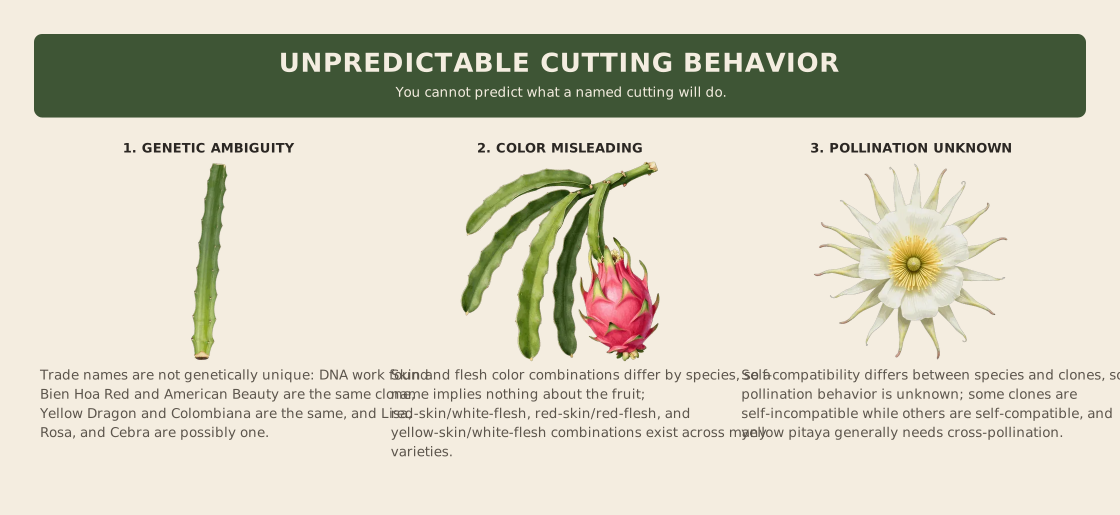
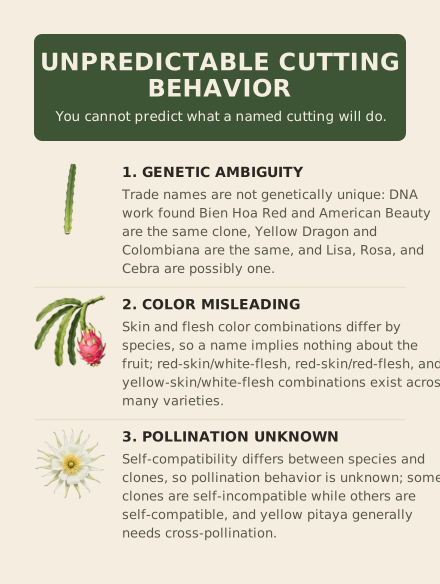
If you already have a Sufi cutting, grow it like any dragon fruit
You have the cutting. You do not have the data. That is fine. Dragon fruit is forgiving, and the mechanics of growing a Sufi clone are identical to growing any other pitaya. Treat it as a generic cactus until it proves otherwise. Start by rooting the cutting upright in a pot. Do not add gravel or stones to the bottom of the container. That old gardening habit raises the perched water table and keeps the mix above it wetter, which invites rot. Fill the pot with one free-draining mix all the way down and ensure it has a drainage hole.
Once rooted, move the plant to its permanent spot. In our Southern California zone 10a site, frost is the primary threat. Dragon fruit is frost tender, suffering moderate to severe damage below 32 F. Sustained growth happens in zone 10b and 11, so you must protect young plants from cold snaps. Space plants 9 to 15 feet apart on a trellis 6 to 7 feet high. They need full sun; light shade is tolerated, but dense shade kills bloom and fruit set.
Watering is where most growers fail. Irrigate twice a week during dry periods but never saturate the soil. Uneven moisture splits fruit, while excess water or heavy rain causes flower drop and fruit rot. Feed lightly. A general recommendation is 1 to 1.5 oz of 1:1:2 NPK per plant every 4 months. Over-fertilizing burns the roots and produces weak growth.
| Item | Recommendation |
|---|---|
| Light | Full sun; avoid dense shade[1] |
| Cold limit | Damage below 32 F; zone 10b+ ideal[1] |
| Soil pH | 5.5 to 6.5 |
| Planting mix | Enriched sandy/loamy with 6+ inches compost[1] |
| Water | Twice weekly in dry spells; avoid saturation[4] |
| Fertilizer | 1-1.5 oz 1:1:2 NPK every 4 months[4] |
| Trellis | 6-7 ft high; 9-15 ft spacing[4] |
| Harvest window | 30-50 days post-set; twist peduncle[4] |
| Storage | 10 days room temp; 14 days at 50 F/90% RH[4] |
Expect fruit within about a year from a cutting. Seedlings take 5 to 7 years and are not true to type. Harvest when the skin color deepens fully. Cut or twist the peduncle. If your clone has spines, remove them before eating. Store at room temperature for up to 10 days, or refrigerate at 50 F with high humidity for two weeks. Since we do not know Sufi’s specific flavor profile, judge the fruit by its look and texture. If it splits, your watering is inconsistent. If it drops, you are overwatering. Fix the water, and the plant will survive.
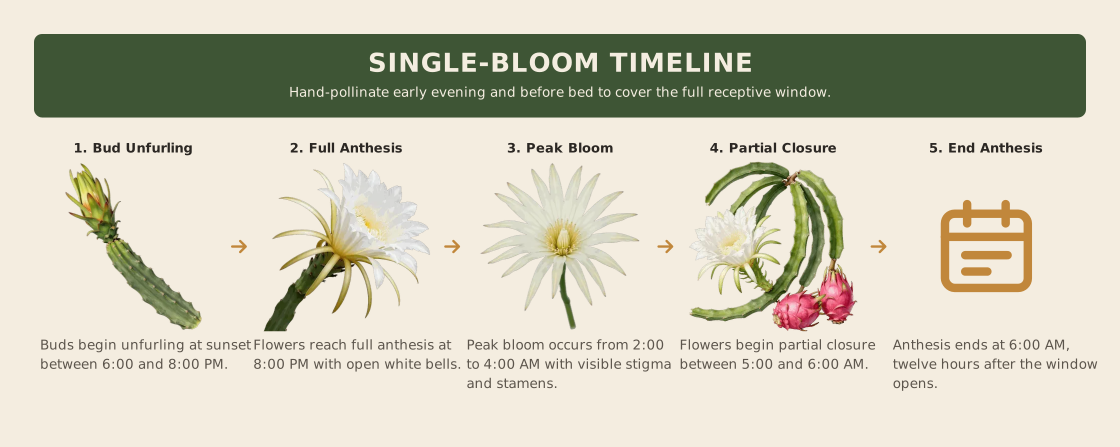
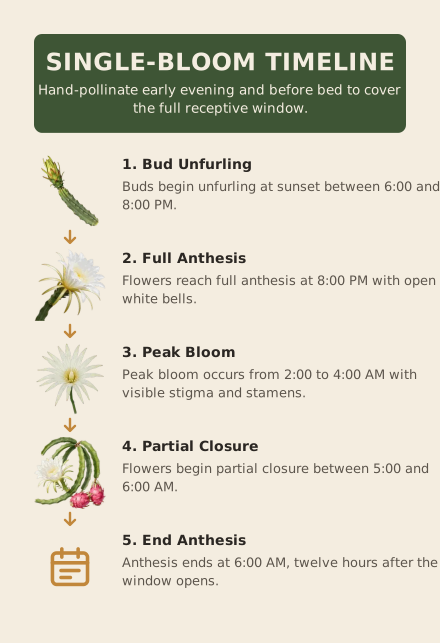
Pollination: the part that decides whether you get fruit worth eating
With Sufi, you are guessing. No one has tested its self-compatibility, so you must prepare for two scenarios: it is either a self-incompatible red clone or a self-compatible white clone. In recent trials, a red-fleshed clone set fruit only under manual cross-pollination, showing strict self-incompatibility otherwise.[2] A white-fleshed clone was self-compatible, achieving full fruit set under manual self-pollination, manual cross-pollination, and open pollination.[2]
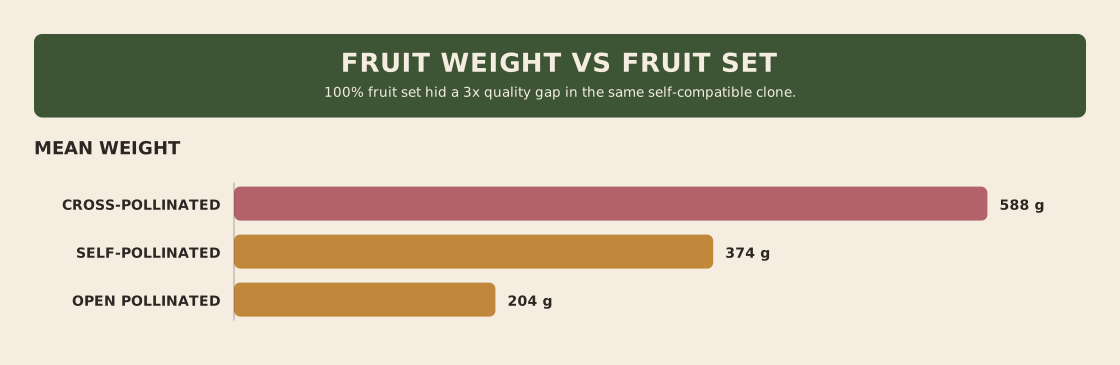
But fruit set is the wrong metric. Size is the goal. On the same self-compatible white clone, cross-pollinated fruit weighed nearly 588 g, while self-pollinated fruit weighed about 374 g and open-pollinated fruit weighed only 204 g.[2] The authors attribute this gap to incomplete fertilization and weak seed development. Restricting pollinators degrades fruit badly before it stops fruit entirely. Wide mesh bags that allowed wind transfer still produced tiny fruit, while narrow mesh bags cut set and weight drastically.[2]
You must do the work yourself. Flowers open for one night, with full anthesis from 8:00 PM to 6:00 AM.[2] The usable window runs from 4 hours before anthesis to 12 hours after, so hand-pollinate early in the evening or again before bed.[2] Rain suppresses the reproductive window, so do not wait on weather.[2] While bats and moths pollinate pitaya in their native range, they are rarely observed in home plantings.[1] Plan to transfer pollen with a brush.
What you actually get from a dragon fruit, nutrition-wise
When you buy a cutting, you are buying a genetic promise. If that name has no registry entry, you cannot know if the fruit will be sweet, large, or cold-hardy. But you can know exactly what is inside the flesh. The nutritional profile of pitaya is determined by species biology, not by the marketing label on the pot. Regardless of the clone, the biochemical baseline remains consistent across the crop.
Dragon fruit flesh is over 85% moisture and sits at a pH of 4.5 to 5.0, making it a low-acid fruit where malic acid is the dominant organic acid[5]. It provides modest amounts of B vitamins and vitamin C, with reported values of 2.4 µg/100 g for thiamin, 2.0 µg/100 g for riboflavin, 12.6 µg/100 g for niacin, and 5.6 µg/100 g for ascorbic acid[5]. The real functional benefit comes from its prebiotic effect. The fruit contains oligosaccharides that resist human alpha-amylase and gastric hydrolysis, meaning they pass through the upper digestive tract intact[5]. Once they reach the colon, they stimulate the growth of beneficial bacteria like Lactobacillus and Bifidobacterium[5].
Species differences do exist, but they follow clear chemical lines. Red and magenta flesh colors are driven by betalains, specifically betacyanin and betanin, which are concentrated in the flesh and peel of red-fleshed Hylocereus species[5]. These pigments carry a significant antioxidant load. In fact, the peel and seeds hold much of this activity; removing the seeds measurably reduces the flesh’s ability to scavenge free radicals[5]. If you are growing for health benefits, eat the whole fruit, seeds and all.
Controlled analyses show that phytochemical content varies by species. For example, H. costaricensis pulp has been measured with higher total soluble phenolics, anthocyanins, carotenoids, and vitamin C compared to H. undatus[6]. Meanwhile, H. megalanthus tends to have the highest soluble sugar content[6]. These are species-level traits. A cutting of a red-fleshed clone will always produce offspring with that same betalain chemistry, regardless of what name is attached to it. A white-fleshed clone never will.
Stocked cultivars with verified numbers
You do not have to plant a mystery. Our current inventory offers cuttings with measured performance, so you know exactly what your trellis will hold. If you want a red-fleshed clone with trial-confirmed data, American Beauty is the strongest starting point. The UC San Diego trial recorded it at 18.51 Brix, 380 g average fruit weight, and 43 days from pollination to harvest.[3] DNA analysis confirmed it is genetically identical to Bien Hoa Red, meaning you are buying a single, proven clone under two trade names.[3] You get the sweetness and the timeline without the guesswork.
If you prefer to judge by eating before committing to a cutting, we sell fresh fruit so you can taste the product before buying a cutting. This lets you taste the actual product our farm produces. You assess texture, sugar balance, and seed crunch on your own terms. If you like what you eat, you can then buy the matching cutting with confidence. This approach removes the risk of growing a plant for a year only to dislike the harvest.
For growers seeking specific traits beyond the trial data, we stock several other named clones with our own farm records. Each of these names comes with our own farm records, not just a label. We have grown them, measured them, and confirmed their behavior in our soil.
Why numbers matter: A Brix reading of 18.51 is a fact. A claim of "super sweet" is a feeling. The trial data for American Beauty also shows 5,566 g of marketable weight per plant, proving it produces enough fruit to justify the space.[3] Compare that to clones with high sugar but zero marketable yield, and the value of measured data becomes obvious.
Buy a name with numbers attached, or buy our fresh fruit and judge by eating. Both paths lead to a verified clone. Neither requires you to hope that a marketing term matches the plant’s actual genetics.
Should you buy a Sufi cutting?
Here is our advice. First, skip it if you want predictable fruit or resell value. Because there is no documented parentage, you cannot guarantee what the plant will produce. If you are paying full price for a named variety, you deserve measured data on yield, sugar content, and hardiness. Sufi offers none of that.
Second, take it if it is free or already in the ground. If a neighbor hands you a cutting, or you inherited a plant with this tag, grow it. You have nothing to lose. Use it as a second genotype. Dragon fruit pollination often benefits from cross-pollination between different genetic lines. Even if Sufi turns out to be a duplicate of a known variety, having two plants increases the chance of successful fruit set. It adds genetic diversity to your patch, which is always a good thing.
Third, in every case, ask the seller for the parentage or source. If they cannot tell you where the cutting came from, assume the worst. Then, hand-pollinate. Do not rely on nature. A two-plant planting with hand pollination beats any single named clone. Why? Because in trial data, a white-fleshed clone showed 100% fruit set under multiple methods, but the fruit weight varied wildly. Manual cross-pollination produced fruit averaging nearly 600 grams. Manual self-pollination dropped that to about 374 grams. Open pollination resulted in fruit weighing only about 204 grams[2]. The difference is not just whether you get fruit, but whether the fruit is worth eating. Incomplete fertilization leads to weak seed development and small, insipid fruit.
The hand-pollination rule: Dragon fruit flowers are open for roughly one night. The usable window runs from four hours before anthesis to twelve hours after. Hand-pollinating early in the evening or again before bed covers the whole receptive period[2]. Rain can suppress this window, so do not wait for bees. Do the transfer yourself.
So, what would we buy instead? We would stock a cultivar with clear growth habits and proven fruit set. Look for names that appear in university trials. American Beauty, Delight, and Physical Graffiti have published performance data. They have measured Brix, weight, and hardiness ratings. You know what you are getting. You know how much fruit to expect. You know how to manage the plant. With Sufi, you are planting a mystery. With a tested variety, you are planting a plan.
Frequently Asked Questions
Growers often ask us for specifics on Sufi, but the honest answer is that the data does not exist. We have handled the name, but we do not have a verified genetic profile to share. Here is what we can say with certainty.
Is Sufi dragon fruit red or white?
We do not know. Skin and flesh colors mix unpredictably across species, so a label claiming "red" or "white" tells you almost nothing about the plant’s actual behavior.[4] Without a registry entry or trial data, we cannot confirm which pigment class this clone produces. Do not trust a listing that promises a specific color without proof.
Is it self-pollinating?
Assume it needs help. White-fleshed H. undatus is generally self-fertile, while yellow pitaya is self-sterile and requires cross-pollination.[1] Red-fleshed clones often show strict self-incompatibility, setting fruit only under manual cross-pollination.[2] Since Sufi’s species is undocumented, you should plan for hand pollination. Read our guide on which dragon fruit varieties are self-fertile and which need a pollination partner to understand the risks of assuming self-compatibility.
How fast does it fruit from a cutting?
Expect fruit within about a year from a healthy cutting.[4] This timeline applies to most vegetatively propagated pitaya. If you start from seed, wait 5 to 7 years, and note that seedlings are not true to the parent variety.[4]
What does it taste like?
Nobody has published a sensory panel for Sufi. Sweetness tracks Brix, and Brix readings in trialled cultivars range from the mid-16s to over 21. Without a measured Brix figure for this specific clone, we cannot predict its sugar content or flavor profile.
Where can I buy one?
Not from us right now. Sufi is recorded in our catalog archive as a name we have handled, but there is no product page, no inventory, and no photos.[7] We do not sell it because we lack verified data. We prefer to offer plants with known performance.
References
- Pitaya (Dragonfruit) Growing in the Florida Home Landscape (HS1068 / HS303, Crane & Balerdi, Department of Horticultural Sciences), University of Florida IFAS Extension (2019).
- Floral and pollination biology of dragon fruit reveals strategies for enhancing productivity through pollination management and reproductive window extension, Scientific Reports (Nature Portfolio), two-year field trial 2023-2024, DOI 10.1038/s41598-025-21168-2 (2025).
- Pitahaya Production in California and Research Update: variety evaluation results, 19 cultivars with cold/heat scores, average weight, Brix, marketable weight per plant and days to harvest, plus DNA cultivar comparisons, University of California Agriculture and Natural Resources / UC Cooperative Extension San Diego County, Small Farm Program (Lobo) (2013).
- Dragon Fruit (FS 5-21): species and skin/flesh colour combinations, propagation, trellis, irrigation, nutrition, flowering and pollination, harvest and post-harvest storage, pests and diseases, University of Guam Cooperative Extension & Outreach, College of Natural & Applied Sciences (Taitano, Ilai, Johnny, Acosta, Tuquero) (2021).
- Nutritional Value and Therapeutic Benefits of Dragon Fruit: A Comprehensive Review with Implications for Establishing Australian Industry Standards, Molecules 29(23):5676, Central Queensland University and Research Institute for Northern Agriculture, Charles Darwin University / NT Department of Agriculture and Fisheries, DOI 10.3390/molecules29235676 (2024).
- Comparative analysis of nutrient composition and antioxidant activity in three dragon fruit cultivars, PeerJ 12:e17719, DOI 10.7717/peerj.17719 (2024).
- Sky Botanicals dragon fruit variety catalog record for 'Sufi' (status: catalog, in_stock: false, no product slug, no inventory, no listing photos), Sky Botanicals own variety catalog (first-party) (2026).
Illustration generated for this article