Pink Panther Dragon Fruit: Small, Sweet, and Slow
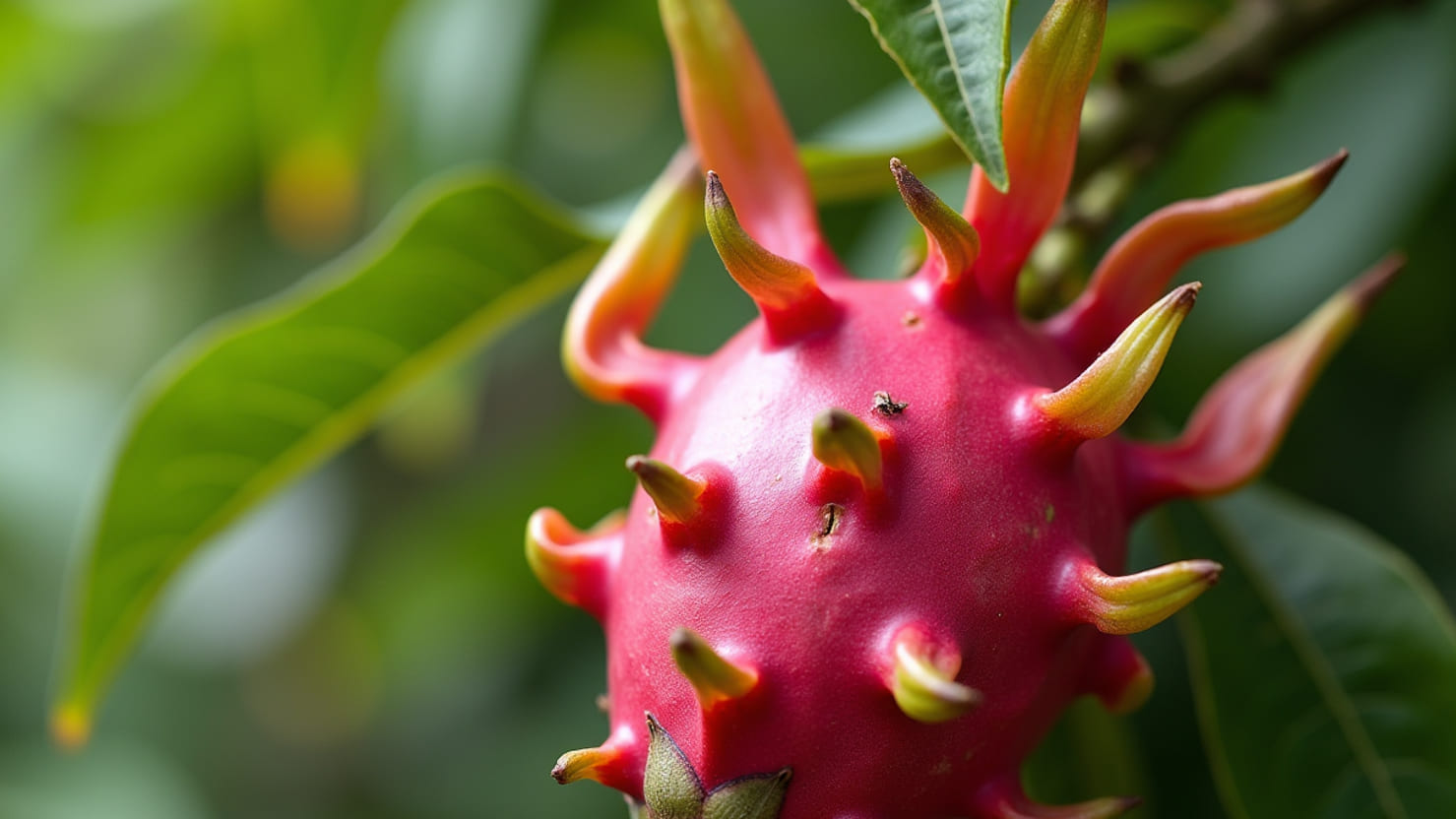
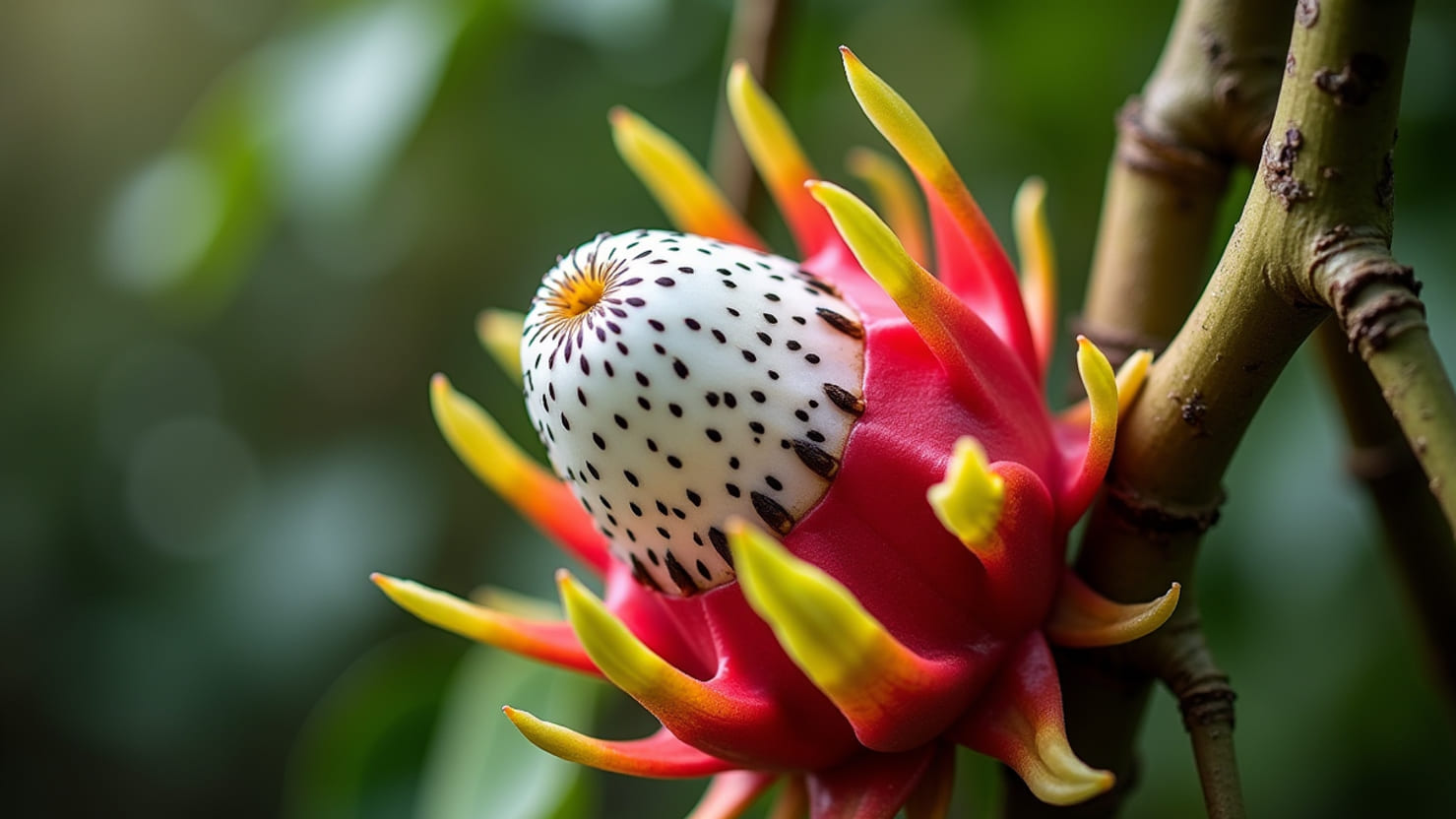
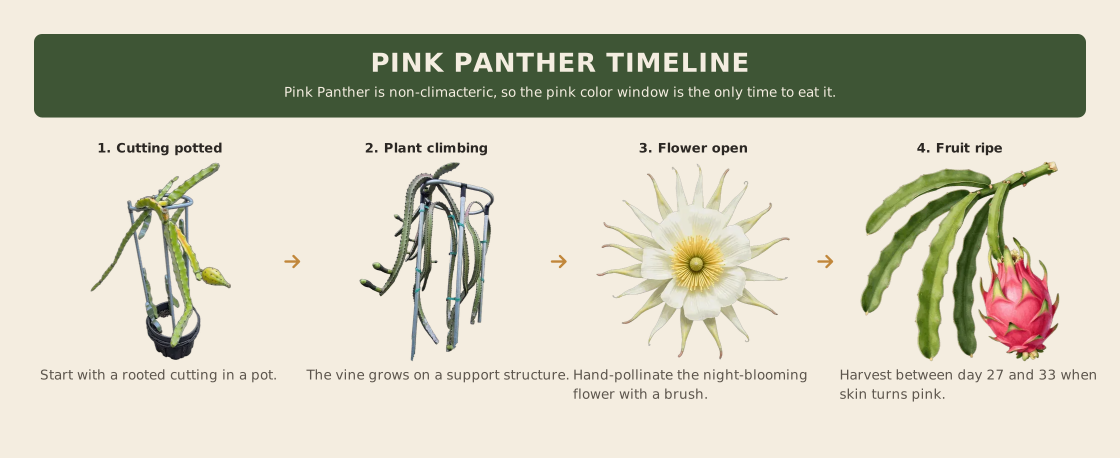
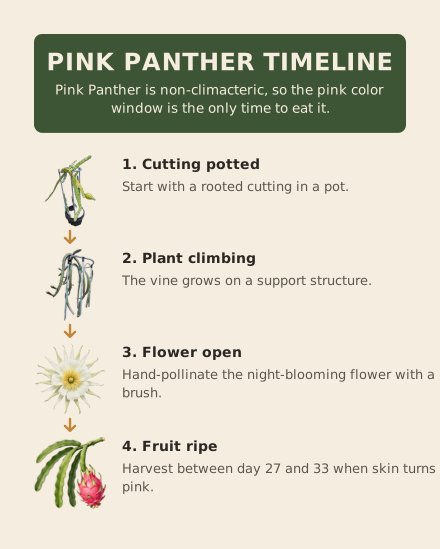
Pink Panther is a self-fertile, pink-fleshed dragon fruit hybrid (a setaceus x guatemalensis type) known for its berry-and-melon flavor and notoriously small fruit. The distributing nursery reports 19 Brix. While it sets fruit with its own pollen, cross-pollination still improves set and size. Expect a slow grower that needs its own trellis, as it is easily outcompeted. It thrives in zones 10-11, or 9b with protection. Fruit matures 27 to 33 days minimum after flowering. Check skin color, not softness, for ripeness. Harvested fruit holds for 4-5 days at room temperature.
These nursery-measured numbers reflect our on-farm observations. For more on managing cross-pollination to boost yields, see our guide. We stock verified Pink Panther cuttings ready for your garden.
What the name actually covers: pedigree and naming
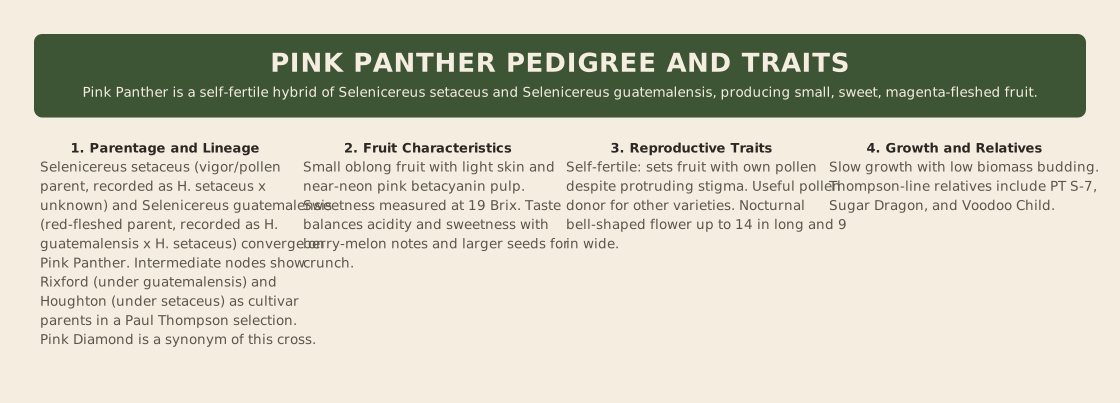
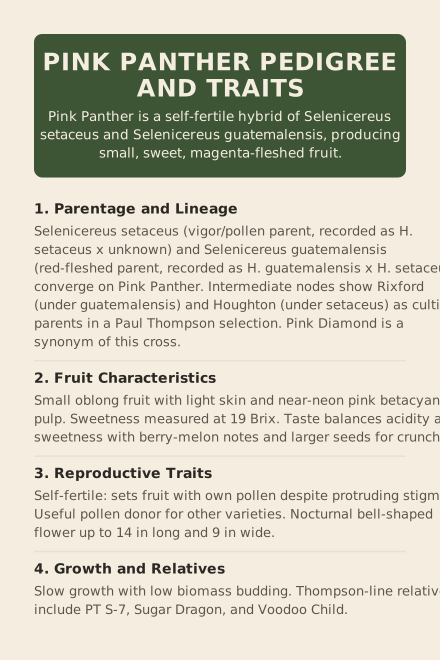
Nursery tags rarely match botanical databases. Pink Panther is a prime example. You will encounter three distinct pedigree descriptions for this plant. Rather than viewing these as contradictions, read them as compatible descriptions of the same hybrid family. The core genetics remain a cross between the setaceus and guatemalensis lineages, but the specific parents and naming conventions vary by source.[4]
| Source Type | Recorded Pedigree | Context |
|---|---|---|
| Distributing Nursery | H. setaceus x Unknown | General hybrid listing; emphasizes the setaceus parent.[4] |
| Seed Vendor | H. guatemalensis x H. setaceus | Specific species cross; aligns with the guatemalensis/setaceus type.[6] |
| Cultivar Directory | Rixford x Houghton | A Paul Thompson selection. Rixford is a Guatemalan-type seedling; Houghton is a setaceus type.[6] |
The directory entry is the most granular. It identifies Pink Panther as a Paul Thompson selection, grouping it with other known hybrids like PT S-7, Sugar Dragon, and Voodoo Child.[6] This confirms the plant is a deliberate cross, not a random seedling. The "Unknown" parent in the nursery listing likely refers to the specific seedling line (Rixford) before its full lineage was documented in broader directories.
Botanical names add another layer of confusion. The setaceus parent is botanically Selenicereus setaceus.[7] Older nursery literature often uses Hylocereus setaceus or the misspelled H. setacus. These are simply outdated generic combinations for the same accepted species.[7] If you see Hylocereus on a tag, it is not a different plant; it is just using the older genus name.
Synonym Alert: Seedlings of this exact cross are sometimes sold as "Pink Diamond."[5] If you have both labels in your collection, you likely have the same genetics under two names.
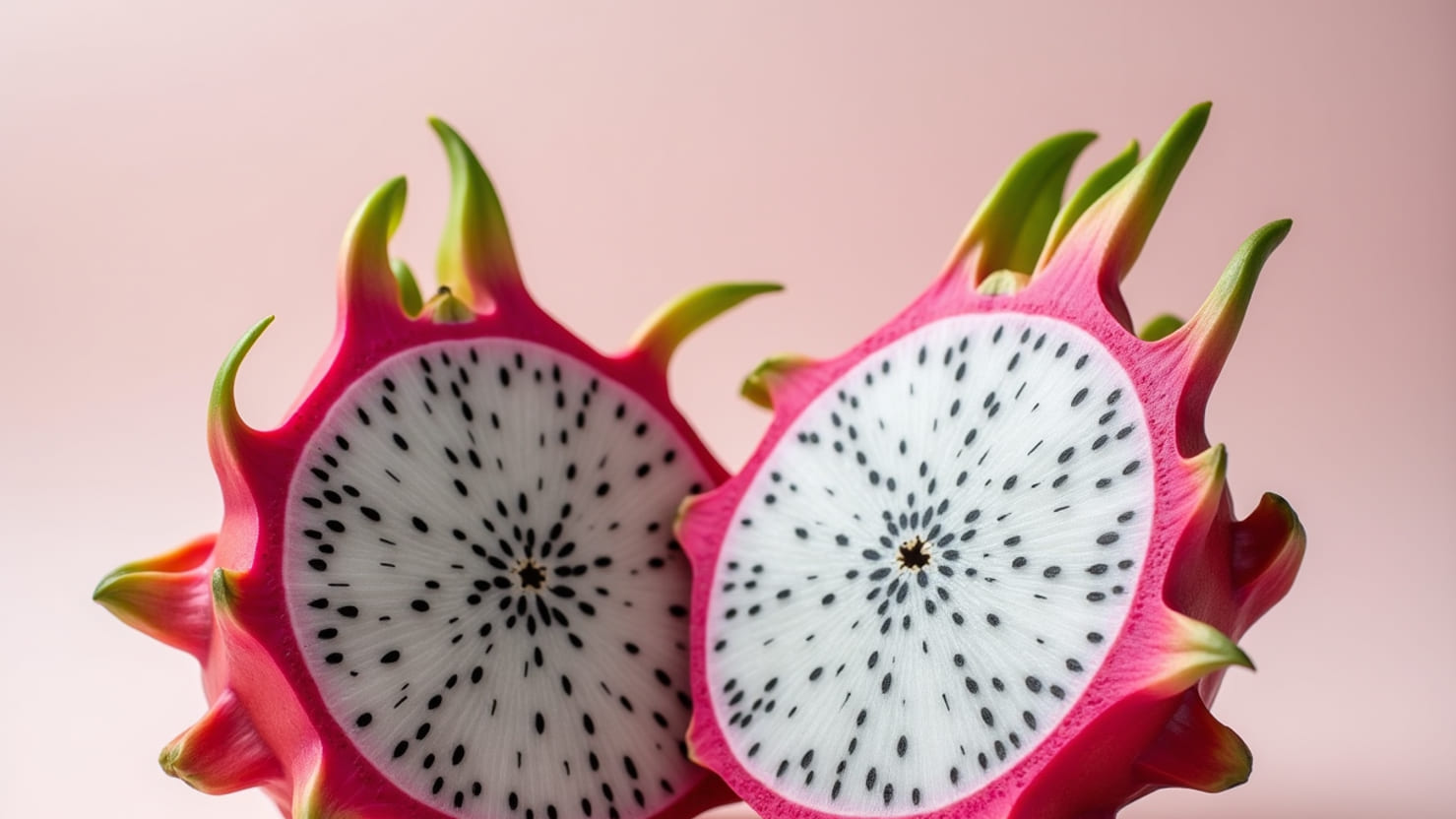
Why the flesh is pink: betacyanins, not dye
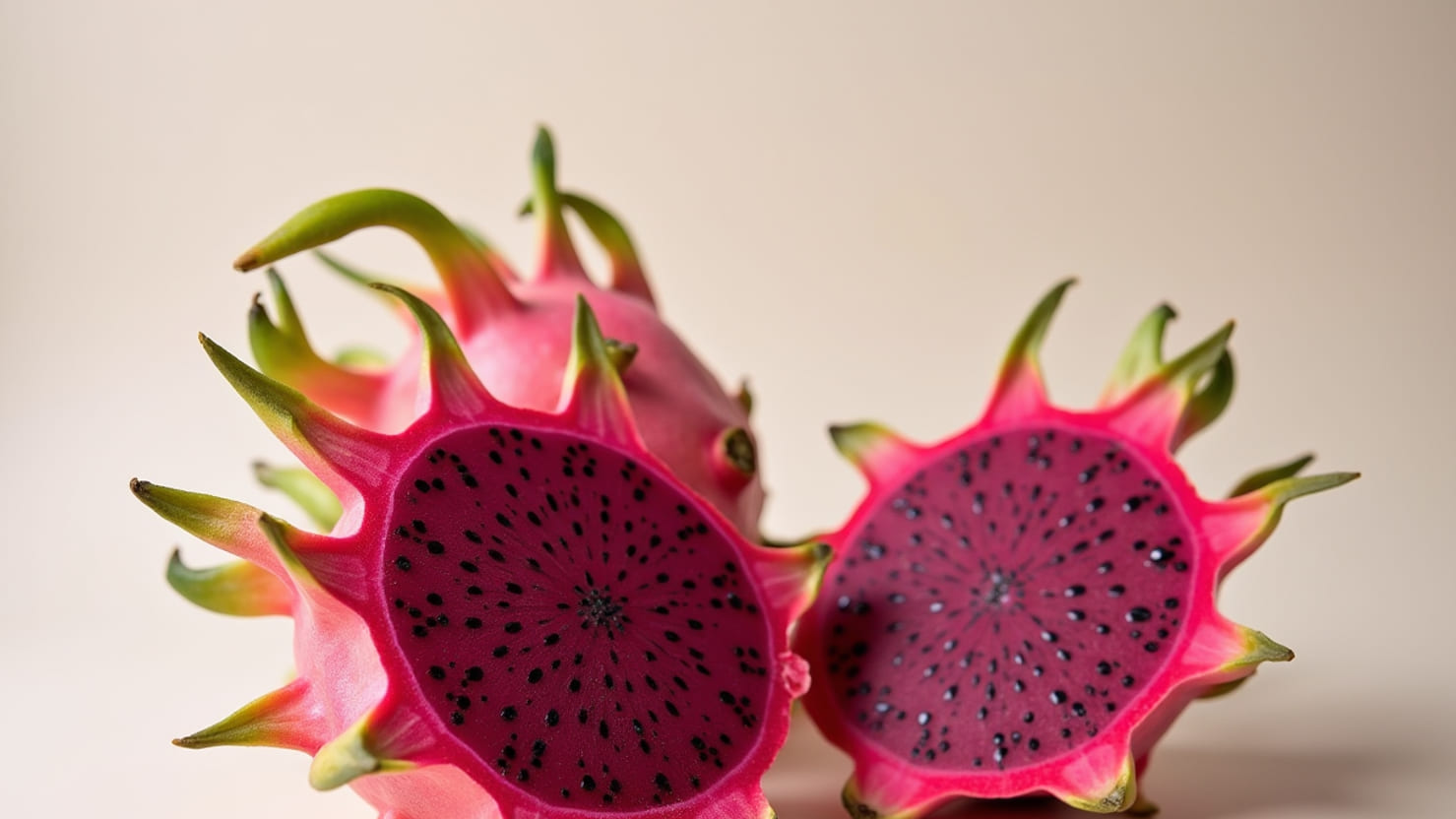
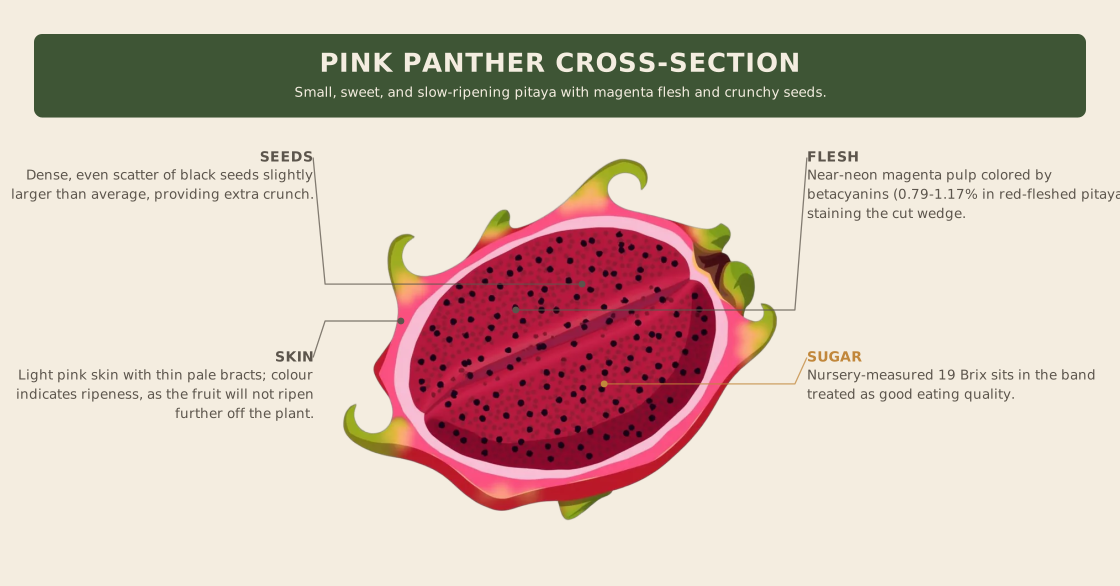
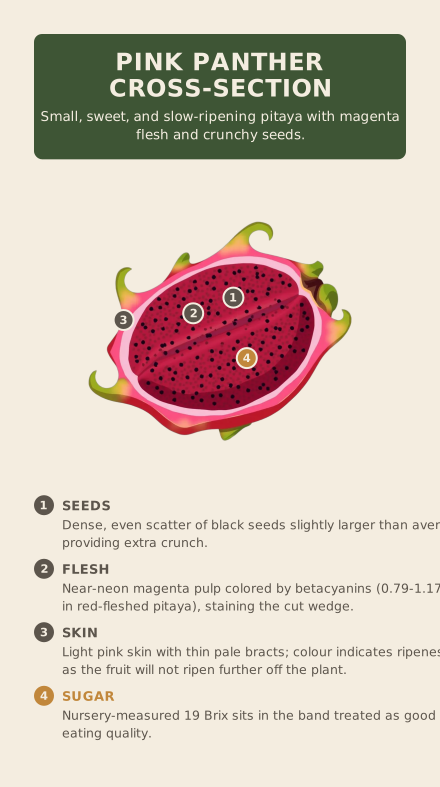
The vivid pulp of a Pink Panther is not the result of added colorant. It is a biological concentration of betacyanins, the same pigment family that turns beets, Swiss chard, and amaranth deep red or purple.[8] In red-fleshed pitaya, these compounds accumulate in high density. A 2025 review places betacyanin content in red dragon fruit at 0.79-1.17%.[8]
Betacyanins are water-soluble and potent. When you slice a Pink Panther, the juice will bleed into porous cutting boards and stain hands, aprons, and countertops. Use a non-porous surface and wash tools immediately.
Color is not a quality guarantee. While the intensity of the betacyanin pigment tracks with fruit maturity, a deep pink hue does not automatically mean the fruit is sweet or flavorful. A light-pink-skinned fruit can still carry near-neon pulp. Always rely on the skin color and days-after-flowering metrics for harvest timing, not just the internal flesh tone.
Because the pigment is concentrated in the pulp, the contrast between the pale skin and the intense interior is stark. This is a natural trait of the Selenicereus genus, not a defect or a sign of over-ripeness. The staining power is simply a side effect of the plant’s natural defense and attraction mechanisms, which rely on bright colors to signal ripeness to seed dispersers.
Flavour and Brix: what 19 on a 0-32 scale means
Pink Panther is a flavor-first cultivar that trades volume for intensity. Growers describe the taste as a balance of acidity and sweetness, refreshing when chilled, with notes of berries and melon.[4] The seeds are slightly larger than usual, adding a distinct crunch to the bite.[5] The single published sweetness figure for this clone is 19 Brix, measured by the nursery that has sold it since acquiring stock from a California tropical nursery.[4]
A raw Brix number tells you how much sugar is present, but not how the fruit tastes. The UC Davis postharvest centre evaluates top-quality pitaya using a minimum Total Soluble Solids to Titratable Acidity (TSS:TA) ratio of 40, along with firm green bracts and no defects.[3] Growers describe Pink Panther as refreshing. Independent quality standards use a TSS:TA ratio of 40 as a benchmark for top-grade fruit.
The species frame is an oval fruit about 10 by 6 cm weighing roughly 150-600 g, with occasional fruit reaching 1 kg.[8] Pink Panther sits at the low end of that weight range.[8] You are growing it for the high-quality eating experience defined by that balanced 19 Brix profile, not for bulk production.[4]
Fruit size, ripening and the orange stage
Pink Panther produces small, oblong fruit with a light skin. This size is the cultivar’s most commonly cited drawback. The fruit sits at the low end of the species range, which spans roughly 150 to 600 grams for oval fruit about 10 by 6 centimeters[8]. Growers note the fruit is more oblong and lighter-skinned than varieties like Malaysian Purple[5]. While the plant buds with less biomass and fruits at a smaller size than typical dragon fruit, the yield is consistent[5].
Ripening follows a distinct two-stage pattern. The fruit holds as a tiny green berry for a long time, showing little visible growth. Then, it colours fast and fattens soon after, passing through a brief orange-tinged stage before the skin settles to light pink[5]. This rapid final swell is your cue to watch closely.
Non-climacteric reality: Dragon fruit does not ripen after harvest. Lab measurements show respiration runs 41-79 ml CO2/kg/h at 20-23 C, while ethylene production stays flat at 0.01-0.09 ul C2H4/kg/h with no rise at ripening[3]. Ethylene treatment does not start colour development[3]. Once you cut the fruit, its quality is locked in.
Because the fruit will not sweeten or soften further off the vine, the colour change is your last chance to wait. It is also the hard pick signal. Use the 27 to 33 day minimum after flowering as your second index to confirm maturity[3]. Waiting for the skin to fully colour ensures you capture the berry-and-melon flavour profile without risking an under-ripe, bland harvest.
Pollination: self-fertile, and why that claim needs a caveat
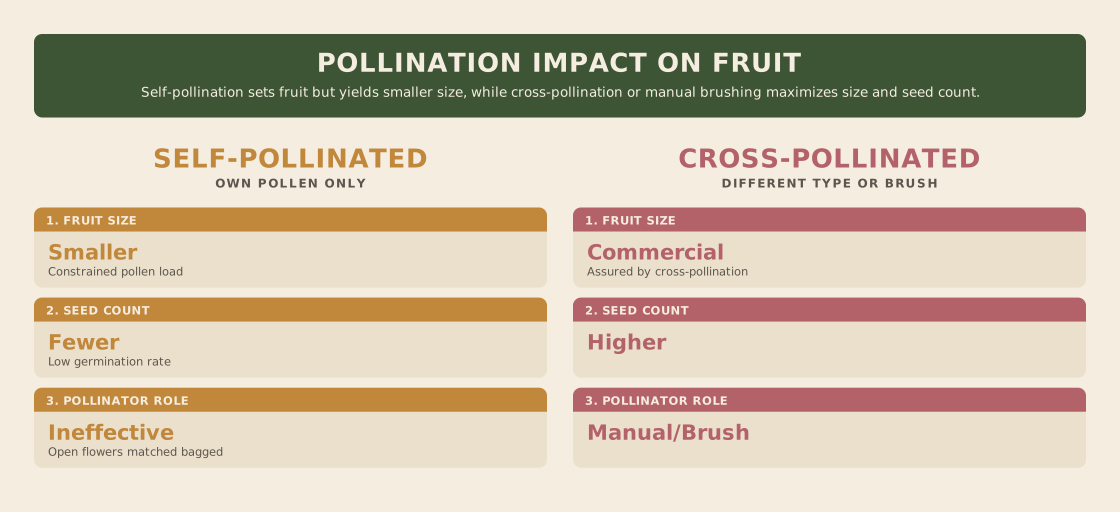
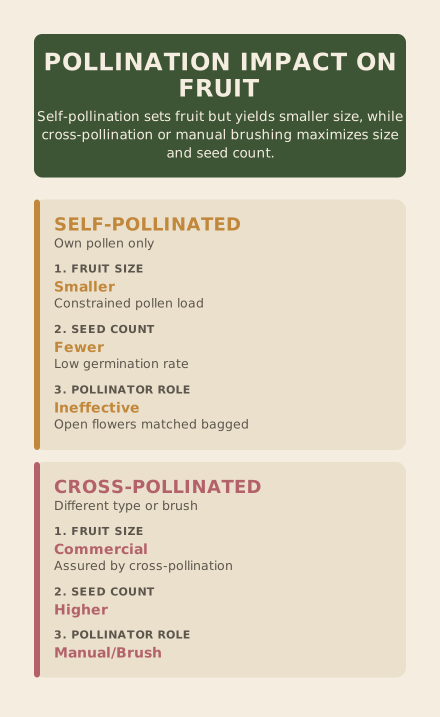
The nursery that distributes Pink Panther states plainly that the variety sets fruit with its own pollen.[4] This is a genuine advantage. A solo planting will still produce a crop, and the plant serves as a reliable pollen donor for neighbors that cannot self-pollinate.[4] However, treat the "self-fertile" label with caution. UF/IFAS concedes that data on self-incompatibility for named pitaya cultivars is not well documented, making specific claims unreliable at best.[1] Red-fleshed types are frequently self-incompatible, so assuming Pink Panther behaves like a white-fleshed variety is risky.
In a 2025 trial of the self-compatible red-fleshed 'Royal Red', bagged flowers did set fruit, proving self-compatibility.[2] But the resulting fruit was smaller and had fewer seeds than those from properly pollinated blooms.[2] The trial also found that open-pollinated flowers performed no better than bagged ones, meaning insect visitors were ineffective.[2] The only way to get commercial-size fruit was manual transfer of pollen with a brush or duster.[2]
For Pink Panther, the practical rule is simple. You can grow it alone and get fruit, but you will get small fruit. If you want larger yields, plant a second genetic type nearby and hand-pollinate.[1] UF/IFAS notes that cross-pollination between different types assures better set and size, even where self-compatibility exists.[1] Do this at night or in the early morning while the large, bell-shaped flower is fresh.[1] Since Pink Panther is a slow grower that is easily outcompeted, keeping it on its own support makes this hand-work easier to manage without fighting over space with vigorous neighbors.[5]
Growing Pink Panther: the care table
Pink Panther demands specific handling because of its slow growth habit. It is easily outcompeted by vigorous neighbors, so give it its own post to ensure it reaches fruiting size. The plant buds at lower biomass than typical dragon fruit, but its development is sluggish. Use the table below to manage its basic needs.
| Factor | Requirement | Pink Panther Note |
|---|---|---|
| Temperature | 65-77 F optimum; up to 100 F; damage below 31 F of long duration. Zones 10-11, or 9a-9b with protection.[8] | Recovers rapidly from light freezing injury.[1] |
| Light | Full sun. Provide 30% shade for the first 3-4 months after planting to prevent stem sunburn.[1] | Too much shade later costs yield.[1] |
| Water | Dry rest for bloom induction, then water from flowering to harvest. No wet feet. | Excess moisture drives bacterial and fungal disease.[1] |
| Soil | Well-drained with organic matter. Tolerates saline conditions.[1] | Thrive where manure is worked in.[1] |
| Support | Strong trellis carrying hundreds of pounds. Sit 15-25 ft from structures. Use a 4-6 in pole with a rebar cap. Avoid bare wire.[1] | Isolate on its own post to prevent competition. |
| Feeding | 0.25 lb every 2 months in year 1. Rise to 0.5-0.75 lb in 3-4 applications from year 4.[1] | Wait about a month after planting before first feed.[1] |
| Pruning | 1-3 times a year, after harvest. Pruning induces flowering.[1] | Train single stem to top, then cut tip to force branching.[1] |
Pests and diseases to expect on a pink-fleshed planting
Dragon fruit is a cactus, but it does not shrug off fungal and bacterial issues the way a desert succulent might. Pruning is the most effective cultural control. Wet canopies and open wounds invite pathogens, so your goal is to keep sunlight and air moving through the stems. A dense tangle holds moisture against the skin, creating the perfect microclimate for rot. Regular pruning to open the center of the plant is the most effective cultural control you can use.[1]
When you do see issues, identify the culprit before reacting. The table below maps common problems to their causes and the practical fix. Note that Pink Panther’s slow growth and smaller biomass mean it has less reserve to fight off heavy infestations, so early intervention matters more here than with vigorous green-fleshed varieties.
| Problem | Cause | Cultural Control |
|---|---|---|
| Stem/fruit canker | Neoscytalidium dimidiatum | Prune out affected stems well below the lesion; improve air flow |
| Fruit/stem rot | Colletotrichum gloeosporioides, Bipolaris cactivora | Remove rotting fruit immediately; avoid overhead watering |
| Bacterial spots | Xanthomonas compestris | Sanitize tools between cuts; prune to reduce canopy humidity |
| Surface pests | Mites, thrips, scale, mealybugs | Strong water spray; prune dense areas to expose pests |
| Chewing pests | Leaf-footed bugs, slugs | Hand-pick; use barriers; remove debris at base |
| Fruit raiders | Raccoons, possums, rats, birds | Netting; harvest promptly at color change |
Ants often follow scale or mealybugs, so if you see trails, look for the sap-suckers they are farming. Vertebrate raiders are a particular risk for Pink Panther because the fruit is small and easy to snatch. Since the skin color is the ripeness signal, do not wait for softness. Harvest as soon as the pink develops to stay ahead of the birds and raccoons.[1]
Harvest, storage and using the fruit
Timing the cut is the difference between a sweet berry-melon treat and a bland, watery disappointment. In Florida, the harvest window generally runs from June to November, but you should judge readiness by the skin, not the calendar. Wait until the fruit is well-coloured and mature. Dragon fruit is non-climacteric, meaning it stops ripening the moment you cut it. If the skin is still green or only partially blushed, the sugars will never develop further on the counter.
Use sharp hand clippers to remove the fruit. Cut the peduncle (the stem connecting the fruit to the branch) flush with the fruit surface. Leaving a long, jagged stem stub invites rot and makes the fruit awkward to handle. Because Pink Panther sets small, oblong fruit, be gentle; the skin is thin and bruises easily if you twist rather than clip.
Once picked, red-skinned pitaya holds for 4 to 5 days at room temperature. For longer storage, place the fruit in plastic bags in the refrigerator. Here, the fruit can last several weeks. However, do not shove them into the coldest drawer. The commercial cold-storage floor for red pitaya is 10 C (50 F), and chilling injury can develop at 5-6 C (41-43 F).[1] A counter bowl or the warmest part of your fridge is safer than the vegetable crisper.
Stain warning: The betacyanin pigment in Pink Panther is potent and water-soluble. Use a non-porous cutting board and wash knives immediately after slicing to prevent permanent staining on wood or porous stone.
When you do slice it open, the flesh is dense. Raw dragon fruit is about 84% water, with 15.2 g of carbohydrate per 100 g, of which 9.75 g are sugars.[8] It provides 3.1 g of fibre, 116 mg of potassium, and 4.3 mg of vitamin C per 100 g, with negligible protein and fat.[8] Red-fleshed types like Pink Panther are drier and more fibrous than white-fleshed varieties. UF/IFAS data shows red-fleshed pulp at 83% water and 0.7-0.9 g fibre per 100 g, compared to 89% water and 0.3 g fibre in white-fleshed types.[1] This lower water content concentrates the berry-and-melon flavor, making the bite more substantial and less watery.
Where Pink Panther fits in a planting
Pink Panther is not a commercial block variety. It is a flavor-first choice for the home gardener who wants one reliable, self-fertile pink fruit for the kitchen. While it sets fruit with its own pollen, it is notoriously small and a slow grower. This makes it a poor candidate for the high-density plantings that drive commercial production, where 1,100-1,350 plants per hectare take up to 60 months to reach full yield of 20-30 t/ha.[8] Instead, view Pink Panther as a specialty accent or a pollen donor. Its self-fertility is a practical asset: it fruits alone and donates pollen to neighbors that cannot.[4]
Because self-incompatibility is common in pitaya and poorly documented for many named cultivars, planting genetically different types ensures better fruit set and size.[1] For a deeper look at managing these interactions, see our dragon fruit pollination guide, which covers self-fertile versus cross-pollinating varieties. The table below outlines how Pink Panther compares to other stock we carry, based on their primary role in a mixed planting.
| Variety | Primary Role | Fruit Profile |
|---|---|---|
| Pink Panther | Self-fertile accent; pollen donor | Small, 19 Brix, berry-melon flavor |
| White-fleshed types | White-fleshed contrast | Large, mild, high water content |
| Red-fleshed commercial types | Heavy cropper | Medium-large, red flesh, vigorous |
| Large fruit producers | Large fruit producer | Big, red flesh, commercial frame |
| Vigorous support types | Vigorous support | Large, red flesh, fast growth |
Pairing Pink Panther with a vigorous red creates a functional garden ecosystem. The larger plants provide the biomass and visual structure, while Pink Panther delivers a unique, intensely flavored fruit that stains the cutting board and stands out on the plate. This combination leverages the strengths of each variety without forcing Pink Panther to compete for light or space, which it does poorly on its own.[5]
References
- Pitaya (Dragonfruit) Growing in the Florida Home Landscape, HS1068 (Crane & Balerdi, UF/IFAS Extension): pollination and undocumented self-incompatibility, 2-3 genetic types, flower size and hand pollination, climate 65-77F optimum / 100F max / 31F freeze injury, 30% shading, spacing and trellis spec, cutting cure and training, fertiliser schedule, irrigation and dry rest, named pathogens and pests, harvest and 4-5 day shelf life, Table 1 species and Table 3 pulp composition, UF/IFAS Extension (EDIS HS303/HS1068) (2020).
- Evaluation of Different Procedures to Pollinate Self-Compatible 'Royal Red' Pitaya Under Protected Cultivation (Hueso, Bouzar & Cuevas): Plants (Basel) 14(19):3102, bagged-flower self-compatibility, smaller fewer-seeded fruit from constrained pollen, brush/duster versus blower versus open pollination, open-pollinated matching bagged, MDPI / Fundacion Grupo Cajamar and Universidad de Almeria (2025).
- Dragon Fruit produce fact sheet (Maturity and Quality, non-climacteric behaviour): minimum 27-33 days after flowering plus skin colour as maturity indices, minimum TSS:TA ratio of 40 and firm green bracts as quality index, respiration 41-79 ml CO2/kg.h at 20-23C, ethylene 0.01-0.09 ul/kg.h with no climacteric rise, red pitaya optimum storage 10C with chilling injury at 5-6C, UC Davis Postharvest Research and Extension Center, Department of Plant Sciences / UC ANR (2011).
- Pink Panther - H. setaceus X H. guatemalensis: product page stating self-fertile, setaceus x unknown parentage, balance of acidity and sweetness, Brix 19 on a 0-32 scale, pollen useful for crossings, stable grower, stock acquired from a California tropical nursery, price $25-$35, Spicy Exotics (specialist nursery) (2026).
- Pink Panther | Dragon Fruit Obsession cultivar record: H. guatemalensis x setaceus cv. Pink Panther, Pink Diamond seedling synonym, self-fertile with protruding stigma and hand-pollination advice, berry-and-melon flavour with larger crunchy seeds, small size as the stated drawback, more oblong and lighter skinned than Malaysian Purple, slow growth and outcompeted, decent sun tolerance, buds at low biomass with red tips, long green stage then rapid colour and swelling through an orange tinge, Dragon Fruit Obsession (grower cultivar catalogue) (2026).
- Pink Panther Dragon Fruit Cultivar: Rixford x Houghton cross, Paul Thompson selection, Guatemalan x Setaceus lineage, related cultivars PT S-7, Sugar Dragon and Voodoo Child, Pitahaya Tree / dragonfruitplants.com cultivar directory (2026).
- Selenicereus setaceus (Salm-Dyck ex DC.) A.Berger ex Werderm. name record, with POWO/IPNI taxonomic cross-links: the accepted name behind the nursery 'Hylocereus setacus' usage, International Plant Names Index (2026).
- Dragon fruit (Selenicereus/Hylocereus): genus and native range, betacyanins and betanin as the red-purple pigments, fruit 150-600 g and up to 1 kg, oval 10 x 6 cm, 4-8 weeks pollination to harvest, self-pollination versus cross-pollination and self-fertile breeding, 3-6 flowering cycles a year, 40C tolerance, short frosts, zones 10-11 and marginal 9a-9b, commercial density 1100-1350/ha, up to 60 months to full production at 20-30 t/ha, raw composition 84% water, 15.2 g carbohydrate, 9.75 g sugars, 3.1 g fibre, 4.3 mg vitamin C, 116 mg potassium per 100 g, Wikipedia (secondary overview, cited here for the species-level frame and figures that trace to USDA and Morton's review) (2026).
Illustration generated for this article