Seoul Kitchen Dragon Fruit: Honest Review
Seoul Kitchen is a white-fleshed, pink-skinned dragon fruit cultivar sold by specialty nurseries as self-pollinating, with a clean smooth pulp and the least earthy aftertaste of the whites according to its main vendor. The reality: the only extension-measured numbers we found put it at 12.18 Brix in a UCCE San Diego trial, rated marginal for eating quality but vigorous, prolific, and longer-seasoning than other whites. It is a reliability and season-length variety, not a sweetness champion. Extension records list the origin as Florida, and the name is a trade name on a Selenicereus undatus plant.
UCCE recorded 41 days from bloom to harvest, with a window running mid-July through December. This clone is valuable as a pollinizer, offering heat and cold tolerance above average. If you want a workhorse that sets fruit without hand pollination and keeps the orchard productive, see our self-fertile cuttings.
Seoul Kitchen at a Glance
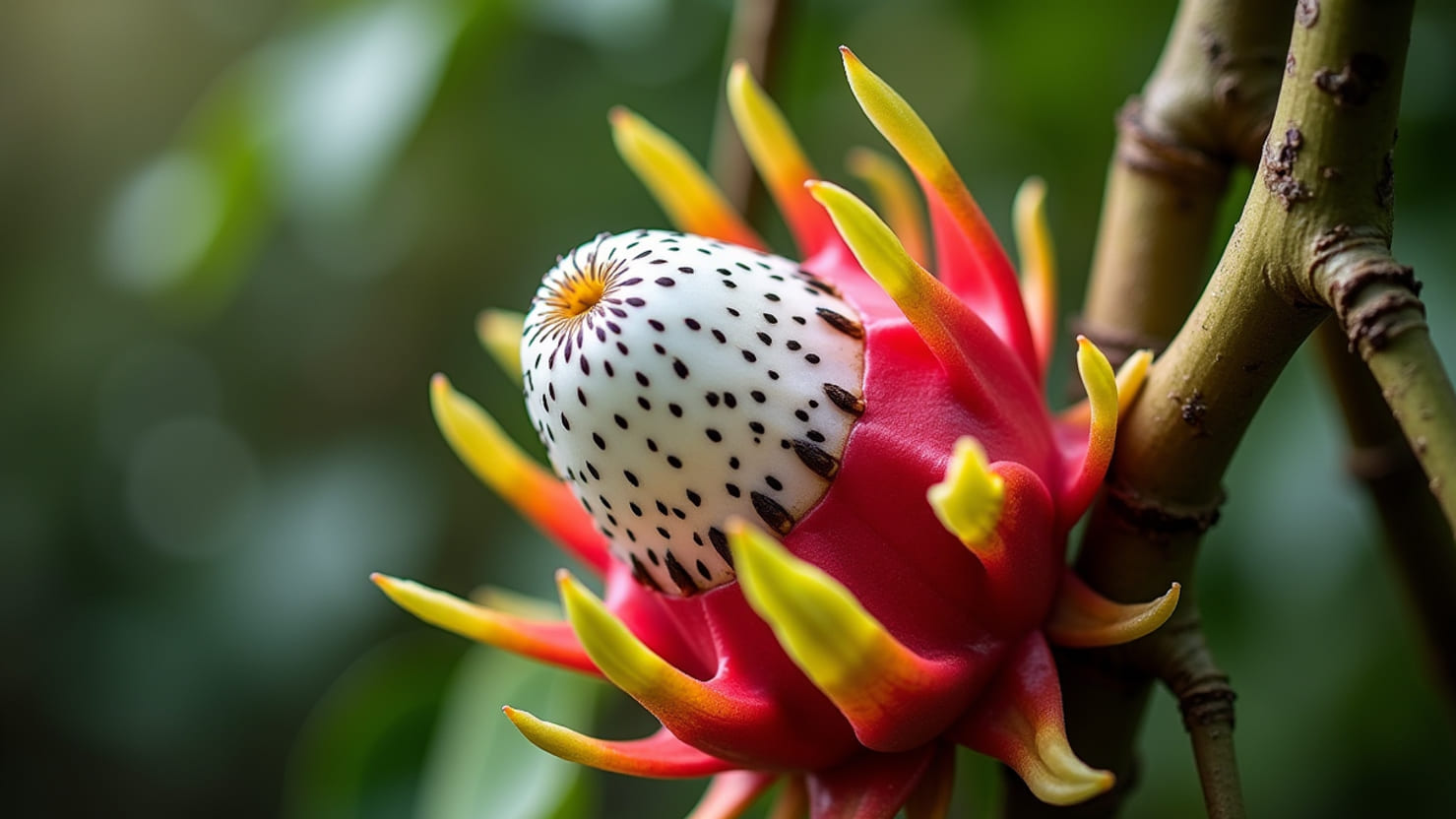
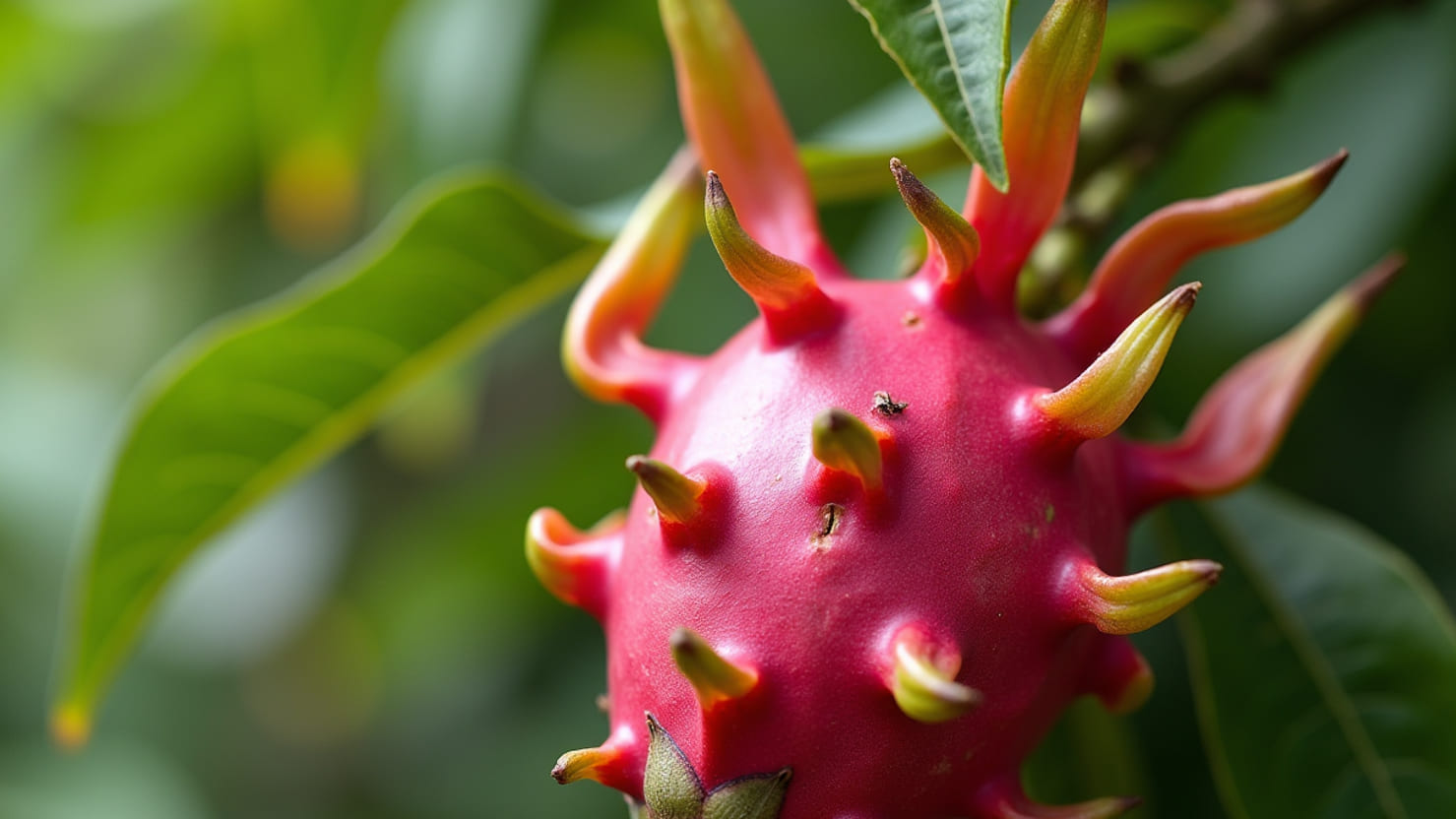
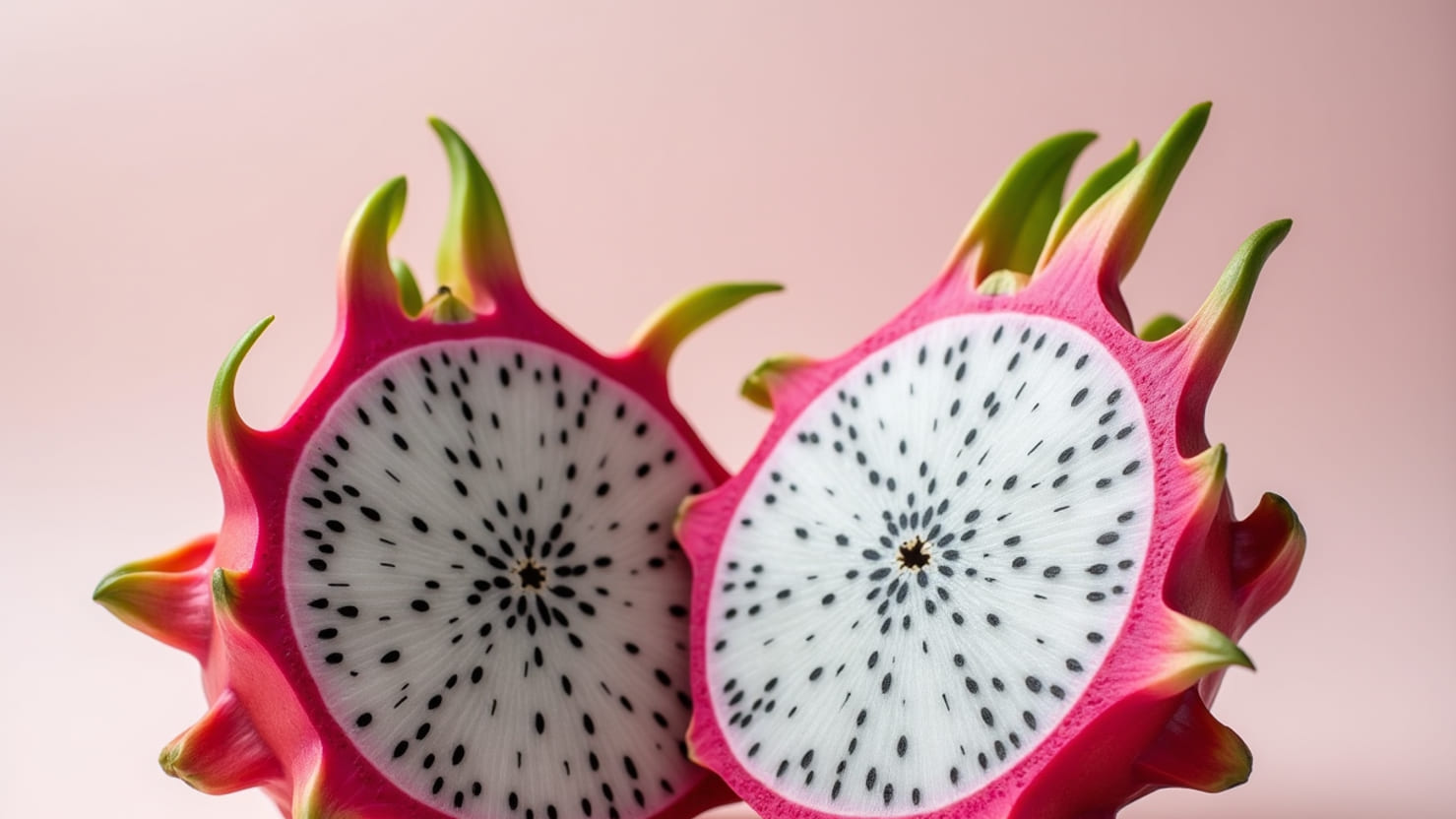
The numbers tell a story of consistency rather than spectacle. UC Cooperative Extension measured a single fruit at 518 g, which places it mid-range for whites in peer-reviewed literature.[5] Vendor weights vary, but the extension measurement is 518 g.[4] The flesh is firm and white, wrapped in thick, pinkish-red skin covered in numerous short, compact bracts.[1]
Sweetness data varies by source. The extension trial recorded 12.18 Brix, a figure that aligns with the lower end of the 12 to 18 percent Brix range typical for white-fleshed varieties.[5] A commercial directory claims 16 to 18 Brix, but this is marketing copy rather than lab-verified data.[3] What is verified is the timing. UCCE tracked 41 days from bloom to harvest, placing Seoul Kitchen squarely within the 30 to 50 day ripening window standard for the species.[5] In Southern California, this translates to a harvest window running from mid-July through December, extending the season for growers who need fruit when other whites have stopped producing.[1]
The plant itself is a workhorse. It features vigorous growth with thick, short stems that develop a distinctive zebra-striped pattern as they mature.[1] It tolerates heat and cold better than average, making it a resilient choice for varied climates.[1] While its commercial fruit potential is rated as limited due to marginal eating quality, its value as a self-fertile pollinizer is high, ensuring neighbors set fruit even when hand-pollination is skipped.[1]
Where the Name Came From, and Where the Plant Came From
The name "Seoul Kitchen" suggests a Korean origin, but the botanical and trade records tell a different story. Buyers often confuse the name with the origin. While one commercial directory claims the plant was selected by a Korean agricultural station for cooking, no primary source supports this. The claim contradicts the documented US trade history and ignores the plant’s native climate. Here is what we know: Seoul Kitchen is a US trade cultivar of *Selenicereus undatus*. The name is a marketing label, not a reflection of its breeding location.
| Source | Claimed Origin | Context |
|---|---|---|
| UC Cooperative Extension | Florida | Describes it as similar to the cultivar George. This is the only sourced provenance in extension records.[1] |
| Spicy Exotics | California | States stock was acquired from a tropical nursery in California.[2] |
| Pine Island Nursery | None | Lists the plant as *Hylocereus undatus* with no origin story provided.[4] |
| Commercial Directory | Korea | Asserts a Korean agricultural-station selection for cooking. This claim lacks primary support and contradicts the Florida/California trade path.[3] |
Botanically, the plant is *Selenicereus undatus* (Haw.) D.R.Hunt, with *Hylocereus undatus* as a synonym. Its native range is Mexico to Honduras, where it grows as an epiphytic cactus in seasonally dry tropical forests.[6] The extension lists Florida origin, contradicting the Korean claim. The "Korean" narrative appears to be back-derived from the name, a common occurrence in trade cultivars where catchy titles replace documented lineage.
How It Actually Tastes: 12.18 Brix Is Not a Coincidence
Seoul Kitchen sits at the bottom of the sweetness spectrum for white-fleshed pitaya, and that is a feature of its biology, not a defect in your soil. Brix measures the percentage of soluble solids in the juice. Peer-reviewed literature places the typical range for white-fleshed varieties between 12 and 18 percent[5]. The UC Cooperative Extension trial in San Diego County measured this specific clone at 12.18 Brix[1]. That number is not an outlier; it is the floor of the species’ normal range.
You may see listings claiming 16 to 18 Brix for this cultivar. Treat those figures as catalogue copy rather than lab data. They describe what the fruit could theoretically achieve under ideal conditions, not what the extension trial recorded in the field. The 12.18 measurement is the only verified number we have, and it aligns with the extension’s rating of the eating quality as marginal[1].
However, sweetness is not the only factor that determines whether a dragon fruit tastes good. For many gardeners, the dealbreaker with white pitaya is not low sugar but off-flavour. A muddy, earthy aftertaste can ruin even a high-Brix fruit. This is where Seoul Kitchen earns its reputation. Growers report that it has the least earthy taste of the white-fleshed varieties, offering smooth, clean pulp that is excellent when chilled and eaten out of hand[2]. This sensory claim is supported by vendor experience, though it lacks a formal sensory panel score[2].
Buyer Profile: Choose Seoul Kitchen if you want a mild, clean fruit for the fridge and a plant that keeps producing from mid-summer into winter. Skip it if you are chasing the intense, high-Brix sweetness of 18-plus Brix dessert fruits. For that level of sugar, look to red-fleshed or yellow varieties instead.
Verifying Your Cutting
Mislabelled cuttings are the primary risk when buying an unusual white-fleshed variety. You cannot taste a cutting, but you can inspect its structure. The UC Cooperative Extension provides a specific morphological description that acts as a field guide for verification. If your plant does not match these physical traits, the tag is likely wrong.
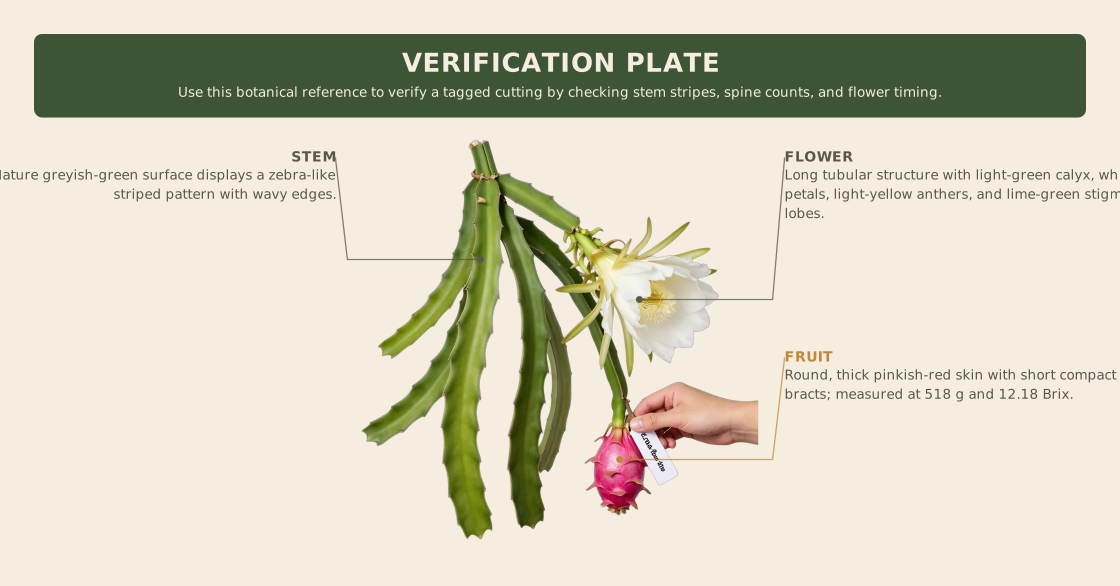
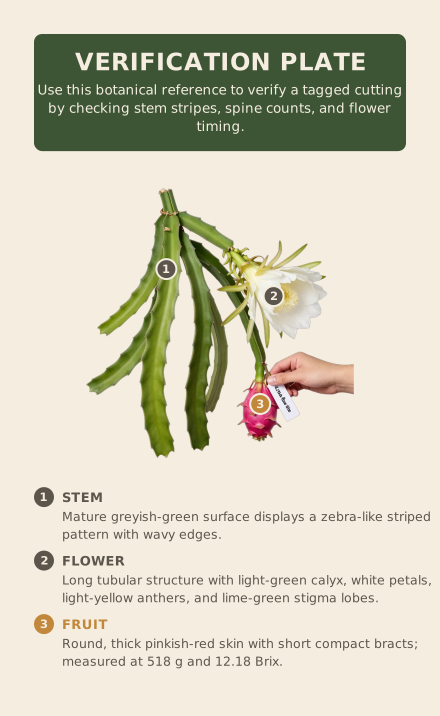
Start with the stems. A genuine Seoul Kitchen cutting will have thick, short stems. As the plant matures, the surface should turn a greyish-green color and develop a distinctive striped pattern resembling zebra stripes. This visual marker is hard to fake and easy to spot on established growth. If your stems are thin, long, or uniformly green without the striping, you have a different cultivar.
Next, examine the areoles. The spine clusters on this variety are arranged in a circular pattern. Each cluster contains 4 to 6 spines, and the spines themselves are short, measuring only 3 to 7 mm long. This compact, circular arrangement is a key identifier. Many other white-fleshed varieties have different spine counts or arrangements, so this detail helps separate Seoul Kitchen from look-alikes.
Flower anatomy offers the most definitive proof. When the plant blooms, look for long, narrow, tubular flowers. The petals should be white. The calyx, which is the leafy structure at the base of the flower, must be light-green. Inside the flower, the anthers should appear light-yellow, and the stigma lobes, which are the female reproductive parts, must be lime-green. This specific color combination is unique to the clone described by extension services.
Verification Tip: Do not rely on fruit color alone. Many white-fleshed varieties have pinkish-red skin. Use the stem striping, spine cluster structure, and flower color details to confirm the identity before you wait for the first harvest.
Flowers, Fruit and a Longer Season Than Other Whites
The real value of Seoul Kitchen is not in the sugar content of the pulp, but in the sheer volume and duration of its production. In the UC Cooperative Extension trial, this clone was rated as a vigorous, prolific bloomer with a fruiting season that outlasted other white-fleshed cultivars tested alongside it.[1] While the eating quality was rated marginal, the plant’s ability to keep producing fruit from mid-July through December makes it a standout for growers who want a steady supply rather than a single, short glut.[1]
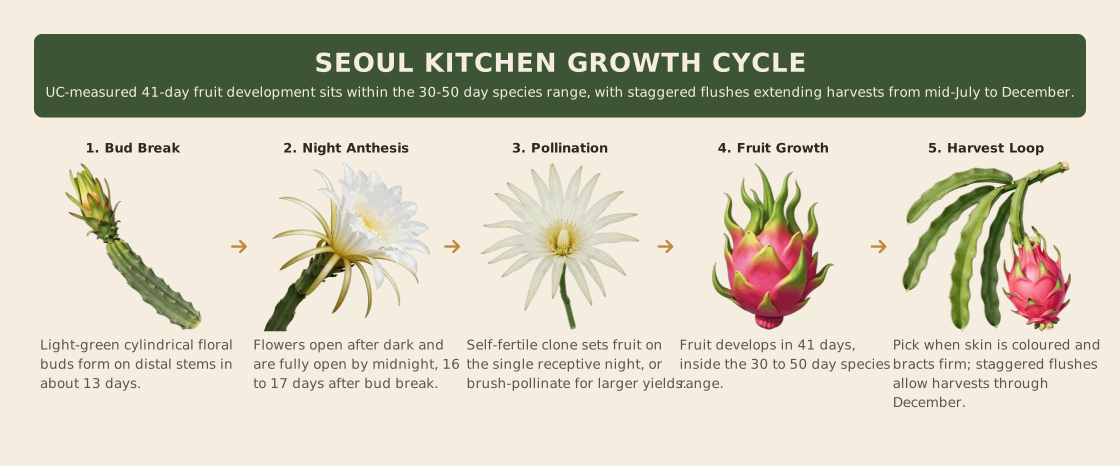
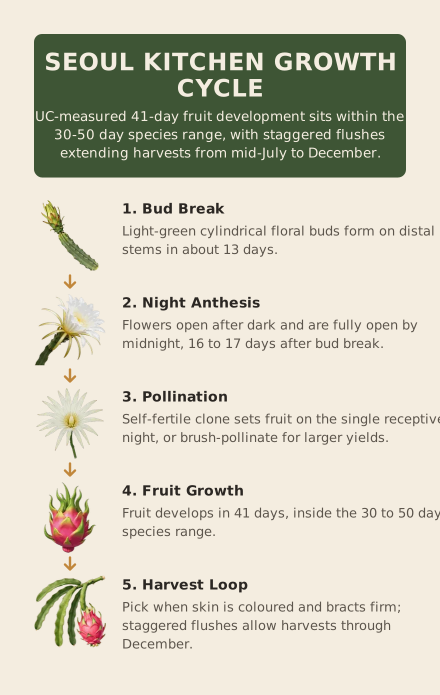
Understanding the biology behind this endurance requires looking at species-level data, as specific bud-break numbers for this clone are not published. The genus name Selenicereus derives from the Greek Selene, referencing the nocturnal nature of the flowers, while undatus describes the wavy edges of the stem.[5] This night-blooming habit dictates the grower’s schedule. Flowers typically begin opening around 7:30 to 8:00 pm and are fully open by midnight, releasing 4 to 9 mL of nectar per bloom.[5] If you are hand-pollinating, this is your window. A plant may produce one to seven flowers per flush, and the timeline from floral bud to anthesis is roughly 13 days for bud development followed by 16 to 17 days to reach full bloom.[5]
The extension trial measured 41 days from bloom to harvest for Seoul Kitchen.[1] This falls squarely within the species-level range of 30 to 50 days from pollination to ripening.[5] Practically, this means a flower opened in late July will be ready for picking within the mid-July to December window, contributing to the long harvest season. Because the season is extended, flushes are staggered, preventing the overwhelming harvest that can occur with shorter-season varieties.
| Stage | Timing / Detail | Grower Action |
|---|---|---|
| Bud Development | ~13 days to cylindrical bud 16-17 days to anthesis |
Monitor for night opening |
| Anthesis | Opens 7:30-8:00 pm Fully open by midnight |
Hand pollinate if needed |
| Ripening | 41 days (measured) 30-50 days (species range) |
Count from bloom date |
| Harvest Window | Mid-July to December (So. CA) | Expect staggered yields |
Do You Have to Hand-Pollinate It?
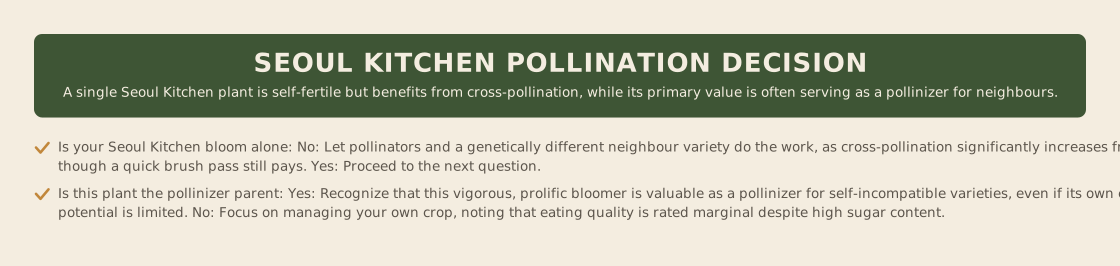
Vendors claim it is self-pollinating, but the complete answer requires understanding how dragon fruit genetics actually work. When a nursery tag promises that Seoul Kitchen sets fruit without hand pollination, that is a specific, valuable claim about this particular clone, not a guarantee for the species as a whole. Pitaya flowers are bisexual, yet self-fertility is a cultivar lottery. Peer-reviewed literature confirms that while some S. undatus cultivars are self-compatible, others are self-incompatible and rely entirely on pollinators to set fruit.[5] This is why the self-fertile status of Seoul Kitchen is a distinct trait worth paying for, rather than a default setting for all white-fleshed pitaya.
Even with a self-compatible variety, biology offers a clear incentive to plant more than one. Cross-pollination, whether within the same species or between different ones, significantly increases both fruit set and fruit weight, even in genotypes that can technically self-pollinate.[5] A lone Seoul Kitchen plant will produce fruit, but a planted pair or a mixed orchard block will yield heavier, larger crops. The decision figure below illustrates this trade-off: single-plant simplicity versus multi-plant productivity.

If you are managing a small space or want to maximize the potential of your existing stock, brush pollination remains the most reliable method. For a step-by-step walkthrough of the brush-and-duster technique, see our dragon fruit pollination guide, which covers self-fertile versus cross-pollinating varieties. We stock specific pollinizer partners that flower in sync with Seoul Kitchen to boost your yields without requiring daily manual intervention.
Growing Seoul Kitchen
Seoul Kitchen is a forgiving plant in the garden, even if its fruit is a modest performer on the table. The practical reason to choose it over a fussy red variety in an inland or coastal-margin garden is its resilience. UC Cooperative Extension rates its tolerance of both cold and heat as higher than average for the crop, and notes it usually grows well in full sun.[1] That hardiness buys you season length and reliability, which matters more than peak sweetness in a home planting.
Expect a vigorous grower. The extension trial describes it as a strong, prolific bloomer with thick, short stems.[1] Those heavy, top-heavy stems need a sturdy trellis, not a flimsy post. If you are planting near self-incompatible neighbors, this heavy flowering is the point: the pollen donated to them is exactly the role UCCE assigns this cultivar when it says commercial fruit potential is limited but pollinizer value is real.[1]
For water and soil, remember what the plant is. It is an epiphytic cactus from a seasonally dry tropical biome, adapted to rainfall ranging from 350 to 2000 mm in its ancestral range.[5] That means fast drainage and a dry rest, not rich wet soil. It is drought-adapted, not bog-adapted. Let the top inch feel dry before watering, and skip the heavy compost mulch that holds moisture against the stem.
| Care Factor | Seoul Kitchen Spec | Source Class |
|---|---|---|
| Sun | Full sun | Extension trial |
| Climate tolerance | Above-average cold and heat tolerance | Extension trial |
| Vigour | Vigorous; prolific bloomer; thick, short stems | Extension trial |
| Soil and water | Fast drainage; dry rest; drought-adapted | Biome data |
| Commercial fruit potential | Limited; plant as home-garden and pollinizer | Extension trial |
For full watering schedules, soil mixes, and trellis specs, see our complete dragon fruit care guide. This section covers only what is specific to this cultivar.
Should You Buy a Seoul Kitchen Cutting?
Buy this cutting if you want a self-fertile white that carries fruit through winter, forgives heat and cold better than most, and serves as a pollinizer for a red or yellow you already grow. Skip it if your whole order is chasing the highest Brix on the menu, because the only measured number on this clone is 12.18.[1] That figure places it squarely in the lower tier of eating quality, rated marginal by extension trials despite its vigorous growth and prolific blooming habits.[1]
Think of Seoul Kitchen as the backbone of a mixed planting rather than the star of the show. Its value lies in its ability to set fruit without hand pollination and to extend your harvest window well into December.[1] If you are already growing a red or yellow variety that struggles with self-pollination, this white clone acts as a reliable partner, donating pollen to neighbors that cannot self-set.[1]
Pairing Seoul Kitchen with Other Varieties
If you are building a collection, consider these honest roles for your other cuttings:
- Albino Ocamponis and Asunta 3: White-fleshed partners that complement Seoul Kitchen’s season length without competing for the same flavor profile.
- American Beauty: A red-fleshed flavor upgrade and cross-pollination partner that benefits from Seoul Kitchen’s abundant pollen.
- Bahamut: A showier heavy-hitter for growers who prioritize visual impact and size over the subtle, clean taste of whites.
- Box Of Fresh: For people who want the fruit without the establishment period, offering immediate gratification while Seoul Kitchen establishes its long-term production.
Choose Seoul Kitchen if you want a resilient, low-maintenance plant that keeps your orchard productive when others go dormant. If you want a dessert fruit that explodes with sugar, look elsewhere.
Sources and Method
We built this profile by separating hard data from marketing copy. The backbone of our analysis is the UC Cooperative Extension San Diego County Small Farms cultivar page. This source provided the only extension-measured numbers for Seoul Kitchen: a 518 g fruit, 12.18 Brix, and a 41-day bloom-to-harvest interval.[5] It also documented the plant’s vigorous growth, zebra-striped stems, and above-average tolerance to heat and cold, while rating its commercial eating quality as marginal.[1] We treated these observations as the ground truth for morphology and performance.
For biological context, we relied on a peer-reviewed 2023 review in the International Journal of Molecular Sciences. This paper clarified that self-fertility is a cultivar-specific trait, not a species guarantee, and explained why cross-pollination still boosts fruit set even in self-compatible varieties like Seoul Kitchen.[5] It also provided the species-level baseline for fruit weight and Brix, allowing us to place the extension data in perspective.[5] Accepted taxonomy and native range were verified through Kew and GBIF records, confirming the plant as Selenicereus undatus with origins in Mexico to Honduras.[6]
Vendor listings from Spicy Exotics and Pine Island Nursery supplied the commercial claims. These sources describe the pulp as smooth with the least earthy aftertaste of white-fleshed varieties and assert self-pollinating capability.[2] We flagged the 16 to 18 Brix figure from a commercial directory as unverified marketing copy, contrasting it with the lab-measured 12.18 Brix.[3] If you have measured this clone, please share your data. Accuracy here depends on community verification as much as published trials.
References
- H. undatus (Seoul Kitchen), San Diego County Small Farms cultivar descriptions: white flesh, pinkish-red skin, 518 g, 12.18 Brix, marginal quality, vigorous and prolific bloomer, longer fruiting season than other white-fleshed cultivars, 41 days bloom to harvest, harvest mid-July to December, zebra-striped stems, 4-6 spine clusters 3-7 mm, tubular flower part colours, origin Florida similar to George, cold and heat tolerance higher than average, limited commercial potential but valuable as a pollinizer, UC Cooperative Extension / ANR, San Diego County Small Farms (2026).
- Seoul Kitchen - Hylocereus undatus: hybrid Hylocereus variety, medium to large fruit 1.0-1.5 lb, smooth pulp excellent chilled, self-pollinating and sets fruit without hand pollination, least earthy taste or aftertaste of the white flesh varieties, stock acquired from a tropical nursery in California, Spicy Exotics (2026).
- Seoul Kitchen dragon fruit cultivar record: white flesh, Brix 16-18, self-fertile, flowering May-September, harvest 30-35 days after flowering, and an unverified claim of selection by a Korean agricultural station for cooking use, The Dragon Fruit Directory (2026).
- Seoul Kitchen, dragon fruit, Hylocereus undatus: medium to large fruit typically 0.75-1.0 lb, smooth sweet pulp, self-pollinating and sets fruit without hand pollination, Pine Island Nursery (2026).
- Pitaya Nutrition, Biology, and Biotechnology: A Review (IJMS 24:13986): bisexual flowers with cultivar-level self-compatibility and self-incompatibility in H. undatus and H. polyrhizus, floral bud development ~13 d and anthesis 16-17 d, flowers opening 8:00 pm summer / 7:30 pm autumn and fully open by ~midnight, nectar 4-9 mL, one to seven flowers per plant, white-fruited range 220-840 g, pH 4.6-5.5, 12-18 Brix, 30-50 d pollination to ripening, season May-January, cross-pollination increases fruit set and weight, Taiwanese industry expansion on self-compatible Vietnamese introductions in 1983, Selenicereus from Greek Selene for nocturnal flowers and undatus meaning wavy edges, native origin in Mexico and Central America at 350-2000 mm rainfall and up to 1840 m, MDPI International Journal of Molecular Sciences (PMC10530492) (2023).
- Selenicereus undatus (Haw.) D.R.Hunt: accepted name with Hylocereus undatus (Haw.) Britton & Rose as synonym, native range Mexico to Honduras, succulent epiphyte of the seasonally dry tropical biome, GBIF / Kew Plants of the World Online (2026).
Illustration generated for this article