Cebra Dragon Fruit: Nicaraguan Sweetness
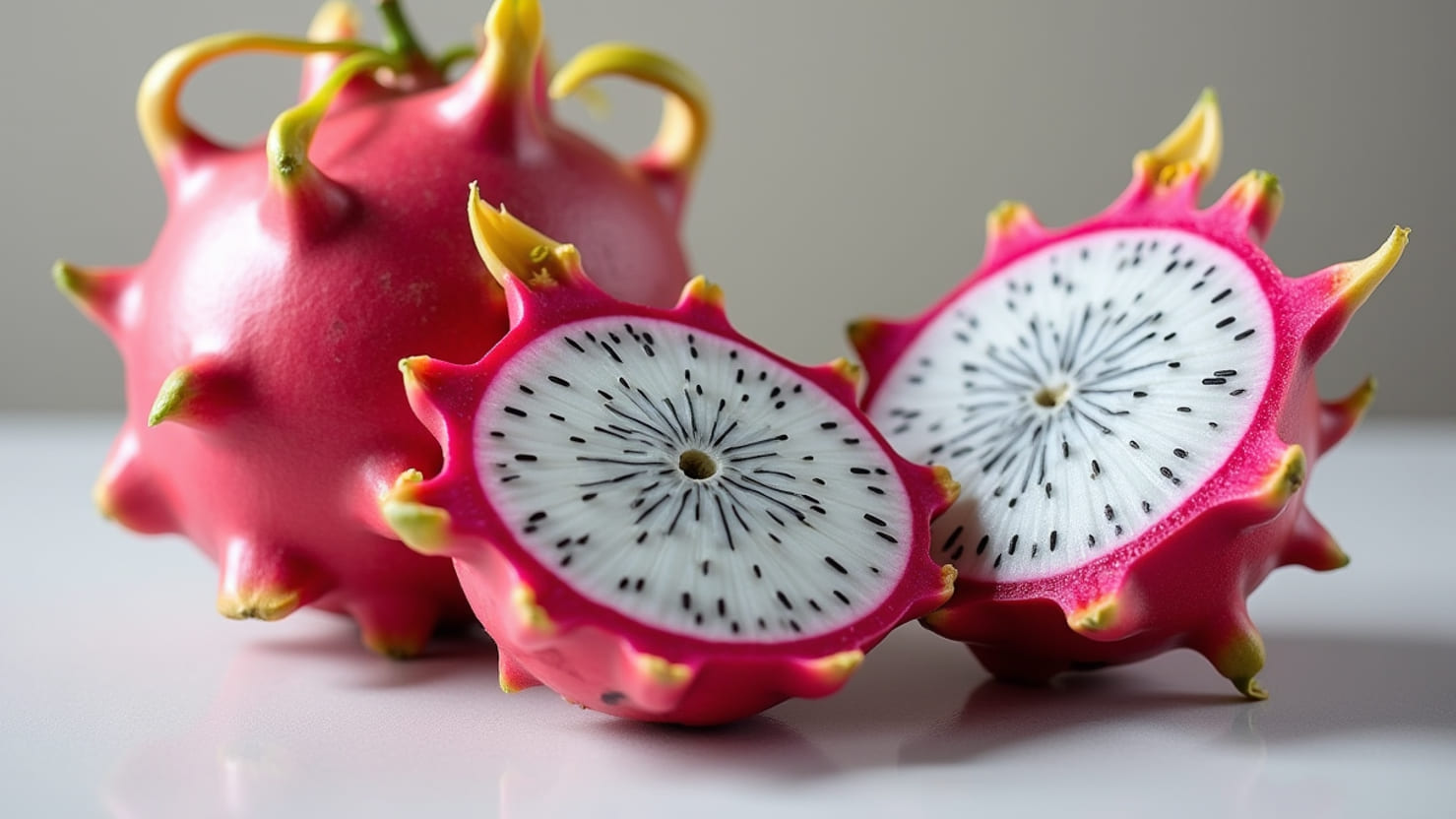
Growers looking for a reliable, sweet red-fleshed pitaya should stock Cebra dragon fruit cuttings. This Nicaraguan cultivar offers high sugar content and striking color. Cebra has vibrant red skin and dark red flesh. Because Cebra is self-sterile, you must plant a compatible second variety for pollination. We stock several partners to ensure your vines set fruit. Check our inventory for compatible pollinators and fresh cuttings ready to ship.
What is Cebra dragon fruit?
Cebra traces its roots to Nicaragua, where it stands as one of only about five pitaya varieties grown commercially.[6] Taxonomically, it is a cultivar of Hylocereus polyrhizus, a species that modern classification increasingly lists under the genus Selenicereus as Selenicereus polyrhizus.[5] It is a very close relative of Hylocereus costaricensis, sharing the greyish-green stems with medium-sized spines and a protective gray waxy coating that helps the plant withstand extreme weather.[5]
One point of confusion in the trade involves the name Rosa Lisa. DNA tests show Cebra and Rosa Lisa are genetically identical, yet growers often report small visible differences in fruit and stem appearance between the two name lines.[5]
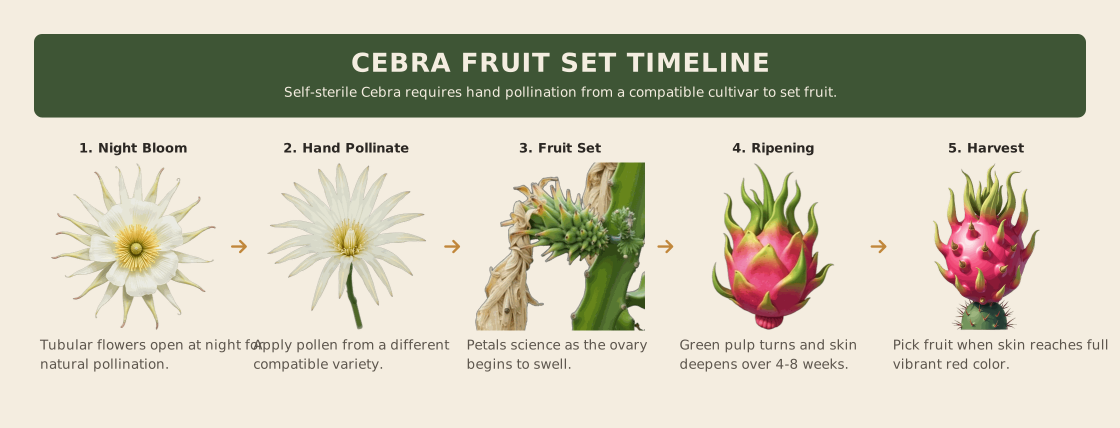
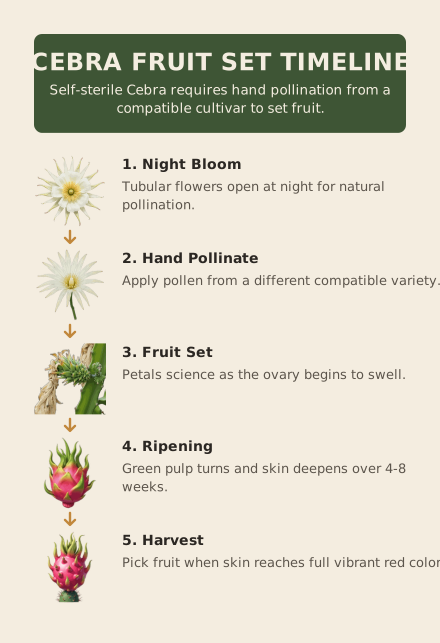
Because Cebra is self-sterile, it requires pollen from a different, compatible variety to set fruit.[7] You cannot rely on a single vine to produce a harvest. You need to understand dragon fruit pollination to get a harvest.
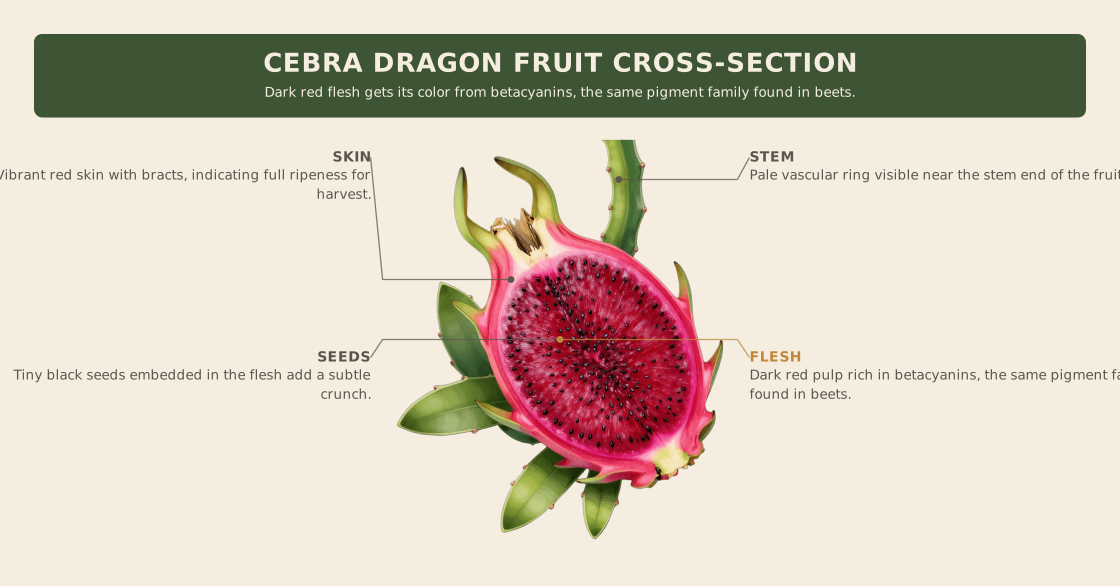
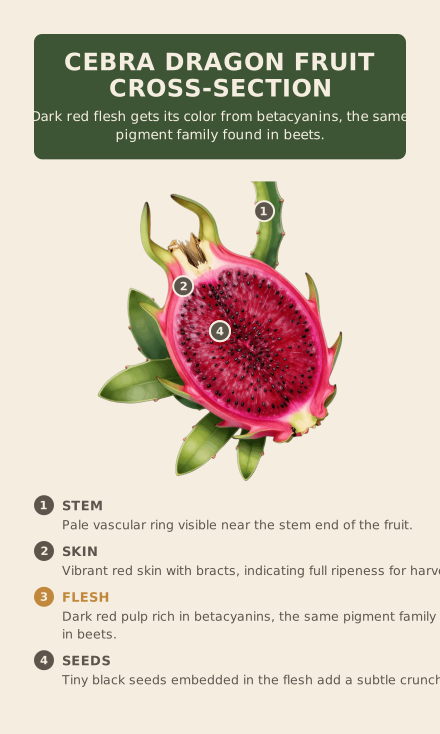
The dark red flesh gets its color from betacyanins, the same pigment family found in beets. Growers report that the flesh is dense and juicy, packed with tiny black seeds that add a subtle crunch. The flavor profile is consistently sweet, with an average reading of 18 to 20 Brix. Some individual fruits have measured in the low 20s, placing Cebra among the sweeter red-fleshed varieties available to home growers.[6]
Each fruit averages about one pound, or roughly 450 grams.[6] Because the plant is self-sterile, you cannot rely on a single vine to produce these heavy fruits. You must introduce pollen from a compatible second variety. Without this cross-pollination, the flowers will drop without setting fruit, regardless of how healthy the vine looks.
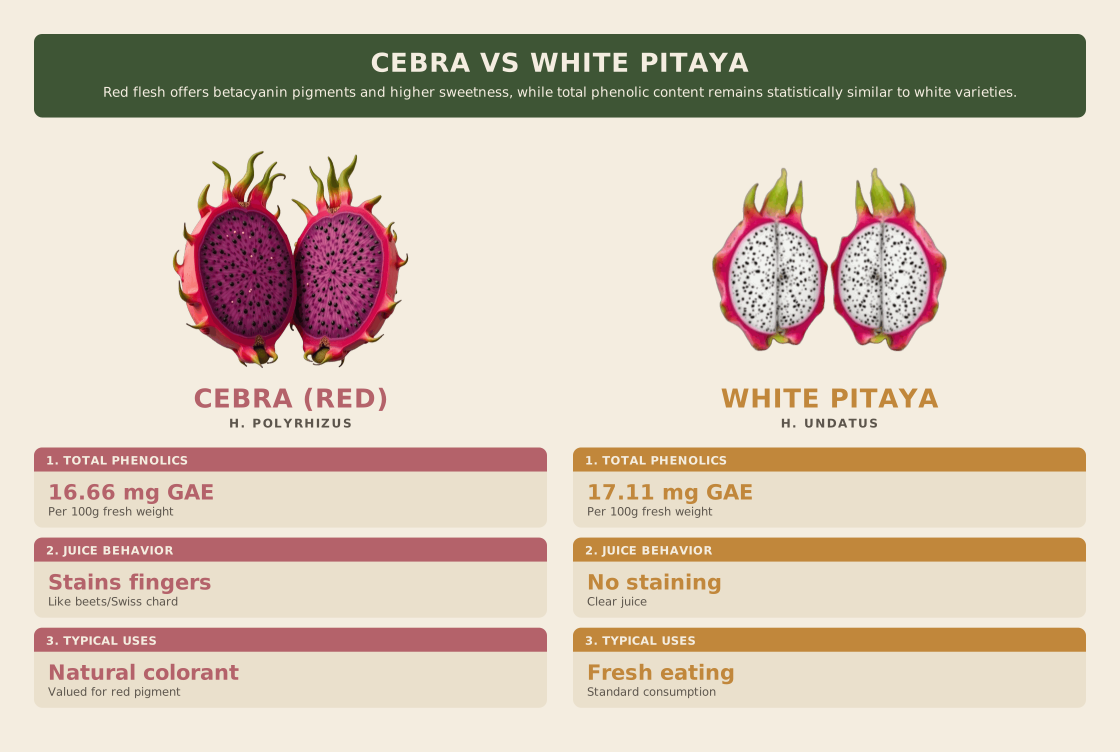
Growers favor Cebra for fresh eating due to its sweetness and texture. The dark red flesh stains hands and cutting boards, a testament to its rich pigment load.
Why the flesh is red
The deep crimson interior of Cebra is not a trick of the light or a sign of overripeness. It is the result of betacyanins, a family of water-soluble, nitrogen-containing pigments that give the fruit its signature hue. If you have ever stained your fingers peeling a beet, you have met this pigment family before. The same compounds that color beets and Swiss chard are responsible for the dark red flesh of red-fleshed pitaya.[1]
Chemical analysis using high-performance liquid chromatography and mass spectrometry has identified four primary betacyanins in the pigment fraction of red pitahaya: phyllocactin, hylocerenin, betanin, and isobetanin.[1] These specific molecules are what create the intense coloration that distinguishes Cebra from white-fleshed varieties.
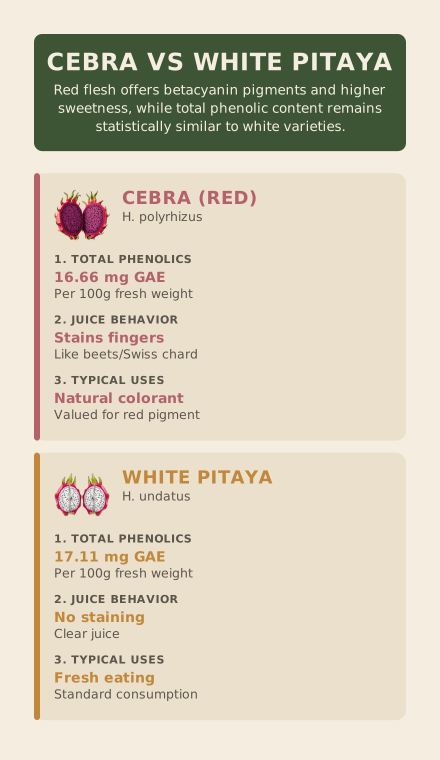
A 2022 study published in Molecules compared the total phenolic content of red and white pitaya. The results showed nearly identical levels: 16.66 mg GAE per 100 g for red-fleshed fruit versus 17.11 mg GAE per 100 g for white-fleshed fruit.[2] This finding suggests that the primary advantage of growing red-fleshed varieties like Cebra is not a higher overall count of phenolic compounds, but rather the presence of the betacyanin pigments themselves.
Stability Note: Betacyanins are sensitive to heat and air. A 2018 study in the International Journal of Food Science and Technology found that drying temperature and air speed significantly impact color retention and antioxidant capacity in dried red-fleshed dragon fruit.[3] If you plan to dry your harvest, low-temperature methods preserve the vibrant red hue and nutritional value better than high-heat drying.
Because of their vivid color and natural origin, red pitaya betacyanins are increasingly valued as a natural red food colorant. However, their instability during storage is a known challenge. Research indicates that encapsulation techniques, such as liposomal encapsulation, can markedly improve the storage stability of these pigments, making them more viable for commercial food applications.[4]
Growing and pollination strategy
Since Cebra is self-sterile, your planting plan must include a compatible partner variety. A single vine will bloom but drop its flowers without setting fruit. You need pollen from a different cultivar that blooms at the same time. This requirement shapes how you arrange your trellis and select your stock. We recommend pairing Cebra with a white-fleshed or red-fleshed variety that has overlapping bloom windows.
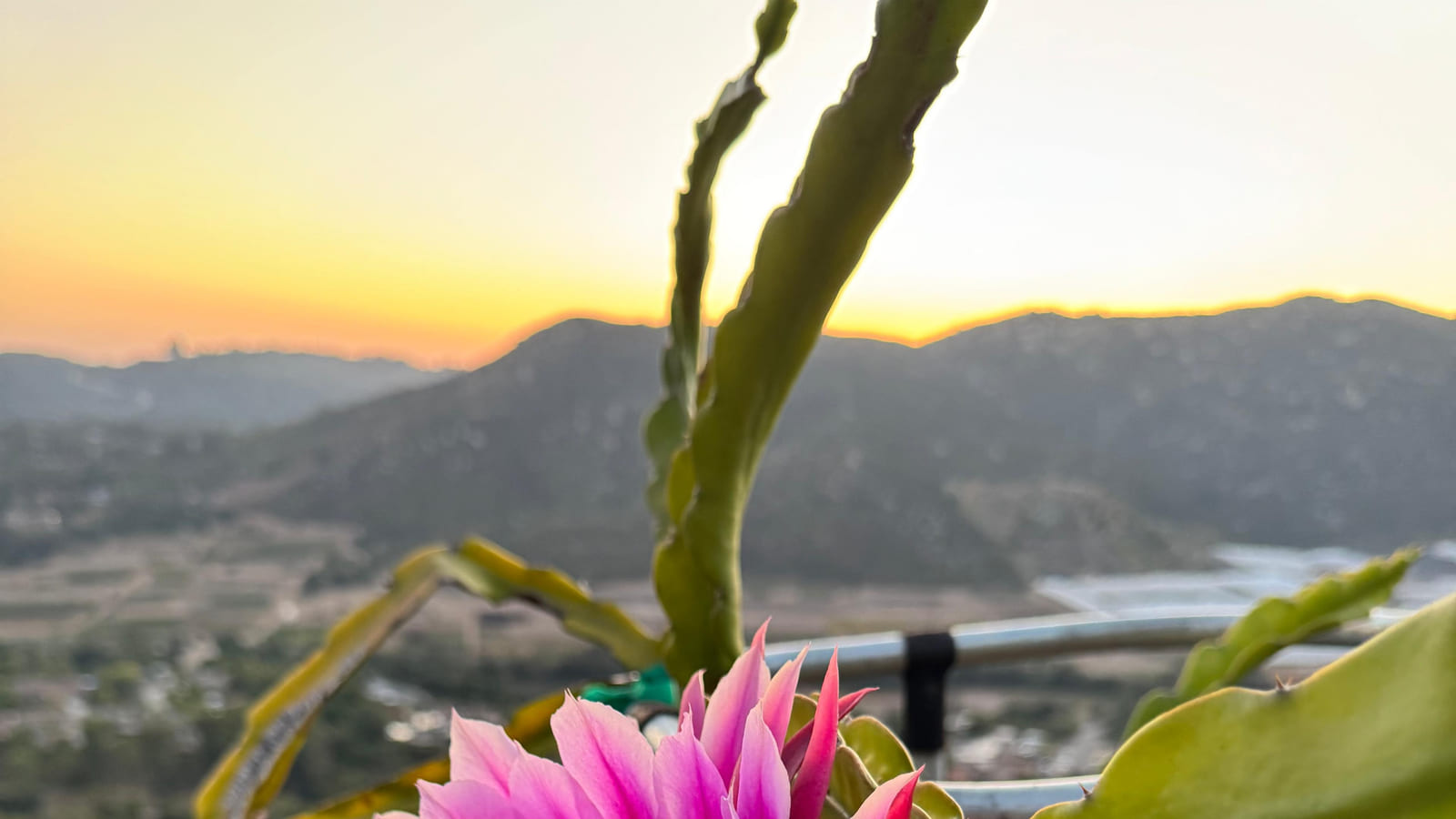
Timing matters. Dragon fruit flowers open at night and are naturally pollinated by bats and moths. In a home garden, you will likely need to hand-pollinate. The window is short, so check your blooms after dark or just before dawn.
Once pollination is successful, the fruit development phase begins. This process typically takes 4 to 8 weeks, depending on ambient temperatures.[8] During this time, the pulp transitions from green to the characteristic dark red of Cebra, packed with tiny black seeds.[8] Consistent moisture and nutrition are still required to support the heavy, one-pound fruits.
Managing betacyanin stability
The dark red flesh is rich in betacyanins, including phyllocactin, hylocerenin, betanin, and isobetanin.[1] These pigments are water-soluble and relatively unstable during storage and processing. If you plan to dry or process your harvest, be aware that heat and air exposure can degrade color and antioxidant capacity.[3] For fresh eating, this instability is not a concern. The pigments remain vibrant in the fruit until you cut it open. The staining power of the flesh is a direct result of this high pigment load, so use gloves and dark cutting boards when preparing Cebra.
Harvesting and Handling Cebra Dragon Fruit
Harvesting Cebra feels different than white-fleshed varieties. Once cut, the flesh yields with a dense, juicy snap. The tiny black seeds embedded in the dark red flesh provide a subtle, consistent crunch. This textural balance is what makes the fruit satisfying to eat fresh, rather than just visually striking.
Handling Tip: The betacyanins in Cebra are water-soluble and stain readily. Wear gloves when cutting or processing large batches to avoid temporary skin discoloration. The stains wash off with soap and water but can linger on porous cutting boards.
The pollination process itself has a tangible timeline that affects the feel of the developing fruit. After successful cross-pollination, the flower base swells rapidly. Within a few weeks, the fruit begins to take on its characteristic shape and color. The transition from green to red is gradual, driven by the accumulation of betacyanins in the pulp and skin. You can feel the fruit gaining weight and density as it matures. A ripe Cebra feels heavy for its size, a sign that the sugars and pigments have fully developed. The self-sterile nature of Cebra means that every fruit on the vine is the result of a successful hand-pollination event, making each one a tangible reward for your labor.
Identifying Cebra Dragon Fruit
When evaluating Cebra, stick to the data verified on the farm. This cultivar is a red-fleshed pitaya of Hylocereus polyrhizus, a species increasingly classified under Selenicereus.[5] It originates from Nicaragua, where it stands as one of only about five varieties grown commercially.[6] Its specific value lies in its verified performance metrics, not in speculative marketing claims.
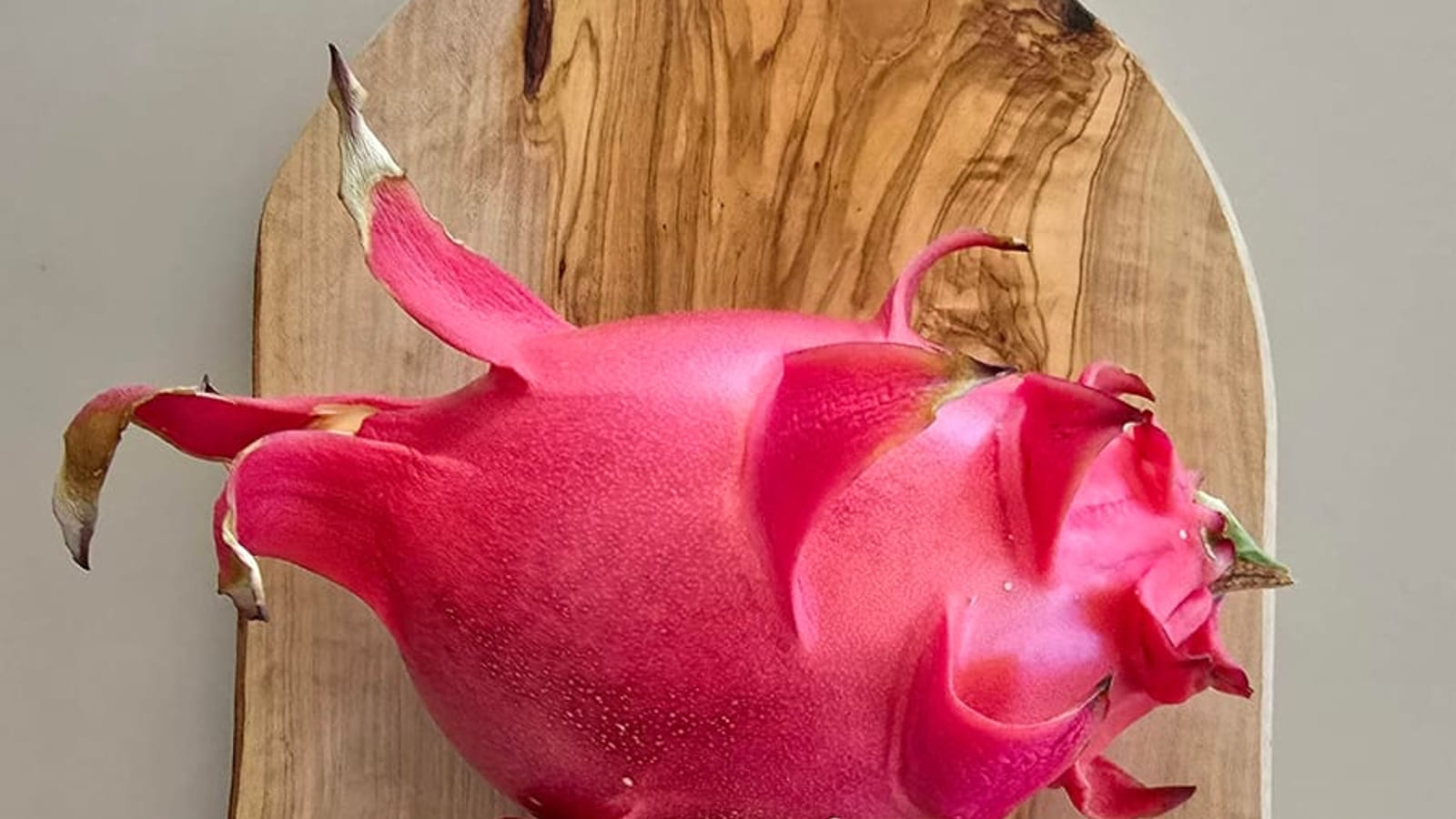
The fruit delivers a consistent profile. Growers report an average of 18 to 20 Brix, with some individual fruits measuring in the low 20s.[6] This places it among the sweeter red-fleshed options available. Each fruit weighs approximately one pound, or 450 grams.[6] The vibrant red skin and dark red interior are standard for this line. The color comes from betacyanins, the same pigment family found in beets.[1] While red and white pitayas have nearly identical total phenolic content, the practical advantage of Cebra is the high concentration of these specific red pigments.[2]
Genetic clarity is essential for serious growers. DNA tests show Cebra and Rosa Lisa are genetically identical.[5] Any visible differences in stem appearance or fruit size between these name lines likely result from environmental factors or minor mutations in specific grower lines, not distinct genetic variances.[5] Treat them as the same plant. Do not invent flavor or yield differences between the two names.
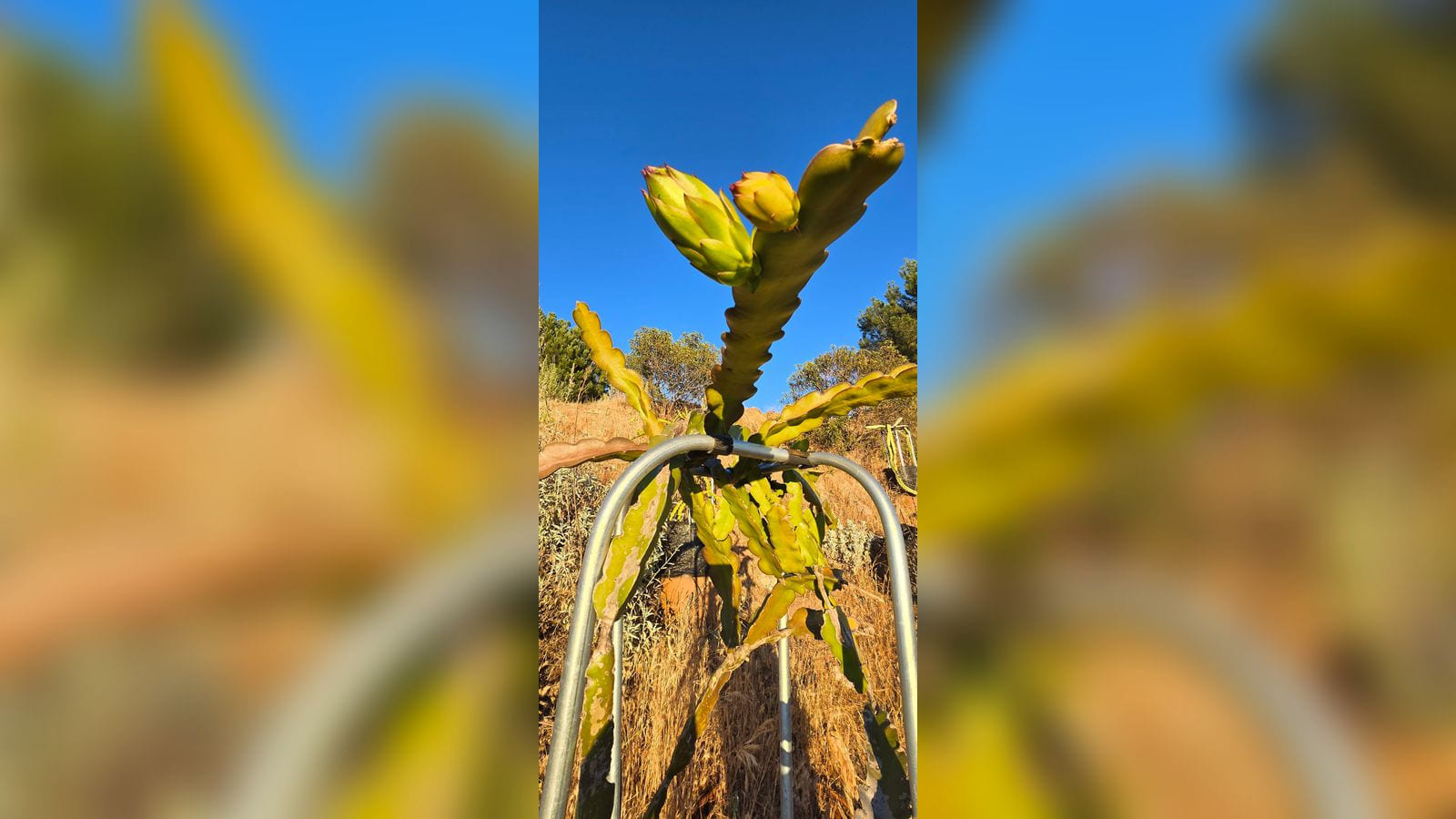
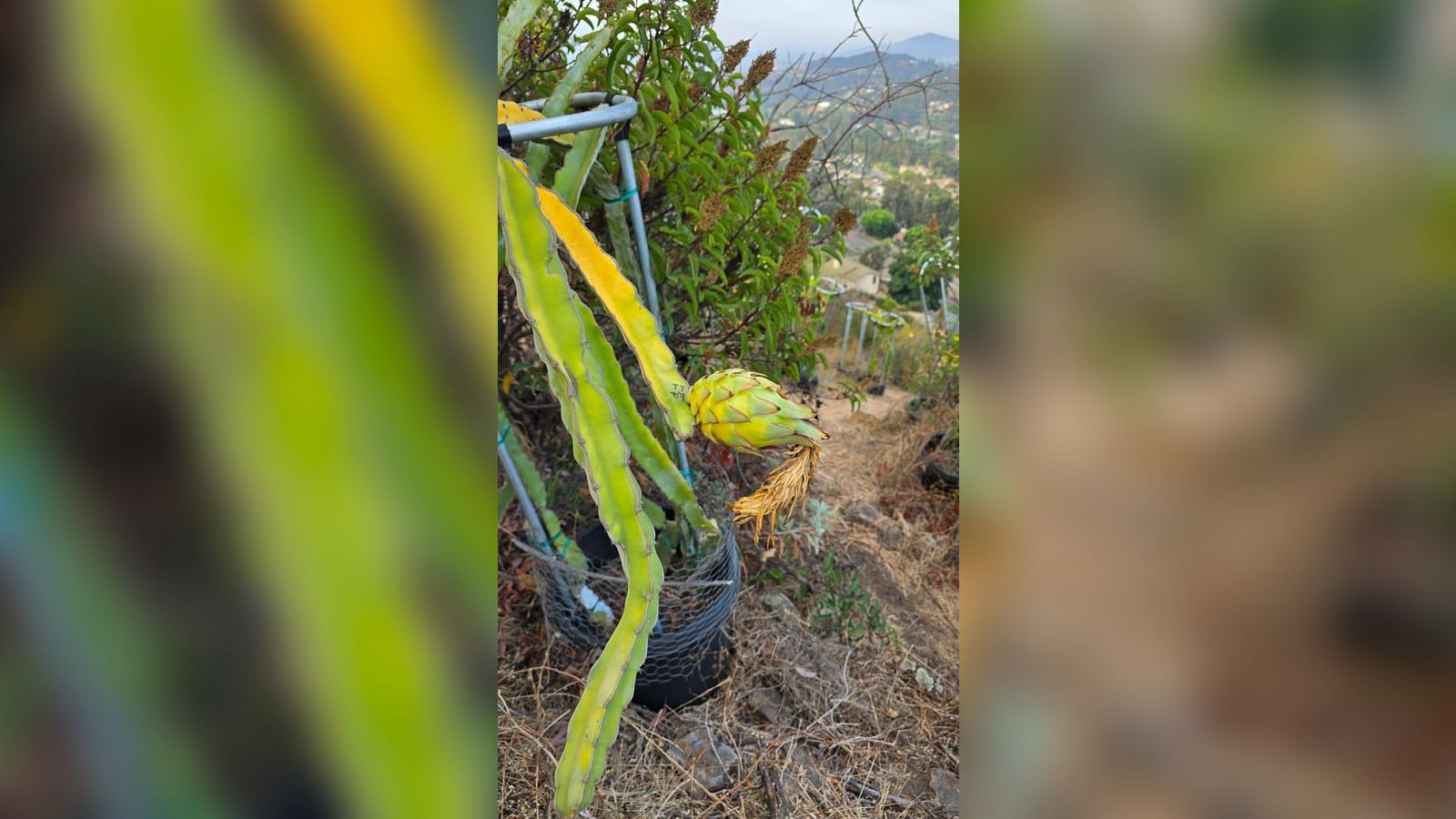
Physically, the plant exhibits greyish-green stems with medium-sized spines and a protective gray waxy coating.[5] This coating helps the plant withstand extreme weather.[5] It is a very close relative of Hylocereus costaricensis.[5] However, Cebra is self-sterile.[7] It requires pollen from a different, compatible variety to set fruit.[7] A single vine will not produce a harvest. You must plant a second blooming cultivar to ensure pollination.[7]
Handling note: Betacyanins are unstable during storage and processing. Drying temperature and air speed strongly affect color retention and antioxidant capacity.[3] If you process the fruit, expect some color loss unless you use stabilization methods like encapsulation.
Pollination and Harvesting
While the flavor profile of Cebra is its primary draw for home growers, the practical mechanics of getting that fruit to set require attention to timing and pollination partners. Because the plant is self-sterile, a single vine will bloom profusely but drop its flowers without producing fruit unless pollen from a compatible variety is introduced [7]. This biological constraint means your garden design must include a second dragon fruit cultivar that blooms at the same time. We stock several red-fleshed and white-fleshed varieties that serve as pollinators for Cebra, ensuring you have the genetic diversity needed for a successful harvest.
Dragon fruit flowers are tubular and open at night, relying on nocturnal pollinators like bats and moths in the wild [8]. In a home garden, hand-pollination is often necessary to guarantee fruit set, especially if you lack a dense population of night-flying insects. The process is straightforward: collect pollen from the anthers of a compatible flower and dust it onto the stigma of the Cebra flower. Once pollinated, the fruit develops rapidly. Depending on ambient temperatures, the transition from pollination to harvest typically takes four to eight weeks [8]. During this period, the pulp inside the developing fruit shifts from green to the characteristic dark red associated with Cebra .
Harvest Timing: Watch for the skin color to deepen to a vibrant red. This signals that the fruit is ready to be cut from the vine.
Handling the harvested fruit requires some care to preserve its quality. The dark red flesh is rich in betacyanins, which are water-soluble pigments that can stain surfaces and skin [1]. These pigments are also sensitive to environmental stressors. Research indicates that betacyanins are relatively unstable during storage and processing, with factors like drying temperature and air speed significantly affecting color retention and antioxidant capacity [3]. For this reason, Cebra is best enjoyed fresh. If you plan to store the fruit, keep it cool and dry to minimize pigment degradation. The high sugar content, averaging 18 to 20 Brix, makes it a delightful fresh snack, but the delicate nature of the pigments means long-term storage or heavy processing can diminish both its visual appeal and nutritional value [6].
It is also worth noting that while red-fleshed varieties like Cebra are often marketed for their high antioxidant content, the total phenolic count is not necessarily higher than that of white-fleshed varieties. A 2022 study found that total phenolic content in red and white pitaya was nearly identical, suggesting that the practical advantage of red-fleshed fruit lies in the specific betacyanin pigments rather than a broader phenolic profile [2]. These pigments, however, have shown interesting biological activity. Lab studies have found that betacyanin extracts from Hylocereus polyrhizus can reduce viral titers in human lung cells, hinting at potential health benefits beyond simple nutrition [1]. For the home grower, the takeaway is clear: grow Cebra for its exceptional flavor and striking appearance, and handle the fruit with care to enjoy it at its peak.
Nutritional Profile and Betacyanin Benefits
While the visual appeal of Cebra is undeniable, its nutritional profile offers a more nuanced story. The deep red color comes from betacyanins, a group of water-soluble pigments that includes betanin, the same compound responsible for the color in beets and Swiss chard [1]. Analysis of red pitahaya flesh identifies four primary betacyanins: phyllocactin, hylocerenin, betanin, and isobetanin [1].
Red-fleshed varieties do not have significantly higher total antioxidants than their white-fleshed counterparts. Research comparing red and white pitaya found that total phenolic content is nearly identical, hovering around 16 to 17 mg GAE per 100 g of fresh weight [2]. The distinct advantage of Cebra lies specifically in the betacyanin pigments themselves, rather than a blanket increase in all antioxidant categories [2]. This distinction matters for growers and consumers who want to understand what they are actually eating.
Lab studies suggest these pigments have biological activity worth noting. In one 2024 study, betacyanin extract from Hylocereus polyrhizus showed no cytotoxicity to human lung epithelial cells at concentrations below 100 ug/mL [1]. At lower concentrations, the extract helped prevent viral cytopathic effects and reduced influenza A virus titers by downregulating viral nucleoprotein expression [1].
Handling the Pigment: Betacyanins are sensitive to heat and air. Drying temperature and airflow significantly impact how much color and antioxidant capacity remain in processed fruit [3]. If you plan to dry Cebra slices, use low heat and gentle air circulation to preserve the vibrant red hue and nutritional value.
For those interested in using the fruit beyond fresh eating, the pigments serve as a natural red food colorant. However, stability is a challenge. Encapsulation techniques, such as liposomal encapsulation, have been shown to markedly improve the storage stability of these betacyanins [4].
Remember that the flesh color develops as the fruit ripens. The pulp starts green and turns red only as the fruit matures, a process that takes 4 to 8 weeks after pollination depending on temperature [8]. Patience during this window ensures the betacyanins have fully developed, delivering both the signature color and the associated health benefits.
References
- Betacyanins from red pitahaya (Hylocereus polyrhizus) exhibit antiviral response against influenza A virus (Lim et al., Heliyon 10(12):e33049, PMID 39021953), Heliyon / PubMed (2024).
- Nutritional Analysis of Red-Purple and White-Fleshed Pitaya (Hylocereus) Species (Attar et al., Molecules 27(3):808, PMID 35164073), MDPI Molecules / PubMed (2022).
- Influence of drying conditions on colour, betacyanin content and antioxidant capacities in dried red-fleshed dragon fruit (Hylocereus polyrhizus) (Mahayothee et al., Int. J. Food Sci. Tech. 54(2):460-470), Wiley / International Journal of Food Science and Technology (2019).
- Storage Stability and In Vitro Bioaccessibility of Liposomal Betacyanins from Red Pitaya (Hylocereus polyrhizus) (Lin et al., Molecules 27(4):1193, PMC8880447), MDPI Molecules / PMC (2022).
- Cebra dragon fruit cutting - variety description (stems, Rosa Lisa DNA note, Nicaragua commercial varieties), Dragons Alley Nursery (2026).
- Cebra dragon fruit plant - variety listing (Nicaraguan origin, red skin, dark red flesh, ~1 lb, Brix 18-20), Cactus Worlds (2026).
- Cebra - Hylocereus polyrhizus, self-sterile red-flesh variety, Spicy Exotics (2026).
- Dragon fruit (pitaya) - Selenicereus/Hylocereus species, betacyanin pigments, night flowers, 4-8 weeks pollination to harvest, Wikipedia (2026).