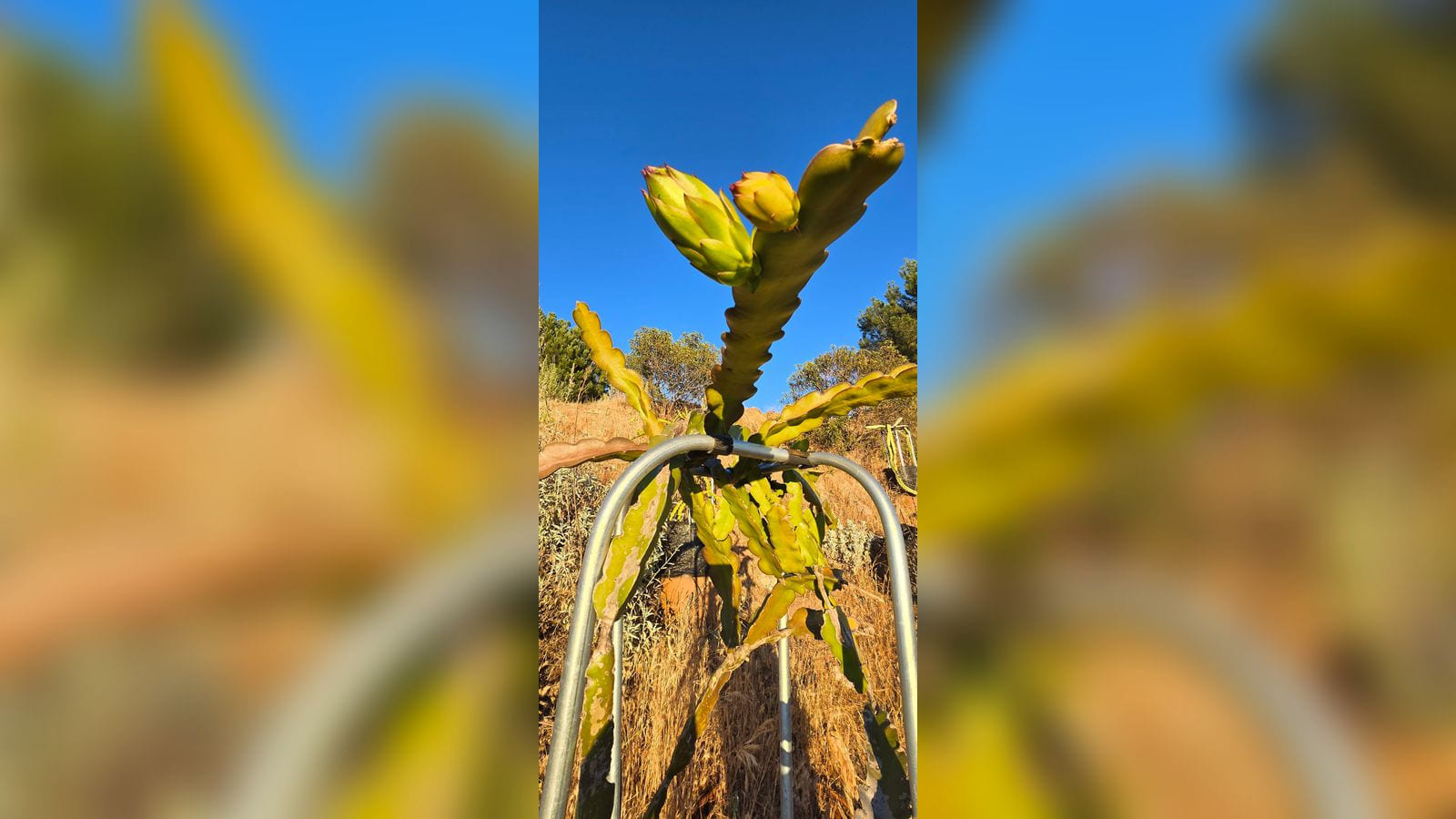
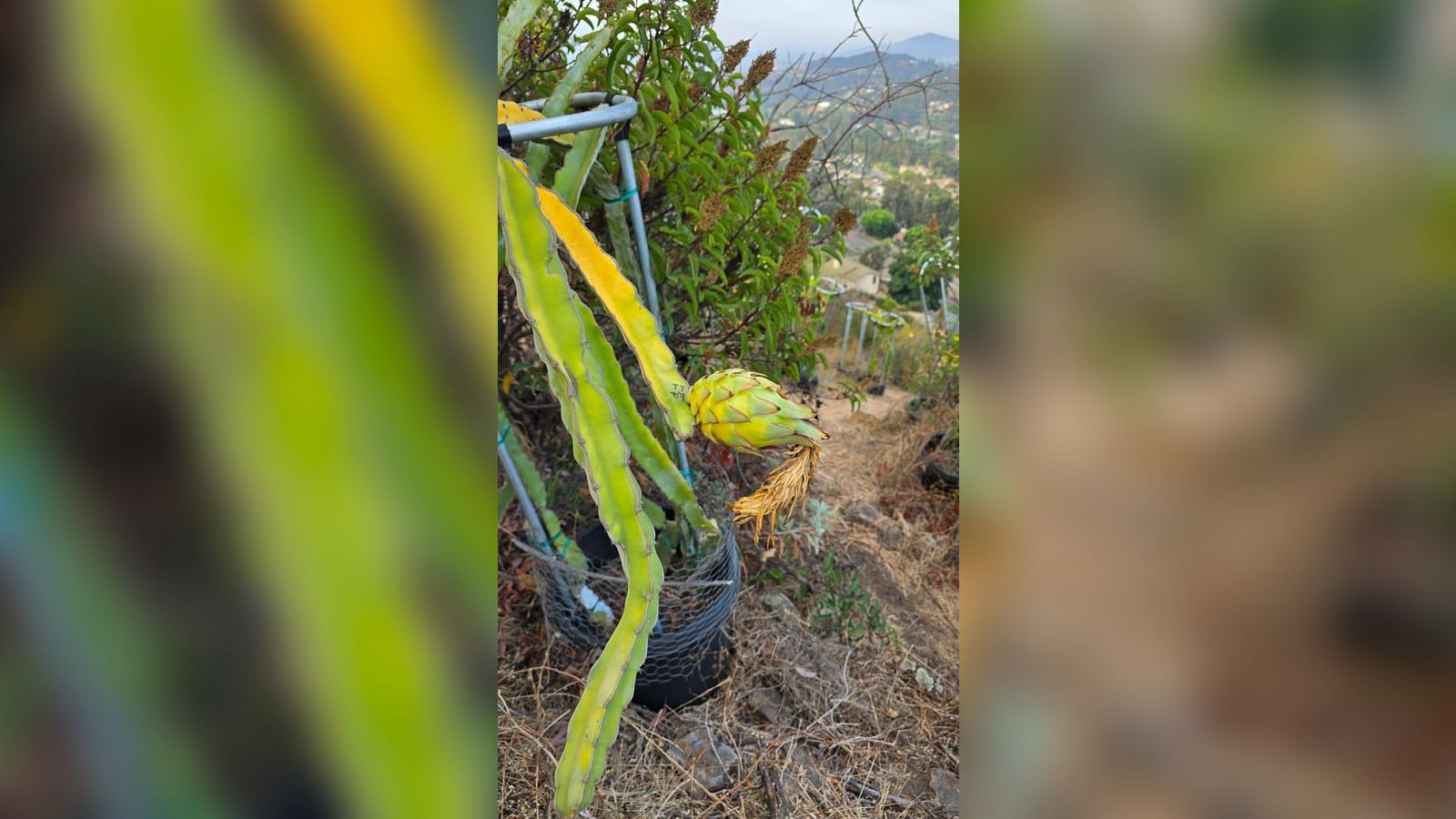
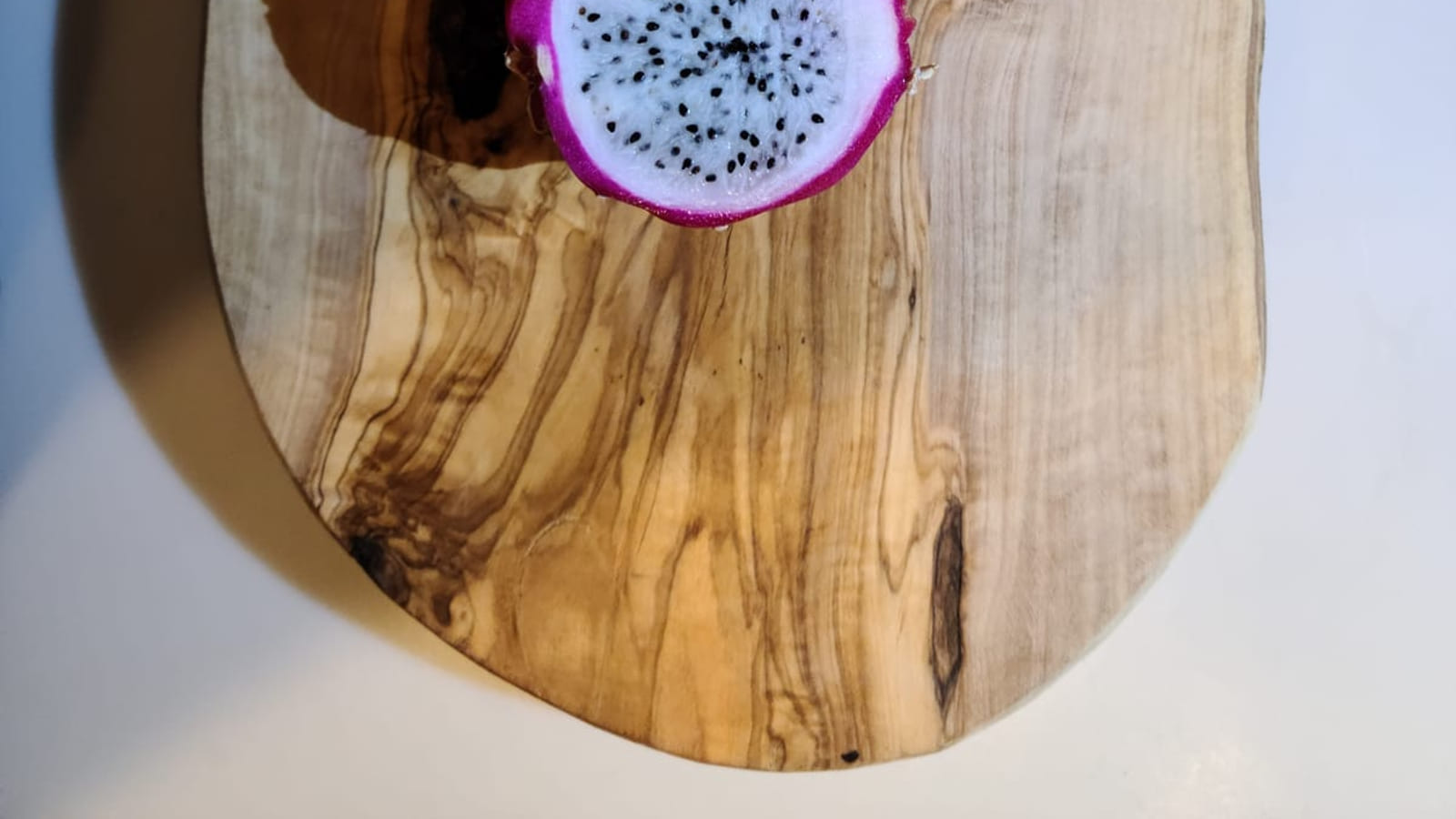
Neitzel Dragon Fruit: Self-Fertile White Pitaya
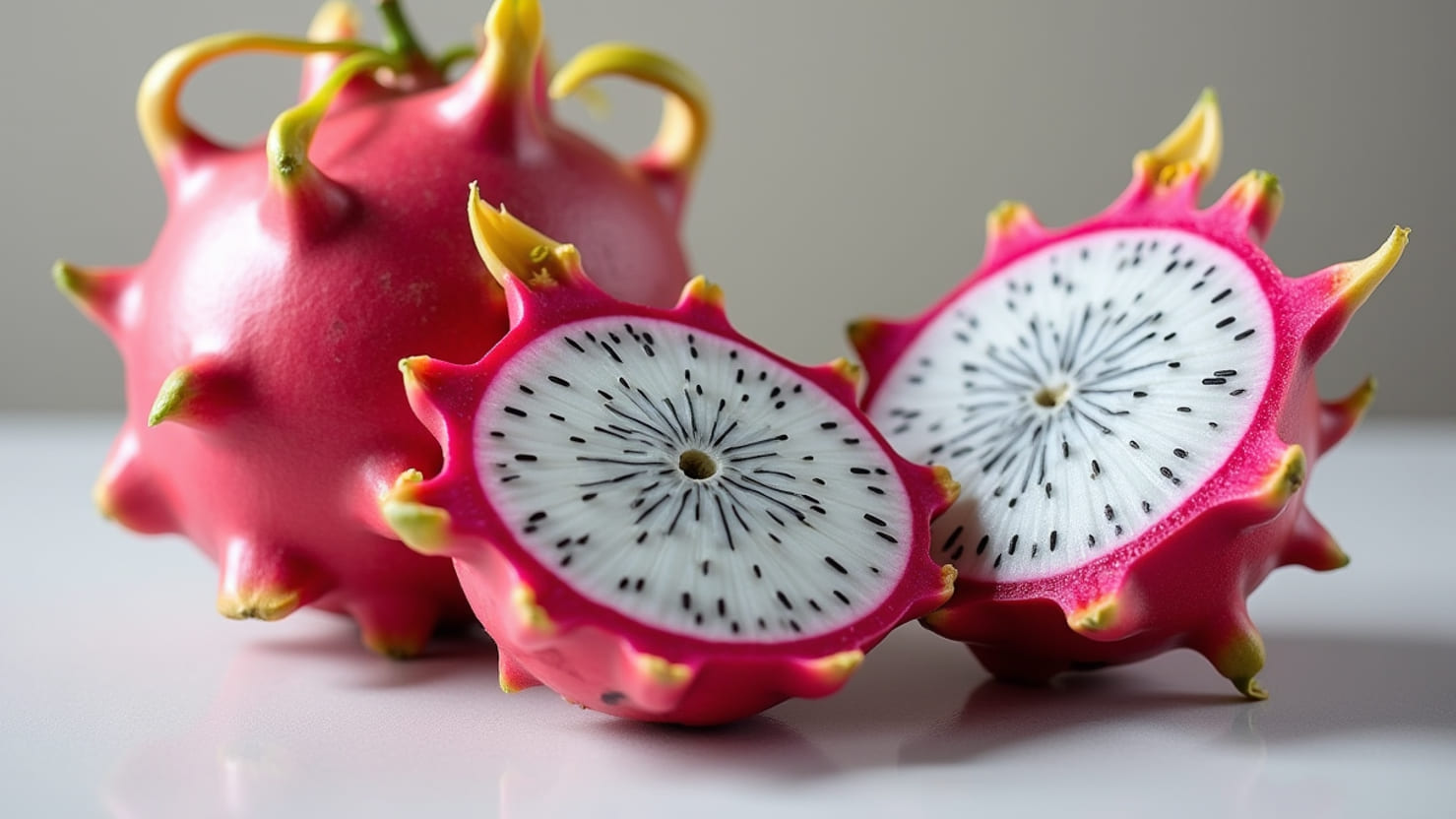
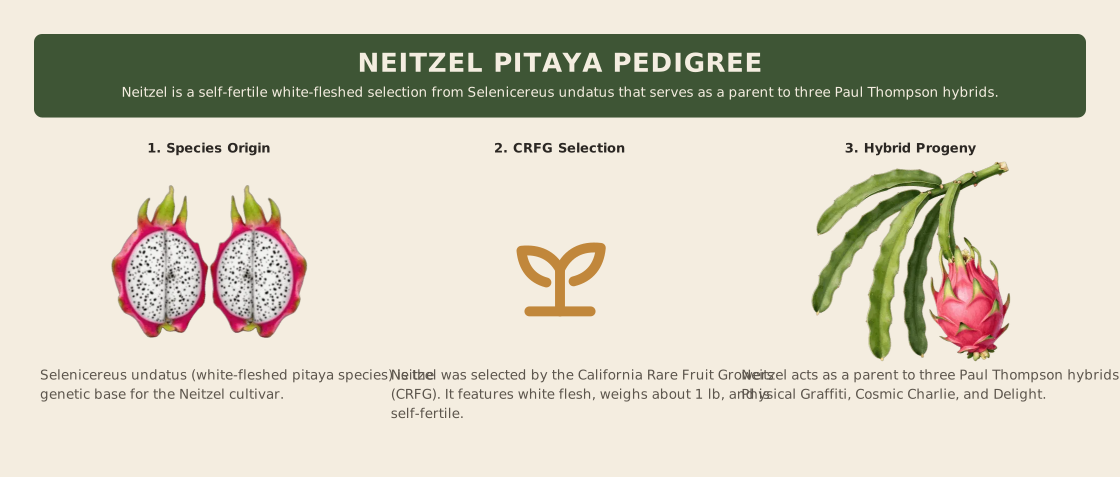
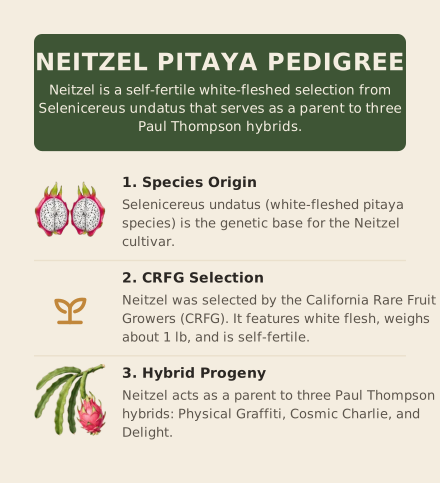
Neitzel dragon fruit is a self-fertile, white-fleshed pitaya selection from the California Rare Fruit Growers, named for Jim Neitzel. You get sweet, firm, bright white flesh with a clean melon flavor on medium to large fruit. Because it is self-fertile, a single plant fruits on its own, so you do not need a pollinator partner. That convenience, plus its clean flavor, makes it a favorite for home growers. Its breeding pedigree adds significant value: Neitzel is a documented parent of Paul Thompson hybrids Physical Graffiti, Cosmic Charlie, and Delight. That means you are growing proven genetics, not a novelty.
We stock Neitzel cuttings and rooted plants for growers who want reliable fruit and a plant with real lineage. If you are weighing Neitzel against other white-fleshed options, our variety comparison guide compares flavor, vigor, and fruit size.
Neitzel at a Glance
Before you dig in, here is the quick reference sheet. This table pulls the hard numbers together so you can check them against your local conditions and grow plans.
At a glance
| Spec | Detail |
|---|---|
| Species | Selenicereus undatus (formerly Hylocereus undatus)[5] |
| Origin | California Rare Fruit Growers selection[7] |
| Flesh | White, firm, vibrant[6] |
| Flavor | Sweet with melon notes[6] |
| Fruit Weight | Up to 1 lb; typically 1.0 to 1.25 lb[6] |
| Habit | Self-fertile[6] |
| Flowering Cycles | 2 to 3 in California; 4 to 8 in tropics[7] |
| Anthesis to Harvest | 29-34 days (trials) to ~45 days (grower reports)[2] |
| Cold Hardiness | Average ~28 F[7] |
| Notable Progeny | Physical Graffiti, Cosmic Charlie, Delight[5] |
These figures are averages from grower reports and trials. Your microclimate will shift the harvest window and fruit size. The self-fertile habit is the standout feature for home growers, removing the need for a second plant just to get a set. Keep in mind that while the plant is tough, the fruit quality depends on consistent water and light during those 29 to 45 days of development.
The Fruit and the Flavor
Neitzel delivers a clean, refreshing eating experience that prioritizes texture and subtlety over aggressive sweetness. The flesh is firm, bright white, and holds its shape well when sliced. Growers and nursery descriptions consistently highlight a sweet melon profile, noting that the fruit is highly attractive and best enjoyed chilled. This variety produces medium to large fruit, typically weighing up to one pound, making it substantial enough for a satisfying single serving or an elegant garnish on a dessert plate.[4]
To understand why Neitzel reads as refreshing rather than intense, look at the composition of white-fleshed pitaya pulp. Per 100 grams, the flesh is approximately 89% water. It contains only 0.3 grams of fiber and 25 milligrams of vitamin C.[1] This high water content and low fiber structure create a light, crisp mouthfeel. The flavor is delicate because the pulp is mostly hydration, not sugar density. The high water content creates a light, crisp mouthfeel that acts as a palate cleanser rather than a jammy bomb.
A note on sweetness: We describe its sweetness based on texture and aroma comparisons with red-fleshed types. Red varieties often have higher sugar concentrations and earthier notes. Neitzel is milder. If you want a fruit that tastes like candy, choose a red-fleshed hybrid. If you want a fruit that tastes like a cool, crisp drink, choose Neitzel.
Because the flavor is subtle, Neitzel shines when eaten out of hand. The firm texture means it does not turn mushy if you cut it ahead of time. It is also an excellent garnish. The stark white flesh contrasts beautifully with dark greens or bright citrus segments. Serve it straight from the refrigerator. The cold temperature sharpens the melon notes and suppresses any potential blandness. This is a fruit that rewards simplicity. Avoid drowning it in lime or chili; let the clean, watery sweetness speak for itself.
Why Breeders Keep Neitzel on the Bench
Neitzel is more than a reliable backyard producer. It sits squarely in the Selenicereus undatus lineage, the red-skinned, white-pulped pitaya species that forms the backbone of most commercial dragon fruit cultivation[5]. But its real value to hybridizers lies in its role as a parent. Neitzel is a documented contributor to several Paul Thompson hybrids, including Physical Graffiti, Cosmic Charlie, and Delight[5]. This makes it breeding stock as much as a dessert variety.
When breeders select a parent, they look for stability, vigor, and predictable fruit set. Neitzel offers all three. Its self-fertile nature ensures that even in isolated plantings, it produces fruit without a partner. This trait passes down, giving hybrid offspring a higher chance of independent fruiting. The firm, bright white flesh and clean melon flavor provide a baseline of quality that hybridizers can build upon, adding color or size without sacrificing texture.
Neitzel’s Genetic Legacy
| Hybrid | Role of Neitzel |
|---|---|
| Physical Graffiti | Parent |
| Cosmic Charlie | Parent |
| Delight | Parent |
If you are interested in these next-generation varieties, we stock cuttings and rooted plants of Physical Graffiti, Cosmic Charlie, and Delight. You can also compare Neitzel directly with other white-fleshed options to see how its breeding history influences its performance in your garden.
Growing Neitzel: Climate, Soil, Support
Neitzel thrives in tropical and subtropical zones where frost is rare. It tolerates a broad temperature range, but growth peaks between 65 and 77 F. Heat above 100 F stalls the plant, while prolonged exposure to 31 F causes damage, though light freezes are usually recoverable[1]. Soil must be well-drained and rich in organic matter; pitayas handle moderate to high salt levels, making them suitable for coastal gardens[1].
Young plants need protection. In high-sun areas, provide about 30% shade for the first 3 to 4 months to prevent stem sunburn, but avoid excessive shading, which reduces fruit quality[1]. Fill the pot with a single free-draining mix all the way down and ensure a drainage hole exists.
Support is critical. Mature stems reach 20 feet and carry several hundred pounds of weight. Install a sturdy trellis, such as a 4 to 6 inch pressure-treated pole with a metal grid cap, set 10 to 15 feet from buildings[1]. Keep plants 15 to 25 feet away from trees and power lines to avoid competition and damage[1].
Propagation is straightforward with cuttings 6 to 15 inches long. After curing, rooted cuttings grow rapidly, sometimes up to 1.2 inches per day[1]. Expect fruit 6 to 9 months after planting. By year three or four, a single plant can yield 220 pounds annually, with a productive life of about 20 years[1].
| Factor | Requirement |
|---|---|
| Optimal Temp | 65-77 F |
| Cold Limit | Damage at 31 F |
| Young Shade | 30% for 3-4 months |
| Soil | Well-drained, high organic matter |
| Trellis Height | Supports 20 ft stems |
Self-Fertile Does Not Mean Hands-Off
Neitzel is sold as self-pollinating, and for good reason. In replicated trials of white-fleshed Selenicereus undatus, manual self-pollination achieved 100% fruit set, proving that a single plant can reliably produce fruit without a partner[2]. But set is only the first step. The real difference between a decent harvest and a great one lies in pollination quality, which directly dictates fruit weight.
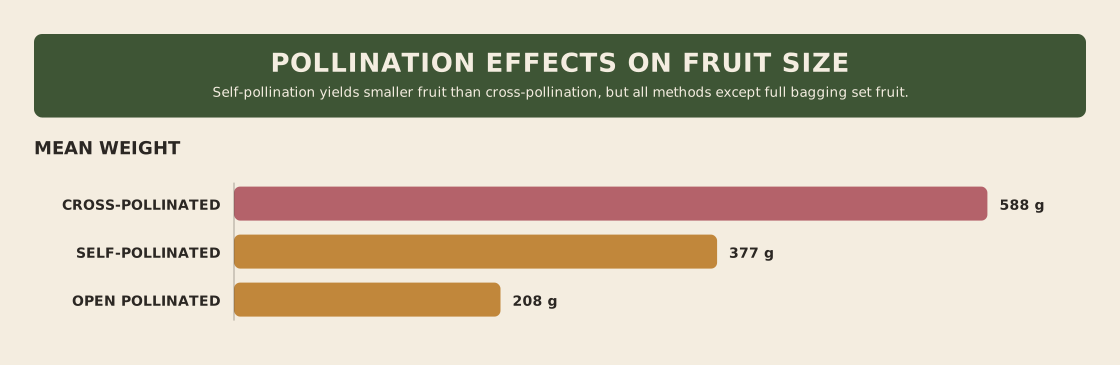
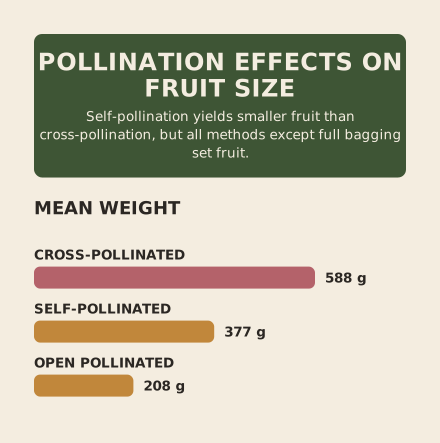
The data is stark. In the same white-fleshed clone, manual cross-pollination averaged 588 g per fruit, while manual self-pollination yielded 377 g[2]. Open pollination dropped to about 208 g, and wind-only bagged flowers managed just 96 g[2]. An independent trial reached the same conclusion, recommending cross-pollination for maximum size and noting that flowers show the highest pollen germination at 7 PM[3].
Seed count tracks this pattern too. Cross-pollinated white-fleshed fruit contained 1,304 to 1,355 seeds, compared to roughly 860 in red-fleshed controls[2]. More seeds mean more hormonal signaling, which pulls more resources into the fruit. If you want Neitzel to reach its full 1.0 to 1.25 lb potential, treat self-fertility as a safety net, not a strategy. For step-by-step timing and technique, see our ecom__dragon fruit pollination guide self fertile vs cross pollinating varieties.
How and When to Hand-Pollinate a Neitzel Flower
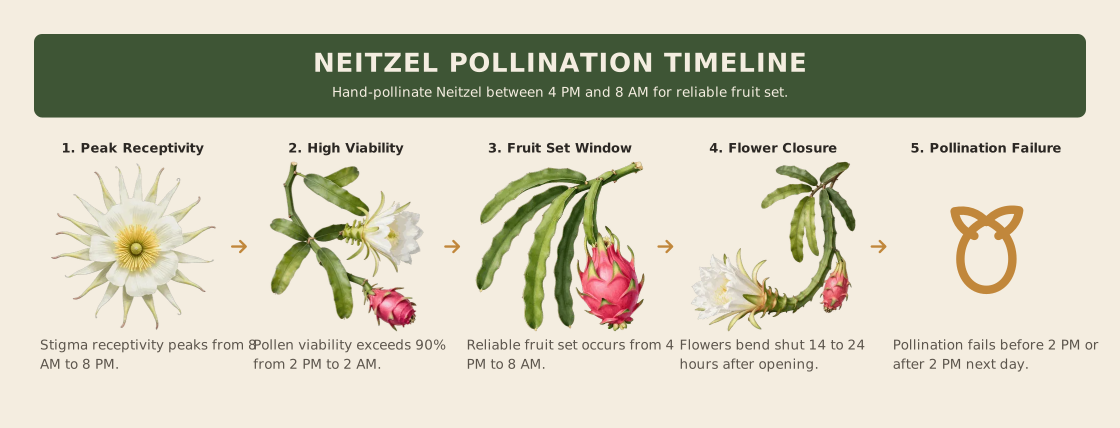
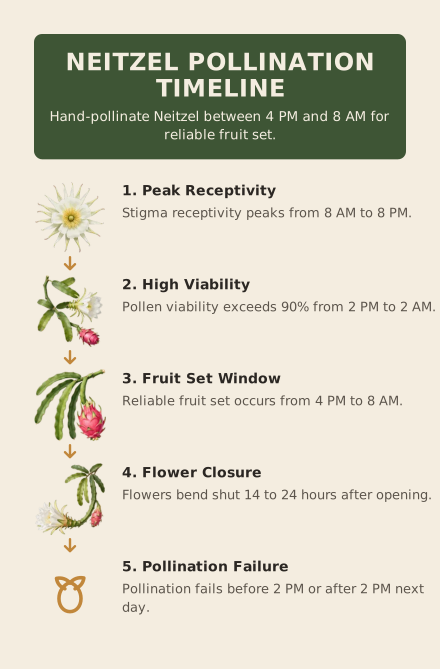
Neitzel is self-fertile, but a single flower rarely sets fruit on its own. Night-blooming pitayas rely on moths and bats, not bees. If your garden lacks these nocturnal visitors, you must move the pollen yourself. The good news is that the window for success is wide, and the method is simple. The timing is critical because the flower is ephemeral. Once a Neitzel bloom opens, it begins to curl shut within a short window. You have one night to act. Trials on white-fleshed *S. undatus* show that pollen viability peaks at anthesis, typically around 8:00 PM, exceeding 98% at that moment. Viability remains above 90% from six hours before to six hours after opening. The stigma is receptive from 12 hours before to 12 hours after anthesis. Pollinating anywhere from four hours before to 12 hours after opening results in 100% fruit set. Waiting until 42 hours after opening yields nothing. To pollinate, locate the lobed stigma in the center of the flower. Gently rub it back and forth against the anthers of another flower. You do not need a brush; direct contact works best. A separate trial noted peak pollen germination at 7:00 PM, confirming that early evening is the ideal start time. If you have only one Neitzel plant, you can bank pollen. Pitaya pollen stores well in a refrigerator for up to two weeks or in a freezer for 30 days. Collect pollen from early blooms, dry it slightly, and freeze it in a labeled envelope. When later flowers open, thaw a small amount and dust the stigma. This ensures every flower sets fruit, even if they do not open simultaneously.
Pro Tip: Do not wait for the moon to be full. The clock starts when the flower opens. Set an alarm for 7:00 PM if you want to catch the peak germination window.
From Bud to Table: The Season
Timing your harvest requires watching the clock from the moment a bud appears. While general pitaya literature suggests a broad window, specific trials on white-fleshed Selenicereus undatus offer tighter data. In controlled studies, floral bud initiation to anthesis took 16 to 22 days, followed by 29 to 34 days from anthesis to maturity. This results in a full cycle of roughly 50 to 60 days.[2] California growers often see a slightly longer bloom phase, reporting 30 to 45 days from bud to flower opening, with fruit development averaging 45 days after pollination. Cool weather stretches this ripening period, so do not panic if your fruit lingers on the vine longer than expected.[7]
Geography dictates how many times you can repeat this cycle. In the tropics, expect 4 to 8 flowering cycles per year. In California’s cooler climate, a normal run is 2 to 3 cycles.[7] In Florida, the harvest season typically runs from June to November.[1]
Once the fruit is ready, proper handling preserves that crisp texture. Only pick well-colored, mature fruit. Cut it with hand clippers and trim the peduncle flush to avoid damaging the stem or the fruit skin.[1]
| Stage | Duration | Notes |
|---|---|---|
| Bud to Flower | 16-22 days (Trial) 30-45 days (CA Growers) | Cool weather slows this phase. |
| Flower to Harvest | 29-34 days (Trial) ~45 days (Growers) | Wait for full color. |
| Shelf Life (Counter) | 4-5 days | Best eaten fresh. |
| Shelf Life (Fridge) | Several weeks | Store in plastic bags. |
For the best flavor, chill the fruit before serving. The cold sharpens the melon notes and keeps the flesh firm.[6]
Neitzel vs the Other White-Fleshed Varieties We Stock
Choosing between white-fleshed pitayas often comes down to convenience and lineage. Neitzel stands out because it fruits without a partner, a trait that simplifies life for backyard growers. However, the pitaya world is messy. CRFG material counts more than 100 named varieties in California alone, with significant confusion over identification. UF/IFAS notes that self-incompatibility data for many US cultivars is poorly documented, so treat grower-reported fertility claims as observations rather than certified traits.[7]
Here is how our stock compares.
| Variety | Habit & Fertility | Reported Fruit | Best Use Case |
|---|---|---|---|
| Neitzel | Self-fertile (grower observation)[7] | 1.0 to 1.25 lb; firm white flesh | Yard plant; breeding parent for Thompson hybrids |
| Thompson Progeny (Red) | Hybrid vigor; fertility varies by cross | Heavy; red flesh; intense sugar | Collector gardens; flavor-focused trials |
Neitzel’s value lies in its dual role. It is a reliable producer for a single-plant setup, yet it also carries proven genetics. As a documented parent of Physical Graffiti, Cosmic Charlie, and Delight, it offers breeders a stable white-fleshed base.[5] For the home grower who wants fruit without the hassle of coordinating bloom times, Neitzel remains the pragmatic choice. Just remember that fertility claims across the industry are often anecdotal. We stock Neitzel because we have seen it set fruit on its own, but your local conditions and pollinator activity will always play a role.
Should You Grow Neitzel?
Neitzel earns its place in your garden if you want a reliable, self-fertile white-fleshed pitaya that performs well in frost-light Southern California climates. It is a strong choice for frost-light climates, where it can thrive in the ground or a container without needing a partner plant to set fruit. You are also growing proven genetics. Neitzel is a documented parent of Paul Thompson’s popular hybrids like Physical Graffiti and Cosmic Charlie, so you are cultivating a plant with real breeding value, not just a novelty[5].
However, Neitzel is a weaker pick if your priority is intense red pigmentation or the absolute highest sugar readings. It offers a clean, melon-like sweetness rather than a jammy, high-Brix punch. Commercial growers who need uniform, large fruit without the labor of hand-pollination might also find it less efficient, as manual cross-pollination typically yields heavier fruit than self-pollination alone[2].
Ready to start? We stock Neitzel cuttings and rooted plants for growers who want this specific lineage. If you are not ready to commit to a plant but want to taste the fruit first, check out our fresh-fruit box options. It is the best way to verify the flavor profile before you build the trellis.
For those who decide to grow, remember that while the plant is tough, consistent care during the fruit development window ensures the best harvest. If you are still weighing options, our variety comparison guide compares vigor and flavor to help you decide.
The technical foundation for growing Neitzel rests on two primary extension publications from the University of Florida IFAS. Crane and Balerdi’s EDIS fact sheet HS1068 provides the baseline agronomic data for pitaya, including soil requirements, trellis specifications, and cold hardiness thresholds that apply to all Selenicereus undatus cultivars . Their companion guide, HS303, offers deeper context on pest management and harvest handling, ensuring that the practical advice you follow aligns with current scientific consensus rather than anecdotal folklore .
For questions specifically about pollination mechanics, we look to recent peer-reviewed research. A 2025 study published in Scientific Reports examined the floral biology of white-fleshed S. undatus, confirming that manual self-pollination can achieve 100% fruit set in compatible accessions [2]. This study also quantified the yield penalty of poor pollination, showing that open-pollinated flowers produced significantly lighter fruit than those hand-pollinated [2]. An independent trial corroborated these findings, identifying the early evening as the optimal window for pollen transfer to maximize seed count and fruit weight [3].
Cultivar-specific descriptions come from the grower networks that maintain these varieties. The California Rare Fruit Growers (CRFG) archive documents the selection history of Neitzel, noting its origin as a named variety within their extensive collection of over 100 pitaya types [7]. Commercial nursery listings from Pine Island Nursery and Leewi Farms provide the sensory and physical descriptors used in our product pages, detailing the firm white flesh, melon-like flavor, and self-fertile habit that make Neitzel a reliable choice for home orchards [4] [6].
References
- Pitaya (Dragonfruit) Growing in the Florida Home Landscape (HS1068/HS303, doi 10.32473/edis-hs303-2005), UF/IFAS Extension, Department of Horticultural Sciences (Crane and Balerdi) (2005).
- Floral and pollination biology of dragon fruit reveals strategies for enhancing productivity through pollination management and reproductive window extension, Scientific Reports (Nature Portfolio), peer-reviewed (2025).
- Natural and artificial pollination of white-fleshed pitaya (Hylocereus undatus), FAO AGRIS record of a peer-reviewed tropical-horticulture journal article (2022).
- NEITZEL Dragon Fruit, variety listing (Hylocereus undatus), Pine Island Nursery variety viewer.
- Neitzel Dragon Fruit Cultivar, Dragon Fruit Plants cultivar database.
- Neitzel (product listing: CRFG selection, named after Jim Neitzel, 1.0-1.25 lb, self-fertile), Leewi Farms.
- Pitaya & Pitahaya (Dragon Fruit) grower presentation, California Rare Fruit Growers.
Illustration generated for this article