CFA DK16 Dragon Fruit: Sweet, Small, and Self-Sterile
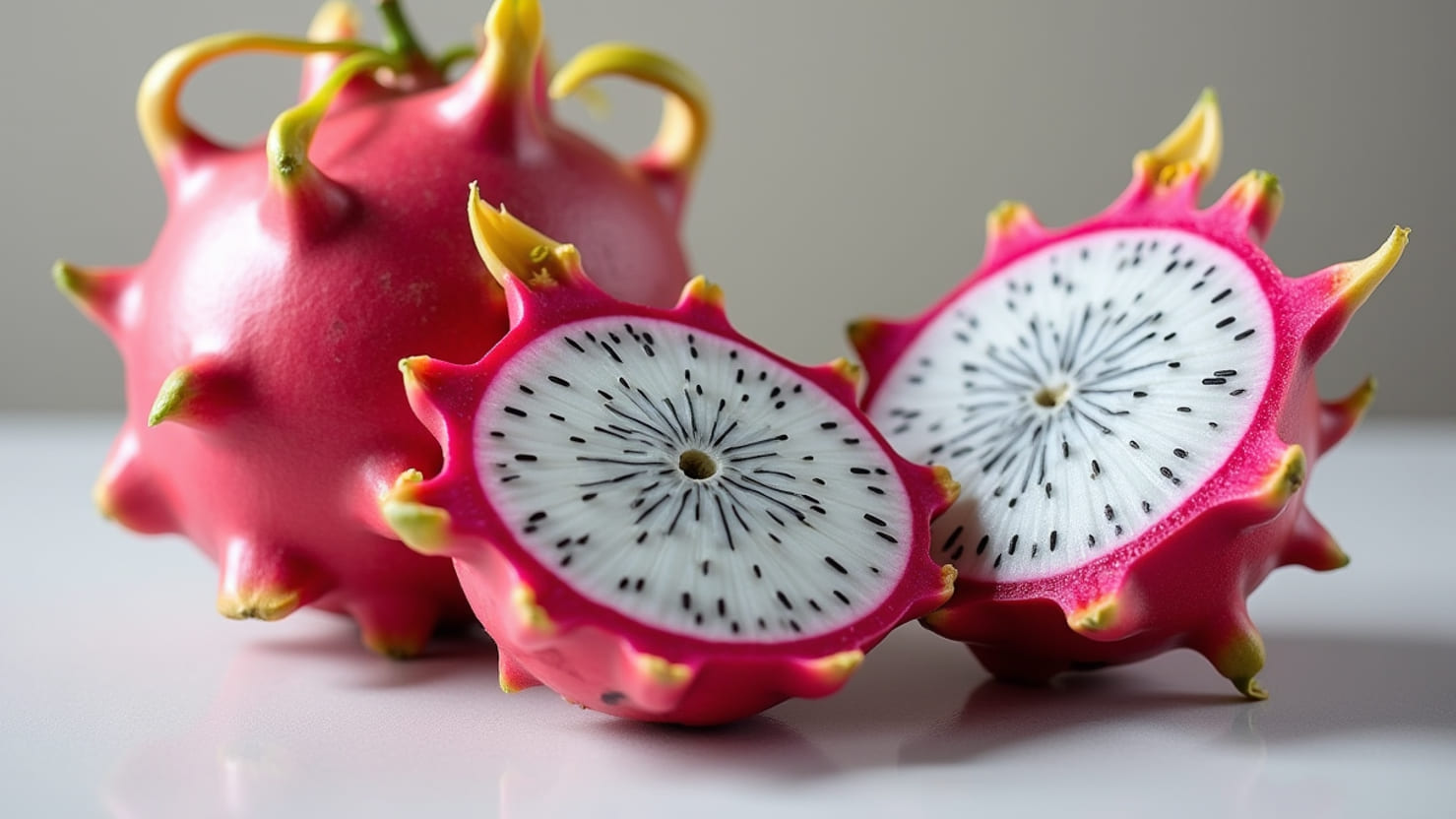
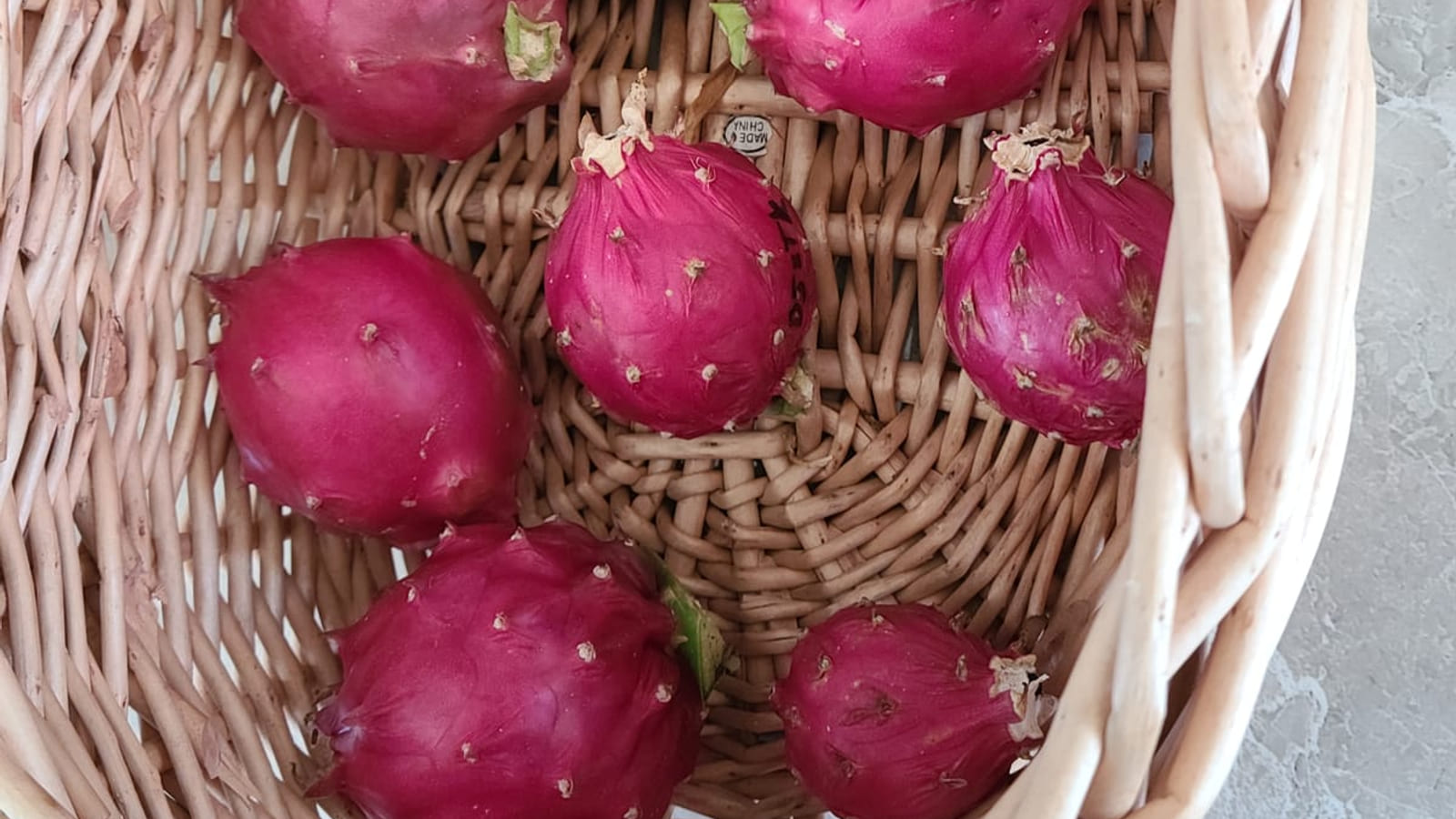
CFA DK16 is a red-fleshed dragon fruit selection from Cactus Fruits Australia. It produces magenta flesh throughout the fruit, not just a ring near the skin, with sugar levels of 20 to 22 Brix. The flavor is intensely sweet with notes of concord grape and mixed berries, and little to no tartness. However, DK16 is self-sterile. You cannot expect fruit from this plant alone. It requires cross-pollination with pollen from a genetically different variety. Flowers open around 11 p.m., so plan for hand-pollination in the early evening through the following morning. The fruit itself is small, averaging around 160 grams, but the quality justifies the space for growers seeking high-Brix dessert fruit.
Because this clone depends on a partner for pollination, you must plant a companion. We recommend pairing DK16 with a white-fleshed Selenicereus undatus or a yellow megalanthus type to ensure compatible pollen is available when your DK16 blooms. This ensures you get the heavy pollen load needed to reach its modest 160 g potential. See our guide on dragon fruit cross-pollination for specific pairing advice and timing tips.
Where it came from: the Desert King line
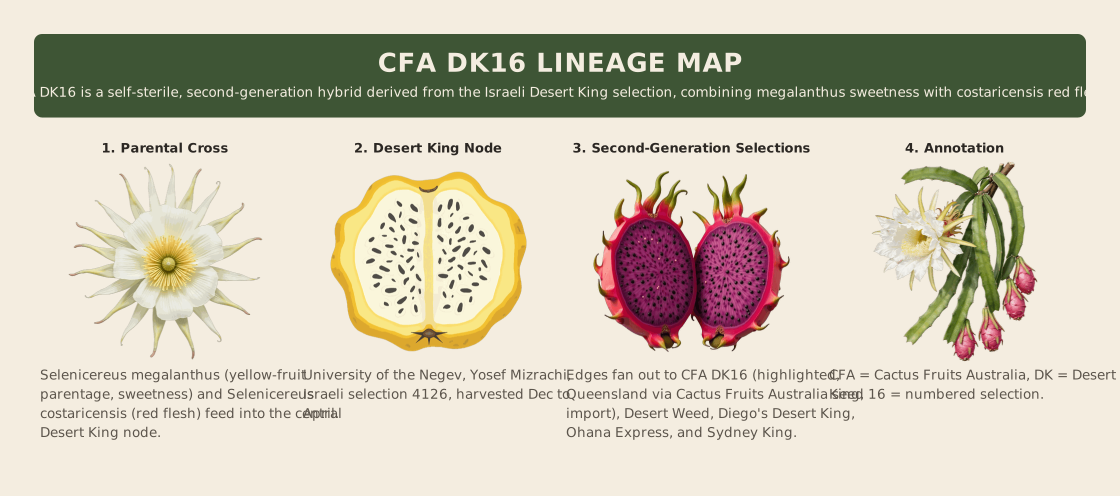
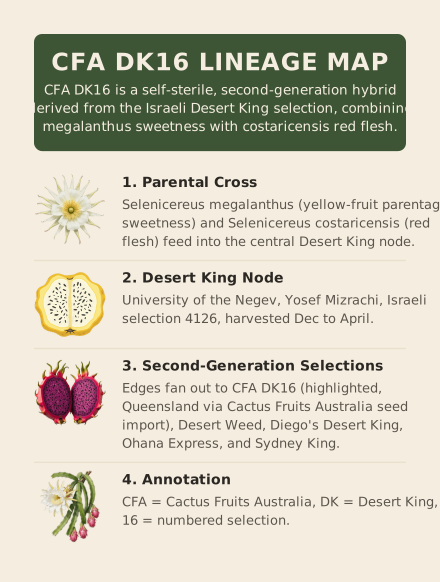
The name CFA DK16 tells you exactly where this plant started. The "CFA" prefix marks it as a selection from Cactus Fruits Australia, a specialist nursery in Queensland run by Steven Prowse that has been breeding cactus fruits for around 30 years.[12] The "DK" records its parentage: Desert King. It is a deliberate, numbered selection from a commercial breeding program designed for high sugar and specific flesh color, not a wild find.[1]
Desert King itself is an Israeli commercial selection, developed by Professor Yosef Mizrachi at the University of the Negev for commercial production.[4] In Israel, this variety fills a gap in the market. While the main commercial varieties, Bilu and Venus, crop from June through the end of the year, Desert King is harvested from the end of December through April.[4] This winter-bearing habit is the reason the line exists. Growers want fruit in the shoulder season, not just all at once in summer.[4]
Genetically, DK16 is a second-generation hybrid. Its parent, Desert King, is a cross between Selenicereus megalanthus and Selenicereus costaricensis.[2] This combination brings together the high sugar content of megalanthus with the deep red flesh of costaricensis.[3] DK16 is one of several documented offspring in this line, which also includes Desert Weed, Diego's Desert King, Ohana Express, and Sydney King.[2] Leewi Farms, one of the few US nurseries to import cuttings directly from CFA rather than through middlemen, lists DK16 as the finest variety in the CFA range.[1]
Because pitaya plants are highly heterozygous, you cannot grow a true-to-type DK16 from seed. Even a cross within the same cultivar yields genetically different plants.[7] Breeding programs reserve seed for new lines. To keep the clone identity intact, you must propagate vegetatively from cuttings.[9] This is why every CFA DK16 plant you buy is a cutting, not a seedling.
Why the winter-bearing habit matters
The Desert King lineage exists for one specific commercial reason: it fruits when the market is quiet. While standard varieties like Bilu and Venus dominate the harvest from June through the end of the year, Desert King fills the gap from late December through April.[4] Growers collect these seedlings to spread their income across the calendar.
For a home grower, this timing shifts how you judge the crop. You cannot rely on visual cues from the skin to tell you when a DK16 is ready. The flesh is magenta throughout the fruit, not just a ring near the surface, which means the exterior does not offer a clear color shift to signal peak ripeness. Growers judge true maturity by a ripening index calculated by dividing total soluble solids by titratable acidity.[11] Because DK16’s skin provides a weak visual cue, you must rely on the fruit’s weight, the drying of the bracts, and eventually, the taste itself to confirm that the high sugar content has fully developed.
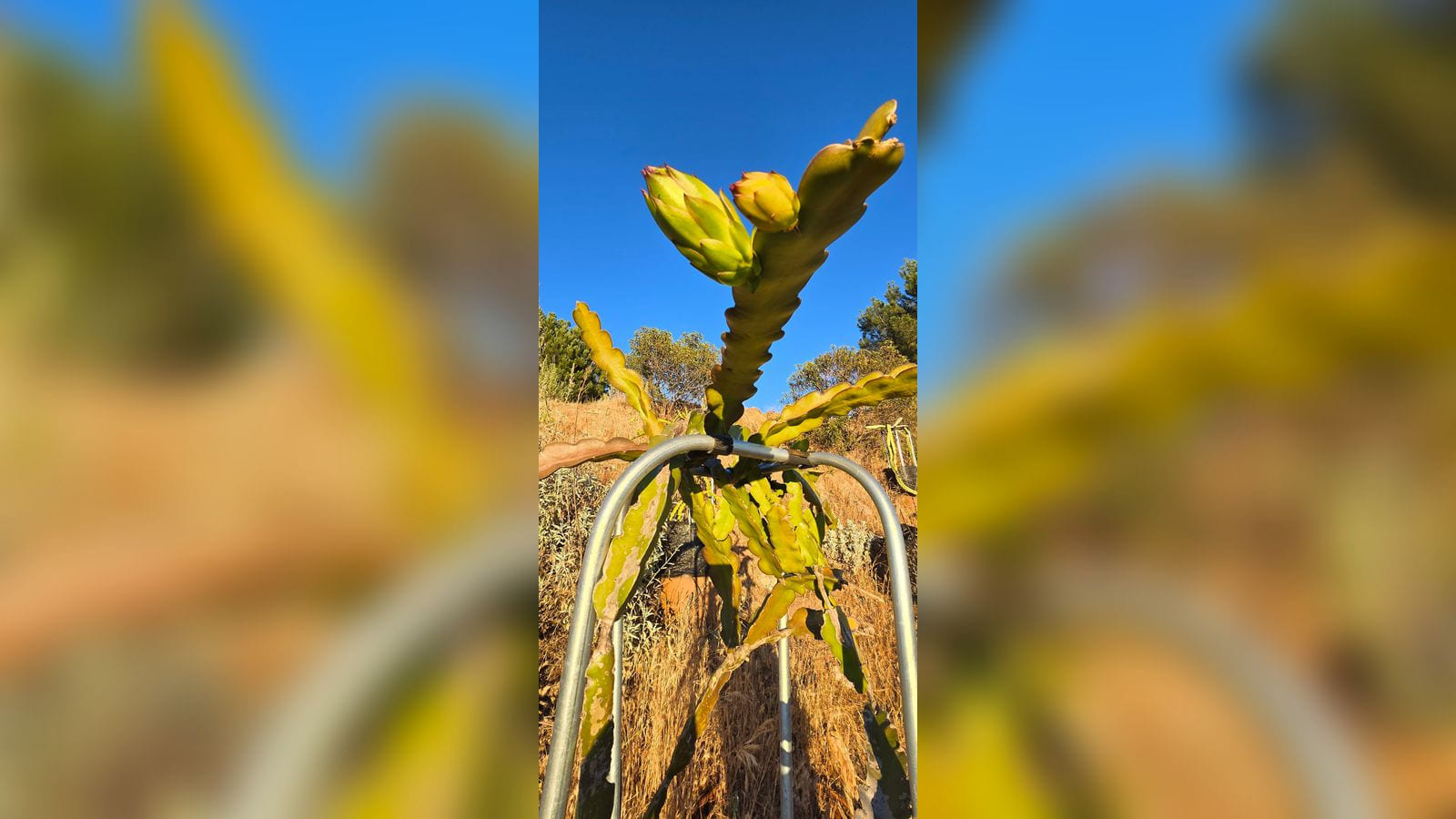
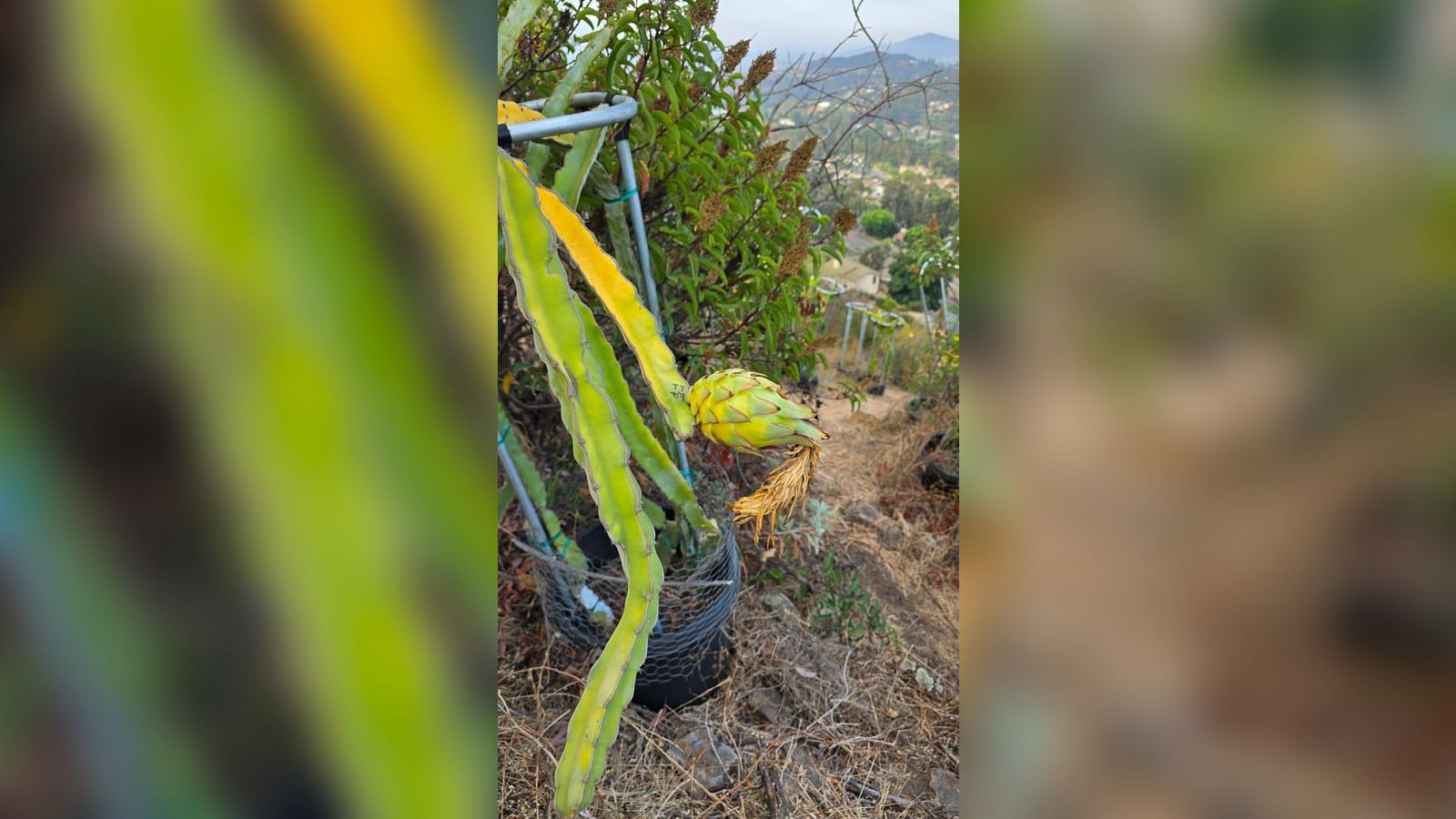
The plant’s structure also plays a role in managing this off-season crop. Dragon fruit stems are triangular, green, fleshy, and jointed, often bearing small spines or none at all.[9] These stems can reach about 20 feet, creating a large canopy that supports the heavy, slow-maturing fruit.[9] Since the fruit takes longer to mature than standard varieties, the plant’s growth habit is essential for sustaining the energy required to push a crop through the cooler months. If you are managing a trellis, remember that pruning is not just for shape; limiting the number of cladodes concentrates resources into thicker stems and better-positioned fruit. This matters when you are chasing high Brix in a smaller, slower-ripening berry.
Flavour and sugar, measured
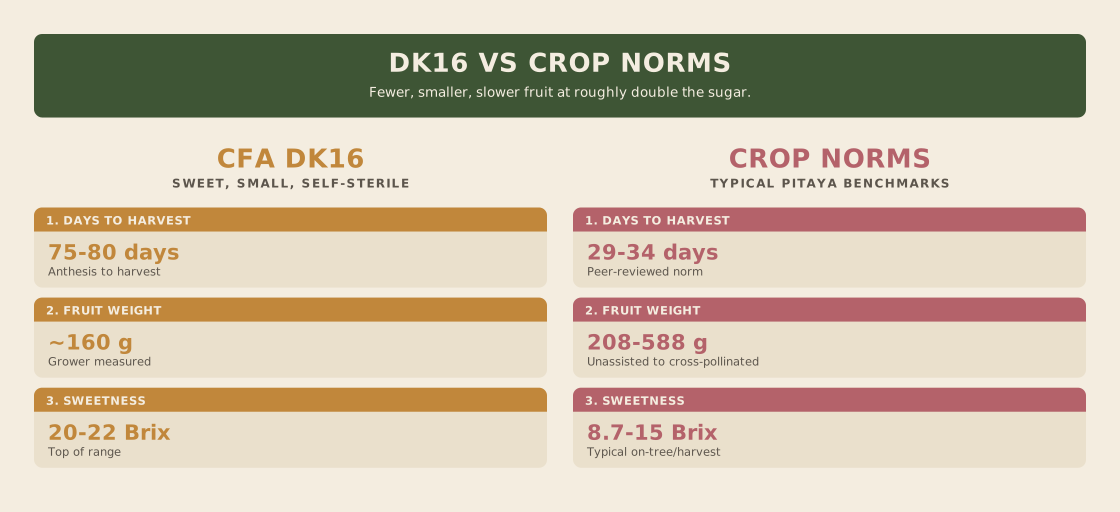
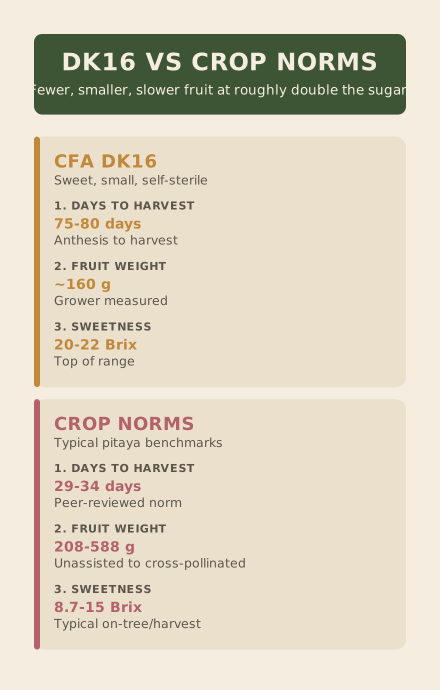
The reputation of CFA DK16 rests on measured sugar levels. Two independent sources place this clone at the extreme upper limit of sweetness for dragon fruit. The importing nursery lists CFA DK #16 at 22 Brix, while an independent grower review of the same selection records a 20 per cent average Brix.[1] These figures align, showing that the clone consistently delivers top-of-range sugar content.
To understand how exceptional this is, look at the broader crop. On-tree ripening pitaya typically reaches about 12 to 15 degrees Brix total soluble solids, depending on the cultivar.[11] Even when measuring across various pitaya species at harvest, total soluble solids usually fall within a narrow band of 8.7 to 13.7 Brix.[11] While some cultivars are reported to hit 20 Brix, a measured 20 to 22 Brix places DK16 at the very top of the range recorded for the crop.[11]
The flavor matches the sugar readings. One US nursery handling the clone describes the taste as overwhelmingly sweet with a candy-like note.[5] A separate varietal review by a grafter characterizes it as extremely sweet with little to no tartness, offering distinct notes of concord grape and mixed berries.[5] This lack of acidity sets it apart. Most pitaya varieties rely on a balance of sugar and acid for flavor. DK16 skips the acid, delivering intense sweetness that makes it a dessert fruit.
Because the skin is magenta, visual cues for ripeness are weak. You cannot rely on color change alone to judge maturity. Instead, growers use a ripening index calculated by dividing total soluble solids by titratable acidity.[11] This method helps you harvest at peak sugar content rather than guessing based on skin tone.
The clone’s self-sterility is also a measured physiological trait. In a two-year trial, the red-fleshed clone NDFR-1 set fruit (100 per cent) only under manual cross-pollination.[8] It set nothing under any bagged or selfed treatment.[8] A white-fleshed clone tested alongside it was self-compatible, highlighting that incompatibility is clone-specific.[8] This shows the need for a compatible partner. See our guide on dragon fruit pollination for details on managing this requirement.
The 75 to 80 day fruit
Patience is the price of entry for CFA DK16. While standard dragon fruit cultivars ripen in 29 to 34 days, this clone takes 75 to 80 days from flower to harvest.[6] Peer-reviewed phenology for the crop generally places maturity at 29.05 to 34.00 days after anthesis, meaning DK16 runs at roughly double the typical timeline.[8] This extended ripening period allows sugars to concentrate, contributing to the high Brix levels, but it also demands that you keep the plant healthy and stress-free for about 11 weeks after the bloom fades.
The small fruit size, averaging around 160 grams, is small even by red-fleshed standards and is doubly dependent on pollination. Berry growth depends on how many ovules are successfully fertilized.[7] If the pollen load is light, the fruit may set but remain stunted. Because DK16 is self-sterile, you cannot rely on the plant’s own pollen to trigger full development. A grower’s trial confirmed that using a different named variety as the pollen parent was necessary to set fruit, proving the clone’s strict dependency on cross-pollination.[6] To reach even its modest size, DK16 needs a heavy, deliberate application of compatible pollen.
Hand pollination is not optional. Natural nocturnal pollinators like moths and bats are rarely effective enough to ensure a good set, especially for self-sterile clones. UF/IFAS extension notes that transferring pollen or whole stamens by hand is the reliable method.[9] Since self-incompatibility in named cultivars is often poorly documented, always confirm compatibility with your nursery before planting.[9] See our dragon fruit pollination guide for technique.
Vegetative propagation accelerates the timeline to first harvest. Unlike seedlings, which take years to mature, cuttings retain the ontogenetic age of the mother plant. A commercial planting from a cladode can produce fruit in less than a year.[7] Once established, a three- to four-year-old plant can yield about 220 lb of fruit per year and remain productive for around 20 years.[9] Pruning plays a role in sustaining this output. Limiting the number of cladodes concentrates resources into thicker stems and well-positioned fruit, improving both set and quality.[7]
Harvesting requires a sharp eye and clean tools. Pick only well-colored, mature fruit using hand clippers, cutting the peduncle flush to the fruit body.[9] The magenta flesh does not continue to sweeten significantly after picking, so wait for full color development. Expect a shelf life of about four to five days at room temperature.[9] Given the long ripening window and small size, each fruit represents a significant investment of time and care, making proper pollination and pruning essential for a worthwhile harvest.
Pollination: the one non-negotiable
Self-sterility is not a defect unique to CFA DK16. It is the standard for most cultivated pitaya genotypes. The flowers are physically engineered to prevent self-pollination. In verified commercial cultivars like S. undatus and S. costaricencis, there is more than 2 cm of spatial separation between the male and female organs, a trait known as herkogamy[7]. This gap makes natural self-pollination nearly impossible. You are not fighting a quirk of this specific clone. You are working with the fundamental biology of the crop.
Because the plant cannot rely on its own pollen, you must provide a genetically different variety. This is not optional. It is essential. Commercial growers in Iberia treat hand-pollination as a routine labor cost because relying on natural pollinators or self-compatibility removes the risk[7]. For DK16, the stakes are higher. It is a small-fruited clone. If you do not deliver a heavy pollen load, the fruit will not just fail to set. It will abort into a runt rather than reaching its modest 160 g potential[7].
The nocturnal window
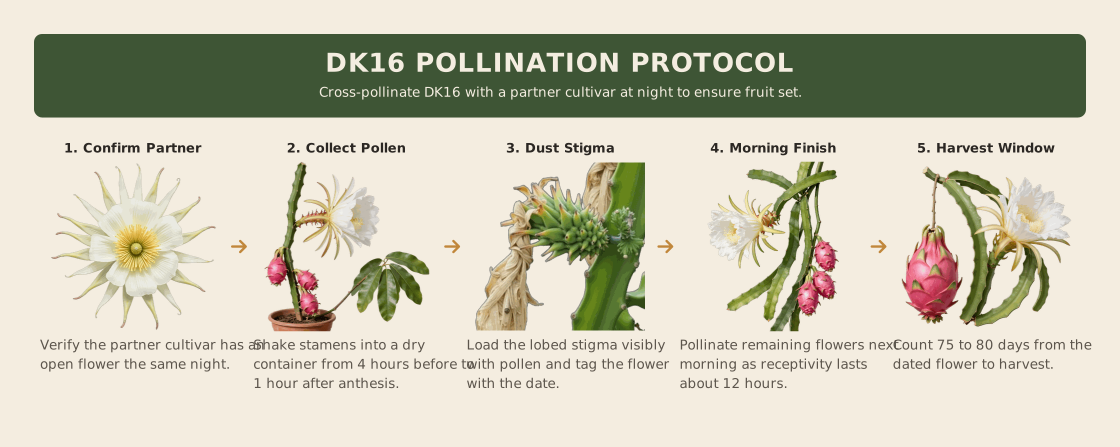
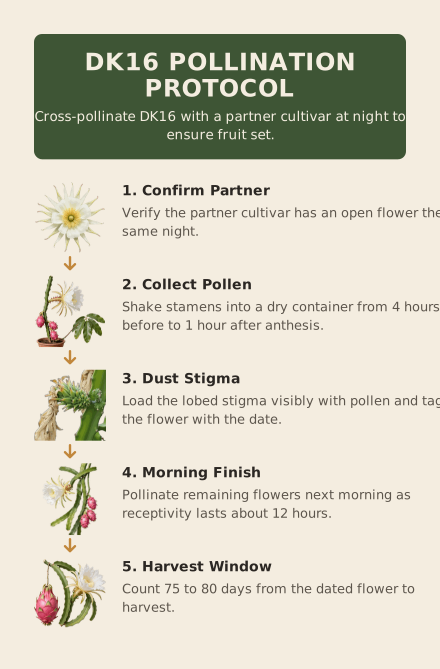
Dragon fruit flowers open at night. In southern Portugal and Spain, anthesis typically occurs around 11 p.m. during peak flowering[7]. The physiological window for successful pollination is wide but specific. It runs from roughly 4 hours before anthesis to 12 hours after[8]. This means your usable time for hand-pollination starts in the early evening and extends through the following morning. You do not need to be awake at midnight. Early evening work is effective. Pollen collected at night or in the early morning remains viable and germinates well[7].
Weather matters. Strong nocturnal winds can blow pollen out of open flowers before it reaches the stigma. If a windy night is forecast, collect pollen early in the evening when the flowers first open. You can also bank pollen. Properly stored pitaya pollen remains viable for up to five days at 4 degrees C[7]. This allows you to collect surplus pollen on a good night and use it to cover a later bloom if your DK16 flowers open on a different schedule than your partner plant.
Why hand-pollination changes the fruit
Hand-pollination does more than ensure a fruit sets. It determines the size and seed count of that fruit. Manual cross-pollination produces significantly heavier fruit than any other method. In comparative trials, hand-pollinated fruit averaged 588 g, compared to 377 g under manual self-pollination and just 208 g under unassisted open pollination[8]. Seed count follows the same pattern. Hand-pollinated fruit contained 1,304 to 1,355 seeds, while fruit protected by coarse netting had only about 280[8].
The mechanism is simple. Berry growth depends on the number of ovules fertilized. Insufficient pollination results in smaller fruit, even if set occurs[7]. For DK16, which is already genetically predisposed to small fruit, this is critical. You need a thorough application of pollen to trigger full development. A light dusting will result in a tiny, underdeveloped fruit. A heavy load will result in a full-sized, high-Brix dessert fruit.
Practical tip: Use a soft brush or a cotton swab to transfer pollen from the anthers of your partner plant directly to the lobed stigma of the DK16 flower. Coat the stigma thoroughly. Do not just touch it. Ensure the pollen is visible and evenly distributed across all stigma lobes.
Pairing strategy is key. Since DK16 is self-sterile, you need a compatible partner. The most reliable approach is to plant a white-fleshed S. undatus or a yellow megalanthus type nearby. These varieties are recommended pairings. Ensure both plants are in flower on the same night. If their bloom times do not overlap, you will miss the window. For more detailed pairing advice, see our guide on dragon fruit pollination.
The nocturnal window, hour by hour
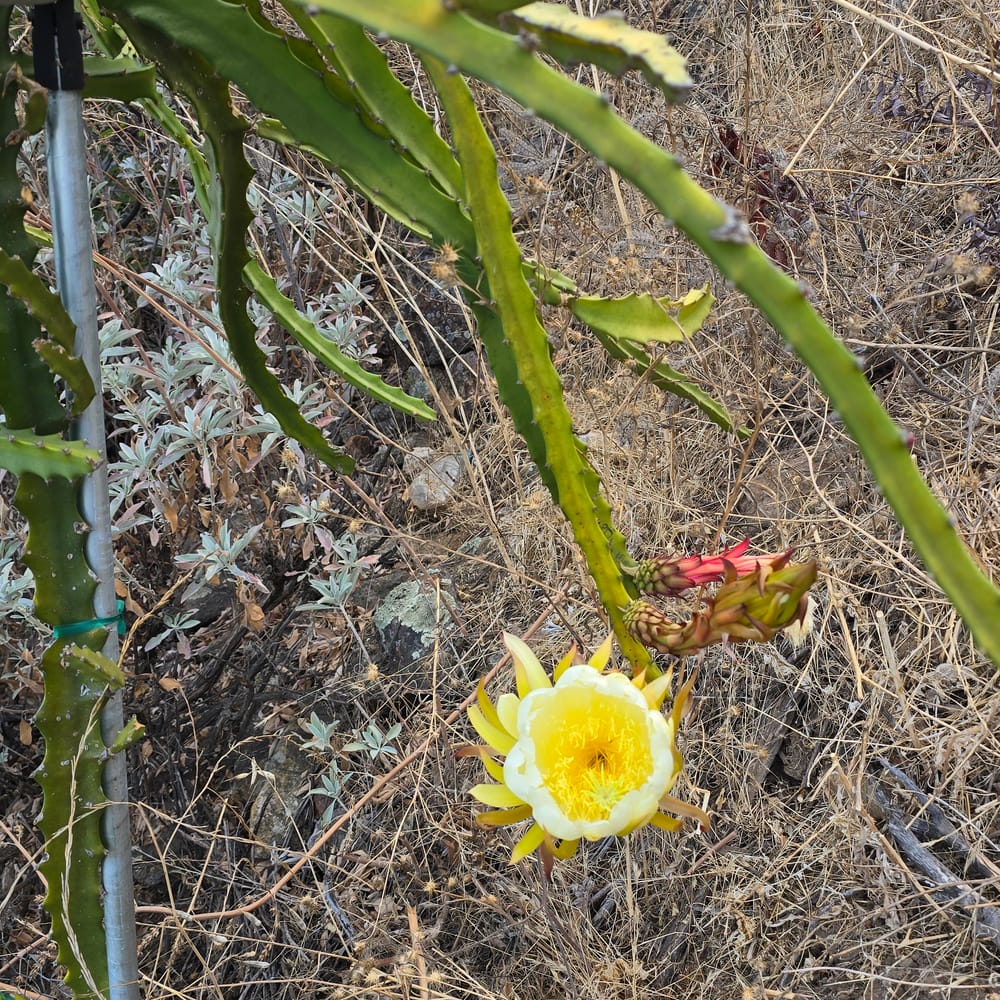
You are working in the dark, and the clock is ticking. The flowers of CFA DK16 are massive, reaching up to 14 inches long and 9 inches wide, with cream-colored stamens surrounding a lobed stigma[9]. They are fragrant and showy, but they are also short-lived. The physiological window for successful pollination is narrow, opening roughly four hours before anthesis and closing about twelve hours after[8]. This means your work begins in the early evening and must be finished by the following morning.
Peak anthesis typically occurs around 11 p.m. during heavy flowering periods[7]. However, you do not need to be precise to the minute. Studies show no significant difference in fruit set between pollination done at night and in the early morning[7]. Pollen collected at night or just before dawn remains highly viable[7]. This flexibility helps growers who cannot stay up all night. You can wait until the flowers are fully open and the stigma is receptive, then work calmly with a flashlight.
Wind is the enemy of the night shift. Strong nocturnal breezes can blow pollen out of open flowers before you ever touch them[7]. If a windy night is forecast, extension-stage reviews advise collecting pollen early in the evening[7]. This protects your supply. It also allows you to bank surplus pollen for later use. Pitaya pollen stored properly remains viable for up to five days at 4 degrees Celsius[7]. A good night’s harvest can cover a later flower that opens when your partner plant is not blooming.
Banking tip: Use a small, clean container for pollen. Keep it cool but not frozen. If you collect on a calm night, you have a buffer for the next few days. This is critical for DK16, which relies entirely on cross-pollination to set fruit.
Remember that hand pollination does more than just ensure a set. It changes the fruit itself. Manual cross-pollination produces significantly heavier fruit than unassisted methods[8]. For a small-fruited clone like DK16, a heavy pollen load is necessary to reach its modest 160-gram size rather than aborting into a runt[7][8]. The mechanism is simple: berry growth depends on how many ovules are fertilized[7]. Be generous with your pollen transfer.
For more details on pairing varieties and timing your efforts, see our dragon fruit pollination guide.
Growing CFA DK16
Successful cultivation of CFA DK16 begins with understanding the context of its origin. Cactus Fruits Australia, the breeder behind this selection, operates as Australia’s first specialist cactus-fruit plantation and nursery, having collected, bred, and grown cactus fruits for approximately 30 years. Their commitment to certified organic and biodynamic farming provides the breeding context for DK16, ensuring the plant is adapted to sustainable farming practices rather than relying on heavy synthetic intervention.[12]
When sourcing cuttings or reading older nursery listings, you may encounter the parents of DK16 listed under the genus Hylocereus. This is a taxonomic holdover. A 2017 phylogenetic framework for the tribe Hylocereeae revealed that species formerly placed in Hylocereus are nested inside Selenicereus, leading to the merger of the two genera. Consequently, the correct scientific names for DK16’s parents are Selenicereus megalanthus and Selenicereus costaricensis.[3] Knowing this helps you find the right species traits for your garden.
Propagation Note: Because DK16 is a highly heterozygous hybrid, it must be propagated vegetatively from cuttings to maintain its specific genetic identity. Seedlings will not match the parent plant’s exceptional sweetness or magenta flesh.
Is CFA DK16 right for you
This clone is a specialist’s choice, not a beginner’s project. It delivers exceptional sweetness but demands specific conditions to produce anything at all. If you want a low-maintenance plant that fruits reliably without intervention, look elsewhere. DK16 rewards effort with flavor, but empty flowers follow if you neglect the pollination step.
| Profile | Fit | Why |
|---|---|---|
| The Flavor Hunter | Yes | 20 to 22 Brix and magenta flesh are rare. You will taste the difference.[7] |
| The Hands-Off Grower | No | Self-sterile. No hand-pollination, no fruit.[8] |
| The Space-Constrained | Maybe | Small fruit (160 g) means you need room for a partner plant.[8] |
| The Night Owl | Yes | Flowers open late. If you are awake at 11 p.m., you can work the blooms.[7] |
The pollination reality
You cannot grow DK16 alone. It is strictly self-sterile, meaning its own pollen will not set fruit.[6] This is not a defect; it is a biological barrier common in many cultivated pitaya genotypes. You must have a genetically different variety blooming on the same night to provide compatible pollen.[7] If you do not have a partner plant, you are growing a cactus, not a fruit tree. Check your dragon fruit pollination strategy before you buy.
Warning: Do not assume a nearby white-fleshed plant will work if it blooms on a different night. Synchronization is key. If your partner variety flowers a week apart from your DK16, you will get no fruit.
Time and effort
Expect a long wait for the payoff. DK16 takes 75 to 80 days from flower to harvest, which is roughly double the time of standard commercial varieties.[8] You will be watching that small fruit swell for about 11 weeks. The reward is a sweet bite, but the investment is significant. If you want quick returns, choose a faster-ripening white-fleshed clone.
Hand-pollination is mandatory, not optional. Studies show that manual cross-pollination produces significantly heavier fruit than natural methods.[8] For a small-fruited clone like DK16, a heavy pollen load is the only way to reach its modest 160 g potential rather than aborting into a runt.[7] You must be willing to work after dark, transferring pollen with a brush or stamen. If you are not prepared to stand in the garden with a flashlight, this variety will frustrate you.
Space and support
Dragon fruit stems can reach 20 feet, and DK16 is no exception.[11] While the fruit is small, the plant grows large. You need a sturdy trellis or post system. Because you likely need a partner plant for pollination, plan for two large structures or a shared support system. A single pot on a balcony is rarely enough space for a self-sterile clone and its pollinator partner to thrive together.
Why the flesh is that colour
The deep magenta you see when you slice a CFA DK16 is not a sign of over-ripeness. It is the result of specific pigment chemistry. Red and magenta pitaya flesh gets its hue from betacyanins, a class of pigments that also colour beetroot and prickly pears. In DK16, these pigments are distributed throughout the fruit rather than forming a thin ring near the skin, which is why the interior looks uniform and intense.[1]
These pigments do more than look good. A study by Monash University isolated individual pigments from red dragon fruit and found they possess anti-amyloid-β aggregation activity. The research identified three specific compounds responsible for this effect: betanin, phyllocactin, and hylocerenin. The study measured their effectiveness in concentration-dependent order, with hylocerenin showing the strongest activity, followed by phyllocactin, and then betanin.[10]
Health note: The concentrations of these pigments shown to be active in the study were validated as non-neurotoxic in human neuroblastoma cells. This suggests the compounds are safe at the levels found in the fruit, adding interest to DK16’s already high sugar content.
Cactus Fruits Australia bred DK16 specifically to maximize this visual and chemical profile. The nursery’s released range, which includes selections like DK #16 and Honey, is built around two main goals: flesh colour and a specific sugar profile.[1] Because these plants are numbered selections rather than formally registered cultivars, the trade relies on the nursery prefix to identify the source. This numbering system tracks the deliberate breeding choices made to combine the deep red flesh of the S. costaricensis parent with the high sugar content of the S. megalanthus parent.[2]
While the colour is striking, it is not the best indicator of harvest readiness. As noted in earlier sections, ripeness is judged by sugar-to-acid ratios, not skin or flesh hue. However, the presence of betacyanins confirms you have a true red-fleshed clone. If you are growing DK16 alongside white-fleshed varieties for dragon fruit pollination, the magenta flesh is a trait of the mother plant.[7]
Key takeaways + FAQ
What you need to know before you buy
CFA DK16 is a high-sugar, small-fruited clone that demands active management. It is not a "plant and forget" variety. You are buying a dessert fruit. The magenta flesh and 20 to 22 Brix sweetness are the reward for the labor involved in hand-pollination.[1] If you cannot commit to evening work during the bloom window, this variety will frustrate you. The self-sterility is strict. Without a genetically different pollen parent blooming on the same night, you get flowers but no fruit.[7] We recommend pairing DK16 with a white-fleshed Selenicereus undatus or a yellow Selenicereus megalanthus type to ensure compatible pollen is available. See our dragon fruit pollination guide for specific pairing advice.
The 75 to 80 day wait is real. Do not expect a quick harvest. This clone takes roughly double the time of standard commercial varieties to ripen. Patience is part of the cost.
Frequently asked questions
Can I grow DK16 from seed?
No. Pitaya plants are highly heterozygous. A seedling from DK16 will not match the parent in flavor, flesh color, or vigor. Seed is reserved for breeding programs. To keep the clone identity, you must propagate vegetatively from cuttings.[7]
Why is my DK16 fruit so small?
The average weight for this selection is around 160 grams.[6] However, insufficient pollination can produce even smaller "runts." Manual cross-pollination produces significantly heavier fruit than open pollination because berry growth depends on the number of fertilized ovules.[8] If your fruit is tiny, you likely did not transfer enough pollen. A heavy pollen load is required to reach the modest 160 g size.[7]
How do I know when it is ripe?
Do not rely on skin color alone. The magenta flesh is pigment chemistry, not a ripeness indicator.[10] Growers judge pitaya ripeness by a ripening index of total soluble solids divided by titratable acidity.[11] In practical terms, wait for the 75 to 80 day mark from flower to harvest, then check for well-coloured mature fruit. Cut the peduncle flush when harvesting.[9]
Can I store pollen for later?
Yes. Pitaya pollen stored properly remains viable for up to five days at 4 degrees C.[7] This allows you to collect surplus pollen on a good night and cover a later flower if strong nocturnal wind blows pollen out of open flowers. Collect early when a windy night is forecast.[7]
Is DK16 self-fertile?
No. It is strictly self-sterile. Most cultivated pitaya genotypes show low fruit development due to self-incompatibility, and DK16 is a case where manual cross-pollination is the only way to set fruit.[7] Planting two or three genetically different types is the standard recommendation to improve fruit set and size.[9]
References
- DK #16 (CFA Desert King #16) - variety listing: 22 Brix, 'finest variety cultivated by CFA', raised from imported seed, direct import from Steven Prowse of Cactus Fruits Australia, Queensland, Leewi Farms (2026).
- DK 16 Dragon Fruit Cultivar - numbered Desert King selection, S. megalanthus x S. costaricensis foundation, related to Desert Weed, Diego Desert King, Ohana Express, Sydney King, Pitahaya Tree (Dragon Fruit Plants cultivar database) (2026).
- Desert King Dragon Fruit Cultivar - S. megalanthus x S. costaricensis/polyrhizus cross, parent of Desert Weed and DK 16, Pitahaya Tree (Dragon Fruit Plants cultivar database) (2026).
- Here be dragons: Israel breathes fire into exotics - Desert King developed by Prof. Yosef Mizrachi at the University of the Negev, harvested end of December to April versus Bilu and Venus June to year end; ~50 ha, ~2,000 t/yr, mostly exported, Eurofruit / Fruitnet (2015).
- CFA DK16 Dragon Fruit Plant - magenta flesh live cutting; 'overwhelming sweet jolly rancher taste', Oax Dragon Fruit Farm (2026).
- CFA DK#16 Dragon Fruit Variety - grower varietal review: magenta flesh, Brix average 20%, extremely sweet with little to no tart, concord grape and mixed berries, 160 g fruit, 75-80 days to harvest, self-sterile and cross-pollinated with a different variety, Grafting Dragon Fruit (commercial grafter) (2024).
- Pitaya as a New Alternative Crop for Iberian Peninsula: Cultural Practices - self-incompatibility of most cultivated genotypes, >2 cm herkogamy verified in S. undatus and S. costaricencis, anthesis near 11 p.m., night vs morning pollination, pollen viable up to 5 days at 4 C, wind risk, routine supplementary manual pollination, smaller fruit from scarce ovule fertilisation, cuttings fruit in under a year, 15-25 cm basal cladodes optimal, wound treatment, pruning effects, Plants (MDPI) / Universidade do Algarve, PMC12987216 (2026).
- Floral and pollination biology of dragon fruit reveals strategies for enhancing productivity through pollination management and reproductive window extension - 588 g vs 377 g vs 208 g by pollination treatment, 1,304-1,355 seeds vs ~280 under netting, viability/receptivity window -4 h to +12 h around anthesis, clone-specific self-incompatibility (NDFR-1), phenology 16.10-22.40 d bud to anthesis and 29.05-34.00 d anthesis to maturity, Scientific Reports (Nature Portfolio) / ICAR & MPKV, DOI 10.1038/s41598-025-21168-2 (2025).
- HS1068/HS303: Pitaya (Dragonfruit) Growing in the Florida Home Landscape - plant two to three genetically different types, hand-pollination method, poor documentation of cultivar self-incompatibility, 65-77 F optimum / injury above 100 F / damage below 31 F, triangular stems to 20 ft, nocturnal edible flowers to 14 in, ~220 lb from a 3-4 year plant, ~20 year productivity, harvest with hand clippers and 4-5 day shelf life, UF/IFAS Extension (Crane & Balerdi) (2024).
- Anti-Amyloid beta Aggregation Activity and Cell Viability Effect of Betacyanins from Red Pitahaya (Hylocereus polyrhizus) for Alzheimer's Disease - betanin IC50 426.30 uM, phyllocactin 175.22 uM, hylocerenin 131.73 uM, non-neurotoxic at active doses, Plant Foods for Human Nutrition / Monash University Malaysia (2023).
- Yellow Pitahaya (Selenicereus megalanthus Haw.): The Less Known of the Pitahayas - on-tree TSS 12-15 Brix by cultivar with some to 20, harvest TSS band 8.7-13.7 Brix across species, ripeness judged by TSS/titratable-acidity index rather than colour, Foods (MDPI) (2025).
- Cactus Fruits Australia - nursery page: Australia's first specialist cactus fruits plantation and nursery, ~30 years collecting, breeding and growing dragon fruit, cactus pear and cactus apple, whole farm certified organic and biodynamic, Cactus Fruits Australia (Silver Valley QLD) (2026).