David Bowie Dragon Fruit: The Fins Are the Point
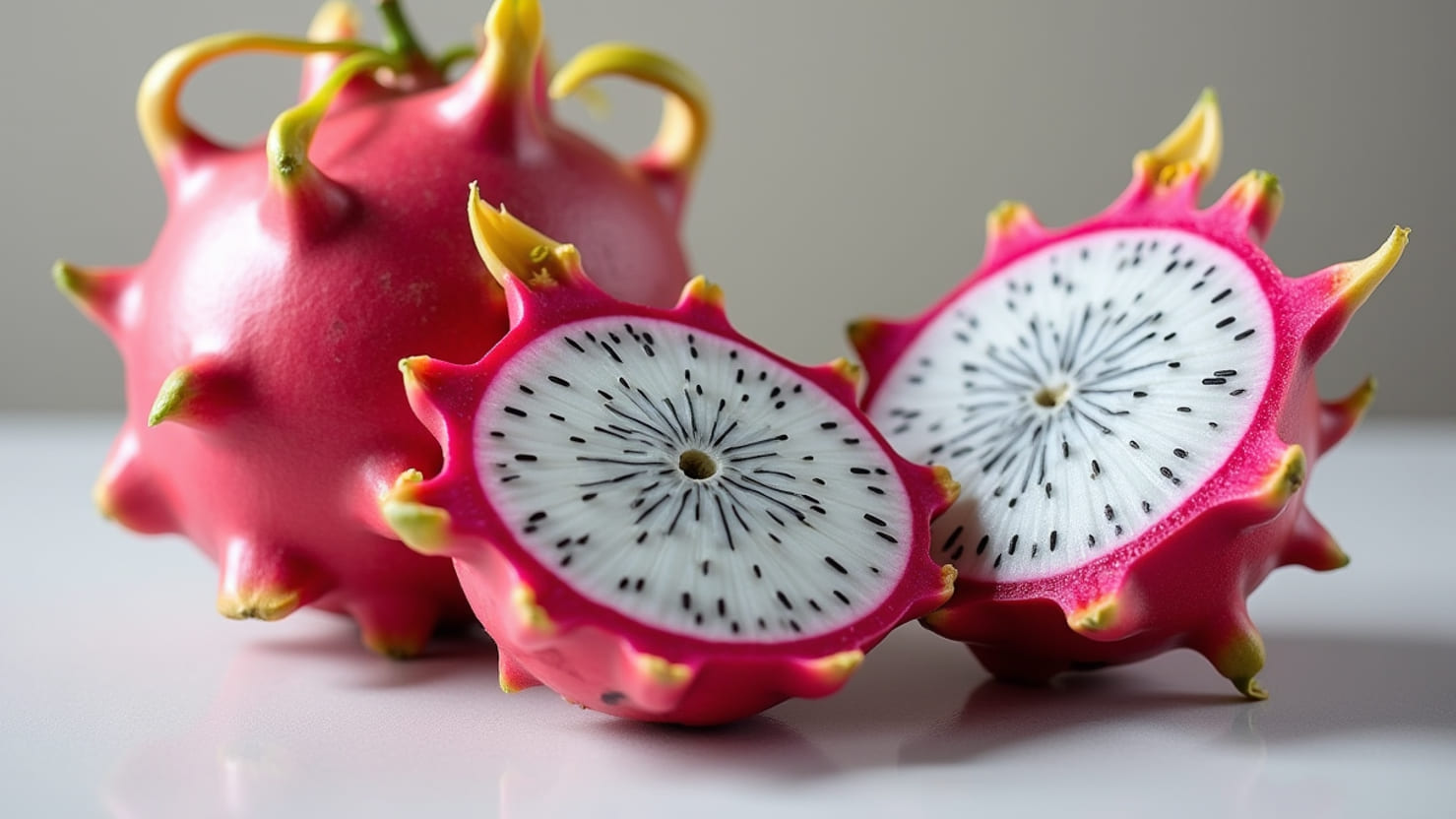
David Bowie dragon fruit is a white-fleshed pitaya, scientifically Selenicereus undatus (often still labeled Hylocereus undatus by nurseries). Listed in the University of Florida variety table as a California selection, it produces fruit with bright pink skin and unusually many green-margined scales. The flesh is sweet, tangy, and lemony, with a distinct aftertaste. It is self-fertile, meaning it sets fruit without a partner, though cross-pollination can improve size.
The name, the species and the synonmy you will see on listings
You will see David Bowie listed under two scientific names: Selenicereus undatus and Hylocereus undatus. These are not different plants; they are the same species renamed by taxonomists who moved the genus Hylocereus into Selenicereus. Nurseries and databases are slow to update, so both names persist on cuttings listings. If you buy a David Bowie cutting labeled either way, you are getting the same white-fleshed pitaya.
One specialist nursery lists David Bowie as a hybrid of Hylocereus undatus x monacanthus[11]. Treat that parentage as one grower’s note, not settled science. Most other sources, including a long-running Florida specialist and a horticultural consumer publication, describe it simply as a cultivar of undatus[8][12]. The fruit traits (more fins than average, white flesh, pink skin) match typical undatus closely enough that the hybrid claim remains unconfirmed by the broader record.
If you look up the University of Florida extension variety table, you will find David Bowie listed with origin California and a note that it does not need cross-pollination[2]. That table is an archival document. The named-section was removed from the live publication, so the list is a snapshot of what was circulating in Florida at the time of removal[2]. It confirms the variety was in the Florida trade, but it does not prove current availability or updated pollination data.
The fruit: what you get, and how sweet it is
David Bowie produces oval fruit with white pulp and pinkish-red skin covered in numerous green-tipped fins or bracts. This extra count of green-margined scales is the variety’s distinguishing visible trait across every description, more so than the flesh itself, which is typical for white-fleshed pitayas.[8] The skin changes from green to hot pink as the fruit matures.[7]
Weight estimates vary by source. The University of Florida extension table lists fruit at 0.5 to 1.0 lb.[2] A specialist nursery reports a range of 0.75 to 1.5 lb.[10] Another grower describes them as medium to large, often up to one pound.[11] A consumer publication also cites approximately one pound each.[12] These discrepancies reflect different growing conditions and pollination methods rather than a single fixed size.
Flavor profiles are consistent. The flesh is sweet, tangy, and lemony.[8] One community directory reports Brix levels of 16 to 18, which is moderately sweet, though this figure is a reported observation rather than a lab result on this specific cultivar.[7] Pine Island Nursery rates the flavor 5 stars and recommends eating it fresh, though it also works for juicing or garnishing.[9] The second specialist grower agrees it is suited to fresh eating, garnish, and smoothies.[10]
| Trait | Description | Source |
|---|---|---|
| Flesh color | White | [1], [9], [10], [11], [12], [13] |
| Peel color | Bright pink to pinkish-red | [1], [9], [10], [11], [12], [13] |
| Scale detail | Unusually many green-tipped fins/bracts | [1], [9], [11], [12], [13] |
| Weight (UF table) | 0.5-1.0 lb | [1] |
| Weight (Nursery range) | 0.75-1.5 lb | [11] |
| Reported Brix | 16-18 (moderately sweet) | [13] |
| Flavor | Sweet, tangy, lemony | [1], [9], [10], [11], [12], [13] |
| Best use | Fresh eating, juicing, garnish, smoothies | [10], [11] |
Because the fruit is non-climacteric, it does not improve after picking. Harvest cues include a skin-color change to hot pink and slight give to pressure.[7] This timing aligns with general pitaya agronomy, where maturity is measured in days after anthesis.[6]
How to tell a real David Bowie from a mislabelled white
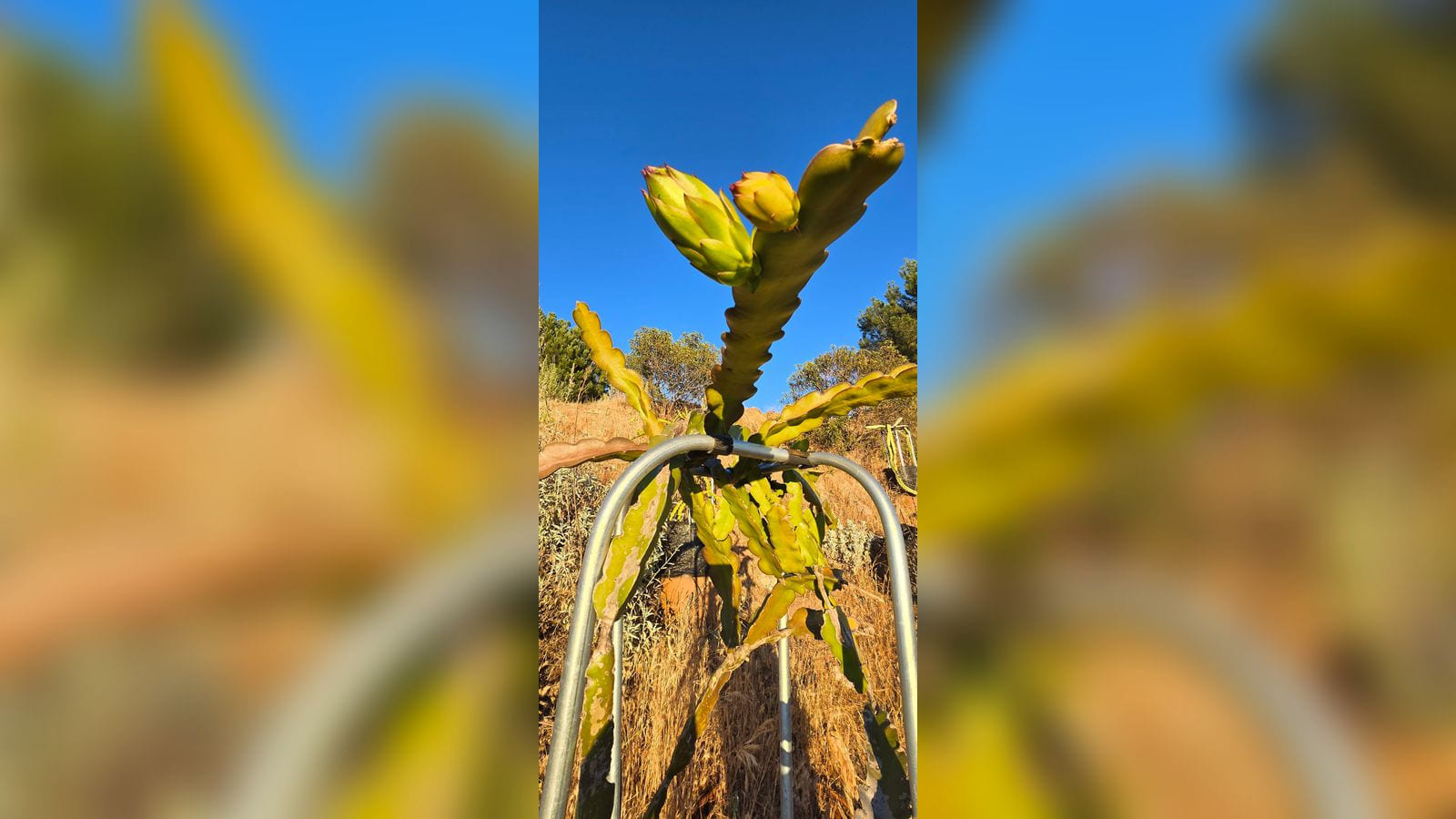
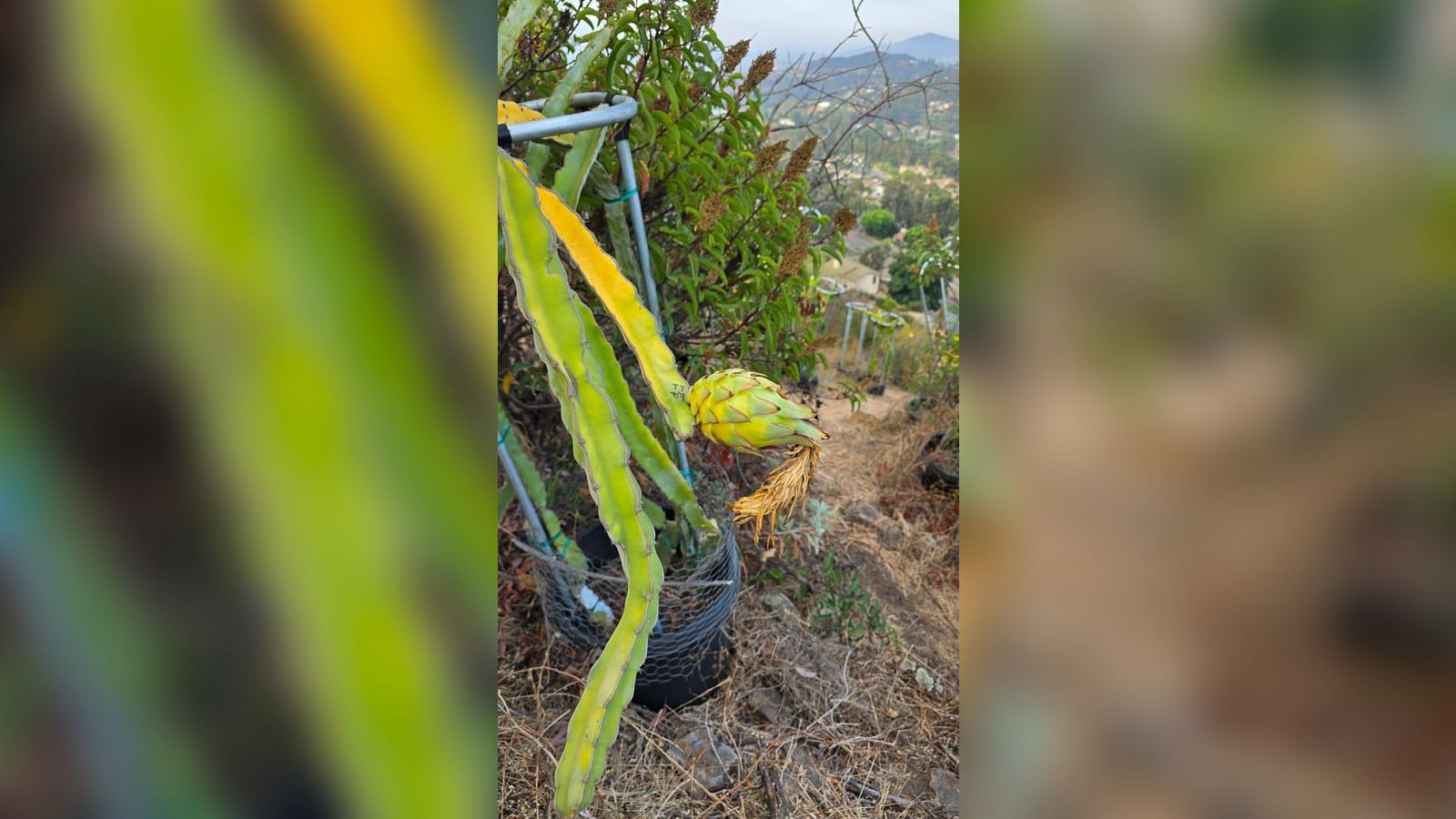
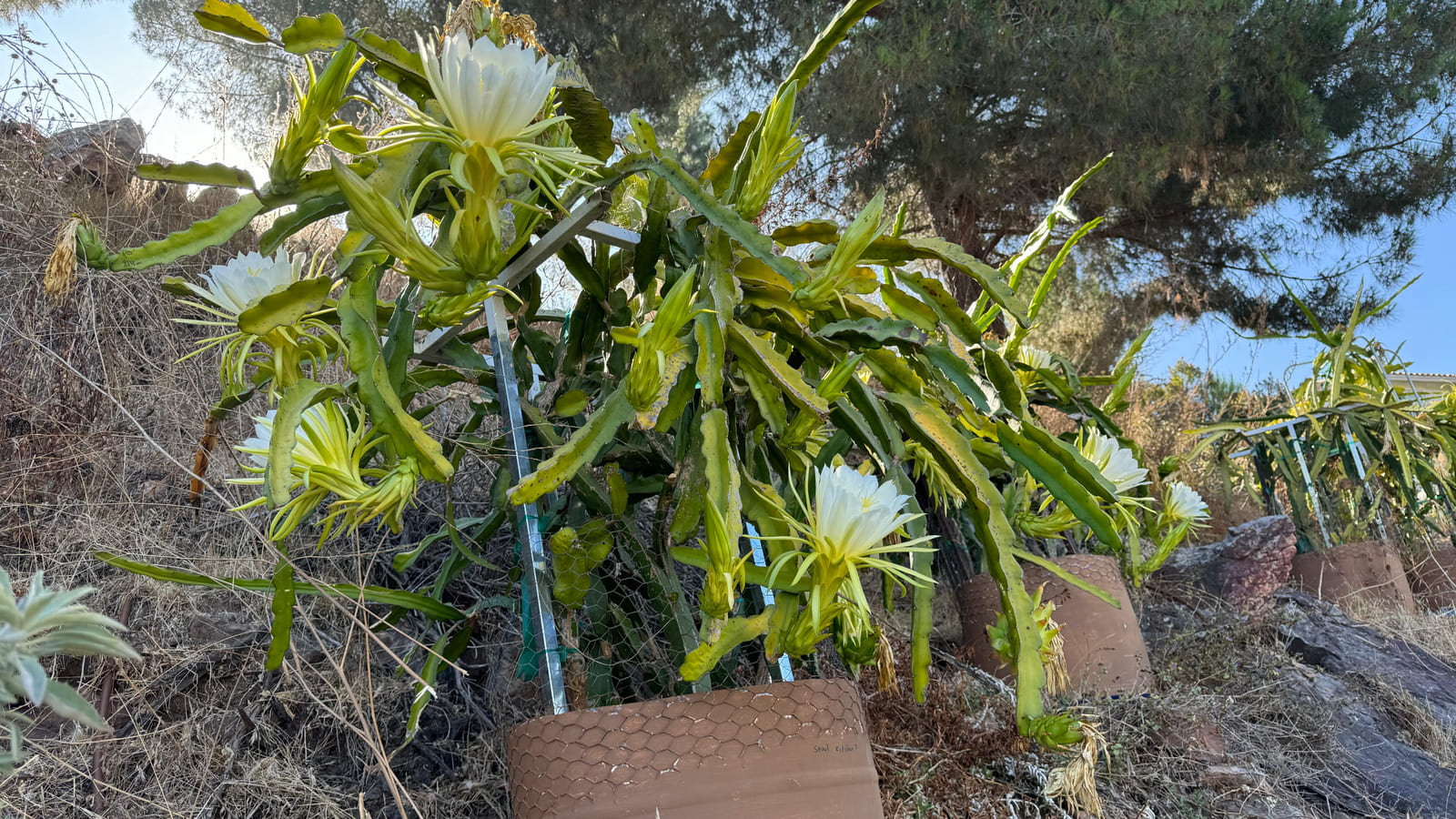
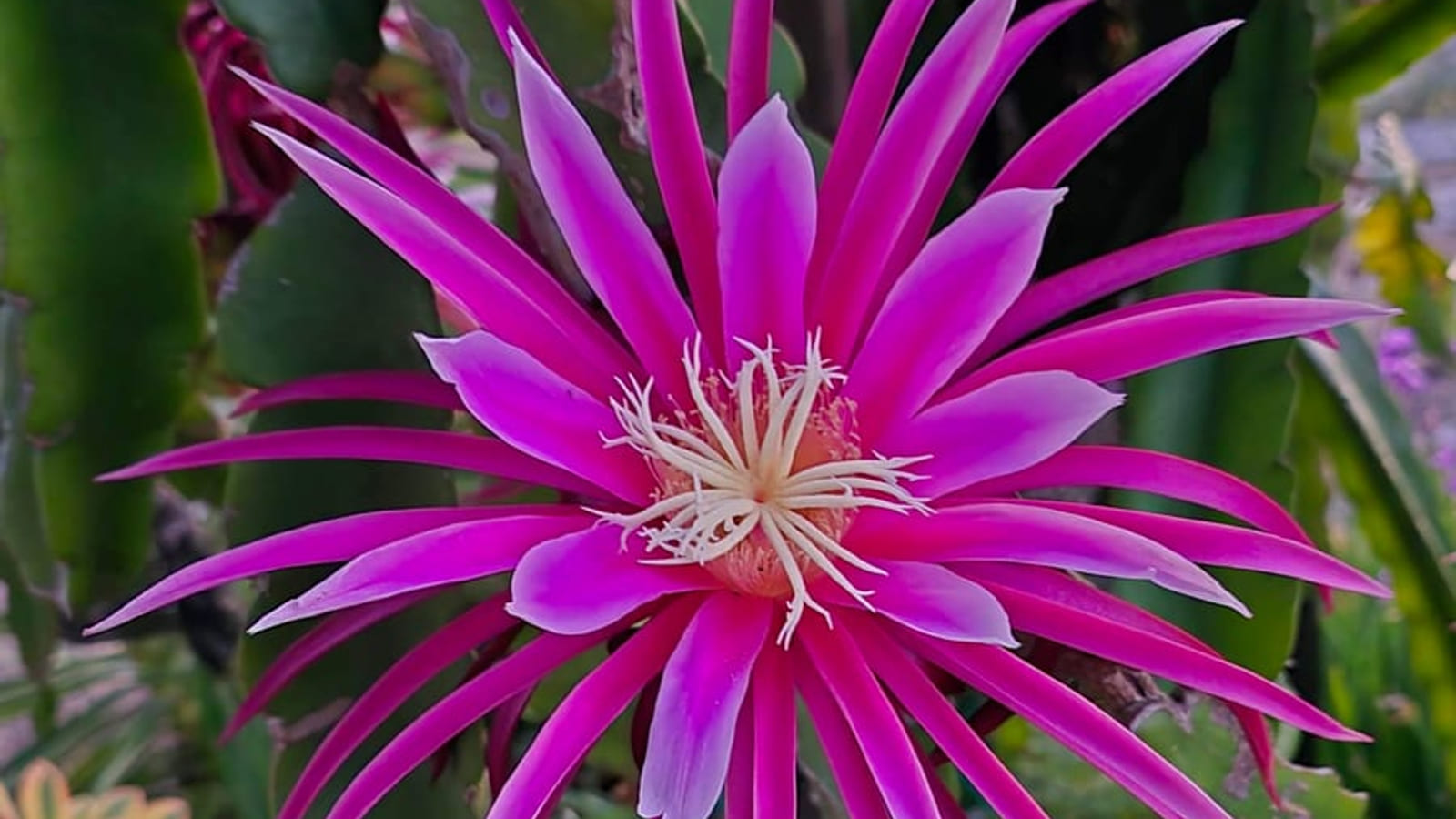
Identifying a David Bowie cutting before it fruits is nearly impossible. The stems, flower buds, and open flowers are nearly identical to ordinary Selenicereus undatus (often still labeled Hylocereus undatus).[8] You cannot rely on vegetative traits to confirm the variety. The plant looks like every other white-fleshed pitaya in the nursery trade until the first fruit sets.
The fruit is the only reliable field key. While the flesh remains white, the exterior displays distinct markers that separate David Bowie from generic undatus. Look for an unusually high count of green-margined scales or fins.[2] The skin transitions from green to a bright, hot pink as it ripens, with the green tips of the scales remaining prominent against the red background.[2] The shape is oval to oblong, though sources vary slightly on the exact range.[12]
| Trait | Generic White Undatus | David Bowie |
|---|---|---|
| Stems & Flowers | Nearly identical | Nearly identical |
| Scales/Fins | Average count | Unusually many, green-margined |
| Skin Color | Pink to red | Green to hot pink, distinct green tips |
| Flesh | White | White, sweet-tangy, lemony |
Because vegetative identification fails, buying a David Bowie cutting is ultimately a trust purchase. You are relying on the supplier’s labeling accuracy and their own sourcing history. There is no simple visual test for a young plant. If you need certainty before the first harvest, ask your nursery for their source of the original cutting. Reputable specialists who have grown the variety for years can often provide this lineage, but no external database or registry entry will confirm the plant’s identity for you in real time.
Self-fertile is not self-optimal: the part nobody prints on the label
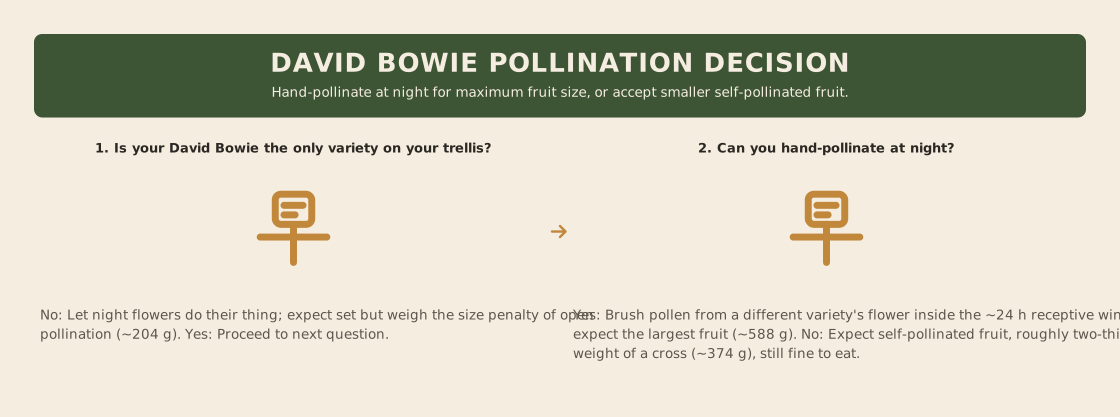
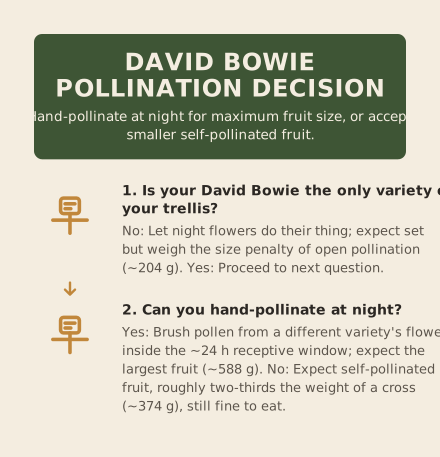
Most growers see "self-fertile" on a David Bowie tag and assume the plant will do everything on its own. The University of Florida extension table lists David Bowie with "Need for cross pollination: No," and several specialist nurseries echo this, calling it self-pollinating or self-fertile.[2] Yet one community directory explicitly states this variety needs a partner.[7] The answer lies in the difference between setting fruit and setting good fruit.
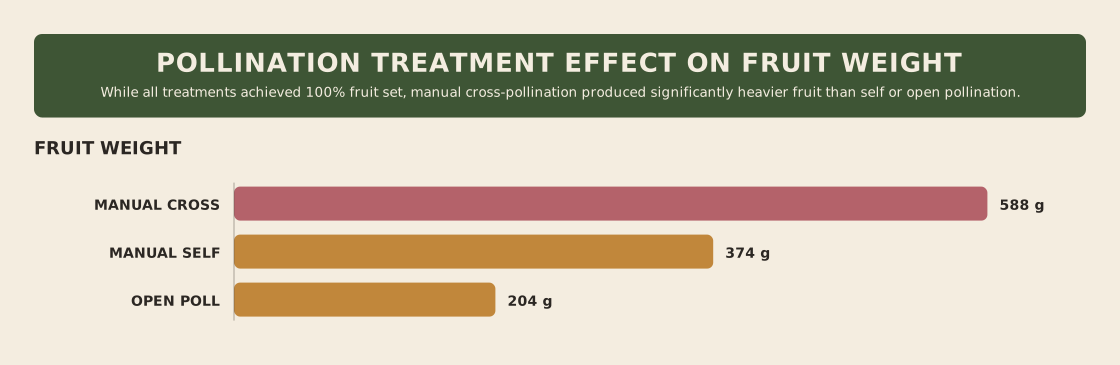
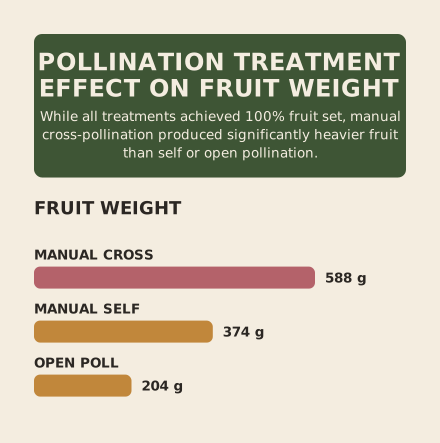
Self-fertile means the plant can produce fruit without pollen from another plant. It does not mean the fruit will be large, heavy, or uniform. A two-year peer-reviewed study on white-fleshed Selenicereus undatus proved this distinction clearly. The researchers achieved 100% fruit set under manual self-pollination, manual cross-pollination, and open pollination.[3] The plant set fruit in every scenario, but the weight of that fruit varied dramatically.
| Pollination Method | Average Fruit Weight | Outcome |
|---|---|---|
| Manual Cross-Pollination | Higher | Commercial grade, heavy, well-filled |
| Manual Self-Pollination | Moderate | Set, but lighter and often misshapen |
| Open Pollination | Lower | Small, poor seed set, low quality |
The study authors attributed the smaller self- and open-pollinated fruit to suboptimal fertilization and inadequate seed set.[3] White-fleshed pitayas have structural floral constraints and delayed autogamy (self-pollination mechanisms) that make them poor at filling out fruit on their own. Cross-pollination is not just a bonus; it is necessary for commercial-grade size and weight.[3]
The timing of this pollination is critical. The same study used hydrogen-peroxide stigma-receptivity tests to show that white-fleshed S. undatus stigmas are highly receptive only within a narrow window: 12 hours before and 12 hours after anthesis (flower opening).[3] Pollinating inside this window gave the highest fruit quality and weights exceeding those from natural pollination.[3] Outside this window, the stigma is less receptive, and fruit set or quality drops.
Because pitaya flowers open at night, natural pollinators like bees are absent. Moths and bats are the primary vectors, but their visitation is inconsistent.[1] Flowers that are not pollinated are aborted, leading to direct productivity loss.[4] Relying on "self-fertile" status can result in small, disappointing fruit because the plant sets fruit that is not heavy or well-formed.
The practical solution is to plant two or three genetically different types on your trellis.[1] Plant David Bowie next to a red-fleshed variety or a different white-fleshed cultivar. Then, hand-pollinate at night.[1] Collect pollen from one flower and apply it to the stigma of another within the 12-hour receptive window.[3] This small effort transforms a "self-fertile" plant into a high-yielding producer. For more on the mechanics of this process, see our pollination guide on what self-fertile actually buys you.
Growing David Bowie: establishment, trellis, climate
David Bowie behaves like a standard white-fleshed pitaya in the ground, but growers report a split personality regarding its speed. Most sources describe it as vigorous and productive, yet one specialist nursery explicitly cautions that it is not a fast grower[10]. If you are comparing it to a common undatus workhorse, expect a slower first year of vegetative expansion. This does not mean the plant is weak, but rather that you should not panic if it does not shoot up three feet in a month. It will establish, but it may take its time doing so.
Once established, the plant demands significant space and structural support. Pitaya is a heavy, spreading cactus. A mature planting can generate several hundred pounds of stem weight, requiring a trellis that is overbuilt rather than just adequate. Because of this long-term commitment and the sheer mass of the canopy, you must plan for clearance. Crowding the plant now leads to expensive pruning or structural failure later.
Climate and light requirements
Temperature management is critical. While the plant tolerates subtropical heat, it hits a ceiling at 100 F[1]. Cold damage is possible if temperatures drop below 31 F for a long duration, but light freezing injury is usually recoverable if the plant is protected from prolonged exposure[1]. Sunlight is another variable to manage. While mature plants handle full sun, young cuttings are susceptible to sunscald. Provide about 30% shade for the first 3 to 4 months after planting if you are in a high-insolation area[1].
Flowering is driven by day length, as pitaya is a long-day plant, meaning it triggers blooms when nights are short. In Florida, this results in a harvest window from June through November[13]. Growers in other regions can extend this season by using supplemental lighting to trick the plant into thinking the day is longer. A single plant can produce many flushes of flowers over a season, provided the photoperiod and temperature conditions are met[13].
Establishment timeline
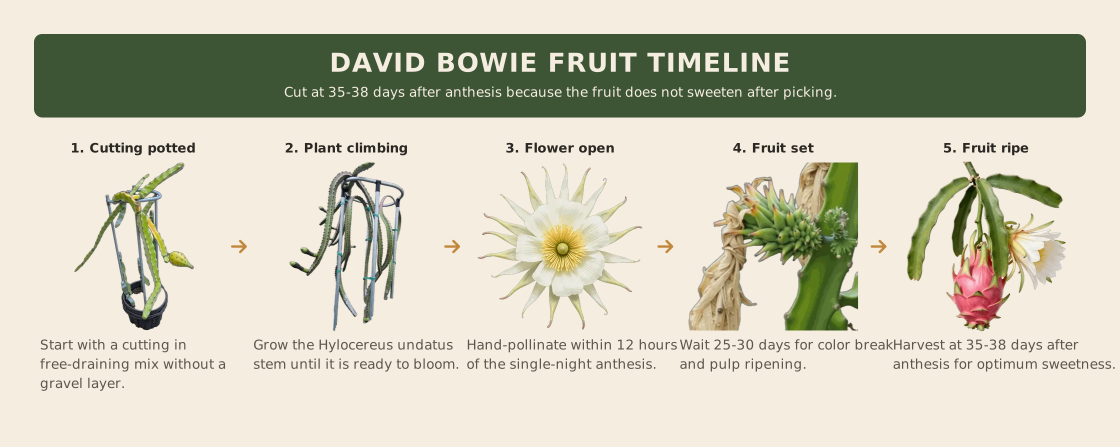
Starting from a cutting is standard practice. Seedlings are variable and can take up to 7 years to bear fruit, whereas cuttings are clones that fruit quickly[1]. The table below outlines the realistic milestones for a David Bowie cutting from purchase to first harvest.
| Stage | Timeframe | Action/Expectation |
|---|---|---|
| Cutting Prep | 7-8 days | Cure in dry shade; slanted cut heals |
| Rooting | 4-6 months | Build root system in pot[1] |
| First Fruit | 6-9 months | From planting; faster if vigorous[1] |
| Full Production | 3-4 years | ~220 lb/yr potential[1] |
When potting your initial cutting, resist the urge to add a drainage layer of gravel or stones at the bottom of the container. This practice raises the perched water table, keeping the mix above it wetter and increasing the risk of rot. Fill the pot with one free-draining mix all the way down and rely on the drainage hole to do the work.
When to cut the fruit
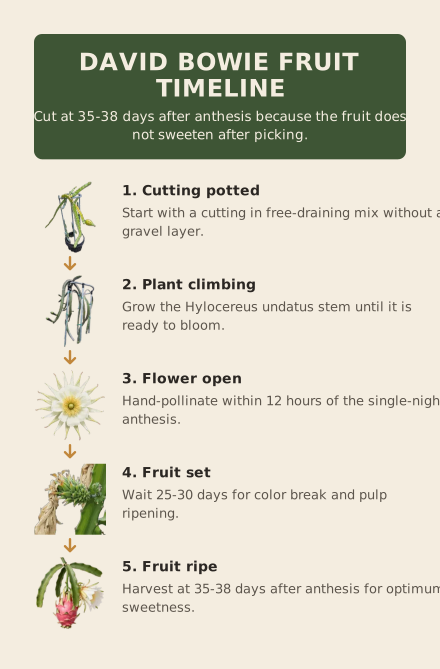
David Bowie is non-climacteric. It does not sweeten on the counter. If you pick it early, you eat it early. Quality depends entirely on harvesting at proper maturity.[5]
Timing the harvest requires attention to days after anthesis. While general extension guidance suggests fruit matures roughly one month after pollination[13], specific data for David Bowie and related white-fleshed types offers a tighter window. A community directory records David Bowie buds taking about 25 days to reach flower, with fruit ripe 30-35 days after flowering[7]. This aligns with broader agronomic data, which sets a minimum harvest maturity of 30-32 days after anthesis[6].
The definition of "ripe" depends on your goal. The APEC project protocol at National Chung Hsing University distinguishes between domestic and distant markets. For immediate local consumption, the optimum window is 35-38 days after anthesis. If you are shipping the fruit, pull it earlier, at 32-34 days, to account for transit[6]. Temperature plays a major role in this speed. At a mean temperature of 28.1 +/- 0.8 C, it takes 25-30 days from flowering to color break[6]. Cooler conditions slow this down; warmer conditions speed it up.
Visual cues can be misleading. The peel changes color, but the pulp changes first. Pulp color shifts 3-5 days before the peel shows any change, and maximum peel coloration follows 4-5 days after that initial shift[6]. Waiting for the skin to look perfect often means you have waited too long for the best texture. The honest ripeness test is not color, but chemistry. A soluble-solids to titratable-acidity ratio of 40 is the optimum harvest index[6]. Soluble solids or acidity alone are poor measures of maturity.
Geography also affects the timeline. A peer-reviewed Mediterranean greenhouse study found Hylocereus fruit reaching maturity about 40-45 days after flowering and pollination[5]. This is slower than the 30-35 day window often cited for David Bowie in warmer, tropical contexts. The published spread by origin is wide:
| Origin | Days After Anthesis |
|---|---|
| Vietnam | 28-32 |
| Israel | 32-35 |
| Brazil | 34-42 |
| California | 40-45 |
| Hawaii | 35-50 |
These ranges reflect local climate and cultivar behavior, so David Bowie, listed as a California selection in some records, may lean toward the longer end of the spectrum in cooler coastal zones, but the directory’s 30-35 day figure suggests it can ripen quickly in heat. The directory’s own harvest cue is a skin-color change plus slight give to pressure[7]. Use the days as a guide, but trust the firmness and the ratio if you have the tools to measure it.
David Bowie next to the varieties worth planting beside it
As a white-fleshed pitaya, David Bowie lacks the betacyanin pigments found in red and magenta types. While the archived University of Florida table lists it as not needing cross-pollination, the science suggests that pairing it with a different genetic type is the best way to ensure commercial-grade fruit size. Extension guidance recommends planting two or three different genetic types to raise fruit set and weight, rather than relying on a single clone[1].
Planting a white variety like David Bowie alongside colored types creates a functional pollination partner system. The white flowers of David Bowie are nocturnal and fragrant, designed to attract moths and bats[1]. By placing a colored variety nearby, you increase the likelihood of cross-pollination events that result in heavier fruit. The colored varieties also provide a visual contrast and a different flavor profile, making the planting more interesting and productive.
Why mix whites and colors? White-fleshed pitayas are often self-compatible but produce smaller fruit when self-pollinated. Cross-pollination with a genetically distinct variety, especially one with colored flesh, can significantly increase fruit weight and quality.
At Sky Botanicals, we stock several varieties that serve as excellent partners for David Bowie. American Beauty is a standout choice. It originates from Guatemala and is listed as not needing cross-pollination, but its dark pink pulp makes it a valuable companion for genetic diversity[2]. Planting American Beauty near David Bowie ensures that if a bat or moth visits both, the resulting fruit has the best chance of reaching full size.
Other varieties we stock that work well in a mixed trellis include Albino Ocamponis, Asunta 3, Asunta 5, Bahamut, and Box of Fresh. We have verified these plants on our farm and know they are distinct genetic types. While we do not list every trait for each in this section, their presence on the trellis provides the necessary pollen diversity to support David Bowie’s fruit development. The goal is to give pollinators a choice, and give your David Bowie the best chance at large, sweet fruit.
Should you grow David Bowie
This variety earns its place if you want a white-fleshed eating fruit with more character than the generic Vietnamese white. The flavor profile is distinct, offering a sweet, tangy, and lemony bite that stands out among standard pitayas. You will also get visual interest from the unusually high count of green-margined scales on the pink skin. If you have room for a second variety to serve as a pollen source, David Bowie rewards that effort with consistent, commercial-grade fruit size. It is a solid choice for growers willing to spend ten minutes on a bloom-night with a brush to ensure proper fertilization.
It is a weaker pick if you are looking for the fastest establishment. One specialist grower notes that this variety is not a fast grower[10], so patience is required during the initial rooting and climbing phase. If you are planting a single isolated plant and want maximum fruit size, you may be disappointed. While the plant is self-fertile[8] and will set fruit, self-pollination often results in smaller, lighter fruit due to inadequate seed set. Cross-pollination is the only way to reliably achieve the larger weights reported by nurseries. If you only grow red-fleshed varieties, David Bowie may feel like a step down in pigment intensity, though its flavor remains a strong contender.
Ready to boost your yield? Proper timing and technique make the difference between small, self-pollinated fruit and large, cross-pollinated harvests. Read our full guide on pitaya pollination to learn how to hand-pollinate for the best results.
References
- Pitaya (Dragonfruit) Growing in the Florida Home Landscape (HS303 / HS1068: climate, cold, propagation, trellis, yields, flowers, pollination, varieties, nutrition), UF/IFAS Extension, Horticultural Sciences Department, University of Florida (Crane & Balerdi; original 2005, revised 2016 and 2019) (2019).
- Pitaya Species and Named Varieties (archival copy of the UF named-variety table, including the David Bowie and American Beauty rows; note that the section was removed from the live UF publication), Growables, mirroring Crane et al., UF/IFAS Extension HS1068 (2021).
- Floral and pollination biology of dragon fruit reveals strategies for enhancing productivity through pollination management and reproductive window extension (Sci Rep 15:37296; doi 10.1038/s41598-025-21168-2; PMC12552510; Table 2 and the H2O2 stigma-receptivity assay), Scientific Reports (Nature Portfolio), Jadhav, Dhumal, Boraiah, Kate, Kakade et al., ICAR / MPKV Rahuri (2025).
- Natural and artificial pollination of white-fleshed pitaya (Anais da Academia Brasileira de Ciencias 94(suppl.3): e20211200; doi 10.1590/0001-3765202220211200; PMID 36477234), Anais da Academia Brasileira de Ciencias (SciELO), Moreira et al. (2022).
- Pitaya, an Attractive Alternative Crop for Mediterranean Region (Agronomy 10(8):1065; fruit maturation 40-45 DAA and the compiled per-country harvest windows; non-climacteric handling), MDPI, Agronomy (2020).
- Pitaya Fruit Maturity Index Implementation (harvest maturity 30-32 / 32-34 / 35-38 DAA, SSC:TA ratio 40 index, 25-30 days to color break at 28.1 C, pulp-before-peel color sequence), APEC project on floriculture and landscape, National Chung Hsing University, Taiwan (2015).
- David Bowie Cultivar (reported Brix 16-18, flowering May-September, bud to flower ~25 days, harvest 30-35 days after flowering, green-to-hot-pink skin; the only source in this set calling it cross-pollination dependent), The Dragon Fruit Directory / Tendra (2026).
- David Bowie Dragon Fruit, product listing (species undatus, more fins than average, white flesh, pinkish-red skin, green fins, sweet tangy with lemony aftertaste, listed self-fertile), Spicy Exotics (2026).
- David Bowie variety card (flavor 5 / appearance 5 / production 4 / home 5 / commercial 4; slender white variety, up to a pound, self-pollinating, best fresh, good for juicing and garnish), Pine Island Nursery, Florida (2026).
- David Bowie Dragon Fruit STARTER (fruit 0.75-1.5 lb average, sweet and lemony, self-pollinating white flowers, 'not a fast grower'), Tasty Dragons (2026).
- Dragon Fruit David Bowie, Pitaya listing and collector's guide (lists undatus x monacanthus parentage, self-pollinating, larger-than-average fruit among whites, USDA Zones 9-11, numerous green-tipped fins), Top Tropicals (2026).
- 11 of The Best Dragon Fruit (Pitaya) Cultivars, David Bowie entry (cultivar of S. undatus; oval fruit with more bracts than average, ~1 lb; pinkish-red skin, numerous green bracts, sweet-tangy white flesh; strong growers), Gardener's Path (HiNurture) (2024).
- Suncoast Grown and Gathered: August Dragonfruit (June-November Florida harvest, long-day photoperiod flowering and supplemental light, fruit matures ~one month after pollination, many flushes per season), UF/IFAS Extension Sarasota County (2025).