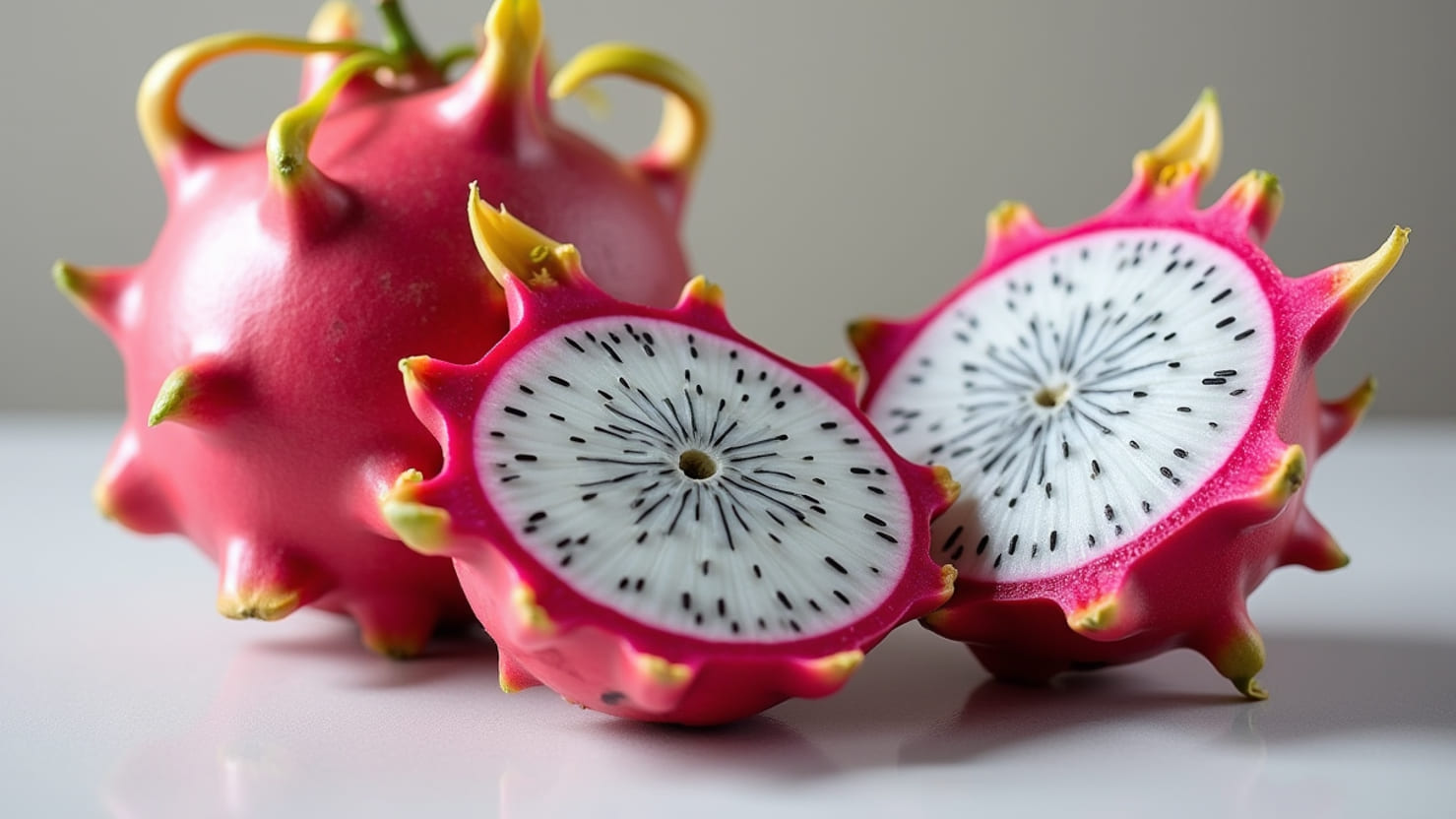
G2 Dragon Fruit: A Guide to Growing This Red-Fleshed Clone
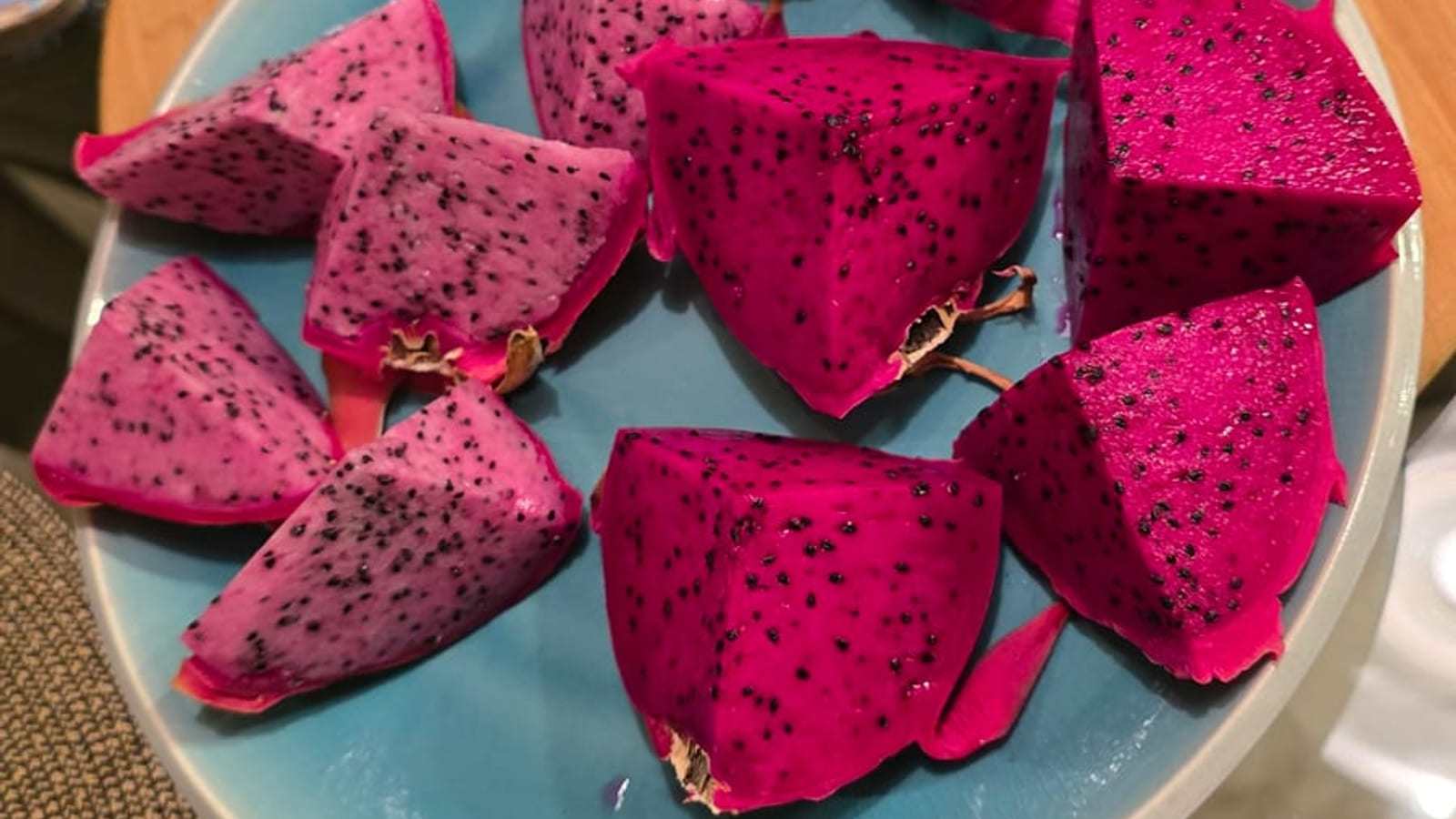
G2 dragon fruit is a red-fleshed clone of Selenicereus guatemalensis. It delivers pink to purple-red, betacyanin-rich flesh with sweetness and berry-and-melon complexity. Expect round fruits ranging from 0.5 to 2.0 pounds, depending heavily on pollination. G2 buds early and remains productive late into the season. Tell G2 from American Beauty by checking the bracts and sepals; G2’s bracts change color as the fruit ripens while American Beauty’s stay green, and G2 displays a yellow sepal outline against American Beauty’s red. Because G2 is self-sterile, you need a compatible pollinator to set fruit. We have G2 cuttings in stock, ready for your trellis. Pair it with a same-species Guatemalan or a red-fleshed variety that flowers on the same night to ensure market-size harvests.
G2 at a Glance
| Feature | Detail |
|---|---|
| Accepted Name | Selenicereus guatemalensis (syn. Hylocereus guatemalensis) [1] |
| Aliases | Thomson G2, Guatemalensis 2, Paul Thomson G2 [2] |
| Flesh Colour | Pink to purple-red [3] |
| Flavour | Strawberry-leaning, tangy-sweet [2] |
| Brix | High sweetness with berry-and-melon complexity [2] |
| Fruit Weight | 700 g (~1.5 lb) to 2.0 lb |
| Self-Fertility | Self-sterile; requires pollinator [4] |
| Flowering Habit | Early budding, late-season cropping [4] |
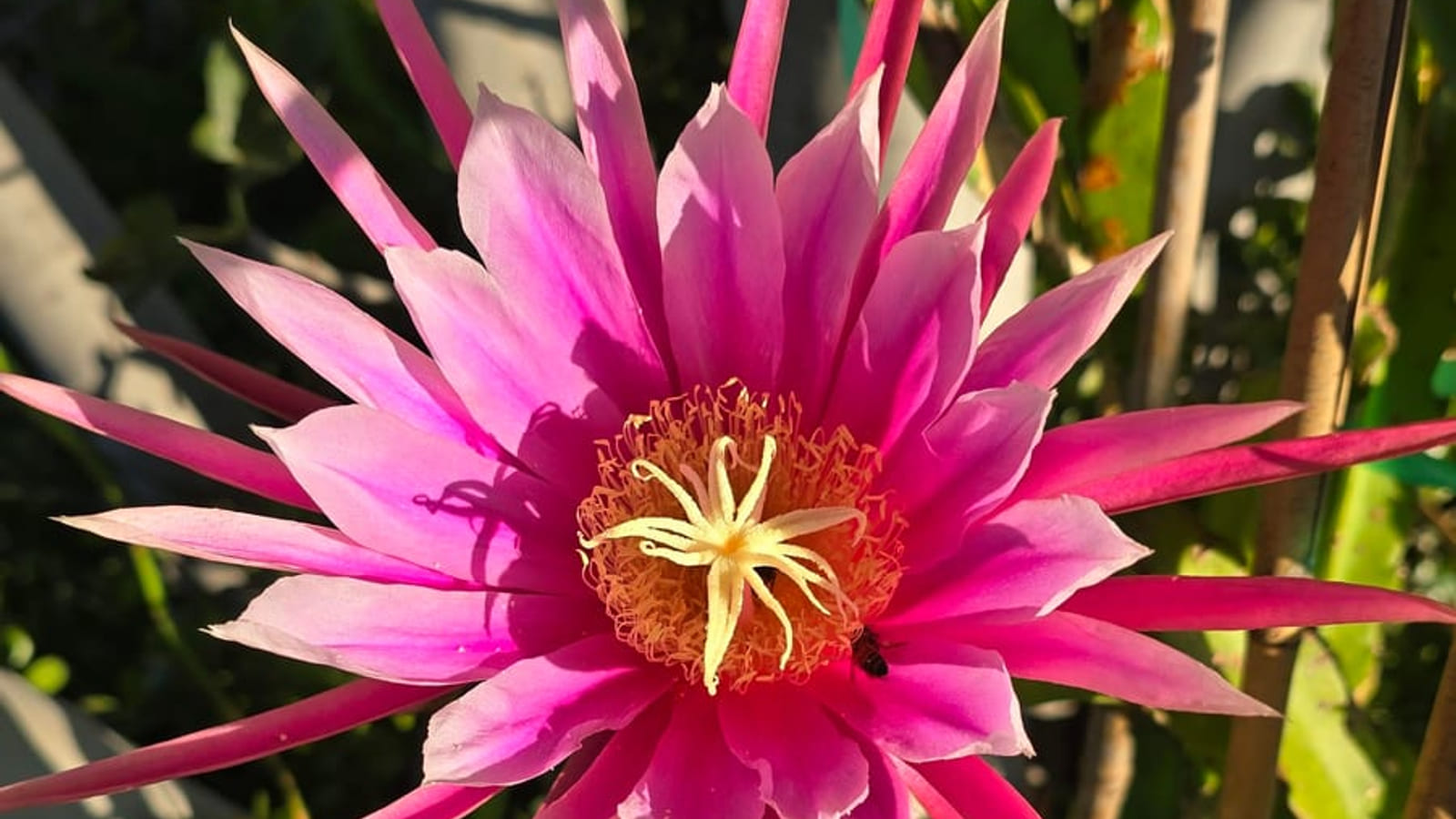
| Flower | Nocturnal, 10-16 in, single evening [5] |
| Sun Tolerance | Stems sunburn, rarely permanent damage [4] |
| Origin | Guatemalan species; clone acquired from California grower [4] |
Name and Origin: Why It Is Selenicereus, Not Hylocereus
If you look at older nursery tags or garden forums, you will likely see this plant labeled Hylocereus guatemalensis. That name is now considered a synonym. Modern botanical consensus, backed by molecular evidence, has moved the entire dragon fruit group into the genus Selenicereus. A mitogenome study published in BMC Plant Biology treats "pitaya (Selenicereus or Hylocereus)" as a single economic crop group, confirming that the old genus name is retired.[7] World Flora Online records Hylocereus guatemalensis strictly as a synonym of Selenicereus guatemalensis, sourced from the Caryophyllales.org backbone.[13] When you buy G2, you are buying a clone of Selenicereus guatemalensis.
The accepted name points to the plant’s true home. Kew’s Plants of the World Online lists Selenicereus guatemalensis as native only to Guatemala, growing primarily in the wet tropical biome.[1] This is not a desert cactus. It is a cloud forest epiphyte. That origin dictates how you grow it. The plant evolved in an environment with steady warmth, high humidity, and filtered light. It dislikes raw, unfiltered desert sun, which can scorch stems, and it cannot tolerate long, hard freezes. If you are growing G2 in a dry, high-altitude location or a frost pocket, you are fighting its genetics. You must provide the humidity and shade it expects.
Provenance Note
While the species origin is clear, the specific lineage of the G2 clone is less documented. The variety was collected by Paul Thomson and acquired from a California grower. Beyond that chain of custody, there is no formal registry entry or published parentage data. We treat it as a verified, distinct clone based on its consistent traits in our nursery, but it lacks the detailed breeding records of some newer hybrids.
The Fruit: Colour, Flavour and What Makes It Red
Ripe G2 fruit is round, with flesh that ranges from vibrant pink to deep purple-red. The outside skin is not particularly flashy, which sometimes tempts growers to leave the fruit on the vine too long. The reliable cue for harvest is the wiggle test combined with the loss of green in the bracts. Once cut, the interior reveals the variety’s true character. Australian growers report fruit averaging 700 g with neon purple flesh and a strawberry-leaning profile.[11]
The flavour profile prioritises complexity over raw sugar. Growers describe reasonable sweetness layered with berry and melon notes, while trade sources categorize the taste as tangy-sweet. This fits the pattern for red-fleshed varieties, where acidity carries as much character as the Brix reading. Sweetness with berry-and-melon complexity provides the sugar backbone, but the acid balance prevents the taste from becoming flat or cloying.[2]
The Science of the Red Pigment
The colour in G2 pulp comes from betacyanins, not anthocyanins. This affects nutrition and cooking. The primary bioactive pigment is betanin, accompanied by isobetanin, bougainvillein-r-I, phyllocactin, and iso-phyllocactin.[3] These compounds are sensitive to their environment. Betacyanins are unstable in high pH or high heat, which explains why red pitaya fades quickly if you cook it or add baking soda to a recipe. The vibrant purple turns brown or grey as the pigment structure breaks down.
Studies show a split in where benefits lie. While the peel often holds a higher total concentration of betacyanins and anthocyanins, the pulp demonstrates a stronger antioxidant effect in DPPH radical-scavenging tests.[3] Both parts of the fruit score low on cytotoxicity, meaning they are safe to consume. The authors of the study attribute the peel’s oxidative-stress protection to its pigment load, but the pulp remains the superior choice for direct antioxidant intake.[3]
Cooking Tip: Because betacyanins degrade with heat and alkalinity, add G2 pulp to dishes at the very end of preparation or serve it fresh. Baking it into a cake batter will likely result in a dull, brownish crumb rather than a vibrant pink one.
Self-Sterile: The Part That Decides Whether You Get Fruit
Spicy Exotics lists G2 as self-sterile, meaning it cannot set fruit with its own pollen. You need a compatible partner to get a harvest. [6] The University of Florida extension confirms that self-incompatibility is reported in several nursery cultivars and advises planting two or three different genetic types to secure better fruit set. [8] Because trade documentation on self-incompatibility is often poor, your success depends heavily on knowing exactly what you planted.
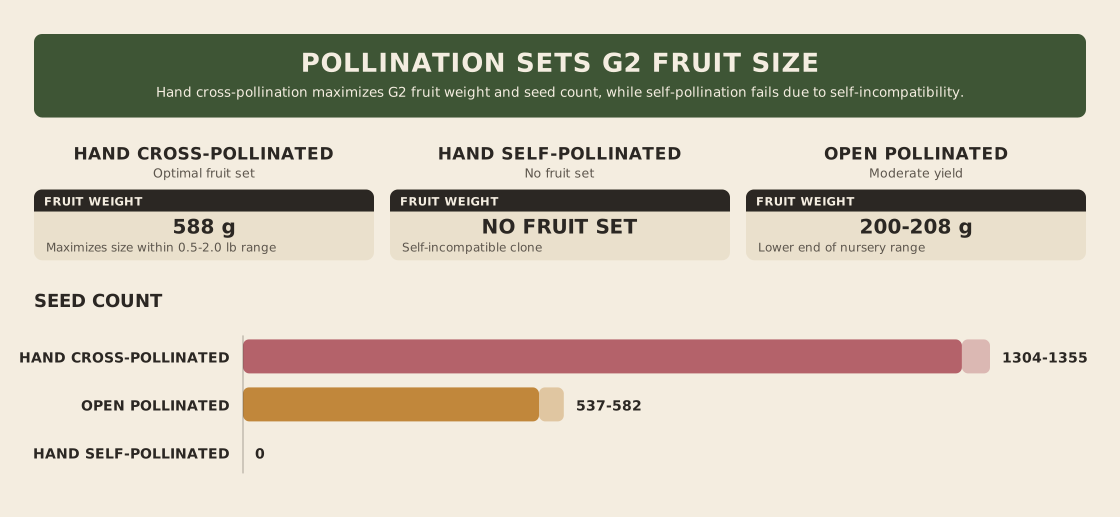
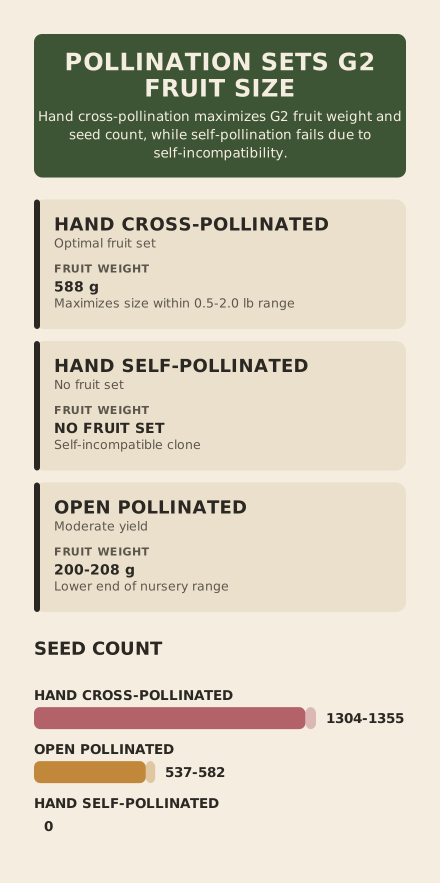
Poor pollination reduces fruit size. In a two-year trial, hand cross-pollination of a self-compatible white-fleshed clone produced fruit averaging 588 g. Hand self-pollination yielded only 377 g, while open-pollinated flowers managed about 200-208 g. Bagged flowers, which received no pollen at all, produced tiny fruits of 68-96 g. [6] For red-fleshed clones like G2, the situation is more severe. The red-fleshed clone NDFR-1 in that same trial was strictly self-incompatible and needed cross-pollination to set any fruit. [6] Cross-pollinated red fruit carried about 860 seeds. Seed number tracks fruit size because each fertilized ovule feeds the surrounding pulp. [6] If you skip the pollinator, you do not just get smaller fruit. You may get none at all.
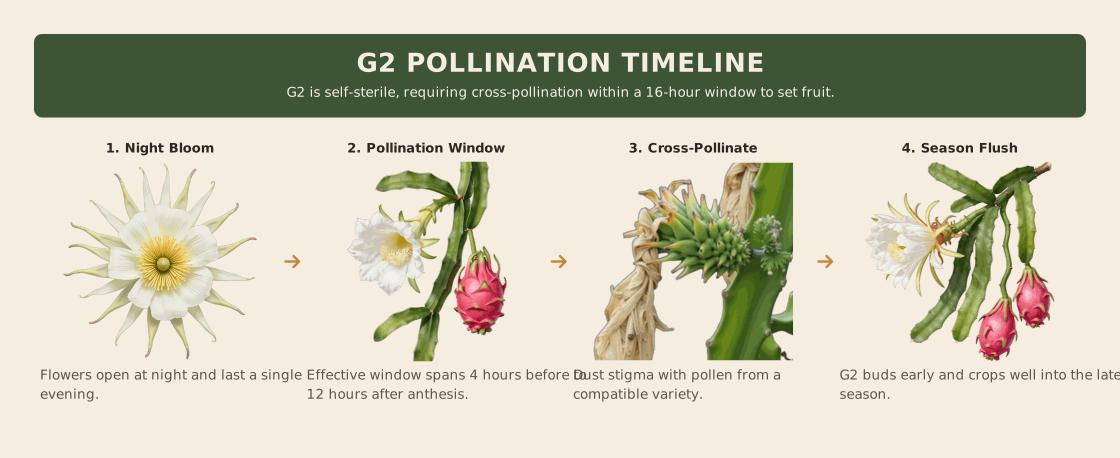
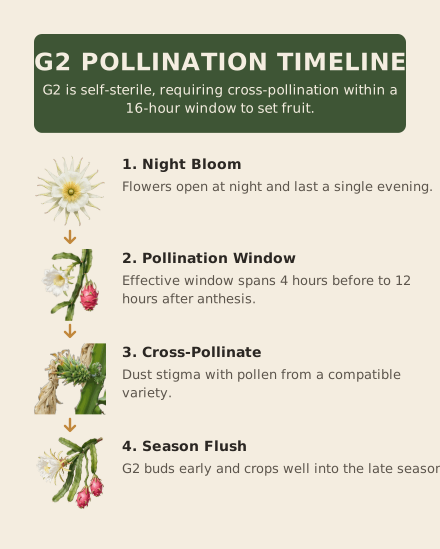
You have a specific window to act. Pollen viability and stigma receptivity in dragon fruit overlap from about 4 hours before to 12 hours after anthesis. [6] This means an evening or early-morning dusting is the reliable move for a self-sterile Guatemalan like G2. [6] The flowers are large, nocturnal blooms, often 10-16 inches wide, that last only a single evening. [5] They open at night when bees are done, relying historically on moths and bats. [5] In a home garden, you are the moth. You must be present during that narrow window. For more on timing and technique, see our dragon fruit pollination guide covering self-fertile and cross-pollinating varieties.
Pollinator Pairing: What to Plant Beside G2
Buying a G2 cutting is only half the transaction. Because this clone is self-sterile, the second cutting you plant determines whether you get a handful of small, underdeveloped fruits or a harvest of market-size pitayas. You need a genetically distinct plant that flowers on the same night as G2. Two cuttings from the same mother plant are not two varieties; they are one genetic type, and they will not cross-pollinate. You need two different genetic types.
Look for a same-species Guatemalan or a red-fleshed variety with overlapping bloom times. The goal is to have pollen available when the G2 stigma is receptive. If your pollinator opens its flowers at a different time, or if it is a white-fleshed variety that finishes blooming before G2 opens, the cross fails. For a deeper look at timing and technique, see our dragon fruit pollination guide covering self-fertile and cross-pollinating varieties.
The Honest Rule: Assume G2 needs a partner and give it one. The University of Florida extension notes that self-incompatibility data across nursery cultivars is thin. While some varieties are self-fertile, G2 is not. Do not gamble on a single plant. Plant a compatible partner from day one.
Pollination dictates weight. In a two-year trial, hand cross-pollination of a self-compatible white-fleshed clone produced fruit averaging 588 g, compared to 377 g under hand self-pollination and about 200-208 g under open pollination. Bagged flowers managed only 68-96 g. For red-fleshed clones like G2, which are strictly self-incompatible, the difference is even starker: without cross-pollination, they may set no fruit at all. A well-pollinated G2 fruit will be heavy, round, and packed with seeds. A poorly pollinated one will be small, lopsided, or drop before maturity.
When selecting a partner, prioritize generous pollen production and synchronized blooming. Some varieties are heavy pollen producers, making them ideal companions. Others are light. Ask your nursery about bloom timing and pollen load. A red-fleshed pollinator is often a good choice because it may share the same nocturnal bloom schedule and flower structure. However, do not assume all red-fleshed varieties are compatible. You need a same-species Guatemalan or a verified cross-compatible clone. If you are unsure, plant two different pollinators beside your G2. This increases the odds of a successful cross and ensures you have backup pollen if one variety’s bloom window shifts slightly due to weather or stress.
| Pairing Factor | What to Look For |
|---|---|
| Genetic Type | Two distinct clones, not two cuttings from one plant |
| Species | Same-species Guatemalan or verified compatible red-fleshed clone |
| Bloom Timing | Overlapping nocturnal bloom; pollen available within 4 hours before to 12 hours after G2 anthesis |
| Pollen Load | Generous producer; avoid light-pollen varieties as sole partners |
| Self-Fertility | Partner should ideally be self-fertile or cross-compatible with G2; check self-fertile list |
Remember that G2 is early to bud and remains productive late into the season. Your pollinator should match this habit. A variety that blooms only once in mid-season will leave your late G2 flowers unpollinated. Choose a partner with a similar flowering rhythm. This synchronization is what turns G2’s early buds and late-season cropping into a continuous harvest. If you miss the window, the fruit will not develop. The plant will expend energy on flowers that never set, weakening the vine over time.
G2 vs American Beauty
Growers often ask if G2 and American Beauty are the same plant. The names are frequently used interchangeably in casual conversation, but the physical evidence says otherwise. While they share a species, early budding habit, and general fruit profile, the differences in bract color and rib structure are distinct. If you are trying to identify what is on your trellis, look at the fruit as it ripens. American Beauty keeps its green bracts until the end. G2 changes color. That single trait is the most reliable field test.
There is also a difference in documentation. American Beauty has published evaluation data from the University of California Agriculture and Natural Resources (UC ANR). G2’s metrics come from nursery measurements. This does not make G2 inferior, but it means you are relying on grower observation rather than a standardized academic trial for its specific performance numbers.
| Feature | G2 | American Beauty |
|---|---|---|
| Species | Selenicereus guatemalensis | Selenicereus guatemalensis |
| Bract Color at Ripeness | Changes color (loses green) | Stays green |
| Sepal Outline | Yellow | Red |
| Rib Pattern | More exaggerated triangular ribs | Standard guatemalensis ribs |
| Flavour Profile | Strawberry-leaning, tangy-sweet | Sweet, mild acidity |
| Market Size Range | 0.5 to 2.0 lbs (nursery measured) | Not specified in verified data |
| Brix | High sweetness with berry-and-melon complexity | Not specified in verified data |
| Bloom to Harvest | Not standardized | Not specified in verified data |
The claim that they are the same plant likely stems from their shared origin as Guatemalan red-fleshed clones. Both are early to bud and produce round, pink-purple fruit. However, the bract behavior is a hard separator. In the trade, American Beauty is defined by its green bracts at harvest. G2 is defined by bracts that turn yellow or brown as the fruit matures. If your fruit has green bracts when it is ready to eat, you likely have American Beauty. If the bracts have faded or changed color, you have G2.
Why does this matter? Because harvest cues differ. For G2, the loss of green in the bracts is a key ripeness indicator. For American Beauty, you cannot rely on bract color change. You must use the wiggle test and time since bloom. Mixing them up can lead to premature harvest or over-ripening. If you are growing both, label them clearly at planting. The rib pattern offers a secondary clue. G2 tends to show more exaggerated triangular ribs on the stem, a trait linked to its specific clone lineage. American Beauty’s ribs are present but less pronounced.
Documentation Gap: American Beauty’s published data comes from UC ANR trials in southern California. G2’s metrics are nursery-measured. Environmental factors like pollination quality and climate will shift these numbers for both varieties. Treat published data as a baseline, not a guarantee.
Choose based on availability and specific flavor preference. G2 is reported to have a more complex, strawberry-leaning profile with higher potential Brix on large fruit. American Beauty is a proven, consistent performer with well-documented agronomic data. Both require cross-pollination for optimal fruit set. If you are unsure which you have, wait for the fruit to ripen and check the bracts. The plant will tell you the truth.
Growing G2: Climate, Sun and Water
G2 thrives in the steady warmth of tropical and subtropical climates, mostly free of frosts and freezes. The University of Florida extension crop profile estimates optimum growth temperatures between 65 and 77 degrees Fahrenheit, with a ceiling of 100 degrees Fahrenheit. While the plant tolerates cool or warm weather, it struggles if temperatures stay below freezing for long periods. Light freezing injury causes damage, but G2 recovers rapidly from these minor cold snaps. This resilience makes coastal San Diego and Oceanside gardens realistic locations for this variety. Inland frost pockets, however, pose a significant risk. If you live in a low-humidity desert or a high-altitude zone, you must provide extra protection against raw sun and dry air.
Sun management requires a careful balance. Severe sunburn on stems has been reported in regions with low humidity or high altitude. Spicy Exotics specifically notes that G2 stems are prone to sunburn, though this rarely results in permanent damage. To mitigate this, provide about 30% shade for the first three to four months after planting. This temporary cover helps the young stems acclimate without scorching. After this initial period, remove the shade. Too much permanent shade leads to low production and poor-quality fruit. G2 needs sufficient light to drive its early budding and late-season cropping habits.
Wind and Support: G2 is wind-tolerant, but its large, spreading habit makes it vulnerable to hurricane-force winds. Ensure your trellis is anchored deeply and strongly enough to handle the weight of a mature plant during a storm.
| Factor | Requirement | Grower Note |
|---|---|---|
| Temperature | 65-77°F optimum; 100°F max | Recoverable from light freeze; avoid long freezing exposure. |
| Sun Exposure | Full sun after establishment | Use 30% shade for first 3-4 months to prevent stem burn. |
| Humidity | Moderate to high | Low humidity increases sunburn risk; misting may help in deserts. |
| Wind | Tolerant | Secure trellis firmly; hurricane winds can topple heavy plants. |
| Salt Tolerance | Moderate to high | Coastal gardens are suitable; rinse leaves if spray is heavy. |
Watering practices should mimic the plant’s cloud forest origins. Keep the soil consistently moist but never waterlogged. Because G2 is a clone of Selenicereus guatemalensis, it expects steady moisture. However, root rot remains a threat if drainage is poor. When potting, do not add gravel, stones, or pot shards to the bottom of the container. This common practice raises the perched water table and keeps the mix above it wetter than necessary. Instead, fill the pot with one free-draining mix all the way down and ensure the container has a drainage hole. This simple setup protects the roots while providing the moisture the plant needs.
For those in marginal climates, microclimate adjustments are essential. Planting near a south-facing wall can provide thermal mass that buffers against cold nights. In dry inland areas, mulching heavily around the base helps retain soil moisture and reduces evaporation. Remember that G2’s self-sterile nature means you are already managing a complex pollination schedule. Keeping the plant healthy through proper climate and water management ensures it has the energy to produce the large, early-budding flowers required for successful cross-pollination.
From Cutting to First Fruit
Starting with a G2 cutting is a straightforward process, but the timeline is specific. You begin with a whole stem segment between 6 and 15 inches long. Make a slanted cut at the base to increase the surface area for rooting and to shed water away from the wound. Treat the cut surface with fungicide to prevent rot, then cure the cutting for 7 to 8 days in a dry, shady spot. This allows the cut end to callus over completely.
Once cured, plant the cutting in well-drained media. Expect a waiting period. It typically takes 4 to 6 months for the cutting to establish a strong root system in the pot. During this time, you may see little above-ground activity. Once rooted, growth accelerates dramatically. Documented growth rates for this clone show new stems extending up to 1.2 inches per day. This rapid vertical growth is why you need a heavy support structure from the start. G2 plants become large and spreading, so place your trellis 15 to 25 feet or more away from trees, fences, or structures to give the canopy room to expand.[8]
A visual timeline showing the progression from a cured 12-inch cutting to a rooted plant, then to a trellis-trained vine with initial buds. Include labels for the slanted basal cut, the 7-8 day cure period, the 4-6 month rooting window, and the 1.2 in/day growth rate.
Many growers see their first fruit 6 to 9 months after planting. This early production is a hallmark of the G2 clone, which buds readily even at a smaller plant size. However, remember that G2 is self-sterile. You must hand-pollinate those early flowers with pollen from a compatible partner to set fruit.
As the plant matures, production scales up significantly. A three- to four-year-old G2 planting can yield approximately 220 pounds of fruit per year. The working life of a pitaya planting is estimated at around 20 years, making this a long-term investment in your garden. Proper spacing and a sturdy trellis are critical to supporting that weight over decades.[8]
Flowering, Bud to Bloom
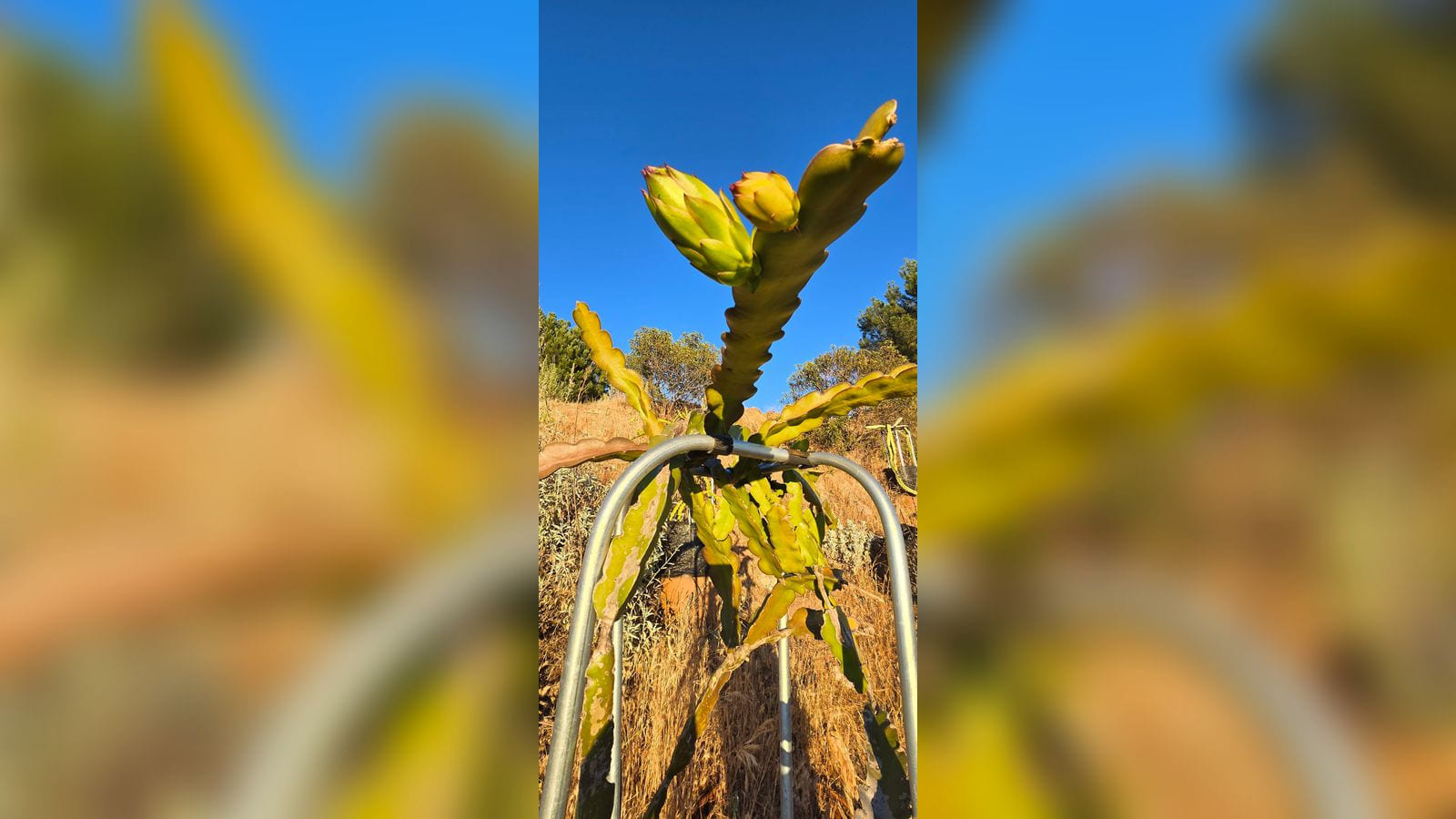
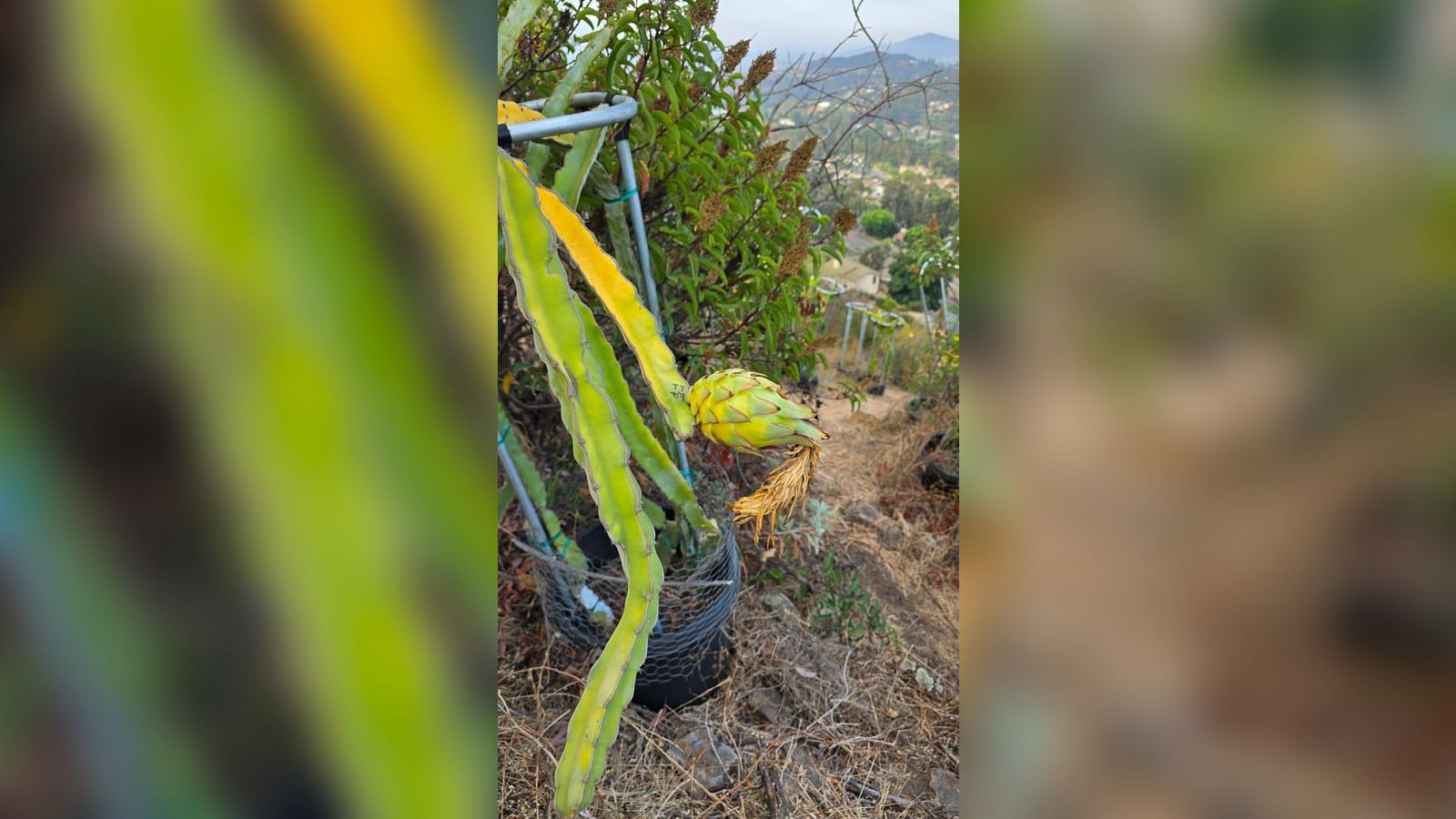
G2 is an early riser in the flowering department. G2 buds early and can initiate flower buds at a relatively small plant size, well before the trellis is fully draped with mature stems[2]. You will spot these early buds by their distinctive reddish-brown tinge, which fades as the bud expands and matures[2]. As the bud develops, look for the yellow sepal outline that distinguishes G2 from its near-twin American Beauty[2].
The bloom itself is a spectacle. G2 produces large, fragrant nocturnal flowers that open in the evening and last for a single night[5]. These blooms can reach 10 to 16 inches across, relying on moths and bats for historic pollination[5]. Because the flower closes by morning, your window to intervene is narrow.
The Early Bud Trap: G2’s eagerness to bud early is a double-edged sword. Because the plant is self-sterile, those first flushes are free fruit only if you are ready to hand-pollinate them[6]. If you miss the window, the bud drops. Worse, early buds are the flush most likely to be lost to a late cold snap. A light freeze can kill a developing bud before it ever opens, wasting the plant’s energy. If you are in a frost-prone area, consider pinching off the very first buds to let the plant focus on vegetative growth until the weather stabilizes.
If you choose to keep the early flowers, you must be prepared to work. The pollen viability and stigma receptivity overlap from about four hours before to twelve hours after the flower opens[6]. This means an evening or early-morning dusting is the reliable move.
| Bud Stage | Visual Cue | Action |
|---|---|---|
| Initiation | Reddish-brown tinge on small bud | Assess frost risk; pinch if freeze is likely |
| Development | Yellow sepal outline appears; brown fades | Ensure pollinator is ready to bloom same night |
| Anthesis | Large fragrant flower opens at night | Hand-pollinate within 12 hours of opening |
Harvest: The Wiggle Test and the Day Count
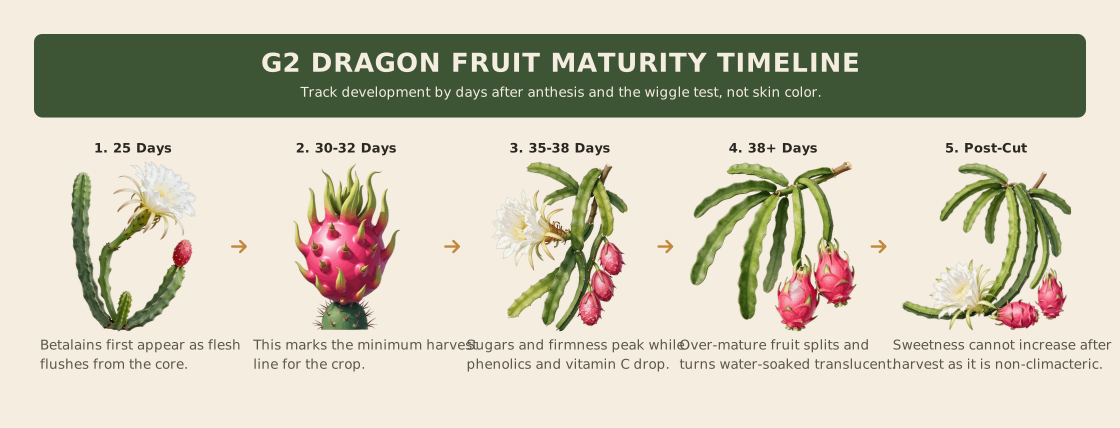
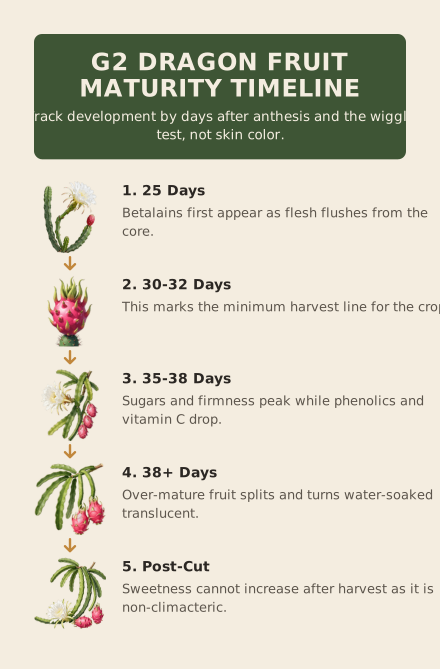
Dragon fruit is a non-climacteric crop. This means the fruit does not continue to ripen or sweeten after you cut it from the vine. The sugar profile and texture are locked in at the moment of harvest. If you pick a G2 fruit too early, it will never taste as good as it could. If you leave it too long, it degrades rapidly. Because G2 has a dull exterior that lacks the vibrant flash of some hybrids, growers often hesitate, waiting for a color change that never fully arrives. This hesitation leads to over-ripening, where the fruit splits, the flesh turns water-soaked and translucent, and off-odours develop. Total soluble solids actually decline after the peak, so waiting for the skin to look "ready" is a mistake.
Instead of watching the skin, watch the clock and feel the fruit. Research from the APEC and National Taiwan University maturity-index kit provides clear benchmarks for harvest timing. The minimum harvest maturity sits at 30 to 32 days after anthesis (DAA). For domestic markets, the optimum window is 35 to 38 DAA. If you are shipping to distant markets, you should harvest slightly earlier, between 32 and 34 DAA, to account for transit time.[9] A peer-reviewed study on red-fleshed dragon fruit under semi-arid conditions confirmed this, finding that eating-quality parameters, including soluble solids, sugars, acidity, firmness, and pulp weight, were optimized at exactly 35 DAA.[10]
For those who prefer a chemical benchmark, a ratio of soluble solids to titratable acidity of 40 has been suggested as an optimum harvest index.[9] However, most home growers do not have a titratable acidity kit. The practical field test for G2 is the wiggle test. Grasp the fruit gently. If it wiggles freely on the stem, the abscission layer has formed, and the fruit is ready. Combine this tactile cue with a visual check of the bracts. G2’s bracts change color as the fruit ripens, unlike American Beauty, which keeps green bracts. When most of the green has disappeared from the bracts, the fruit is at its peak.[2]
Why the wait matters for nutrition: The same development study tracked pigment and antioxidant changes. Betalains, the pigments responsible for the neon purple flesh, were first detectable at 25 DAA and rose by 48.6% as the fruit matured. However, total phenolics fell by 29.96%, total flavonoids fell by 41.06%, and vitamin C dropped by 75.3% across the developmental stages.[10] Waiting past the 35-38 DAA window increases the color intensity slightly but sacrifices significant nutritional value and texture quality.
Do not rely on the skin color alone. G2’s exterior is not particularly vibrant, which tempts growers to leave the fruit on the plant too long. The reliable cue is the wiggle test plus the loss of green in the bracts.[2] If you are managing pollination carefully to ensure fruit set, you have already done the hard work. Do not undo it by missing the narrow harvest window. Cut the fruit with a clean, sharp knife, leaving a small piece of stem attached if possible, and handle it gently to avoid bruising the delicate flesh.
Pests, Stock Quality and Clean Cuttings
Buying a clone like G2 is a biological gamble. You are not just buying a plant; you are buying its health history. If your cutting arrives carrying pathogens, no amount of perfect soil or trellis work will save it. This is especially true for red-fleshed Guatemalan types, which have shown specific vulnerabilities in recent agricultural trials.
The University of Cooperative Extension evaluated twenty pitahaya cultivars at the South Coast Research and Extension Center as part of a southern California small-farms project. They distributed 10,000 cuttings to growers to test adaptation and performance.[12] The results highlighted two major threats to stock quality. First, every tested cultivar was susceptible to root-knot nematode Meloidogyne incognita. This pest causes considerable root galling and stunts new shoot growth, leaving plants weak and unproductive.[12] Second, cactus virus X tested positive in the majority of samples analyzed.[12]
These findings change how you should vet a nursery. Asking about stock origin is not theatre; it is a necessary check on whether your G2 is clean or compromised. If a seller cannot tell you where their mother plants came from or how they manage disease, you are likely inheriting a problem.
Sanitation is non-negotiable. Cactus virus X spreads mechanically. If you prune an infected plant and then prune your healthy G2 without cleaning your tools, you have just transmitted the virus. Decontaminate shears, pots, and surfaces between every plant.
The UC project’s best-management practices are straightforward but strict. Establish new plantings with clean plant material only. Scout routinely for symptoms like stunted growth or distorted roots. Isolate susceptible varieties if you have mixed plantings. If you find infected stock, remove and destroy it immediately; do not compost it. Good sanitation prevents transmission through handling, tools, and plant debris.[12]
For G2 specifically, clean stock is the foundation of fruit set. Because this variety is self-sterile, you need a vigorous, healthy plant to produce the large, fragrant flowers required for pollination. A plant fighting nematodes or virus will produce weak buds that may drop before they even open. When you pair your clean G2 with a compatible pollinator, you are ensuring that both parents are strong enough to set market-size fruit.
| Threat | Symptom | Action |
|---|---|---|
| Root-knot nematode | Root galling, reduced shoot growth | Start with clean stock; avoid soil reuse |
| Cactus virus X | Mosaic patterns, stunting, deformity | Decontaminate tools; destroy infected plants |
| General pests | Visible damage, webbing, frass | Routine scouting; isolate if needed |
Ultimately, the health of your G2 cutting determines the ceiling of your harvest. You can manage water and light, but you cannot manage a systemic virus or a nematode-infested root system. Buy from sources that prioritize clean mother plants, and treat your tools with the same respect you give your trellis.
Is G2 Right for Your Garden?
Choosing a dragon fruit variety is less about picking the sweetest fruit and more about matching the plant’s demands to your garden’s reality. G2 is a rewarding grower, but it is not a "plant it and forget it" option. It requires specific conditions to thrive and specific actions to fruit. Consider these trade-offs.
Choose G2 if:
- You want red-fleshed fruit with complex, tangy-sweet flavor rather than just high sugar content.
- You are willing to plant a second compatible variety for pollination.
- You live in a frost-free or light-frost coastal zone where temperatures stay mostly above freezing.
- You are prepared to hand-pollinate flowers during the evening or early morning window.
Choose a self-fertile variety instead if:
- You can only fit one plant on your trellis.
- You cannot be at the trellis after dark or before dawn to dust pollen.
- You prefer a variety that sets fruit reliably without human intervention.
The biggest hurdle for most home growers is self-sterility. G2 will not set fruit on its own. You need a compatible pollinator that flowers on the same night. If you miss the single evening the bloom is open, you lose that fruit. This is not a minor inconvenience; it is the defining characteristic of this clone. If you are away on business or travel often, this requirement might be too demanding. In that case, look for a self-fertile red-fleshed variety instead. Our dragon fruit pollination guide covering self-fertile and cross-pollinating varieties can help you find a low-maintenance alternative.
Climate is the second filter. G2 is a cloud forest epiphyte, not a desert cactus. It dislikes raw, unfiltered sun and cannot tolerate hard freezes. While it can recover from light frost damage, a garden in an inland frost pocket is a risky bet. If you are in a zone with frequent freezes, you will spend more time protecting the plant than enjoying it. A coastal garden with steady warmth and humidity is the ideal setting. If your summers are hot and dry, you must provide shade. Sunburn on the stems is common, though rarely fatal, but it stresses the plant and reduces vigor.
Finally, consider the harvest experience. G2 fruit is round and heavy, but the exterior is dull. It does not turn bright red or yellow when ripe. You must rely on the wiggle test and the loss of green in the bracts to know when to pick. This can be frustrating for new growers who expect a clear visual cue. If you prefer a variety that signals ripeness with a dramatic color change, G2 might feel ambiguous. But if you are willing to learn its subtle cues, the payoff is a flesh with deep color and a flavor profile that balances sweetness with acidity.
We have G2 cuttings in stock now. For the best results, pair it with a same-species Guatemalan or a red-fleshed variety that flowers on the same night. This pairing ensures you can turn those early buds into market-size harvests.
FAQ
Is G2 the same as American Beauty?
No, though they are near-twins. You cannot rely on the fruit skin or general habit to tell them apart. The reliable distinction lies in the bracts and sepals. On G2, the bracts change color as the fruit ripens, while American Beauty’s bracts stay green. Additionally, G2 displays a yellow sepal outline, whereas American Beauty has a red one. The rib pattern on G2 is also more exaggerated than on American Beauty.
Is G2 self-fertile?
No. G2 is self-sterile. It requires pollen from a compatible variety to set fruit. If you plant a single G2 clone, you will get flowers but no fruit. You must pair it with a same-species Guatemalan or a red-fleshed variety that flowers on the same night. Hand pollination within the window of four hours before to twelve hours after anthesis is the most reliable method for ensuring fruit set.[6] See our dragon fruit pollination guide covering self-fertile and cross-pollinating varieties for pairing strategies.
How sweet is G2, and what does an 18-20 Brix measurement actually tell you?
Grower measurements report an average Brix of 18, with larger fruit reaching 20.[4] However, Brix alone does not define the flavor. G2 is valued for complexity rather than raw sugar. The flesh has a strawberry-leaning, tangy-sweet profile where acidity carries as much character as the sugar content. A high Brix reading without balanced acidity can taste flat, but G2’s tanginess provides depth. The red color comes from betacyanin pigments, not anthocyanins, which also contribute to its antioxidant profile.[3]
How big is the fruit, and why do nurseries disagree?
Size claims vary because pollination dictates weight. Some nurseries list G2 at 0.5 to 0.7 pounds, while others report 1.0 to 2.0 pounds.[6] This spread is not a genetic mystery; it is a pollination story. In trials, cross-pollinated red-fleshed fruit set significantly larger than self-pollinated or open-pollinated fruit because each fertilized ovule feeds the surrounding pulp.[6] If you see small fruit, it is likely due to poor pollination, not a different clone.
How long from flower to fruit?
Dragon fruit is non-climacteric, meaning it must be picked fully ripe. The optimum harvest window is 35 to 38 days after anthesis (DAA).[9] Waiting longer risks fruit splitting and a decline in soluble solids. Do not rely on skin color alone, as the exterior is not particularly vibrant.[2]
Can I grow it outside California or Florida?
Yes, if you can replicate a frost-free subtropical climate. G2 is native to the wet tropical biome of Guatemala and dislikes raw desert sun or long freezes.[1] It tolerates cool or warm climates provided temperatures do not exceed 100°F (38°C) and avoid prolonged exposure to freezing.[8] Coastal areas with steady warmth and humidity are ideal. Inland frost pockets are risky. If you are in a marginal zone, provide about 30% shading for the first few months after planting to prevent stem sunburn, which is a known issue for this variety.[4]
References
- Selenicereus guatemalensis (Eichlam ex Weing.) D.R.Hunt - native distribution, biome and synonyms, Royal Botanic Gardens, Kew - Plants of the World Online (2025).
- Thomson G2 (G2, Guatemalensis 2, Paul Thomson G2) - cultivar notes, self-sterility, rib pattern, bud and sepal colour, bract colour vs American Beauty, flavour, Dragon Fruit Obsession (specialist cultivar catalogue) (2025).
- Betacyanins and Anthocyanins in Pulp and Peel of Red Pitaya (Hylocereus polyrhizus cv. Jindu), Inhibition of Oxidative Stress, Lipid Reducing, and Cytotoxic Effects, Frontiers in Nutrition 9:894438, doi:10.3389/fnut.2022.894438 (PMID 35811964) (2022).
- Thomson G2 - Hylocereus guatemalensis (self-sterile, brix 18 with large fruit at 20, 1.0-2.0 lb fruit, Paul Thomson clone, sunburn habit, California source), Spicy Exotics (2025).
- Thomson G2 Dragon Fruit Cactus (Hylocereus guatemalensis) (fruit 0.5-0.7 lb, red skin with green-tipped scales, purple tangy-sweet flesh, mid yield, 10-16 in one-evening fragrant night flowers), Urban Tropicals (2025).
- Floral and pollination biology of dragon fruit reveals strategies for enhancing productivity through pollination management and reproductive window extension (fruit weights 588/377/208/96/68 g, seed counts, strict self-incompatibility in the red-fleshed clone, pollination window -4 h to +12 h from anthesis), Scientific Reports 15:37296, doi:10.1038/s41598-025-21168-2 (ICAR / MPKV / ICRISAT) (2025).
- Complete mitogenome assembly of Selenicereus monacanthus revealed its molecular features, genome evolution, and phylogenetic implications (Selenicereus/Hylocereus synonymy; pitaya as the most economically important Cactaceae crop), BMC Plant Biology 23:541, doi:10.1186/s12870-023-04529-9 (2023).
- Pitaya (Dragonfruit) Growing in the Florida Home Landscape (HS303 / HS1068) - climate envelope, sunburn and shade, cold injury, cuttings and curing, trellis, spacing, years to bearing, yield per plant, flower size, self-incompatibility in nursery cultivars, University of Florida IFAS Extension (Crane & Balerdi) (2016).
- Pitaya Fruit Maturity Index Implementation (non-climacteric; minimum 30-32 DAA, optimum 35-38 DAA domestic / 32-34 DAA distant, SSC:TA 40 index, splitting and TSS decline on over-delay), APEC Policy Partnership on Food and Food Loss Waste / National Taiwan University (Dr Chun-Ta Wu) (2015).
- Development Changes in the Physicochemical Composition and Mineral Profile of Red-Fleshed Dragon Fruit Grown under Semi-Arid Conditions (eating quality optimum 35 DAA; betalains detected 25 DAA, +48.6%; total phenolics -29.96%; flavonoids -41.06%; vitamin C -75.3%), MDPI Agronomy 12(2):355, doi:10.3390/agronomy12020355 (2022).
- G2 Dragon fruit cutting (Paul Thomson selection, ~700 g fruit, neon purple flesh, strawberry flavour, Brix 18-20), Rare Dragon Fruit (Australia) (2025).
- Pitahaya or Dragon Fruit (Hylocereus spp.): A New Water Efficient Crop for Southern California Small Scale Farmers (20 cultivars evaluated at South Coast REC, 10,000 cuttings distributed, all cultivars susceptible to Meloidogyne incognita, cactus virus X prevalence and best-management practices), UC Cooperative Extension / UC ANR Thelma Hansen Trust (San Diego & Riverside) (2017).
- Hylocereus guatemalensis (Eichlam ex Weing.) Britton & Rose - reported as a synonym of Selenicereus guatemalensis by Cactaceae, World Flora Online (Caryophyllales.org backbone) (2025).