Isis Gold Dragon Fruit: The Yellow Pitaya Guide
Isis Gold is a yellow-skinned, white-fleshed pitaya that demands cross-pollination for quality fruit. You need a compatible pollen partner to get the large, high-sugar fruit it is known for. While it handles heat and cold well, growth rate and fruit production are moderate. For successful fruiting, pair it with a red or white commercial type. Our pollination guide lists compatible partners.
Why one cultivar has five names
Isis Gold appears as Aussie Gold, Bundaberg Gold, Golden Yellow, and Golden Isis. These are not distinct varieties with different growing requirements. They are trade names applied to the same yellow-skinned, white-fleshed Selenicereus undatus cultivar. The confusion stems from how pitaya names travel. A breeder releases a selection in one country, a distributor imports it under a descriptive name, and a local nursery rebrands it for their market.
The peer-reviewed literature recognizes the cultivar as 'Golden Isis', placing it in the small group of yellow-peeled S. undatus types alongside 'Golden of Israel' [1]. In that same review, the entry 'Golden' describes a yellow peel, white pulp, and fruit weighing 200 to 800 g [1]. Grower records for Isis Gold list fruit at three quarters to 1.5 lb, which is about 0.34 to 0.68 kg, and 19.0 Brix [6]. The overlap in weight ranges and flesh color confirms these names point to the same genetic line. The difference in reported Brix between the review and the grower record reflects measurement conditions and pick timing, not a different plant.
| Name you may see | Source context | What it tells you |
|---|---|---|
| Isis Gold | Grower cultivar record | Parentage: S. undatus x S. undatus, not self-fertile, 19.0 Brix [6] |
| Aussie Gold / Bundaberg Gold | Trade nursery listings | Thornless fruit, needs pollen from red or white commercial type [8] |
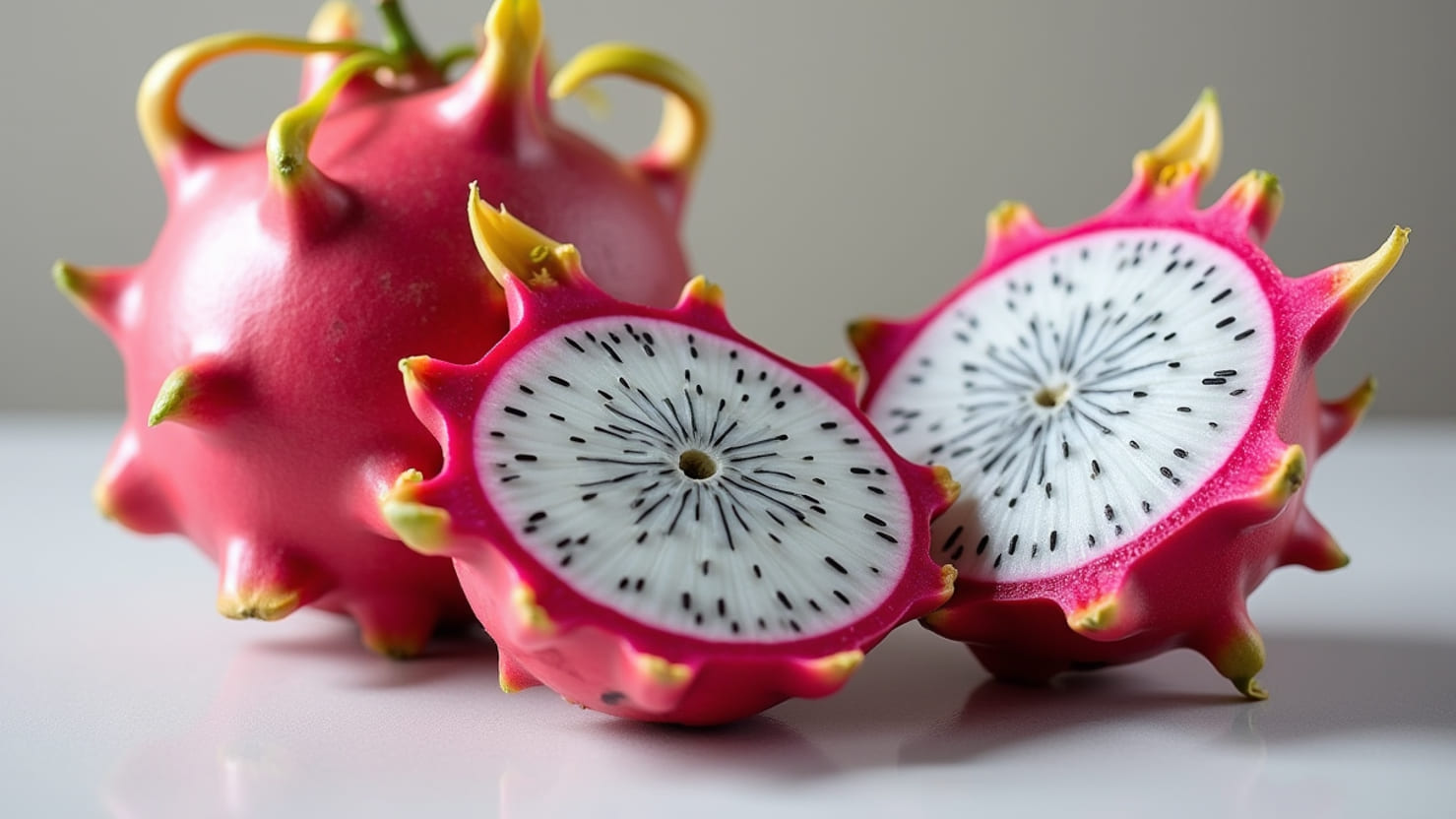
| Golden Yellow / Israeli Golden | US nursery description | Oval yellow fruit with green fins, spineless skin, dense white flesh [7] |
| Golden Isis | Peer-reviewed cultivar table | Yellow peel, white pulp, partially self-compatible, very similar to 'Golden of Israel' [1] |
One nursery attributes the cultivar to decades of breeding by botanists at Ben-Gurion University in Israel and calls it an aggressive grower that flowers faster than other varieties [7]. That institutional claim has partial support: a review from the university confirms pitaya domestication for Israeli deserts began in 1984 and succeeded with hybrids chosen for water-use efficiency [2]. However, that same review does not name Isis Gold, Golden Isis, or Golden of Israel among its released clones [2]. The specific Ben-Gurion parentage of this cultivar rests on nursery tradition rather than a primary publication. A Florida extension bulletin notes that many named cultivars and unnamed selections are in circulation, and that self-incompatibility data is poorly documented, which makes variety recommendations potentially unreliable [4].
When you buy by name, you are buying a label. When you buy by trait, you are buying a plant. Ask the seller for the flesh color, the skin texture, and the pollination requirement. If the answer is white flesh, spineless yellow skin, and cross-pollination needed, you have the right plant regardless of whether the tag says Isis Gold, Aussie Gold, or Golden Yellow.
The naming mess matters for one practical reason: it can lead you to buy the wrong plant. A seller might list 'Yellow Palora' and 'Isis Gold' side by side, both with yellow skin. But Yellow Palora is Selenicereus megalanthus, a tetraploid species with 2n = 44, while Isis Gold is diploid S. undatus with 2n = 22 [1]. The fruit surfaces differ too. S. megalanthus bears short bracts carrying prickles that detach when the fruit ripens, while the yellow S. undatus cultivars are spineless [1]. If you want a pleasant harvest with no thorns to dodge, the name on the pot matters less than the texture of the skin. Check the fruit, not the label.
Where it actually came from, and what the record supports
The origin story of Isis Gold is a mix of institutional history and nursery folklore. One US nursery attributes the cultivar to decades of breeding by botanists at Ben-Gurion University in Israel, describing it as an aggressive grower that flowers faster than other varieties [7]. This claim has partial support. A review from that university confirms that pitaya domestication for Israeli deserts began in 1984 and succeeded with hybrids chosen for water-use efficiency [2].
What the record does support is the plant’s physiological limits. Pitaya performs best between 18 and 26 C, but can be grown where mean temperatures are 14 to 32 C [1]. It tolerates up to about 40 C when roots have water, but temperatures above 38 C inhibit flowering [1]. Above 28 C, every additional degree cuts nightly CO2 uptake in S. undatus by about 58 percent through the PEPC pathway and about 30 percent in the early morning through RuBisCO [1]. This explains why heat tolerance ratings are nuanced: the plant survives heat, but its metabolism slows down.
Frost is the binding limit for this crop, even in Mediterranean greenhouses. The minimum temperature pitaya withstands is about -2 C, and temperatures near -4 C kill the plant [1]. A Florida extension bulletin agrees that long exposure at or below 31 F (-2 C) causes damage, from which plants recover rapidly if the freeze was light [1]. For growers in marginal zones, this narrow window between survival and death is the primary risk factor.
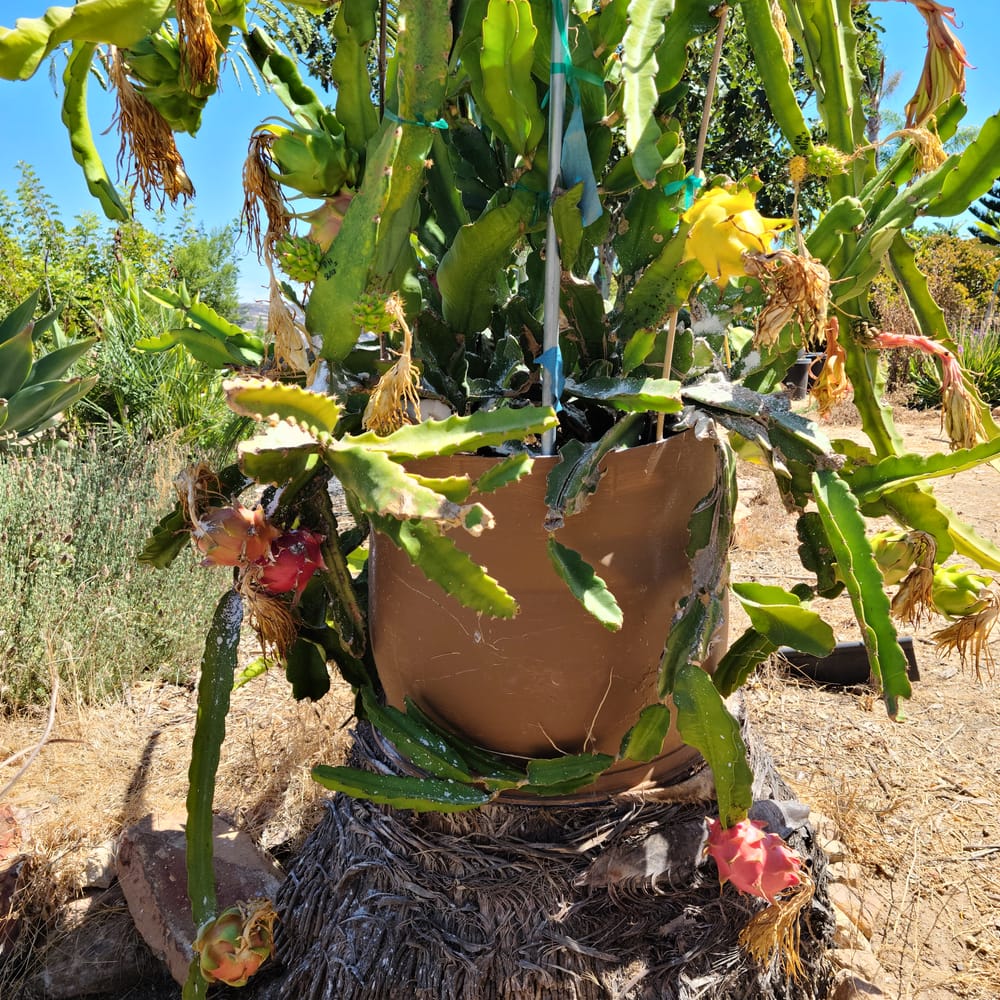
Structural planning must account for the plant’s longevity and weight. A mature planting is expected to live about 20 years, with stems reaching about 20 ft [4]. At three to four years old, a single planting can produce about 220 lb (100 kg) of fruit per year [4]. The trellis must withstand several hundred pounds of stem weight, and plants should be set 15 to 25 ft from trees, structures, and power lines [4]. This is a long-term infrastructure commitment rather than a quick container hobby.
It is not a yellow Palora: the taxonomy that decides your growing experience
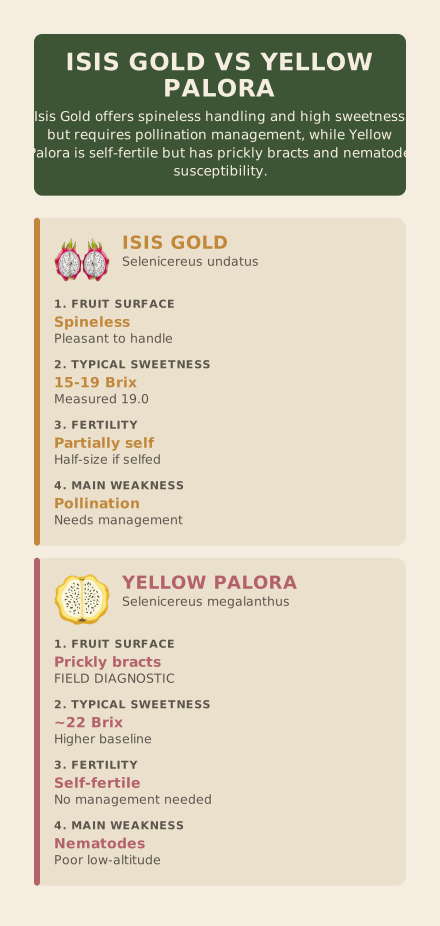
Many gardeners assume that because Isis Gold and Yellow Palora both produce yellow fruit, they behave the same way in the garden. They do not. The difference lies in the species. Isis Gold is a cultivar of Selenicereus undatus, the same species as the common red-skinned dragon fruit, though it is distinct from red varieties like 'Vietnamese White' beyond sharing a species name[5]. Yellow Palora, by contrast, belongs to Selenicereus megalanthus. This distinction is not academic; it dictates how you pollinate, how long you wait for fruit, and how you handle the harvest.
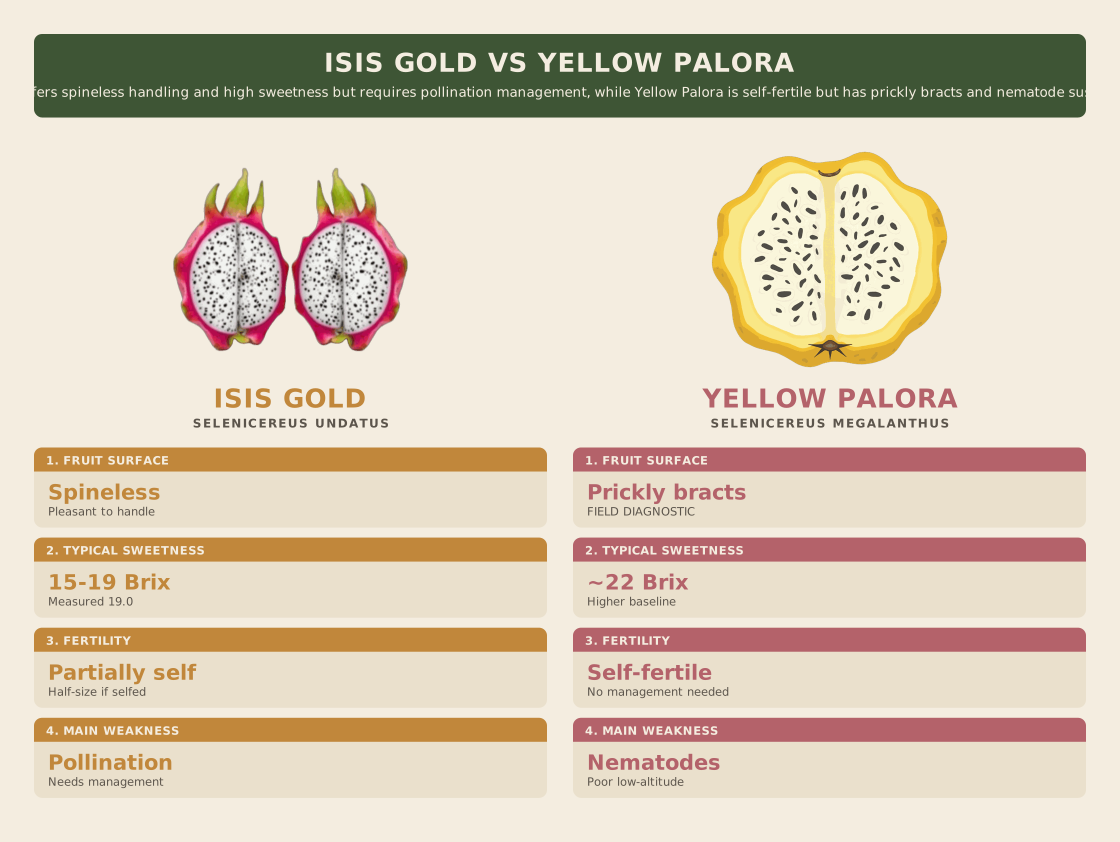
The most immediate field diagnostic is the fruit surface. S. megalanthus fruits, such as Palora and Colombian Yellow, bear short bracts with prickles that detach easily when ripe[1]. You will feel these spines if you touch an unripe Palora fruit. Isis Gold is spineless. Its skin is smooth and pleasant to handle, a trait that makes harvest significantly more comfortable than working with thorny alternatives[8]. If you are looking for a low-friction harvest, the spineless nature of the S. undatus group is a major advantage.
The timeline from flower to ripe fruit also differs sharply. Yellow Palora takes about 120 days, roughly 17 weeks, from pollination to ripe fruit. This is a long commitment for a single fruit. Isis Gold, while moderate in growth rate, does not share this specific extended ripening window, allowing for a different harvest rhythm. The species difference also extends to genetics. Most S. undatus cultivars are diploid with 22 chromosomes, while S. megalanthus is tetraploid with 44[1]. This cytological gap means the two species are not interchangeable in breeding programs or pollination strategies.
Self-fertility is another critical divergence. Yellow Palora and Colombian Yellow are self-fertile, meaning they can set fruit without a pollen partner[1]. Isis Gold is not self-fertile. It requires cross-pollination with a compatible partner to produce quality fruit. If you plant Isis Gold alone, you will likely see small, poor fruit set. If you plant Palora alone, you will get a crop. This makes the purchasing decision straightforward: if you want a single-plant solution, choose a self-fertile S. megalanthus. If you want the spineless, sweet-tart profile of Isis Gold, you must plan for a partner plant.
While Palora offers higher sugar content, around 22 Brix, and an extended production season, it comes with limitations. S. megalanthus is susceptible to nematodes and performs poorly at low altitudes[1]. Isis Gold, rated 4.5 out of 5 for hardiness, tolerates both heat and cold well[6]. For growers in variable climates, the robustness of the S. undatus hybrid may outweigh the convenience of self-fertility. Understanding these taxonomic boundaries prevents frustration.
Flavour, sugar and the pick-date decision
The breeder’s record is blunt about the window: pick the fruit only days after the skin turns yellow. Do this, and you get a balanced sweet and tart profile that tastes like lemonade. Wait too long, and the acidity vanishes. The fruit becomes very sweet with a slightly dulled lemony note. Leaving the fruit on the vine past the initial colour change does not just add sugar; it flattens the flavour profile entirely.
The difference between a dull fruit and a 5/5 rated harvest comes down to days, not weeks. Growers who track this cultivar report that the peak eating quality aligns with the early yellow stage. The flesh is dense and translucent white, filled with numerous small black seeds. At this stage, the texture is juicy and the flavour is bright. If you are aiming for the 19.0 Brix sweetness recorded in grower logs, you get it naturally, but you must catch it before the sugars overpower the acids.
Harvest cue: Watch for the skin to turn fully yellow. Do not wait for the fins to dry or the fruit to soften significantly. The ideal pick is just days after colour change, when the fruit is firm but fully coloured.
Because Isis Gold is not self-fertile, the size of the fruit you pick also depends on how well you pollinated the flower. Cross-pollination sets fruit of about 500 to 850 g, while self-pollinated flowers set fruit of only about 200 to 350 g.[1] Larger, well-pollinated fruit tend to develop more uniform sugar content. Small, poorly set fruit may ripen unevenly or lack the depth of flavour that makes the variety worth growing. If you are hand-pollinating, ensure you are using pollen from a compatible red or white commercial type to maximise both size and taste.
| Pick Timing | Flavour Profile | Texture |
|---|---|---|
| Just after skin turns yellow | Balanced sweet-tart, lemonade notes | Juicy, firm |
| Left on vine longer | Very sweet, no acidity, dulled citrus | Softer, potentially mealy |
The pollination problem, in numbers
Self-pollination is not a viable strategy for Isis Gold if you want marketable fruit. The difference in yield is stark and measurable. When flowers are self-pollinated, the resulting fruit typically weighs between 200 and 350 grams. When those same flowers are cross-pollinated with compatible pollen, the fruit sets at 500 to 850 grams[1]. This is not a marginal improvement; it is a doubling or tripling of size. The mechanism is biological: fruit size in pitaya is a direct function of fertilization. More ovules fertilized means more seeds formed, which drives the fruit to expand[1]. If you leave an Isis Gold flower to its own devices, you are betting on a small, seed-poor harvest.
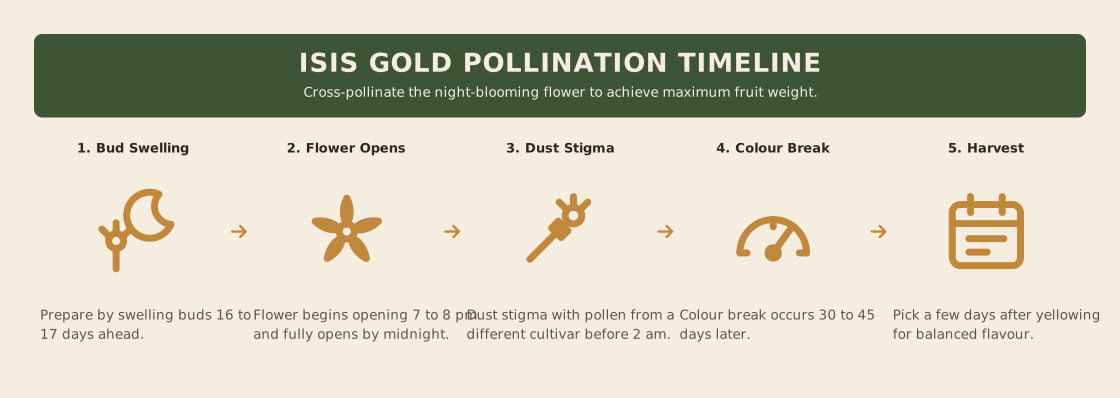
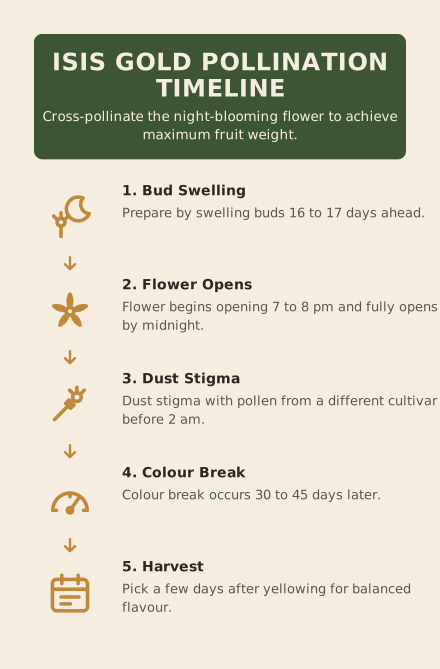
Timing is the second critical variable. Pitaya flowers are nocturnal, opening only after dusk and closing by morning. In southern Portugal, flowers begin opening around 7 pm and are fully open by 11 pm, though hot days can accelerate this to 6 pm[1]. A molecular review provides a tighter clock: buds develop for about 13 days, then take 16 to 17 days to reach anthesis. Opening begins at 8:00 pm in summer and 7:30 pm in autumn, with full openness reached around midnight and pollination complete by 2 am[3]. After this window, the flower wilts and withers, even if unfertilized. You have a narrow window, often less than six hours of peak viability, to move pollen from a compatible partner to the stigma.
| Pollination Method | Expected Fruit Weight | Seed Count |
|---|---|---|
| Self-pollination | 200 to 350 g | Low |
| Cross-pollination | 500 to 850 g | High |
Data from cultivar review[1]
The geographic context matters as much as the timing. In the Americas, nocturnal pollinators like bats and moths provide some natural service, though their activity is rarely observed and hand pollination remains the reliable standard[4]. In Europe, the situation is worse. The bat species present in southern Portugal and Spain are insectivores, meaning they do not visit pitaya flowers for nectar. Nocturnal pollinator pressure on pitaya is scarce, making manual cross-pollination the only practical substitute for a good crop[1]. If you are growing Isis Gold in a Mediterranean climate, you cannot rely on nature to do the work. You must be the pollinator.
Because the window is short and the stakes are high, preparation is key. Collect pollen from a compatible red or white commercial variety before the flowers open, or gather whole stamens from a partner plant and apply them directly to the Isis Gold stigma during the night or early morning[4]. The choice of pollen partner does more than just set the fruit; it can influence the eating quality through xenia and metaxenia, where pollen from a different plant affects the characteristics of the fruit on the mother plant[1]. For detailed steps on selecting partners and executing the hand pollination, see our dragon fruit pollination guide.
Growing Isis Gold: climate envelope, water, structure
Isis Gold sits comfortably within the standard pitaya temperature band. Optimal growth occurs between 65 and 77 F (18 to 25 C), with injury possible above 100 F (38 C)[4]. While the plant tolerates heat, flowering is inhibited when temperatures exceed 38 C[1]. Above 28 C, every additional degree reduces nightly CO2 uptake significantly through the PEPC pathway[1]. This metabolic slowdown explains why fruit set can stall during heatwaves even if the plant looks healthy.
Cold tolerance is rated 4.5 out of 5, meaning it handles chill better than many tropical varieties[6]. However, frost remains the hard limit. Exposure to -2 C causes damage, though plants recover rapidly if the freeze was light[1]. Temperatures near -4 C will kill the plant outright[1]. If you are in a zone with occasional hard freezes, plan for protection or container culture that can be moved.
Water management: Maximum biomass is achieved when soil moisture is held at 70 to 80 percent of field capacity. Allowing the soil to drop to 50 to 60 percent shifts energy into root growth and reduces fruit production potential[1]. A drought lasting ten days measurably reduces CO2 uptake, so consistent irrigation is critical during the June to October season[1][6].
Structural support is non-negotiable for a vine that can reach 20 ft. A mature planting at three to four years old may produce about 220 lb (100 kg) of fruit annually, requiring a trellis that withstands several hundred pounds of stem weight[4]. Plant the cuttings 15 to 25 ft from trees, structures, or power lines to allow for this spread[4]. Because Isis Gold is described as an aggressive grower that flowers faster than other varieties, it forms a dense tangle quickly[7]. Production pruning one to three times per year is required to keep light into the stems, remove stems touching the soil, and prevent breakage[4].
For the first three to four months after planting, provide about 30 percent shade to reduce transplant stress[4]. After establishment, full sun is preferred, but be aware that too much shade lowers both yield and fruit quality[4]. The plant’s high water-use efficiency, a trait selected for in Israeli desert domestication programs, means it is resilient but not drought-proof when you want heavy fruiting[2].
What to expect from your first two seasons
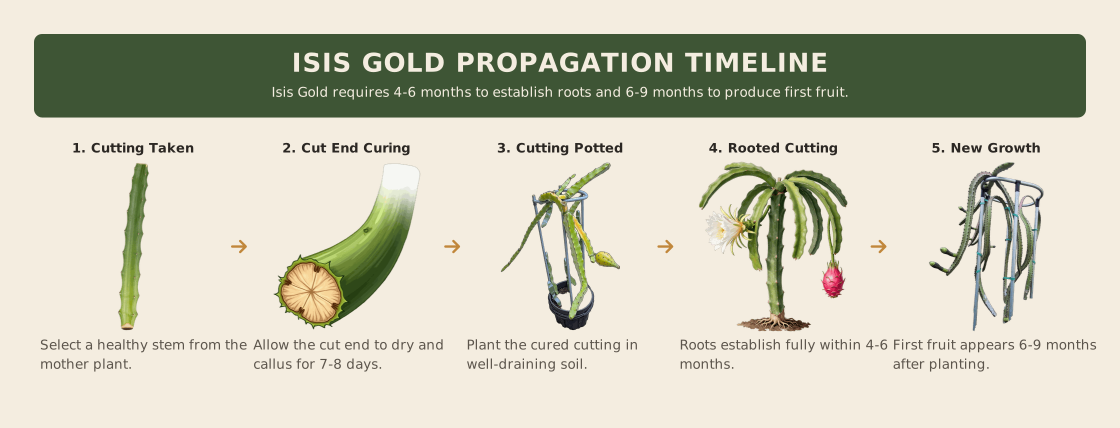
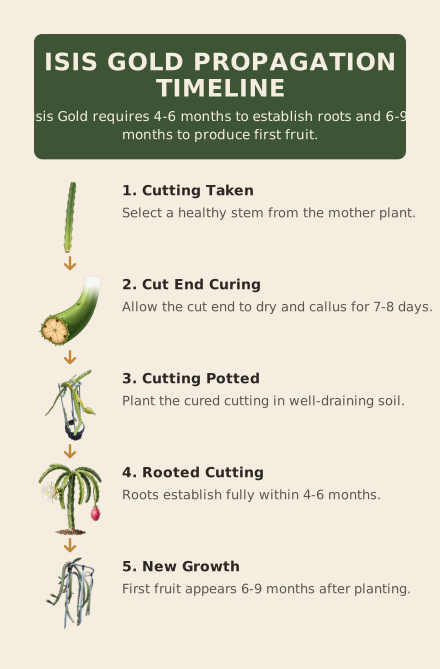
Unlike some vigorous commercial clones that rush to fruit, this cultivar has a moderate growth rate, rated only 3 out of 5 for speed in grower records[6]. If you plant a cured cutting, do not expect a harvest in the first year. The plant is busy establishing its root system and building the structural mass needed to support heavy fruit later. A young vine will likely focus entirely on vegetative growth, sending out new stems and climbing your support structure. Rushing the plant with excessive nitrogen or forcing early flowering can result in weak stems that break under the weight of future fruit.
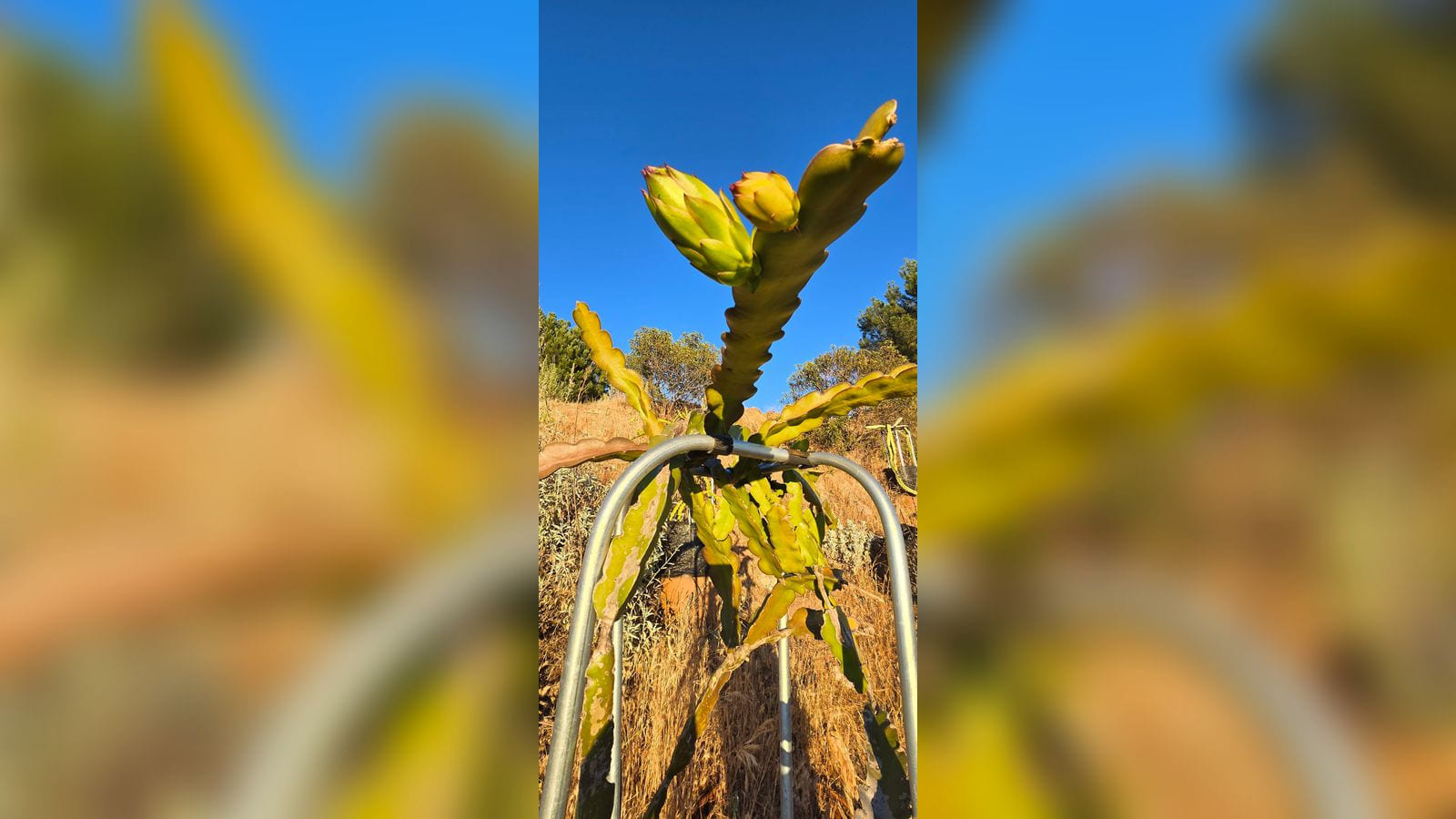
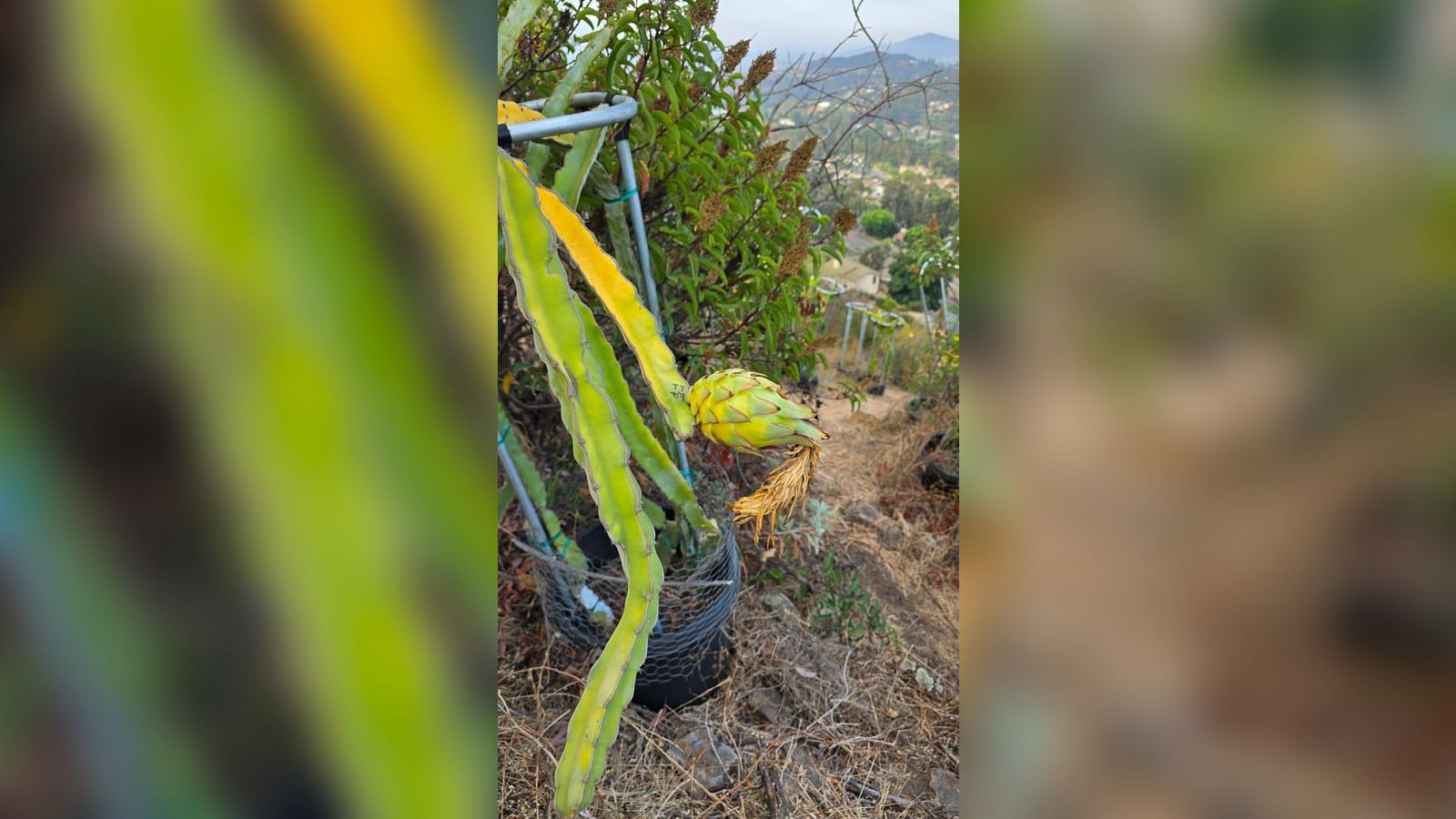
By the second season, you may see the first flowers, but do not be discouraged if they are few. The bloom window for Isis Gold typically runs from July through September, with a peak in August[5]. These flowers are large, fragrant, and open at night, staying open for roughly 8 to 12 hours[1]. Because the plant is still maturing, the number of blooms will be lower than on a mature, established vine. You might see only a handful of flowers in year two, compared to dozens on a plant that is three or four years old. This gradual increase in flowering is part of the moderate production profile of this variety.
Pruning is not optional. Even in the early years, you must prune to manage the tangle. Production pruning one to three times per year is required to keep light into the stems and remove any growth touching the soil[4]. This prevents breakage and encourages the development of new, fertile stems. Do not let the vine become a dense, unmanaged mass, as this reduces air circulation and invites disease.
When flowers do appear, remember that Isis Gold is not self-fertile. You cannot rely on the plant to set fruit on its own. The flowers require cross-pollination from a compatible partner to produce quality fruit[1]. If you leave the flowers to self-pollinate, you will get small, poor-quality fruit, if any at all. Self-pollinated flowers on yellow S. undatus cultivars typically set fruit of only about 200 to 350 g, while cross-pollination sets fruit of about 500 to 850 g[1]. This dramatic difference in size and quality is why hand pollination is essential. You must have a compatible red or white commercial type nearby to provide pollen[8].
Harvest timing in the second season will be your first real test of patience. The fruit is ready only days after the skin turns yellow. Picked at this stage, the flavor is a balanced sweet and tart, often described as tasting like lemonade[6]. If you leave the fruit on the vine longer, it becomes very sweet but loses its acidity, resulting in a dull, one-dimensional flavor[6]. The skin is spineless and smooth, making harvest pleasant and easy, unlike the thorny alternatives[8]. Expect a few high-quality fruits in year two, rather than a heavy crop. The plant is still building the energy reserves needed for the heavy yields of years three and four.
| Season | Primary Focus | Expected Output |
|---|---|---|
| Year 1 | Root establishment and vegetative growth | No fruit. Strong stem development. |
| Year 2 | First flowering and structural pruning | Few flowers. Hand pollination required. Small harvest. |
| Year 3+ | Mature production | Heavy flowering. Large, high-Brix fruit. |
Symptom check: flowers but no fruit, or fruit that stays small
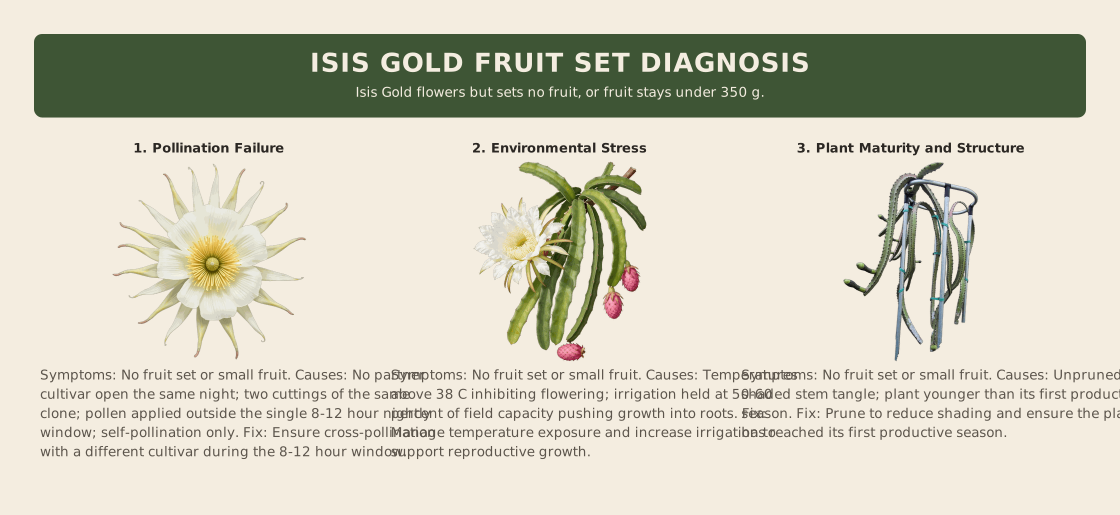
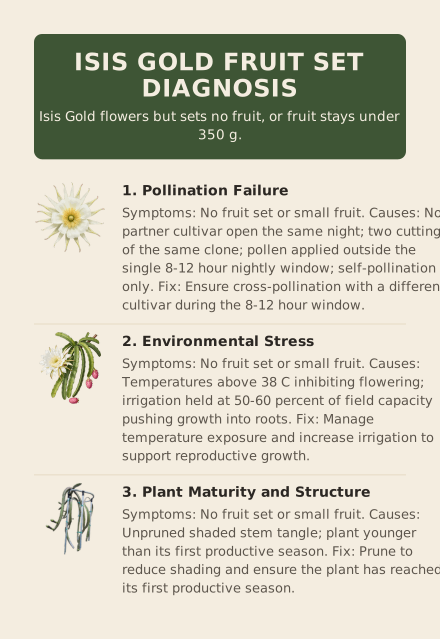
Abundant white blooms followed by tiny, misshapen fruit or flower drop usually indicate pollination failure, not disease. Because this cultivar is not self-fertile, its own pollen cannot fertilize its own ovules. You are seeing the result of empty fertilization events.
Fruit size in pitaya is a direct function of fertilization. The more ovules that are successfully fertilized, the more seeds form, and the larger the resulting fruit becomes. In yellow Selenicereus undatus cultivars, self-pollinated flowers typically set fruit weighing only 200 to 350 grams, while cross-pollination sets fruit of 500 to 850 grams.[1] If your fruit is staying small, you are likely getting partial or self-pollination rather than a full cross.
The window for correction is narrow and nocturnal. Pitaya flowers open only at night and stay open for roughly 8 to 12 hours.[1] In many climates, buds begin opening around 7 pm and are fully open by 11 pm, with pollination complete by about 2 am before the flower wilts by the next morning.[1] If you are checking your plants during the day, you are missing the event entirely.
| Symptom | Likely Cause | Fix |
|---|---|---|
| Flowers drop after 24 hours, no fruit set | No pollen transfer or incompatible pollen | Hand pollinate with a different genetic type |
| Fruit sets but stays under 350 g | Self-pollination or poor cross | Ensure pollen comes from a red or white commercial type |
| Fruit is lopsided or unevenly sized | Incomplete ovule fertilization | Apply more pollen to the entire stigma surface |
| Flowers open but no scent or nectar | Environmental stress or age | Check irrigation levels and shade exposure |
Hand pollination is the only reliable method for most growers. Moths and bats are natural pollinators, but their activity is rarely observed and often insufficient for commercial-quality fruit, especially in regions where bat species are insectivores rather than nectar feeders.[1] To pollinate, collect pollen or whole stamens from a compatible partner plant and apply it to the stigma of the Isis Gold flower during the night or early morning.[4]
The choice of pollen partner matters for more than just size. Xenia and metaxenia effects mean that pollen from a different plant can influence the eating quality of the fruit carried on the plant that was pollinated.[1] Using a red or white commercial variety as a pollen source not only ensures fruit set but can also enhance the flavor profile of your Isis Gold harvest.
Do not rely on wind or bees. Pitaya pollen is heavy and sticky, not airborne. Without manual intervention or specific nocturnal pollinators, self-incompatible cultivars like Isis Gold will not set quality fruit.
If you have multiple Isis Gold plants, remember that they are clones. Pollen from one Isis Gold flower to another is still self-pollination. You need a genetically different parent, such as a red-skinned or white-fleshed commercial type, to achieve the large, high-Brix fruit this variety is known for.
Should you grow it, and what to plant beside it
Deciding to add Isis Gold to your collection depends less on climate and more on your willingness to manage a pollination partnership. This is a collector’s variety, not a commercial staple. It offers a rewarding, high-flavor fruit with a smooth, spineless skin that makes harvest pleasant. However, it demands active intervention to reach its potential. If you enjoy the craft of hand-pollinating night-blooming flowers and want a unique yellow fruit with a balanced sweet-tart profile, it is a worthy addition. If you want a set-and-forget plant that produces large crops without a second variety nearby, look elsewhere.
The plant itself is robust. It tolerates heat and cold well, rated 4.5 out of 5 for hardiness, and handles the temperature swings of many growing zones without fuss. But its growth rate and fruit production are moderate, rated 3 out of 5 in both categories. You will not get a wall of fruit in the first few years. Expect a steady, manageable vine that requires production pruning one to three times a year to prevent a dense tangle and keep light reaching the stems. Because Isis Gold is not self-fertile, you must provide pollen from a compatible partner to set fruit of any significant size. Self-pollinated flowers produce small, poor fruit, while cross-pollination yields the large, 19 Brix fruit the variety is known for.
The Pollination Partner Rule: Do not plant two Isis Gold clones next to each other and expect a crop. They are genetically identical and will not cross-pollinate. You need a different genetic type.
Choosing the right companion plant is critical. The extension recommendation for self-incompatible types is to plant two or three different genetic varieties rather than repeated copies of the same clone. For Isis Gold, this means pairing it with a red or white commercial type. These varieties are generally vigorous, self-fertile or partially self-fertile, and produce abundant pollen. A red-skinned variety like 'Vietnamese White' (which is actually red-skinned with white flesh, despite the name confusion in some trade channels) or a robust red-skinned commercial cultivar serves well. The goal is to have a pollen source that blooms at the same time. Since pitaya flowers open only at night and stay open for roughly 8 to 12 hours, you need the companion plant’s flowers to be open and ready to donate pollen when your Isis Gold flowers are receptive.
| Companion Type | Why It Works | Watch Out For |
|---|---|---|
| Red-skinned commercial (e.g., 'Common White' or similar) | High pollen viability, overlapping bloom window, vigorous growth. | Can outcompete Isis Gold for space if not pruned aggressively. |
| White-fleshed red-skinned hybrids | Often self-fertile, reliable bloomers, easy to source. | May have different water or fertilizer needs if not matched carefully. |
| Another yellow S. undatus (e.g., 'Golden of Israel') | Similar cultural needs, same species, compatible pollen. | May be hard to source; ensure they are not the same clone. |
Consider your space and structure when planning this pairing. A mature planting can produce about 220 lb (100 kg) of fruit per year at three to four years old, and stems may reach about 20 ft. Your trellis must withstand several hundred pounds of stem weight. Planting two or three varieties means you need a support system that can handle the combined biomass. Set plants 15 to 25 ft from trees, structures, and power lines to allow for airflow and light penetration. Too much shade lowers both yield and fruit quality, so ensure your companion plants do not cast a permanent shadow on the Isis Gold blooms.
Finally, think about the harvest experience. Isis Gold fruit is spineless and smooth, making it a joy to pick. If you plant a red-skinned companion, you will have a mix of textures and colors in your harvest basket. The yellow fruit should be picked just days after the skin turns yellow for that balanced lemonade-like flavor. Leaving it on the vine longer makes it overly sweet and dulls the citrus notes. With a compatible partner, you can enjoy this precise harvest window. Without one, you will be left with small, disappointing fruit that barely justifies the space. If you are ready to commit to the nightly pollination and the pruning discipline, Isis Gold offers a unique, high-quality fruit that stands out in any collection.
Key takeaways
Frequently asked questions
Can I grow Isis Gold alone?
You can grow it alone, but you will not get a harvest worth the effort. Isis Gold is not self-fertile. Self-pollinated flowers set small fruit, typically 200 to 350 g, which is roughly half the size of cross-pollinated fruit[1]. To get the large, high-Brix fruit this cultivar is known for, you must introduce pollen from a compatible partner. Planting two or three different genetic types, such as a red or white commercial variety, ensures better fruit set and size[4].
Is it the same as Yellow Palora?
No. They are different species with different needs. Isis Gold is a Selenicereus undatus cultivar with spineless fruit skin. Yellow Palora is Selenicereus megalanthus, which bears short bracts with prickles that detach when ripe[1]. Isis Gold requires cross-pollination and has a different flavor profile. Do not assume care instructions for one apply to the other.
Hand pollination is essential. Pitaya flowers open at night and stay open for only 8 to 12 hours[1]. In Europe, natural nocturnal pollinators like bats are often insectivores and do not visit pitaya flowers, making manual cross-pollination the only reliable method for fruit set[1]. Collect pollen from a compatible partner and apply it to the Isis Gold stigma between 8 pm and 2 am[1].
Why is my fruit small or dropping?
Small fruit usually indicates poor fertilization. Fruit size in pitaya is directly linked to the number of ovules fertilized; more seeds mean larger fruit[1]. If you are relying on natural pollination, you may be getting partial self-pollination, which results in the smaller 200 to 350 g fruit size[1]. Temperature stress can also inhibit flowering, especially if night temperatures exceed 38 C[1].
When should I pick the fruit?
Harvest Isis Gold just days after the skin turns yellow. Picked at this stage, the fruit has a balanced sweet-tart flavor with citrus notes[6]. If you leave it on the vine longer, the acidity drops, and the flavor becomes overly sweet and dull[6]. The skin is spineless, so you can handle it easily without gloves[7].
Do not grow from seed. Isis Gold is propagated vegetatively from cuttings to maintain its specific traits. Seed-grown pitaya are variable and can take up to seven years to fruit, whereas cuttings can fruit in 6 to 9 months[4]. If you buy a plant, it should be a cutting, not a seedling.
References
- Pitaya as a New Alternative Crop for Iberian Peninsula: Biology and Edaphoclimatic Requirements (Plants 12(18):3212, doi:10.3390/plants12183212), MDPI Plants (peer-reviewed; full text PMC10537634) (2023).
- Do We Need New Crops for Arid Regions? A Review of Fruit Species Domestication in Israel (Agronomy 10(12):1995, doi:10.3390/agronomy10121995), Mizrahi Y., Ben-Gurion University of the Negev, MDPI Agronomy (peer-reviewed) (2020).
- Pitaya Nutrition, Biology, and Biotechnology: A Review (Int J Mol Sci 24(18):13986), full text PMC10530492, MDPI International Journal of Molecular Sciences / PubMed Central (2023).
- HS1068/HS303: Pitaya (Dragonfruit) Growing in the Florida Home Landscape, UF/IFAS Extension (Crane & Balerdi) (2024).
- Isis Gold Cultivar, The Dragon Fruit Directory (community grower logs, Tendra), dragonfruit.wiki (2026).
- Isis Gold Dragon Fruit: Taste, Growing & Cuttings, breeder's record measured by Jason Gentile, Hybridizing Dragon Fruit (2026).
- Isis aka Golden Yellow, nursery cultivar description, Dragons Alley Nursery (2026).
- Dragonfruit Aussie Gold (Isis Gold / Bundaberg Gold), nursery cultivar description, Flying Dragon Nursery (NZ) (2026).