Mega Red Dragon Fruit: Brix, Size, and Parentage
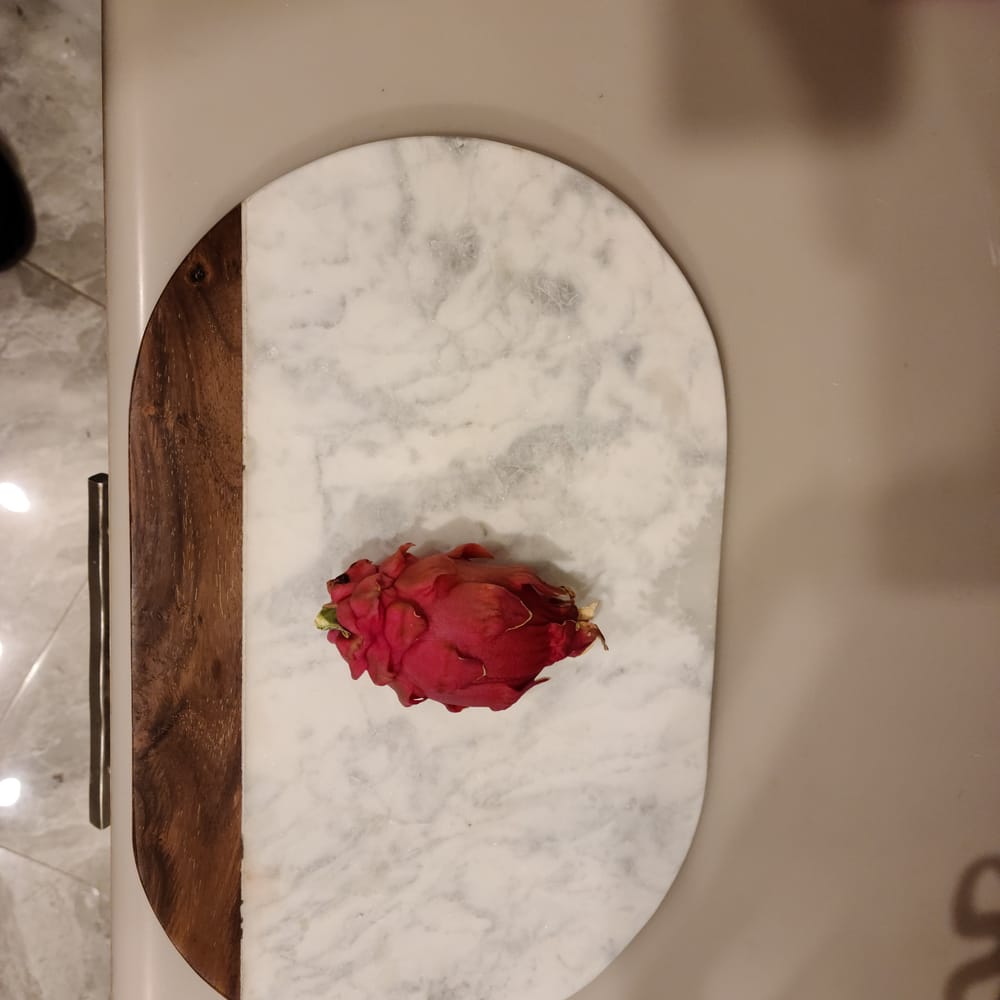
Mega Red dragon fruit is a deep red-fleshed pitaya cataloged at 17 to 19 Brix, with fruit often exceeding 1.5 lb. It flowers May through September and ripens 30 to 35 days after flowering. Catalogs list it as self-fertile, but parentage records conflict. Pick when skin colour shifts and the fruit gives slightly to thumb pressure. You can join the waitlist on our dragon fruit cuttings page.
Mega Red at a Glance
| Spec | Detail |
|---|---|
| Flesh colour | Deep red |
| Sugar | 17 to 19 Brix (trade-listed) |
| Fruit weight | Often over 1.5 lb |
| Self-fertile | Listed yes, treat with caution |
| Flowering | May to September in a warm-temperate collection |
| Bud to flower | ~25 days |
| Flower to harvest | 30 to 35 days |
| Ripeness test | Colour change plus slight give |
| Support need | Strong, heavy fruit |
| Our listing status | Out of stock, waitlist open |
These variety specs are grower-reported. The pollination and ripening biology covered in the sections below comes from published trials.
Parentage, And Why The Records Disagree
If you look up Mega Red in different databases, you will find conflicting stories about its lineage. This isn't a mistake; it reflects how young the name is and how fragmented dragon fruit taxonomy remains.
One directory files Mega Red as a cultivar of Selenicereus undatus, the standard white-fleshed pitaya. Another records it as a cross between Selenicereus costaricensis (or polyrhizus) and Selenicereus megalanthus. No parentage claim for this name should be presented as settled fact.[1]
Before we unpack the species, a quick note on names. You may see older literature or nursery tags using Hylocereus. That genus was merged into Selenicereus years ago. Hylocereus costaricensis is now Selenicereus costaricensis. They are the same plant, and current peer-reviewed work uses Selenicereus, so we stick with that to avoid confusion.[3]
Selenicereus costaricensis is native to Costa Rica and Central America. It is known for stout stems and red to scarlet fruit. It is a major parent behind most commercial red hybrid lines because it delivers the deep pigment and robust structure.[8] Selenicereus megalanthus is the yellow-skinned species. It is generally associated with higher sweetness and distinct flavor profiles.
Why the confusion? Dragon fruit taxonomy is messy. Many varieties are selected from open-pollinated seedlings or undocumented crosses. When a plant performs well, it gets named and sold. The paperwork often lags behind. In this case, the name is young and the records are thin. Treat the parentage as unverified. Focus on how the plant performs in your garden, not on the label.
The Self-Fertile Claim, Tested
Catalogs often label red-fleshed pitayas as self-fertile. This claim suggests you can grow a single Mega Red cutting and expect full-size fruit without a partner plant. Trials show mixed results. One red clone (NDFR-1) was strictly self-incompatible. Another red variety, 'Royal Red', was self-compatible. There is no single pattern across red varieties.
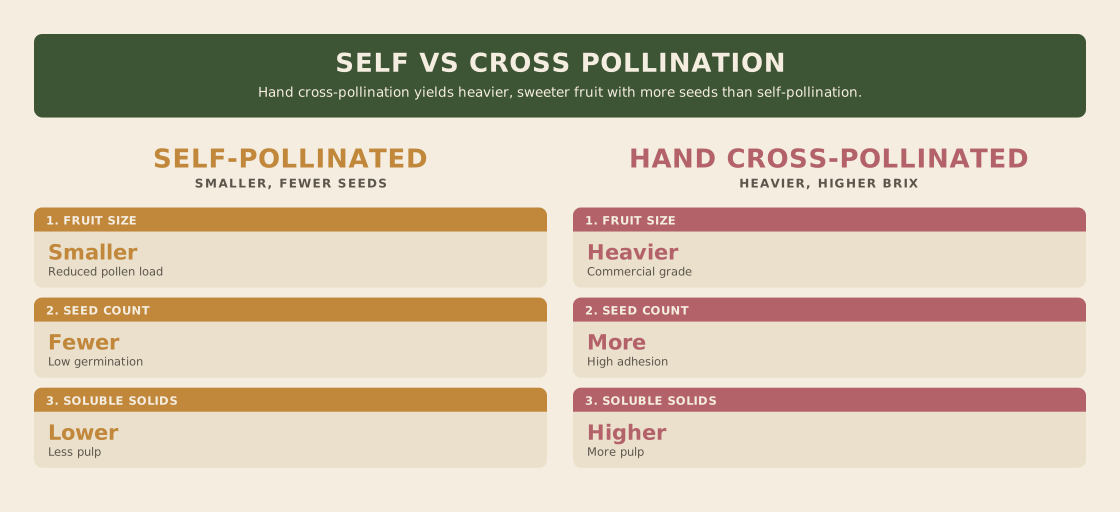
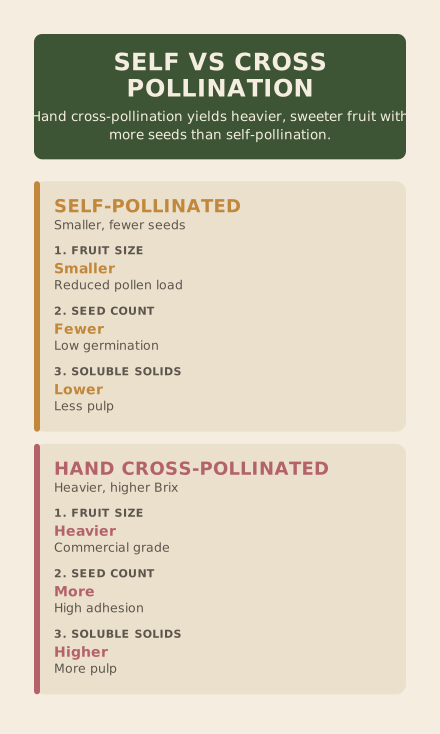
A two-year study in subtropical India examined commercially grown dragon fruit clones. The red-fleshed clone (NDFR-1) was strictly self-incompatible and required cross-pollination to set any fruit. The white-fleshed clone (NDFW-1) was self-compatible, but it produced significantly heavier fruit when hand cross-pollinated.[3] Self-fertility buys fruit set, not size.
Greenhouse trials with 'Royal Red' further clarify the limits of self-pollination. Bagged flowers, which prevented insect access, did set fruit. However, these selfed fruits were smaller and contained fewer seeds due to reduced pollen load and low pollen germination rates.[4] Crucially, freely open-pollinated flowers in the same greenhouse matched the bagged flowers exactly. This indicates that the occasional insect visitors inside covered pitaya flowers are not efficient pollinators.[4] Relying on nature to do the work inside a greenhouse, or even an open garden, often results in underperforming fruit.
Another Indian trial reported 100 per cent fruit set across both self and cross pollination treatments in white and red types. Yet, maximum fruit weight, pulp weight, peel weight, and total soluble solids occurred only when white-fleshed flowers were pollinated with H. polyrhizus pollen. The authors recommend mixed planting with H. polyrhizus to avoid light, low-quality fruit.[7] Crossing with a different red or white variety will boost size and sugar content.
| Symptom in Garden | What It Means | Fix |
|---|---|---|
| Fruit sets but stays small | Self-pollination occurred, but pollen load was low | Hand pollinate with pollen from a different variety |
| Flowers drop without setting | Strict self-incompatibility; own pollen rejected | Cross-pollinate with compatible pollen |
| Fruit has few seeds | Incomplete pollination; ovules not fully fertilized | Apply more pollen, ensure full stigma coverage |
| Low Brix despite ripe color | Insufficient cross-pollination impact on sugar accumulation | Use pollen from a high-sugar partner variety |
A self-fertile label on a red variety like Mega Red means it might set fruit alone, but it will not reach its potential size or sweetness. To get the heavy, high-sugar fruit described in trade listings, you need a pollinator partner or diligent hand pollination. For a deeper look at how to manage this, see our guide on self-fertile versus cross-pollinating dragon fruit varieties.
How To Hand-Pollinate Mega Red
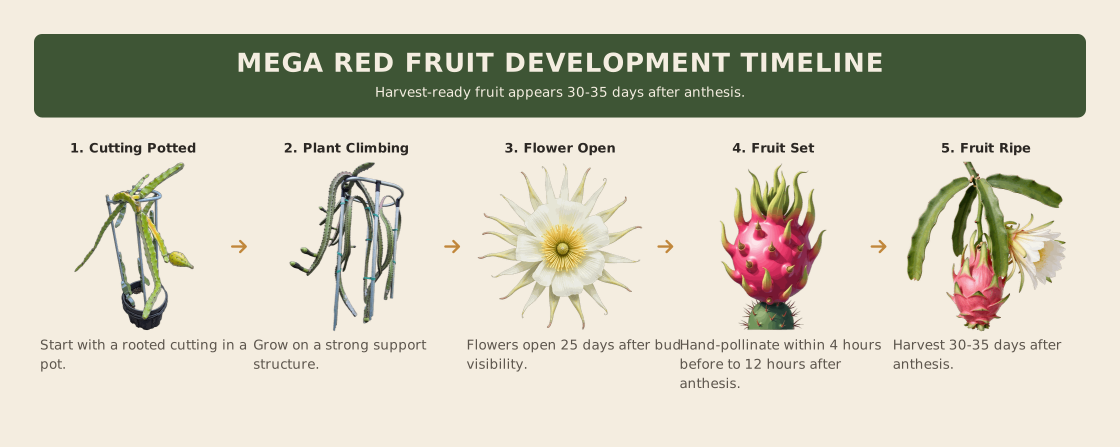
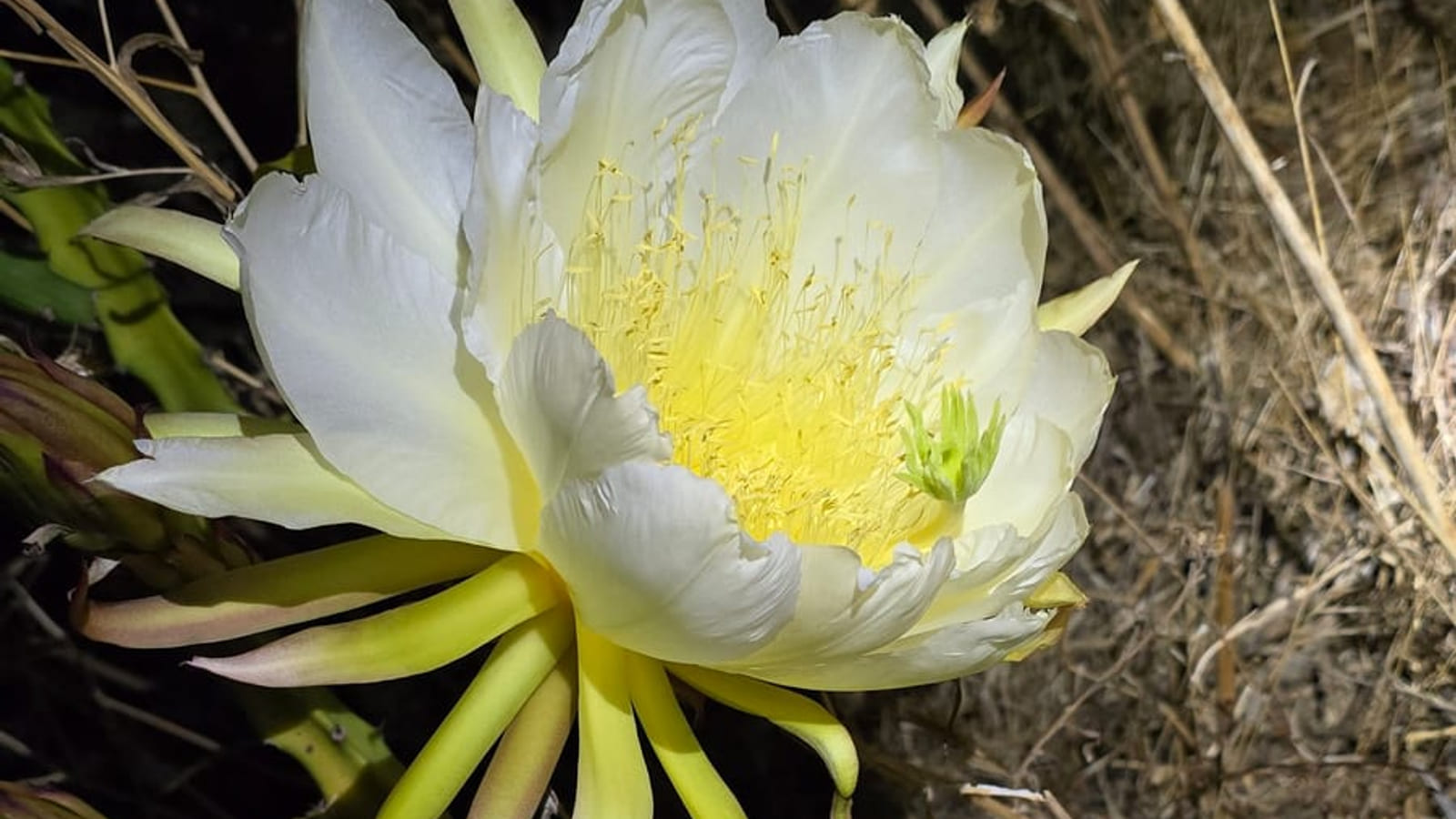
Mega Red flowers open at night, but the biological window for successful pollination is wider than the bloom itself. A study on commercially grown dragon fruit in subtropical India found that pollen viability and stigma receptivity remained effective from four hours before the flower opens until twelve hours after anthesis[3]. This gives you a practical window in the early evening or the following morning. Do not wait for the flower to fully open and then rush; plan your visit for when the flower is just starting to unfurl or shortly after it has closed.
While trade listings often claim red varieties are self-fertile, relying on natural pollination or self-pollination alone often results in smaller fruit. Hand-pollination is the most reliable way to ensure commercial-grade size and seed count. The method you choose matters. In trials with 'Royal Red', using a paintbrush or a duster to transfer pollen resulted in higher pollen adhesion on the stigma compared to using blowers[4]. Blowers do work and can save labor, but they are less precise for adhesion. For a home grower aiming for maximum fruit quality, a soft brush is the better tool.
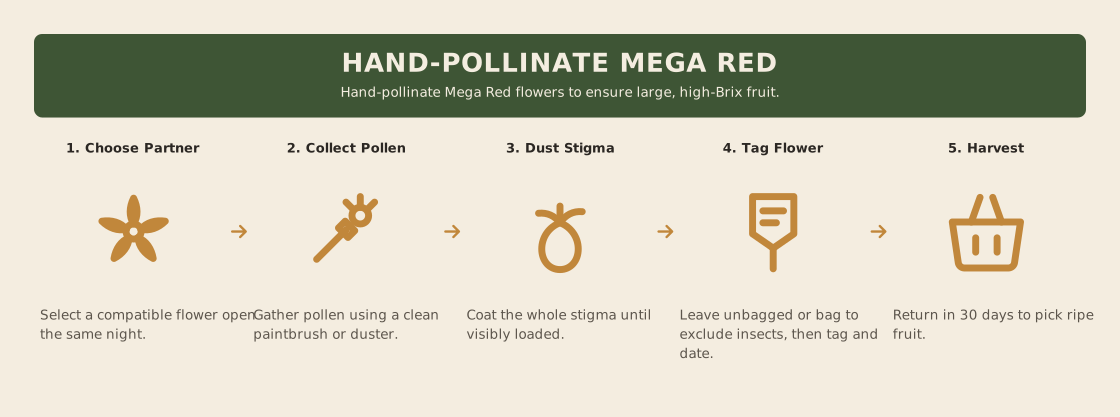
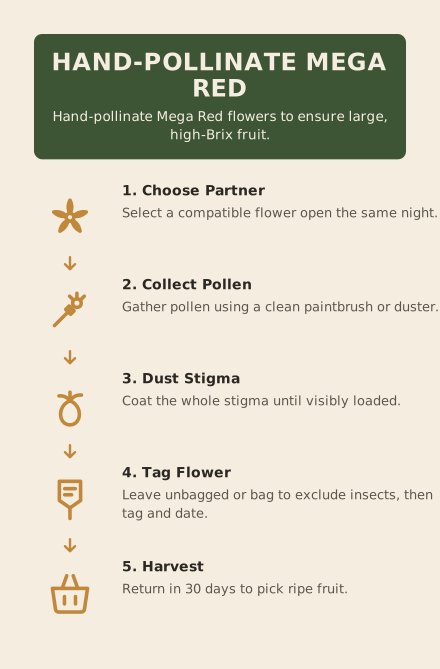
- Prepare your tool. Use a clean, soft paintbrush or a small duster. A standard artist’s brush works well for precision.
- Collect pollen. Gently brush the anthers (the male parts) of the flower. You will see yellow pollen dust on the bristles. If you are cross-pollinating, collect from a different variety. If self-pollinating, collect from the same flower.
- Apply to the stigma. Lightly brush the collected pollen onto the stigma (the central, star-shaped female part). Cover the entire surface of the stigma lobes. Do not rub hard; you want the pollen to stick, not to damage the tissue.
- Tag the flower. Use a small tag or string to mark the pollinated flower. This prevents confusion if you have multiple flowers open at once.
- Mark your calendar. Note the date. Mega Red fruit typically ripens 30 to 35 days after flowering. Set a reminder for day 30 to start checking for ripeness.
Timing tip: The most effective time to pollinate is in the early evening as the flower opens, or in the morning after it has closed. Avoid midday heat, which can dry out the stigma and reduce pollen viability.
Hand-pollination is a simple task, but it is critical for red-fleshed varieties. If you want to learn more about the specific techniques for different pitaya types, check out our internal pollination guide.
Flower To Harvest: The Real Timeline
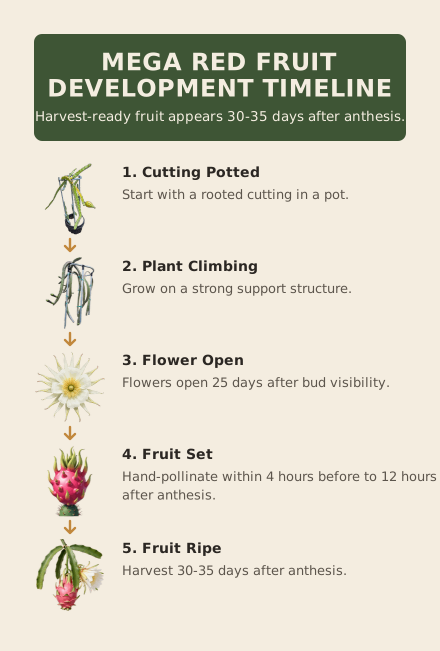
Once a Mega Red flower opens, the clock starts ticking. Trade listings suggest a window of 30 to 35 days from anthesis to harvest. Researchers sampled dragon fruit peel at the 25th, 35th, and 45th day after anthesis to track chemical changes. Their data confirms that a four to six week fill period is normal for the species. This aligns with the trade estimate for Mega Red, though the exact day you pick depends on your goals.
As the fruit ages, its internal chemistry shifts in one direction. Dietary fibre and mineral content rise steadily. At the same time, phenolics, flavonoids, and antioxidant activity fall. This means a fruit picked at day 25 will have a different nutritional profile than one picked at day 45. For most growers, the goal is sugar and texture, not maximum antioxidant load. Waiting for the skin to deepen and the fruit to give slightly under thumb pressure remains the best practical cue.
Rain flushes can trigger flowering. Early summer rains often act as floral inducers. If you see a sudden bloom after a dry spell, expect a heavy fruit set. Adjust your support structure if needed, as heavy fruit drags stems down.
Soluble solids and pulp yield in red-fleshed dragon fruit shift with the pick month and the site. A study across three counties in Guizhou, China, found that fruit from Guanling peaked in August, while fruit from Luodian was best in August or September. Zhenfeng fruit hit its stride in September. Your microclimate dictates the sweet spot.
| Days After Anthesis | Chemical Trend | Harvest Note |
|---|---|---|
| 25 | Higher phenolics/antioxidants | Early pick, lower sugar |
| 30-35 | Balanced profile | Standard trade window |
| 45 | Higher fibre/minerals | Late pick, softer flesh |
Do not expect a uniform ripening date across your whole trellis. Flowers that open after a rain flush will lag behind those from the initial bloom. Track the date of anthesis for each fruit if you want to hit peak Brix. For most backyard growers, the visual cues of colour change and slight give are reliable enough. Just remember that the window is narrow. A few days can mean the difference between firm, sweet flesh and a fruit that is too soft for storage.
Why The Red Flesh Is Red, And Why It Bleeds Less Than You Think
The deep crimson pulp of Mega Red is not colored by anthocyanins, the pigments found in blueberries and red cabbage. It is colored by betalains. This class of pigments splits into two groups: betacyanins, which provide the red and purple hues, and betaxanthins, which contribute yellow and orange tones. Metabolite profiling of red-fleshed pitayas like Selenicereus polyrhizus and white-fleshed Selenicereus undatus has cleanly separated these species by mapping the betalain pathway in both. This biochemical distinction is sharp enough to serve as a reliable marker for flesh type.
When you cut open a red-fleshed dragon fruit, you might expect the juice to stain everything it touches with intense nutritional power. The chemistry says otherwise. Comparative studies ranked total phenolic content, total flavonoid content, and total betacyanin content, along with antioxidant activity measured by DPPH, ABTS, and FRAP assays. The ranking was consistent: red peel is greater than or equal to white peel, which is greater than red flesh, which is greater than white flesh. The pigment load and antioxidant capacity sit mostly in the skin, not the pulp.[5]
Do not judge sweetness by color. The intensity of the red juice in the flesh is a visual cue for betalain presence, not a proxy for sugar content or nutritional density. The honest measure of sweetness is Brix. Mega Red catalogs at 17 to 19 Brix. If you are evaluating fruit quality, trust the meter or the taste, not the stain on your cutting board.
This distinction matters when you are deciding what to do with the peel. Most gardeners discard it, but the data suggests the skin carries a higher concentration of phenolics and antioxidants than the flesh itself. While the pulp offers the sugars and the juicy texture, the peel is the powerhouse of the fruit’s chemical defense system. The bleeding you see when slicing is simply water-soluble betacyanins leaching out. It looks dramatic, but it is not a sign of degraded quality or lost nutrition. The flesh remains stable and sweet, provided the fruit was harvested at the correct ripeness stage.
Growing Mega Red In A Backyard Collection
Heavy fruit demands heavy infrastructure. Because Mega Red often produces fruit over 1.5 lb, a standard thin stake will buckle or snap under the weight of a mature canopy. You need a solid post, ideally concrete or thick treated timber, topped with a wide cap or T-bar that allows stems to drape freely. This structure prevents the stems from dragging in the dirt, which invites rot and pests.
Training and pruning are not just aesthetic choices; they are survival mechanisms for the plant. A 2026 review of pitaya cultural practices identifies training, pruning, and floral induction as the core levers for sustainable production, alongside soil management.[6] In a backyard setting, this means you must actively manage the canopy. Remove weak or crossing stems to direct energy toward the strongest branches. If you let the plant grow wild, the sheer weight of the fruit will tear the stems from the support, or the plant will exhaust itself producing small, low-quality fruit.
Grower Reality Check: Our own ratings for Mega Red place its growth rate at 3/5 and fruit yield at 2/5. This is a moderate performer, not a runaway vine. Do not expect it to fill a trellis in a single season. Plan for a slower, more deliberate build-up of the support structure.
Watering is where many gardeners stumble because they copy schedules from other climates. The same Iberian review notes that water requirements and irrigation strategies are the least settled areas of pitaya practice, with no universal guidelines that apply across different regions.[6] What works in a humid subtropical zone may drown roots in a dry Mediterranean climate. Instead of following a rigid calendar, watch your plant and your soil. Stick your finger into the top inch of soil. If it is dry, water deeply. If it is damp, wait.
Because the yield is modest, you cannot rely on nature to do the work. The review confirms that supplementary manual pollination is the key to securing higher productivity and superior fruit quality.[6] In a backyard collection, this means hand-pollinating every flower you want to keep. Do not assume that a few bees will suffice. With a yield rating of 2/5, you are already starting with a lower fruit set potential. Hand pollination is the only way to maximize the few fruits this variety produces.
| Management Task | Why It Matters for Mega Red |
|---|---|
| Support Structure | Fruit >1.5 lb drags stems; requires heavy post and cap. |
| Pruning | Directs energy to strong stems; prevents canopy collapse. |
| Irrigation | Local conditions vary; check soil moisture, not the calendar. |
| Pollination | Hand pollination is required to overcome modest yield (2/5). |
Where To Buy Mega Red Cuttings
We stock Mega Red under SKU MGR. Standard cuttings run $20, and large cuttings are $25. Right now, this variety is out of stock. We are propagating more to meet demand.
If you want to grow this specific clone, join the waitlist on our dragon fruit cuttings page. You will get an email the moment we have inventory ready to ship. This ensures you get a verified cutting rather than a mislabeled plant from a third-party seller.
Do not want to wait? If you are looking for a deep-red, high-Brix fruit you can plant today, check our variety guide. We list other red-fleshed options that are currently in stock and ready to grow.
Key Takeaways
- Mega Red delivers deep red flesh with a cataloged sweetness of 17 to 19 Brix and fruit often exceeding 1.5 lb, though its parentage remains unconfirmed across directories.[1]
- While trade listings claim self-fertility, published trials suggest you should cross-pollinate to achieve real commercial-grade fruit size rather than relying on a single plant.[3]
- Plan for a 30 to 35 day window from flower to harvest, and target hand pollination within the critical period of 4 hours before to 12 hours after anthesis.[1]
- Heavy fruit drags stems down, so ensure your support structure is robust enough to handle the weight of these large, sweet pitayas.[1]
- Mega Red is currently out of stock at Sky Botanicals, but you can join the waitlist on our dragon fruit cuttings page to be notified when it returns.[2]
References
- Mega Red Cultivar, The Dragon Fruit Directory, The Dragon Fruit Directory (2026).
- Mega Red Dragon Fruit Cutting (SKU MGR), Sky Botanicals (2026).
- Floral and pollination biology of dragon fruit reveals strategies for enhancing productivity through pollination management and reproductive window extension, Scientific Reports (2025).
- Evaluation of Different Procedures to Pollinate Self-Compatible 'Royal Red' Pitaya Under Protected Cultivation, Plants (MDPI) (2025).
- Metabolite profiling of red and white pitayas (Hylocereus polyrhizus and Hylocereus undatus) for comparing betalain biosynthesis and antioxidant activity, Journal of Agricultural and Food Chemistry (2014).
- Pitaya as a New Alternative Crop for Iberian Peninsula: Cultural Practices, Plants (MDPI) (2026).
- Evaluation of Self-incompatibility on Fruit Set and Yield Parameters of Dragon Fruit (Hylocereus spp.: Fam. Cactaceae), Journal of Advances in Biology & Biotechnology (2025).
- S. Costaricensis / Polyrhizus Dragon Fruit Species, Dragon Fruit Plants (2026).