Tasty Dragon Fruit: A 20 Brix Cerrado Clone
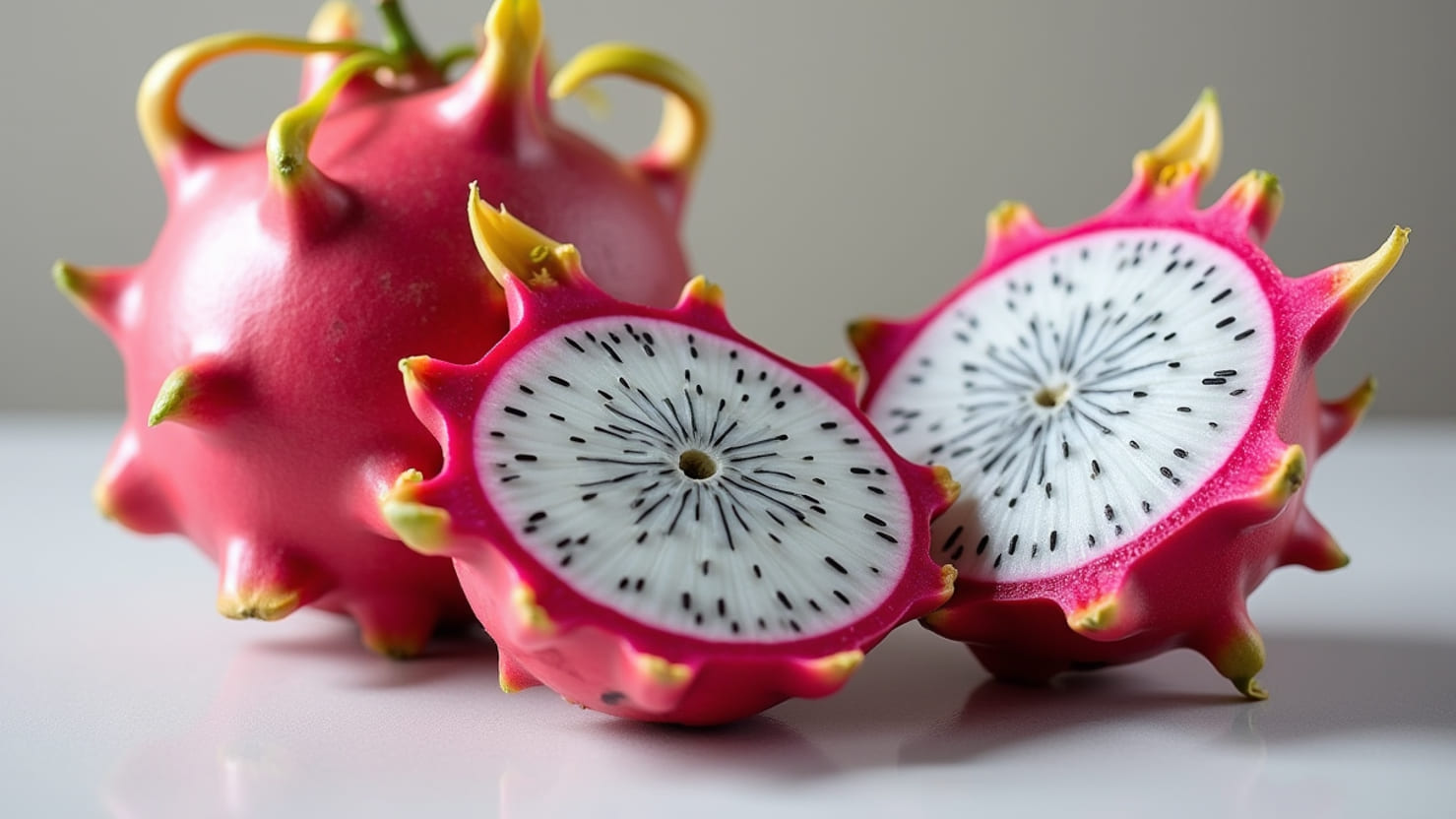
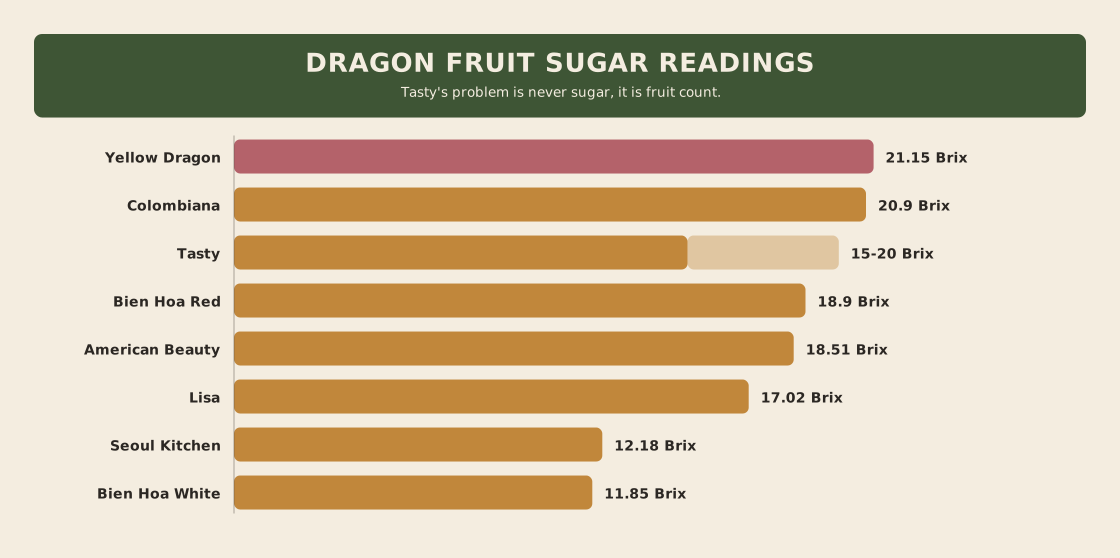
Tasty dragon fruit is the most flavorful clone we grow, scoring a perfect five out of five on our taste card. This selection of Selenicereus setaceus, also known as Baby Cerrado or Sweet-21, delivers sugar levels between 15 and 20 Brix depending on plant age and ripeness. That puts it at the very top of what pitaya can achieve, far above the faint sweetness of most supermarket stock. You are growing for flavor rather than volume. The fruit is small, with translucent white flesh and a velvety maroon skin that develops bright pink spines. It roots readily from green cuttings. If you want a dessert-grade harvest, pick the fruit at full color with a slight give.
What Tasty actually is: a Cerrado pitaya, not the supermarket white
Most dragon fruit sold in grocery stores is Hylocereus undatus, a species with scalloped stem margins and spineless fruit walls. Tasty is a different animal entirely. It is a selection of Selenicereus setaceus, a cactus native to the Brazilian Cerrado. Botanists sometimes still use the synonym Hylocereus setaceus, but the genus was merged based on chromosome evidence, so the names refer to the same plant.[1] If you see "Baby Cerrado" or "Sweet-21" on a listing, it is the same clone we sell.[8]
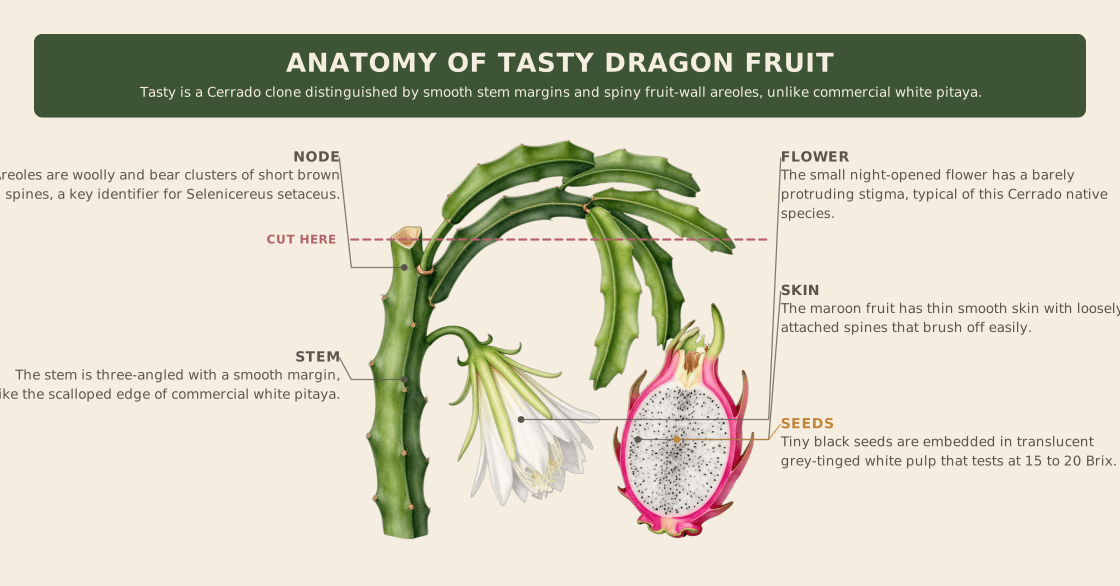
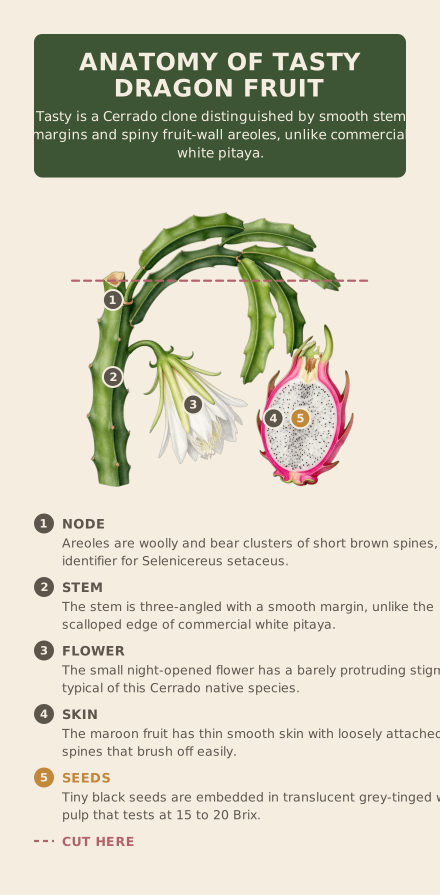
The supermarket fruit is bred for shelf life and volume, often picked early at 8.7 to 13.7 Brix. Tasty is a wild-collected South American native, sourced from a grower in the region rather than a domestic breeding program.[8] It grows naturally on rocky outcrops and tree trunks in states like Minas Gerais and Bahia.[8] You can tell the species apart from the commercial white pitaya by looking at the stem: Tasty has a smooth stem-margin edge, whereas Hylocereus undatus has a scalloped one.[10] The fruit wall also differs; Tasty has spiny areoles, while the common white variety is spineless.[10]
Because it is a distinct species, Tasty behaves differently in the garden and on the plate. It is not just a sweeter version of the white dragon fruit; it is a different botanical entity with its own growth habits and flavor profile. The peer-reviewed literature identifies it as a Cactaceae with strong potential in the fruit market, precisely because it offers something the standard commercial varieties do not.[6]
What it tastes like, and why the number is not the whole story
Most growers obsess over Brix, but that single number is a blunt instrument. Sweetness in pitaya is actually a tug-of-war between sugar and acid. The pulp is loaded with glucose and fructose, but it also contains malic acid, and the balance between the two determines how the fruit hits your palate. Within a single species, harvest acid levels can swing wildly, from 0.15 to 1.47 g per 100 g. This creates ripening index values ranging from 9 to 58, even when fruit is picked at what looks like the same stage. [2]
This variability explains why two fruits from the same plant can taste different. A high Brix reading does not guarantee a dessert-like experience if the acid content is also high. Conversely, a fruit with moderate sugar can taste incredibly sweet if the acid is low. The dominant sugars provide the body of the flavor, while the malic acid provides the brightness. If the acid is too high, the fruit tastes sharp or tart, masking the sugar. If the acid is too low, the fruit can taste flat or cloying, even if the sugar content is technically high.
The ripening index matters more than raw Brix
Because acid levels vary so much, researchers recommend using a soluble-solids to titratable-acid ratio as the true harvest index. A ratio of 40 is often cited as the target for optimal eating quality. This means you are looking for a specific balance, not just maximum sugar. A fruit with 18 Brix and low acid will taste sweeter than a fruit with 20 Brix and high acid. This is why relying on a refractometer alone can be misleading.
Color also plays tricks on your brain. In blind sensory trials, panelists rated flavors differently when they could see the flesh color compared to when they could not. Appearance biases how good a fruit seems before it reaches your tongue. A deep red fruit might be perceived as sweeter or more intense simply because of its color, even if the actual sugar content is lower. Tasty has translucent white flesh, so it does not benefit from this visual bias. You have to rely on the actual taste profile, which is where its high sugar-to-acid ratio shines.
Storage conditions further complicate the flavor picture. Dragon fruit degrades quickly after harvest. Even at optimal storage temperatures, the fruit loses weight, softens, and sheds soluble solids, monosaccharides, and malic acid. Chilling injury can cause discoloration and a loss of both sugars and acid. This means that a fruit that tested at 18 Brix on the plant might test lower after a few days in the fridge. The flavor you paid for is partly spent in the refrigerator, so eating fresh is always best.
| Factor | Impact on Perceived Sweetness |
|---|---|
| Malic Acid Level | High acid masks sugar; low acid enhances perceived sweetness |
| Glucose/Fructose Ratio | Fructose is sweeter than glucose; ratio affects flavor profile |
| Flesh Color | Visual bias can make red flesh seem sweeter than white |
| Storage Time | Sugars and acids degrade over time, flattening flavor |
Small, spiny and early: what the plant does in the garden
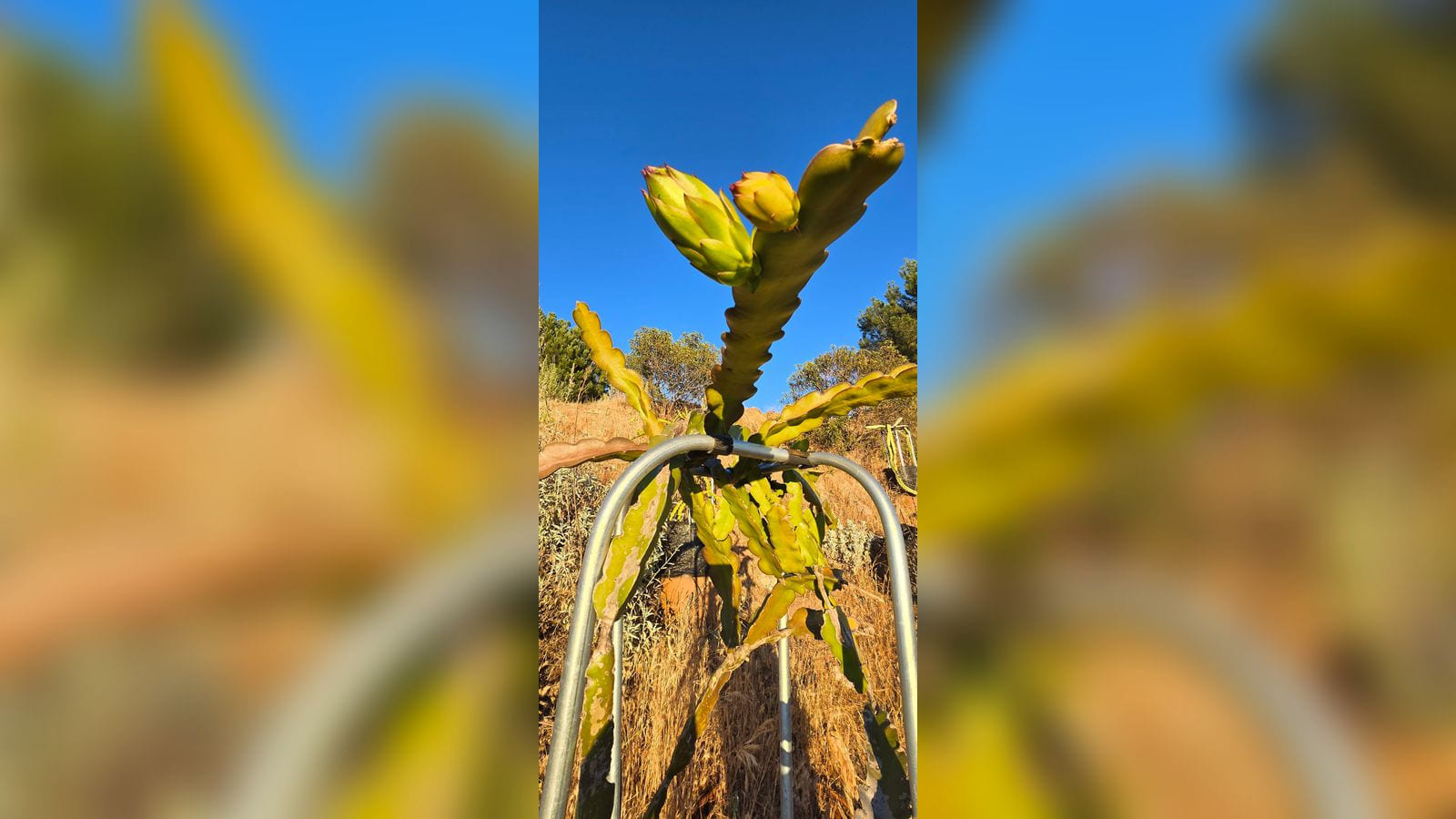
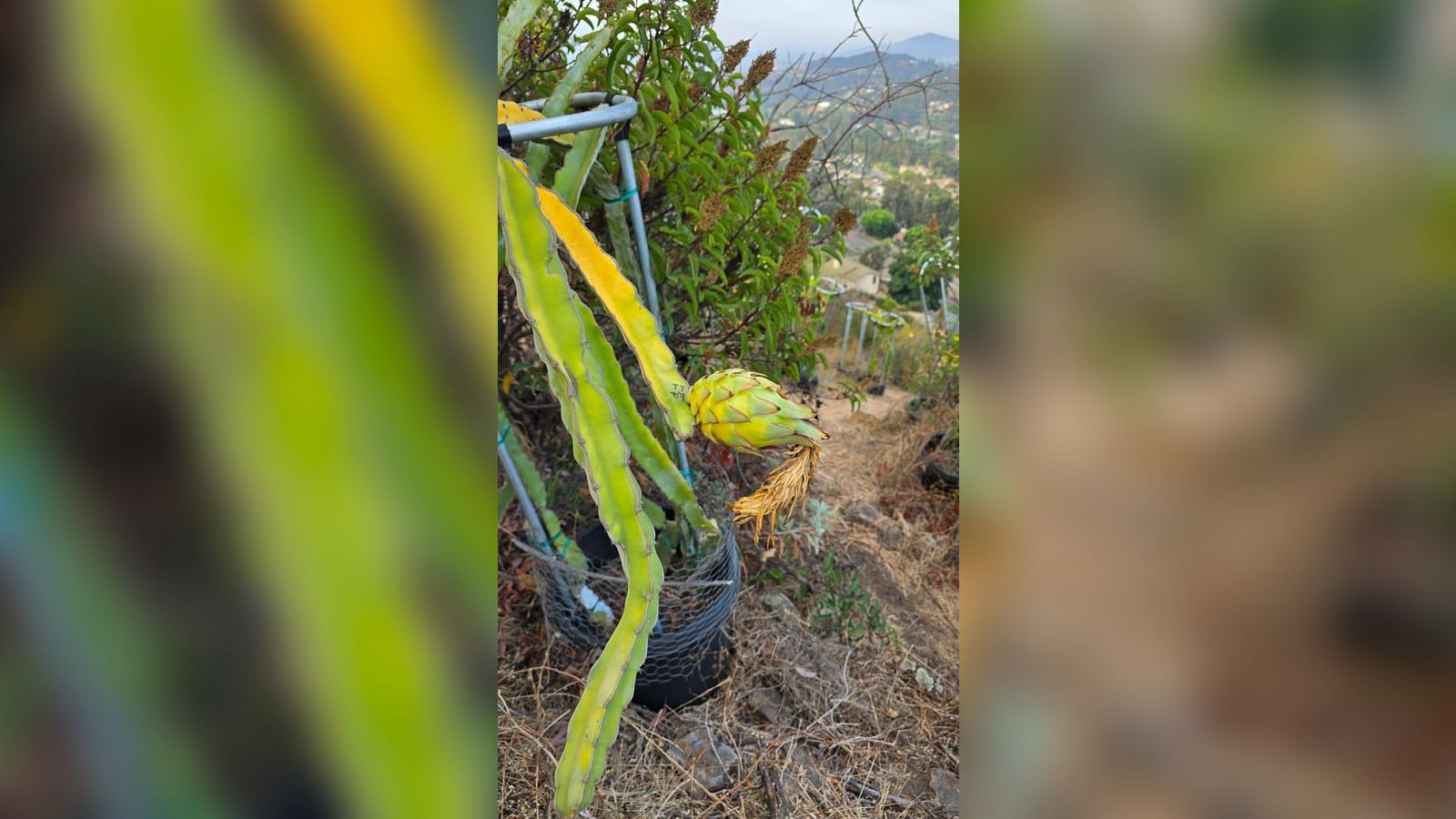
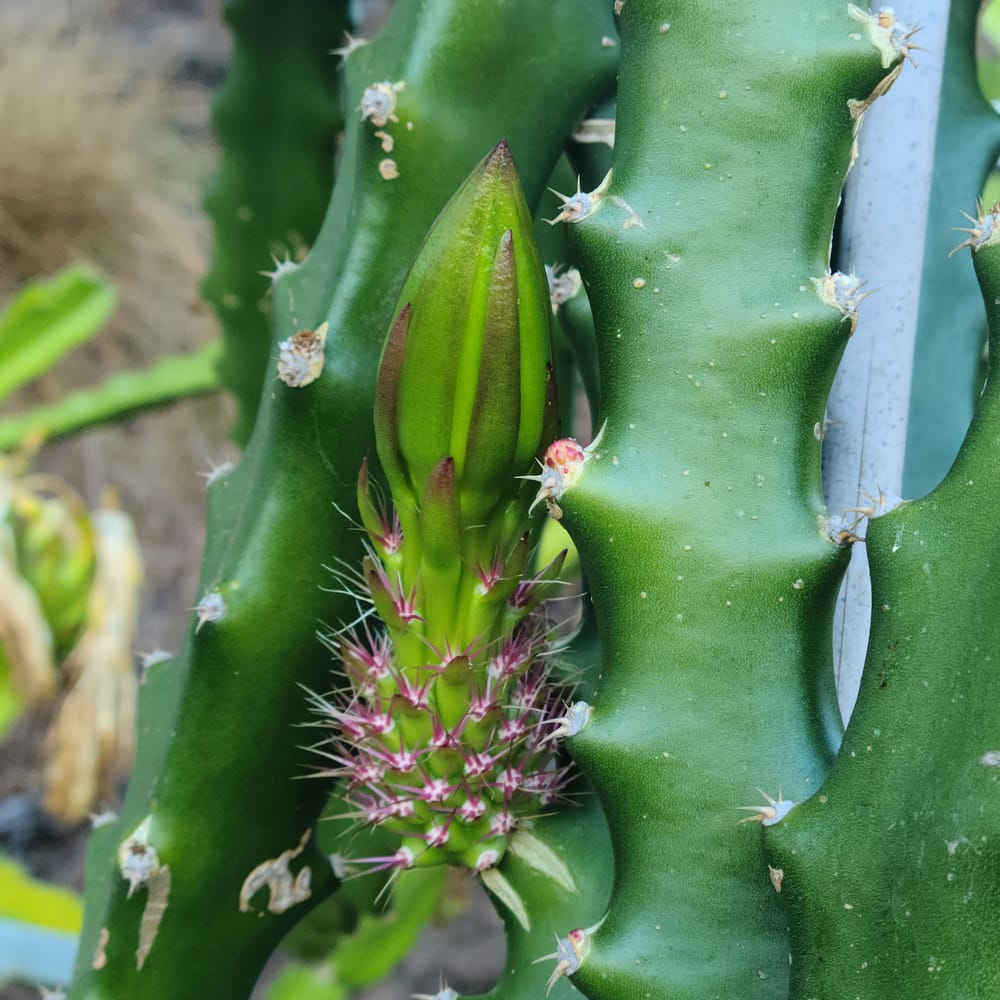
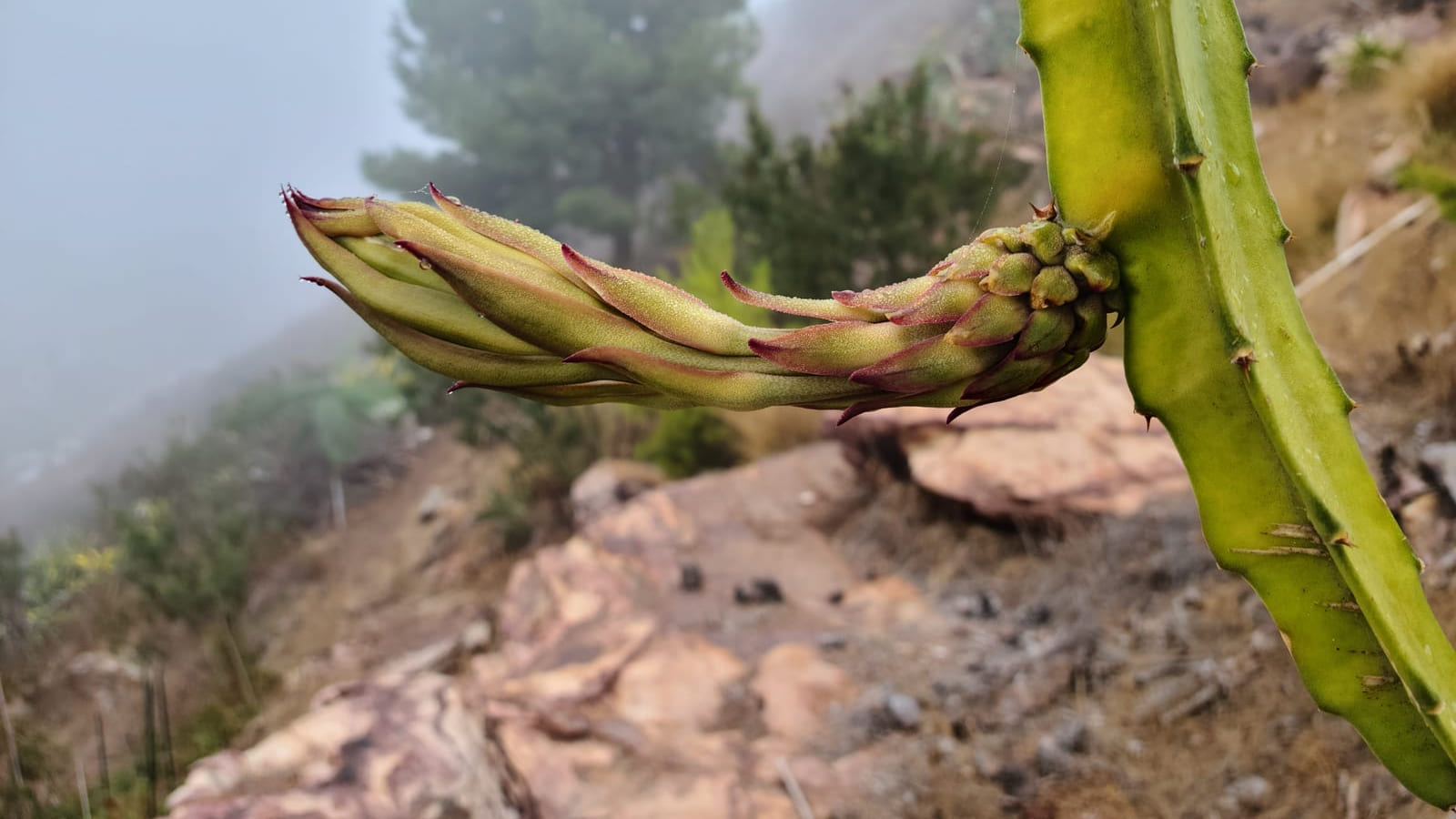
Tasty is a compact, armoured plant. The branches are skinny and chunky, covered in sets of spines that demand care when you are pruning or training the stems.[8] You will notice the buds first. They start as fuzzy buttons, but that fuzz is actually soft spines.[8] As the flower develops, it remains one of the smallest in many collections, with a stigma that barely protrudes from the bloom.[8]
The fruit is small, even by the standards of its own species, so you are growing for quality rather than volume.[8] Flowers open after sunset and fade by sunrise, releasing a sweet pollen aroma while they are open.[8]
The nectar strategy explains why this plant behaves differently than the large-flowered hybrids. The nectar is rich but small in volume. Studies on the species measured nectar at 28.3 percent sugar with an average volume of 133 microlitres per flower.[4] This is a rich small-reward strategy. It is consistent with a bee-pollinated cactus rather than a bat-pollinated one.[4]
You are managing a plant that invests in flavor density rather than size. The spines on the fruit wall are not just a defense; they are part of the plant’s identity. When the fruit ripens, the skin turns a deep velvety maroon red, and the spines turn bright pink.[11] These spines brush off loosely at harvest, but they are a reminder that you are handling a wild-type cactus, not a domesticated hybrid.
Watch the buds. The fuzzy appearance of young Tasty buds is soft spines, not mold or pests. Do not wash them off or prune them away in panic. They are part of the flower’s structure.
The plant’s compact nature makes it easier to manage in a small space, but the spines require attention. Wear gloves when you are tying stems or inspecting flowers. The small flower size means you need to look closely to see the stigma. If you are hand-pollinating, a small brush is essential. The flower’s brief window means you need to be ready at dawn or dusk. This is a plant for the gardener who appreciates detail. The yield is modest, but the process of watching the small, spiny buds open into tiny, aromatic flowers is rewarding in itself. The fruit is small, but the flavor is intense. You are trading volume for quality, and the plant’s architecture reflects that choice.
Pollination: the honest answer, including where sources disagree
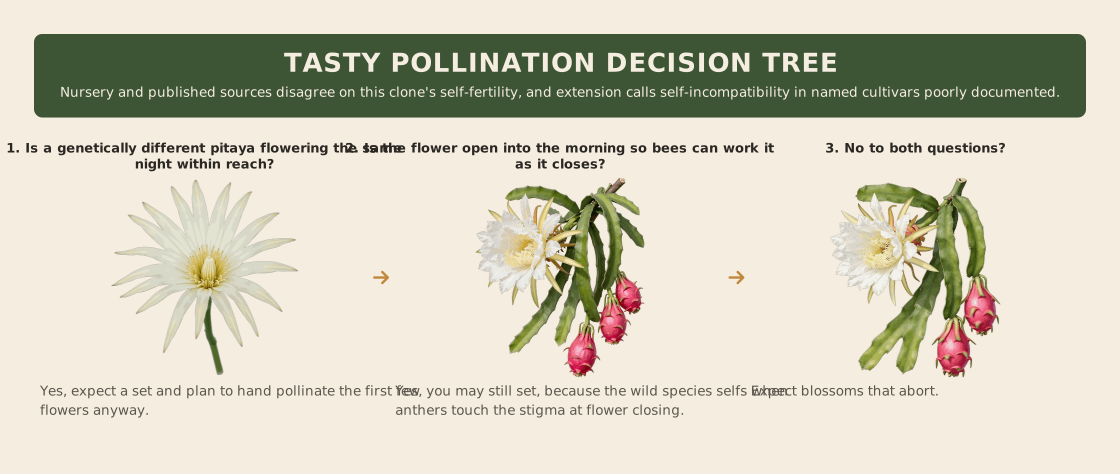
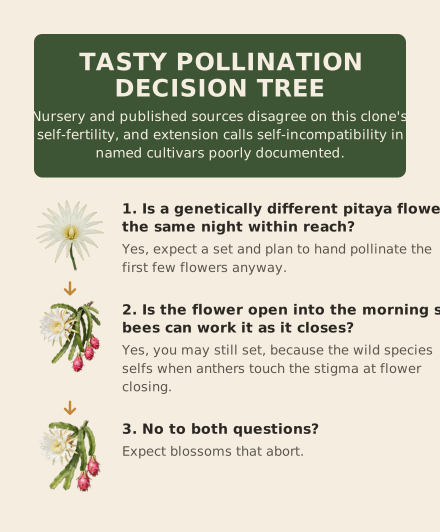
You should plan on hand pollination. Extension guidance is blunt that pollination management still pays, noting that self-incompatibility is documented in several nursery cultivars and that moth and bat pollination has not commonly been observed.[3] The reliable option is to transfer pollen yourself in the night or early morning.
But the science on Tasty specifically is more nuanced than the standard advice suggests. While many commercial pitayas are self-incompatible, exclusion experiments on wild populations of the species in southeastern Brazil found them to be self-compatible.[6] These plants set fruit with manual or spontaneous self-pollination when anthers touched the stigma lobes as the flower closed. The main pollinator in those studies was the honeybee, not a bat or a sphingid moth, with most visitation happening while the flower was closing between 5am and 10am.[4]
We still recommend hand pollination because self-incompatibility in commercially available pitaya cultivars and selections is poorly documented, which makes variety recommendations unreliable at best.[3] Many named selections are wild collections rather than tested breeding lines. You cannot assume your specific clone behaves exactly like the wild population studied in Brazil. If you want to guarantee a set, you control the variable.
The best strategy is redundancy. Plant two or three different genetic types rather than clones of one variety.[3] This hedges your bets against self-incompatibility and ensures you have compatible pollen on hand. A bee-friendly garden does part of the work, as UC ANR trials reported that most selections set fruit with no hand pollination because bees and other insects visited the flowers.[7] But relying solely on insects is a gamble. Hand pollination removes the guesswork.
If you are unsure about your specific mix of varieties, our guide on which dragon fruit varieties need a pollination partner breaks down the compatibility issues further. For Tasty, treat it as potentially self-incompatible until proven otherwise. Hand pollinate, and you will not be left wondering why the flowers dropped.
Getting fruit that is actually sweet: the 25 to 38 day window
You cannot wait for a dragon fruit to ripen on your counter. It is a non-climacteric fruit, meaning it stops developing sugar and flavor the moment you cut it from the stem. A fruit picked green and bland will stay green and bland in your kitchen for a week. To get the dessert-grade experience Tasty promises, you have to pick it at the peak of its life on the plant. This requires watching the calendar and the skin, not just guessing based on size.
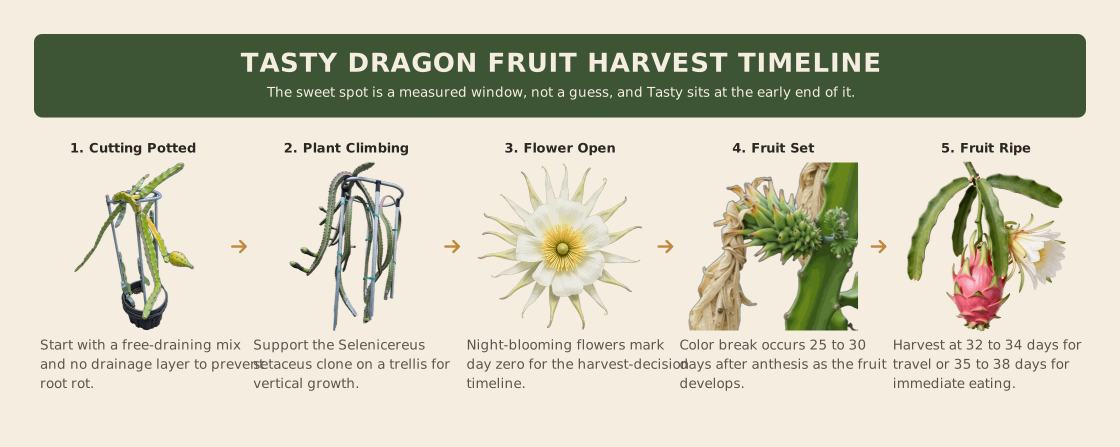
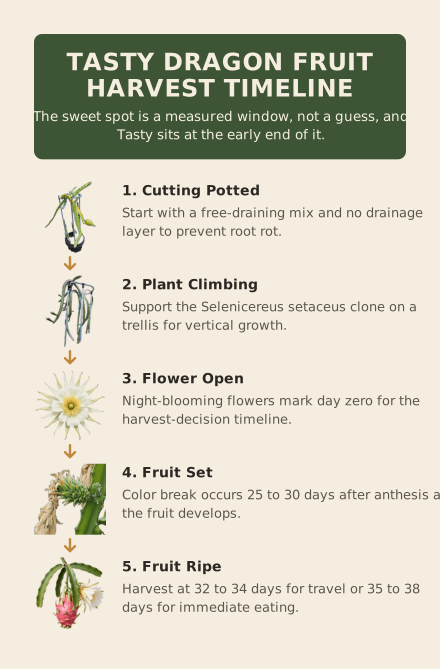
Harvest timing is measurable rather than guesswork. Color break typically arrives 25 to 30 days after flowering. The pulp changes color 3 to 5 days before the peel does, and maximal coloration comes 4 to 5 days after that shift. A fruit at full color with a slight give is a ripe fruit, not a lucky one[5]. For fruit eaten locally, optimum harvest sits at 35 to 38 days after anthesis. If you need to transport the fruit, pick it slightly earlier, between 32 and 34 days[5].
Do not wait too long. Delaying harvest beyond maturity causes fruit splitting, a decline in soluble solids, water-soaked translucent flesh, and off-odors[5]. The window for peak sweetness is narrow. Once the fruit passes full color and begins to soften excessively, the sugar content drops and the texture degrades.
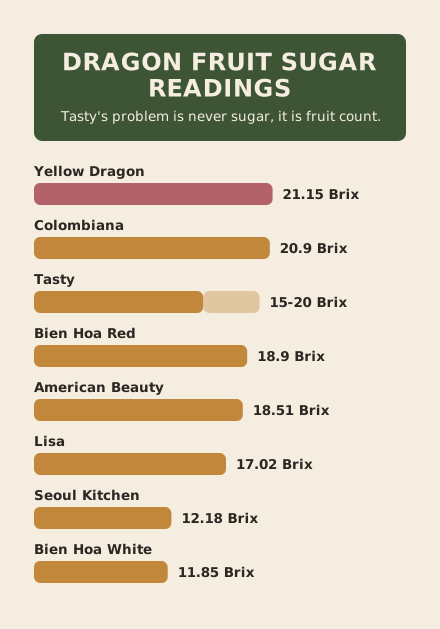
The specialist nursery that distributes this clone reports fruit testing at an average of 18 Brix, with years two and three even better at a rating above 20 Brix. They describe the flavor as sweet with hints of tropical fruit, calling it one of the top dragon fruits they grow[8]. This high sugar content is fragile. If you pick early, you miss the peak. If you pick late, the fruit splits and loses quality. The 25 to 38 day window is the critical window for peak sweetness.
| Days After Flowering | Visual Cue | Action |
|---|---|---|
| 25-30 | Color break begins | Wait. Do not pick. |
| 32-34 | Full color, firm skin | Pick if shipping or storing. |
| 35-38 | Full color, slight give | Pick for immediate eating. |
| 39+ | Splitting, soft spots | Too late. Quality declines. |
In a UC ANR trial, the cultivars a blind sensory panel rated highest in flavor were Bien Hoa Red, American Beauty, Physical Graffiti, Sin Espinas and Lisa. However, the panel's flavor preferences shifted when panelists could see the flesh color[7]. With Tasty, the translucent white flesh might not look as impressive as deep red varieties, but the sugar content is real. Trust the timing and the texture, not just the visual drama of the skin.
Remember that sweetness is a balance. Researchers recommend using a soluble-solids to titratable-acid ratio as the true harvest index, with a ratio of 40 often cited as the target for optimal eating quality. Picking within the 35 to 38 day window helps ensure the acid levels have dropped enough to let the sugar shine. If you pick too early, the acid remains high, masking the sweetness you paid for.
Growing Tasty: the spec sheet
Tasty is a vigorous grower that rewards attention with exceptional flavor. It is not a vine that will smother your yard in volume. The plant’s behavior is defined by its origin in the Brazilian Cerrado, a savanna ecosystem that dictates specific needs for light, temperature, and structure. These parameters determine whether you get a struggling cutting or a reliable dessert producer.
Temperature and light tolerance
Tasty is more forgiving than many tropical pitayas because it has the most southerly natural range in its genus, extending into regions with cooler nights than the Mexican and Central American centers of diversity for other species.[4] This geographic outlier status translates to a plant that handles backyard temperature swings better than showy yellow types. However, it is still a cactus from a warm climate. Growth peaks between 65 and 77°F, and the plant suffers injury if exposed to prolonged temperatures below 31°F or above 100°F.[3]
Light management is critical in the establishment phase. For the first three to four months after planting, provide about 30 percent shade to prevent sunscald on the tender new stems.[3] After this initial hardening-off period, move the plant to full sun. Too much shade beyond the early stage results in low production and poor-quality fruit, as the plant needs intense light to drive the sugar accumulation that defines this variety.[3]
Substrate and potting rules
Because Tasty is a cactus, its root system is adapted to fast-draining conditions. When potting, resist the urge to add a layer of gravel, stones, or pot shards to the bottom of the container. Instead, fill the pot with a single, free-draining mix all the way down and ensure the container has a functional drainage hole.
For cuttings, the rooting environment matters as much as the mix composition. Trials show that peat combined with expanded perlite produces more roots and longer roots than peat with carbonized pine bark, particularly when cuttings are taken in spring.[6] Avoid taking cuttings in autumn, as they often fail to sprout under those conditions.[6]
Structural management for yield
Yield in Tasty is not just about how many flowers you get; it is about how you manage the plant’s architecture. As a cactus, the plant’s productivity is tied to stem health. Mature plantings are managed by selectively removing stems to keep the remaining ones vigorous and to induce flowering.[3] A well-managed planting of three- to four-year-old plants can carry significant weight, with production measured in hundreds of pounds per year across a whole planting, though individual fruit remain small.[3]
Compared to red-fleshed cultivars, Tasty has a fruit yield rating of 3 out of 5, meaning you are growing for intensity rather than bulk.[9] This is consistent with its wild ancestry, where it evolved to produce fewer, higher-sugar fruits on rocky outcrops and tree trunks rather than the massive clusters seen in commercial white pitayas.[8]
Pruning note: When pruning, focus on removing old, corked stems. Adventitious roots do not form on stems where periderm has replaced the epidermis, so these older segments are less useful for propagation and can drain energy from the vigorous green growth that produces the best fruit.[6]
Cuttings: why Tasty is sold as a stem, not a seed
You buy a cutting because you want the exact flavor profile described in the nursery notes. Dragon fruit grown from seed is a genetic lottery. A seedling can take as long as seven years to bear fruit, and the resulting plant is a unique individual that may not resemble its parents.[3] In contrast, a cutting is a clone. It carries the precise genetic code of the mother plant, ensuring that the high-sugar, low-acid balance you are paying for is preserved in your garden.
The speed difference is dramatic. Once a cutting establishes a root system, it grows fast, sometimes adding about 1.2 inches of stem per day.[3] Many cuttings produce their first fruit six to nine months after planting.[3] Named clones like Tasty are always propagated vegetatively because waiting seven years for a seedling that might taste mediocre is a poor trade-off when a clone can deliver dessert-grade fruit in less than a year.
Choosing the right stem segment
Not every piece of stem will root. The anatomy of the cactus dictates success. Adventitious roots form easily in green, youthful tissue because the internal structure allows roots to cross the interfascicular cambium and cortical bundles without blockage.[6] The pith and cortex are rich in mucilage and starch, providing the water and energy needed during the rooting phase.[6]
However, there is a hard limit. If you take a cutting from an old, grey, corked stem, it will likely fail. Once the periderm replaces the epidermis, the plant loses the ability to form adventitious roots at all.[6] Stick to segments that are still green and flexible. Standard practice recommends whole stem segments 6 to 15 inches long, with a slanted cut at the base to maximize surface area for root initiation.[3]
Timing and substrate matter
When you take the cutting is as important as what you take. Replicated trials show that cuttings prepared in autumn often fail to sprout, leading researchers to recommend against autumn propagation.[6] Spring is the preferred season. In those trials, peat mixed with expanded perlite produced more roots and longer roots than peat mixed with carbonized pine bark.[6]
Rooting expectation: After curing and planting, expect 4 to 6 months in a pot to develop a good root system before transplanting to the garden or a larger container.[3]
Before planting, the cutting must be prepared correctly. Treat the cut surface with fungicide and cure it for 7 to 8 days in a dry, shady place.[3] This callusing period prevents rot when the stem is finally placed in moist media. Once planted, keep the mix consistently moist but not waterlogged. A free-draining mix is essential.
Should you buy it
Deciding to grow Tasty is a decision to prioritize flavor over volume. Our internal rating card scores this clone a perfect five out of five for taste, but only a three out of five for fruit yield[9]. If your goal is a heavy harvest of large, commercial-grade fruit, this is the wrong plant for you. If your goal is a dessert-grade snack that you can eat straight off the stem, it is one of the best options available.
Compared to the red-fleshed cultivars measured in the UC ANR San Diego trial, varieties like American Beauty and Bien Hoa Red offer higher sugar levels on much larger fruit, while Tasty delivers high sweetness in a small, spiny package[7]. The trial notes that spiny fruits like Orejona have low commercial potential despite acceptable Brix readings, simply because the spines make handling difficult[7]. You are buying ease of handling and intense flavor, not grams per fruit.
Who should buy Tasty
| Buy if you want... | Skip if you want... |
|---|---|
| Maximum sweetness (15-20 Brix) | High volume harvests |
| Small, manageable plants | Large, showy fruit |
| Fast rooting from cuttings | Seed-grown variability |
| A unique Cerrado species | Standard supermarket types |
Tasty is resilient because the species has the most southerly natural range in its genus, growing wild in the Brazilian Cerrado rather than the tropical zones of Mexico and Central America[4]. This geographic outlier status suggests a more forgiving temper in a backyard planting than the showy yellow types, which often require stricter climate control[4]. It is a tough, adaptable cactus that roots readily from green cuttings[6].
Plan for pollination management. While wild populations are self-compatible, cultivated clones often behave differently. Extension guidance recommends planting two or three different genetic types to ensure fruit set, as self-incompatibility is poorly documented in many named selections[3]. If you buy a single Tasty cutting, you may need to hand-pollinate it or plant a second variety nearby to guarantee a harvest.
References
- Genetic Relationships among Hylocereus and Selenicereus Vine Cacti (Cactaceae): Evidence from Hybridization and Cytological Studies. Annals of Botany 94:527-534, Oxford University Press / Annals of Botany (Gibbs, Barthelemy & Bachelier) (2004).
- Yellow Pitahaya (Selenicereus megalanthus Haw.): The Less Known of the Pitahayas. Foods 14:202 (harvest TSS 8.7-13.7 Brix, on-tree 12-15 Brix, glucose/fructose and malic acid, TA 0.15-1.47 g/100 g, ripening index 9-58, non-climacteric behavior, 10 C and 6 C storage at 85-90% RH, chilling injury, betalain pigments), MDPI Foods (Universidade Miguel Hernandez / ESPOCH); full text https://res.mdpi.com/d_attachment/foods/foods-14-00202/article_deploy/foods-14-00202.pdf (2025).
- Pitaya (Dragonfruit) Growing in the Florida Home Landscape (HS303: climate envelope 65-77 F, injury below 31 F and above 100 F, 30% shade rule, pollination and self-incompatibility documentation gaps, cutting and curing protocol, seedling vs cutting timelines, yield and stem management), UF/IFAS Extension (Crane & Balerdi) (2023).
- Without Moths or Bats, Cacti form Friendships with Bees: Reproductive Biology of the Queen of Night Selenicereus setaceus (Cactaceae) in Sao Thome das Letras, Brazil (self-compatible population, Apis mellifera as main pollinator, nectar 28.3% sugar and 133 uL, southernmost range of the genus), Research Square preprint (indexed in Crossref) (2021).
- Pitaya Fruit Maturity Index Implementation toolkit (25-30 days to color break, pulp preceding peel by 3-5 days, 35-38 DAA domestic and 32-34 DAA distant markets, soluble-solids to acid ratio of 40, over-maturity disorders; attributed to Dr. Chun-Ta Wu, National Taiwan University), APEC Policy Studies Organization horticulture toolkits / National Taiwan University (2020).
- Morphoanatomical aspects of stem cuttings of Selenicereus setaceus (Salm-Dyck) A. Berger ex Werderm. (Cactaceae). Brazilian Journal of Biology 85 (adventitious roots from interfascicular cambium, periderm as rooting barrier, substrate and season effects, 'cerrado pitaya' common name), Brazilian Journal of Biology (SciELO) (2025).
- Pitahaya or Dragon Fruit Variety Evaluation Chart and San Diego County sensory panel results (cultivar Brix scores, days from bloom to harvest, marketable weight per plant, blind and visible flavor rankings; 2013 Pitahaya Production Seminar and Field Day, San Marcos CA), UC ANR / UC Cooperative Extension San Diego County, Small Farm Program (2013).
- Baby Cerrado dragon fruit variety page (Selenicereus setaceus, Cerrado origin and Brazilian states, collection provenance, spiney growth, hairy-button buds, dusk-to-sunrise flowers, self-sterile and requires a pollinator, fruit average 18 Brix rising to 20+ in years two and three, sweet with tropical hints), Spicy Exotics (specialist nursery, distributing grower of this clone) (2025).
- Tasty Dragon Fruit Cutting product listing SKU TY (variety profile scored Taste 5/5, Growth Rate 5/5, Fruit Yield 3/5, combined 13/15; small and large cutting sizes, in stock), Sky Botanicals (own product data) (2026).
- Cactaceae no estado do Parana, Brasil. Rodriguesia 65(1):201-219 (Selenicereus setaceus description, smooth stem margin and spiny pericarp areoles separating it from H. undatus, Cerrado and Atlantic Forest state records), Rodriguesia (Soller, Soffiatti, Calvente & Goldenberg) (2014).
- Baby Cerrado variety page (Selenicereus setaceus cv. Baby Cerrado, self-sterile, mid-season budding, small pointy flowers with barely protruding stigma, lime-green to velvety red spiny fruit, thin smooth skin, translucent grey-tinged slightly slimy white flesh, pear-like tropical flavor), Dragon Fruit Obsession (grower cultivar archive) (2025).