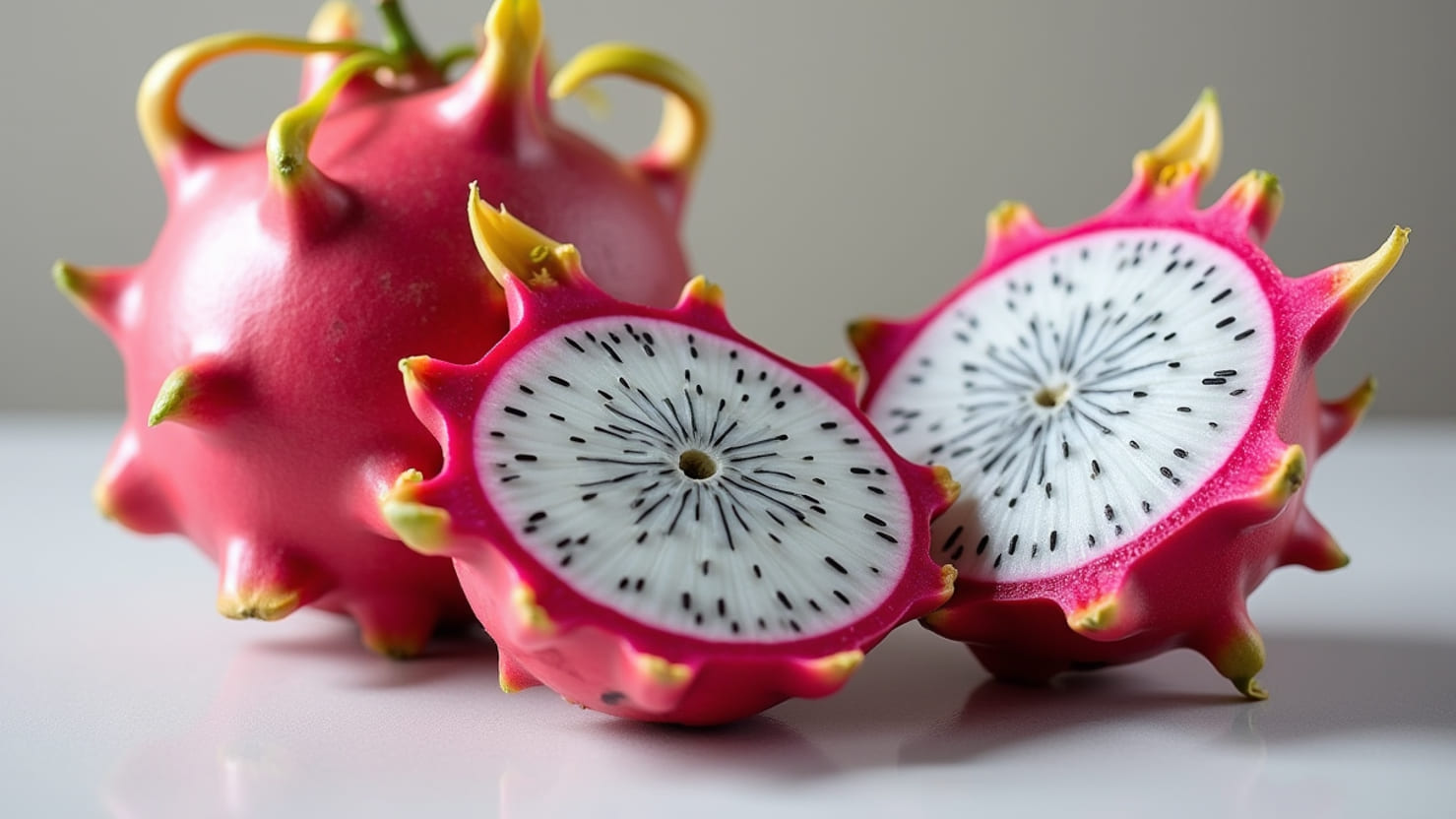
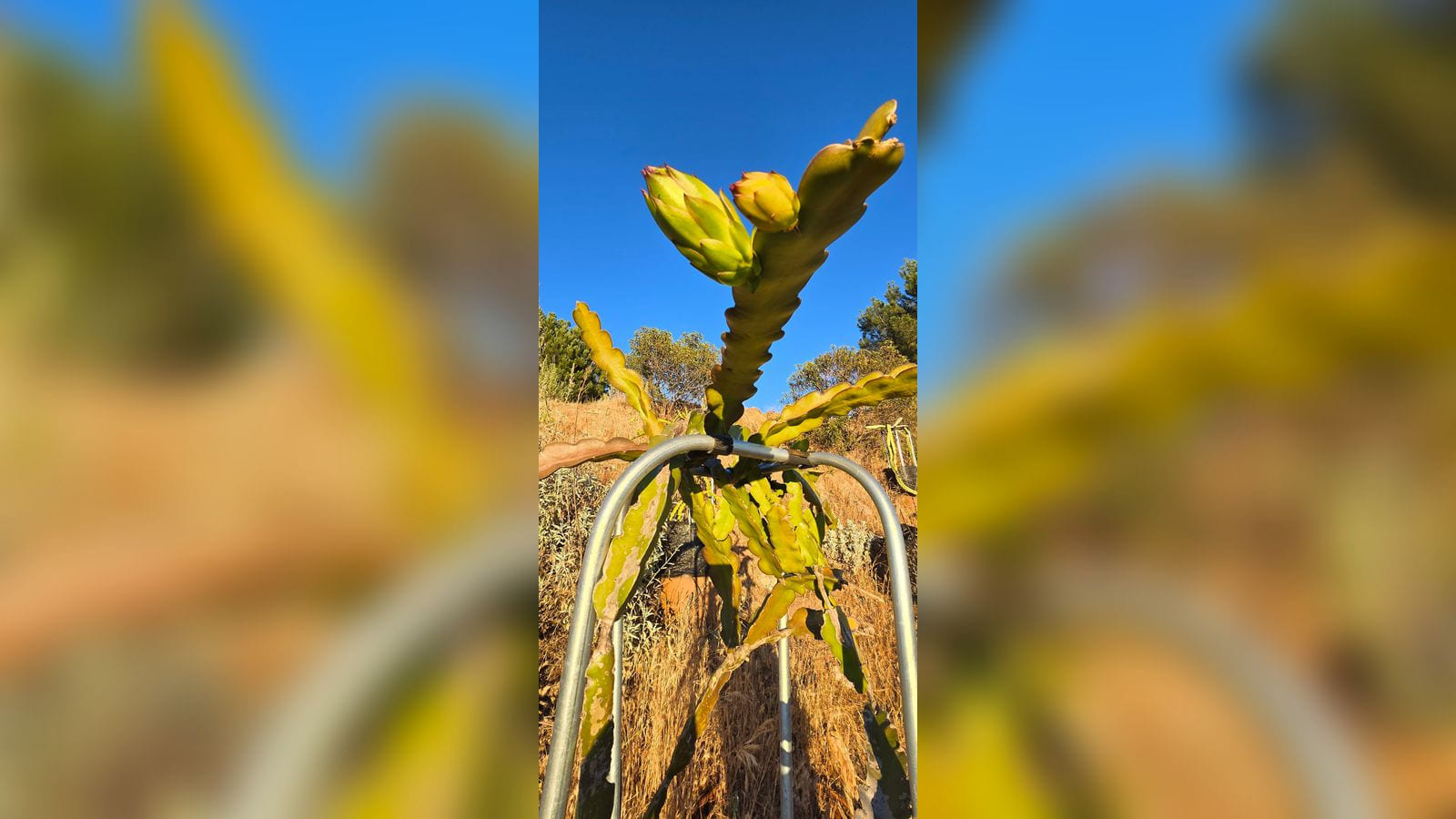
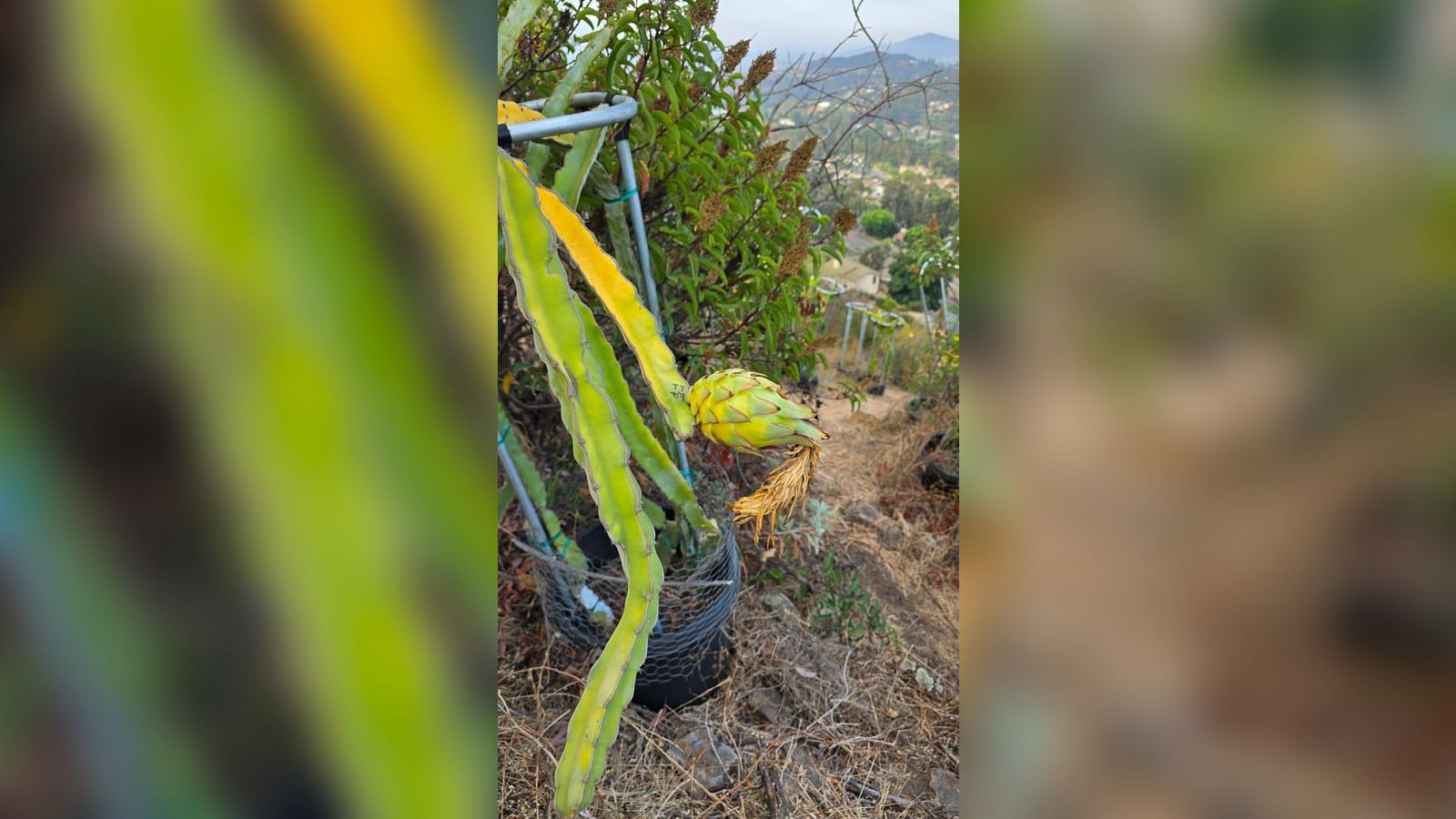
Yellow Dragon vs Palora Dragon Fruit
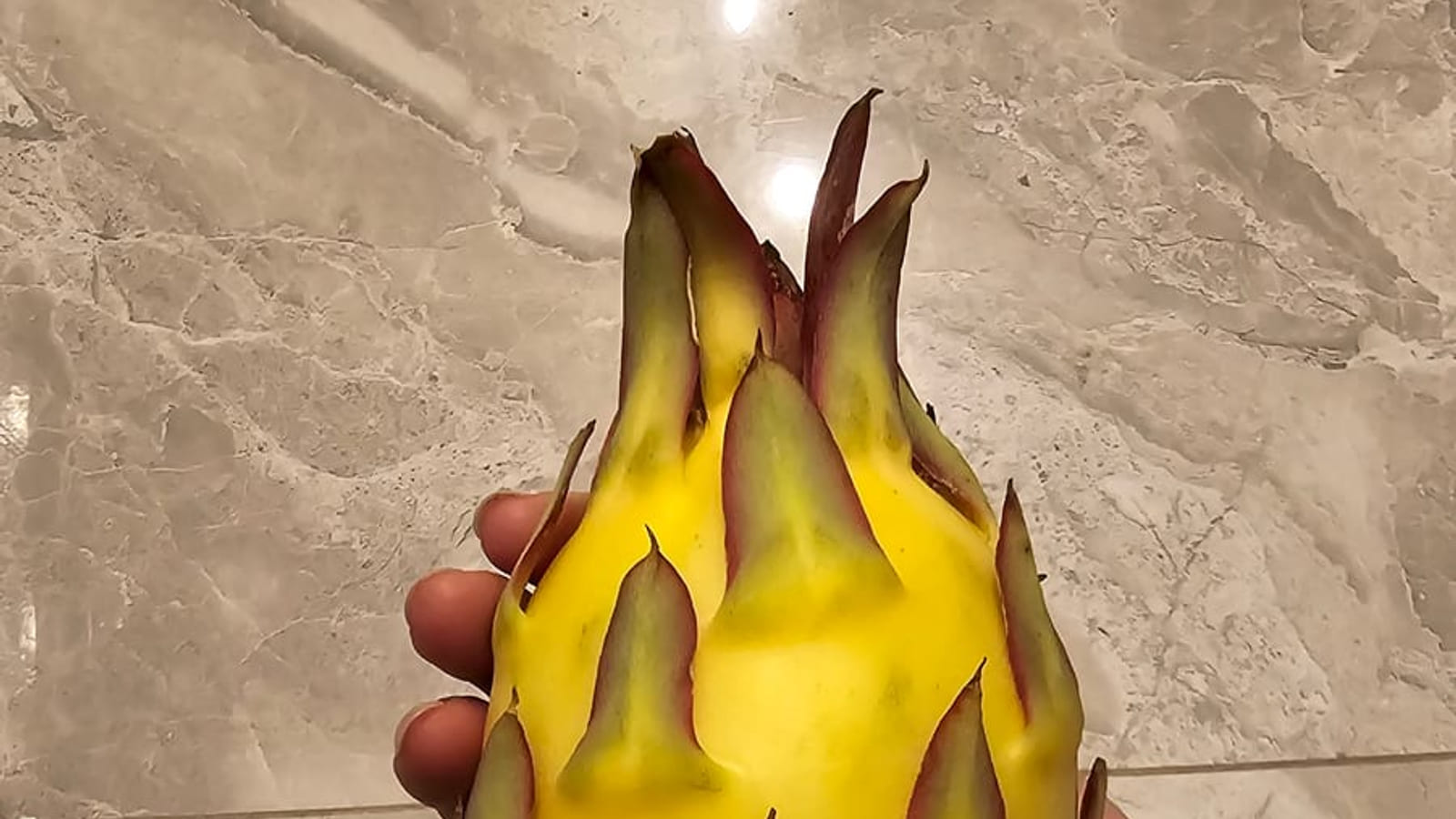
Yellow Dragon and Palora are two distinct clones of Selenicereus megalanthus, the spiny yellow-skinned pitaya from northern South America. Palora is the Ecuadorian commercial ecotype, named for the town of Palora, and is the heavier of the main local types at about 350 g. Yellow Dragon is the Colombian Colombiana selection, smaller at roughly 160 g but noted for high sugar content and recognized in UC trial notes as the best flavoured of all pitahayas. We grow Yellow Dragon Palora at Sky Botanicals. It does not have a shop listing yet, so there is no buy link. If you are curious about the species basics, read our Selenicereus megalanthus growing guide.
Palora And Yellow Dragon Side By Side
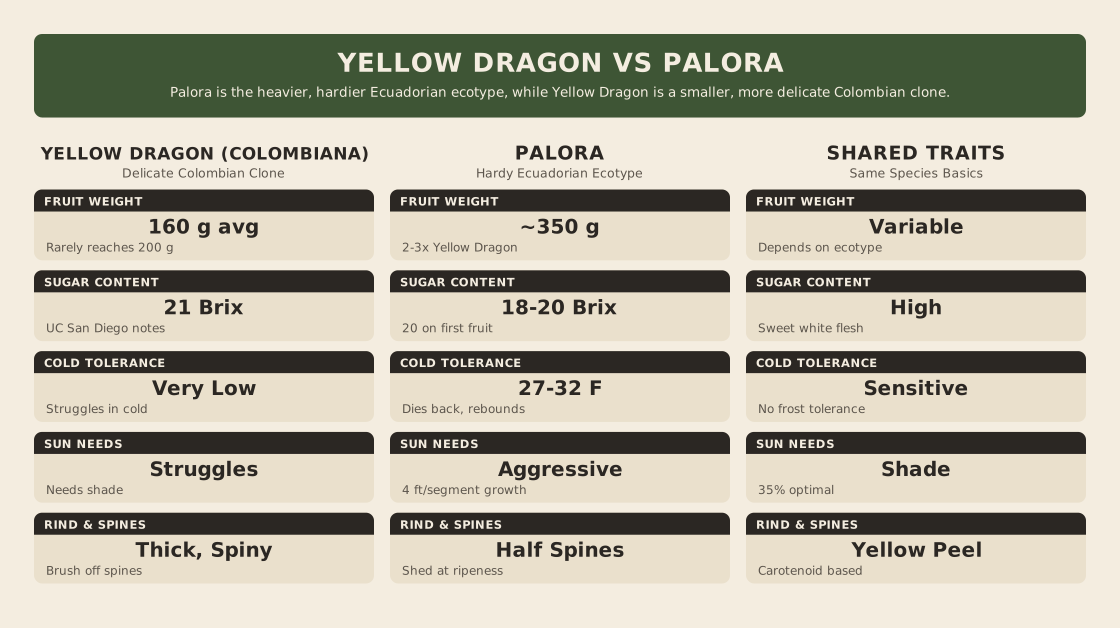
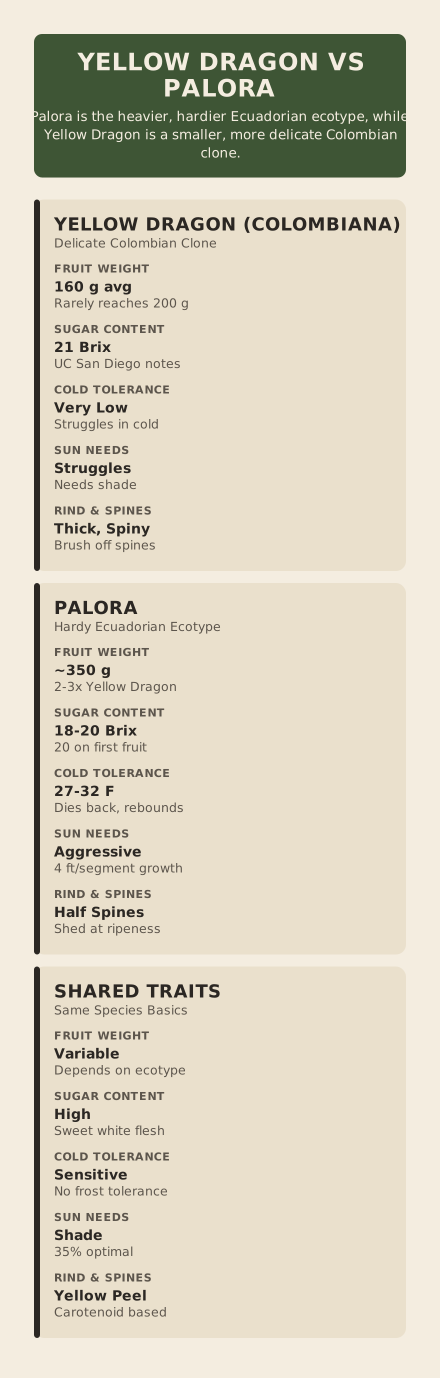
While both clones share the same species, their garden performance differs sharply: Palora acts as a robust commercial workhorse, whereas Yellow Dragon is a delicate, high-flavor specialist. The table below breaks down the practical differences you will encounter on the trellis.
One note on taxonomy: some directories incorrectly file Palora under Selenicereus undatus. This contradicts every other source. Palora is Selenicereus megalanthus. This distinction matters when comparing it to other types, such as when reviewing yellow versus red dragon fruit traits, as the spiny rind and growth habits are unique to the yellow species.
Why The Fruit Takes Half A Year
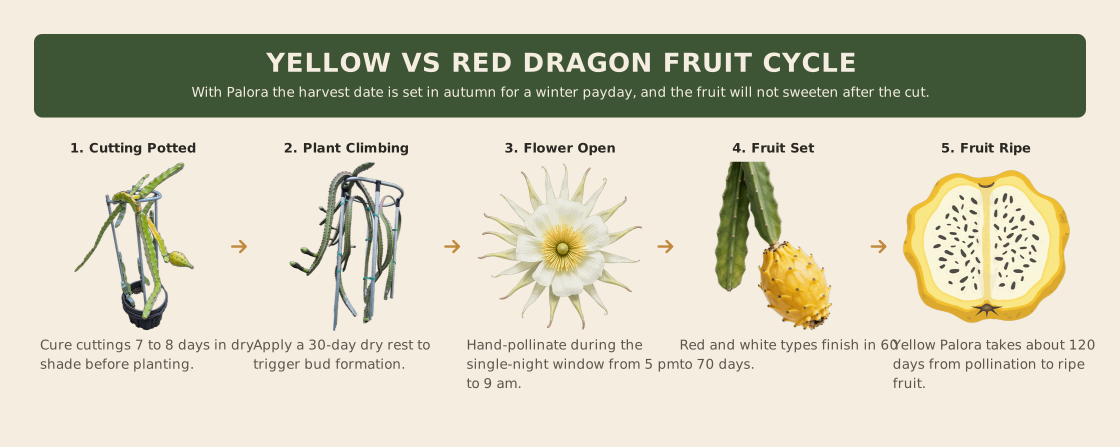
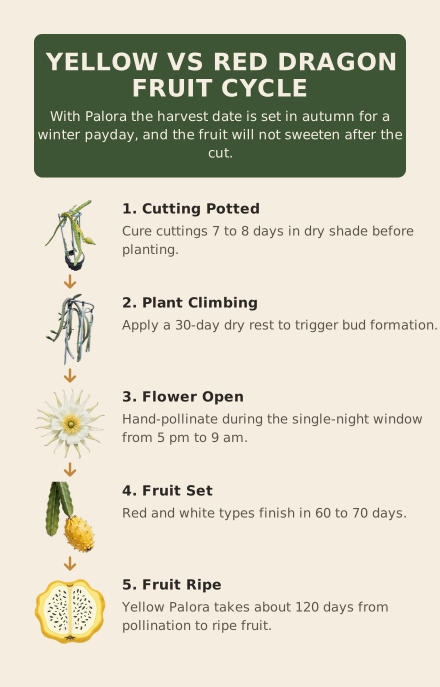
The timeline is the main difference between growing yellow pitahaya and the red or white varieties you might be used to. Yellow pitahaya matures much faster than standard red dragon fruit, but it still operates on a slower clock than many gardeners expect. At Sky Botanicals, we see Palora take about 120 days, roughly 17 weeks, from pollination to ripe fruit. This is significantly longer than the 4 to 8 weeks typical for other species.
Research confirms this extended development period. Yellow pitahaya exhibits sigmoidal growth, requiring about 13 to 14 weeks of development after pollination in summer conditions. In winter, that window stretches to 20 to 22 weeks.[1] UC Cooperative Extension observations in Southern California recorded 150 to 180 days from bloom to harvest for the Colombiana selection, with harvests occurring from November to February.[3] Another commercial profile notes that it can take six months for fruit to ripen once set.[7]
Why wait this long? The payoff is market timing. Because the fruit finishes its cycle in the cool months, it fruits during the off-season for most other dragon fruit varieties. UC notes highlight that this off-season availability is precisely why the commercial potential for Yellow Dragon is considered excellent.[3] You are growing a product that appears when shelves are empty.
Harvest Rule: Non-Climacteric Logic
Yellow pitahaya is non-climacteric. This means it will not sweeten meaningfully after you cut it from the vine. The harvest decision must be made on the plant. If you pick it too early, it stays bland. If you leave it on the vine after it reaches commercial ripeness, it can continue to gain weight for up to about 50 days. However, after that point, turgidity drops fast, and the fruit becomes highly sensitive to handling and climate changes.[1]
Managing this long cycle requires patience and protection. Yellow Dragon is sensitive to both cold and heat and usually struggles in full sun, needing a protected environment to thrive.[3] While Palora is more vigorous and handles stress better, the fundamental physiology of the species remains the same. The fruit is a slow burn, rewarding the grower who understands that speed is not the goal, but rather a high-quality, off-season harvest.
One Night, One Window: Flowering And Pollination
These are among the largest flowers in the cactus family, measuring 32 to 38 cm long[4]. On Palora, growers have measured fully open bells at about 14 inches across[6]. The buds take roughly 40 days to develop into these massive structures[6]. When they finally unfurl, they release a sweet, heavy fragrance that becomes noticeable by around 10 pm[6]. This scent is not just for human enjoyment; it signals the start of a critical, short-lived event.
Palora is self-fertile, but the mechanics of that fertility are specific. The stigma sits buried deep inside its own anthers, a structural trait that guarantees pollen contact without external help[8]. This internal arrangement is the physical signature of self-compatibility. However, you should not treat this as a license to ignore pollination. The window is tight. Flowers open only once, typically from roughly 5 pm to 9 am the next morning[1]. While moths and bats are the natural night pollinators, their visits are rarely observed in home gardens, making hand pollination the reliable method for ensuring set[2].
Do not use Palora pollen on other varieties. Palora is an autotetraploid with 44 chromosomes, while common red dragon fruit (S. undatus) is diploid with 22 chromosomes[5]. This ploidy mismatch means Palora pollen is genetically incompatible for standard cross-pollination. Grower archives specifically warn against using it on other clones unless you are deliberately attempting a hybrid[8].
Even though Palora can set fruit on its own, UF/IFAS still recommends planting two or three different genetic types in your garden[2]. This advice holds true even for self-fertile clones. Cross-pollination between different genetic types generally results in better fruit set and larger fruit size[2]. If you are growing Palora alongside other yellow pitayas, you can hand-pollinate within the same variety to boost yields, but remember that the single-night window is unforgiving. For a detailed walkthrough on how to manage this timing, see our complete pollination guide.
What It Takes To Ripen A Palora Crop
Getting a Palora crop to ripen is less about luck and more about managing a specific set of environmental triggers. Because this clone is a commercial workhorse, it responds predictably to the right conditions. You are managing a long-cycle plant that needs warmth, a dry rest, and careful handling to produce that heavy, sweet fruit. The table below summarizes the critical parameters for a successful harvest.
| Factor | Target / Action | Why It Matters |
|---|---|---|
| Temperature | Keep between 65-77 F. Avoid long exposure below 46.5 F. Damage occurs above 100 F. | Palora is hardy but not indestructible. It can survive brief dips to 27-32 F with dieback, but sustained cold or extreme heat stalls ripening or kills tissue. |
| Sunlight | Full sun for established plants. Use 30-35% shade for young plants or in low-humidity sites. | While Palora is more sun-tolerant than Yellow Dragon, severe stem sunburn can occur in dry, high-altitude air. Too much shade reduces fruit quality.[2] |
| Water | 600-1300 mm/year equivalent. Enforce a hard 30-day dry-down to trigger flowering. Avoid clay soils. | The dry rest is a scheduling tool, not an accident. Waterlogging causes rot; the dry period signals the plant to shift from growth to reproduction. |
| Time to Fruit | 6-9 months from a cured cutting. About 14 months after transplanting. Up to 7 years from seed. | Vegetative propagation is the standard for commercial speed. Seedlings are variable and too slow for most growers.[2] |
| Yield Load | Expect ~220 lb per plant per year at 3-4 years old. Plan for a 20-year productive life. | This is a heavy load. Support structures must be robust enough to handle the weight of multiple ripening fruits simultaneously. |
| Harvest | Wear gloves. Cut the peduncle flush to the fruit. Brush off spines gently. | Palora spines are less aggressive than Yellow Dragon's but still require protection. Cutting flush prevents stem rot and preserves fruit integrity. |
| Storage | Store at 6 C (43 F) with 85-90% humidity. Room temp: 4-5 days. Fridge (bagged): Several weeks. | Yellow pitaya is sensitive to chilling injury. Proper humidity prevents weight loss and peel discoloration during storage.[1] |
Winter Watch: Palora can look terrible after a freeze. A grower in Northern California reported survival at 27 F, while another saw a mother plant die back to the base at 17 F before rebounding the next year. Do not pull the plant out immediately. If the root system is alive, it will push new growth when temperatures stabilize.
The dry-down period is the most critical intervention for timing your crop. If you want fruit in a specific window, you must withhold water for about 30 days. This stress triggers the flowering wave. Once flowers are pollinated, the clock starts. You are managing a four-month commitment per fruit set. During this time, consistent moisture is vital, but never let the roots sit in water. Clay soils are a liability here; raised beds or containers with excellent drainage are safer bets.
Handling the harvest requires attention to detail. The spines on Palora fruit are geometric and shed as the fruit ripens, but they can still prick you. Wear leather gloves and long sleeves. When you cut the fruit, slice the peduncle flush against the fruit surface. Leaving a stub can lead to rot or snagging. After cutting, brush the spines off gently. They should come away easily if the fruit is truly ripe. If they resist, the fruit may have been picked too early.
Storage conditions determine how long you can enjoy the harvest. Yellow pitaya is more sensitive to cold than red varieties. The ideal storage temperature is 6 C (43 F) with high humidity (85-90%). At room temperature, the fruit lasts only 4-5 days. For longer storage, place the fruit in plastic bags in the refrigerator. This can extend shelf life to several weeks, but monitor for chilling injury, which shows up as peel discoloration or weight loss. The goal is to keep the fruit turgid and sweet until you are ready to eat it.
When The Long Crop Fails
You have waited nearly half a year. The fruit is on the vine, but it looks wrong. It might be stalling, dropping off, or ripening into a pale, bland husk. With a crop this long, small errors compound into total loss. You need to diagnose the failure before you blame the variety.
Water and Disease Pressure
Yellow pitahaya adapts to many soils but hates wet feet. Clay ground and overwatering cause root stress that shows up as fruit drop or stalled development. The plant is also vulnerable to specific pathogens when humidity stays high. Stem and fruit canker caused by Neoscytalidium dimidiatum, along with fruit and stem rot from Colletotrichum gloeosporioides and Bipolaris cactivora, thrive in stagnant moisture. The bacterium Xanthomonas campestris adds to the pressure. Pruning for sunlight penetration and air movement helps plants dry quickly after rain, which lowers disease risk.[2]
Yellow Dragon specifically tends to rust when rainfall is excessive. If your fruit is dropping in a wet season, look at your drainage first. A dry rest period is not just a suggestion; it is a scheduling tool. To trigger flowering, water must be cut back hard for about 30 days. Without this dry rest, the flowering wave never lands, and you get no fruit to manage in the first place.[1]
Light and Temperature Stress
Yellow Dragon is a Colombiana-type plant that struggles in full sun. It has low heat tolerance and needs a protected environment. Too much direct sun causes stem sunburn and can stall fruit development. While the species is a cactus, it grows well in shade. Published work shows that 35% shade can give maximum net CO2 absorption and better stem growth. Full desert sun is not automatically optimal for this clone.[1]
Cold is another killer. Winter freeze dieback costs the season but rarely kills the plant. Palora has survived 27 F in Northern California with extended rainfall, but it needs protection once temperatures fall below 30 F or during prolonged wet weather. Yellow Dragon is less forgiving. If a freeze hits, the plant may recover, but the current crop is gone.[2]
Pollination and Set Issues
Even self-fertile stock benefits from cross-pollination. A single-clone planting caps set and fruit size. UF/IFAS advises planting two or three different genetic types rather than clones of one variety. Cross-pollination between different types assures better fruit set and larger fruit. If you only have one clone, you are leaving yield on the table.[2]
Harvest and Post-Harvest Mistakes
The most common cause of bland fruit is an early cut. Yellow pitahaya is non-climacteric. It will not sweeten meaningfully after you cut it. The ripening index (TSS/TA) swings from 9 to 58 depending on the cut point, because acidity collapses far faster than sugar. If you pick too early, the fruit stays bland forever. You must wait for the correct color and texture on the vine.
Storage errors also ruin flavor. Yellow pitahaya is very sensitive to chilling injury. The recommended cold-storage temperature is 6 C at 85 to 90% relative humidity. A domestic fridge often runs colder than this. Exposure to temperatures below 6 C causes weight loss, peel color change, and a loss of sugars and acids. You can undo a good harvest in a few days of improper storage.[1]
Do not refrigerate below 6 C. Chilling injury destroys the sugar profile and texture of yellow pitahaya.
Taste, Sugar And What The Numbers Actually Mean
When you see a Brix reading of 20 for Palora, understand the context. That figure comes from our own refractometer tests on well-ripened fruit harvested at peak quality. It is not a laboratory average across a commercial shipment. Published harvest indices for yellow pitahaya generally report total soluble solids between 8.7 and 12.6 Brix, with titratable acidity ranging from 0.15 to 1.47 g per 100 g[1]. The gap between a mediocre yellow pitaya and an excellent one is rarely about sugar alone. It is about acidity. As the fruit ripens, acidity collapses far faster than sugar accumulates, which causes the ripening index (the ratio of sugar to acid) to swing wildly depending on when the grower cuts the fruit[1]. A fruit picked too early tastes flat and tart; one picked at the right moment tastes intensely sweet because the acid has faded enough to let the sugar shine.
The yellow skin, however, tells a different biological story. Unlike the red and magenta pitayas that rely on betalain pigments, the yellow peel of Palora gets its colour from accumulated carotenoids[1]. The specific carotenoid composition in the peel and pulp is not yet fully characterised in the literature, but the visual result is a bright, uniform yellow that signals ripeness when paired with the right texture cues.
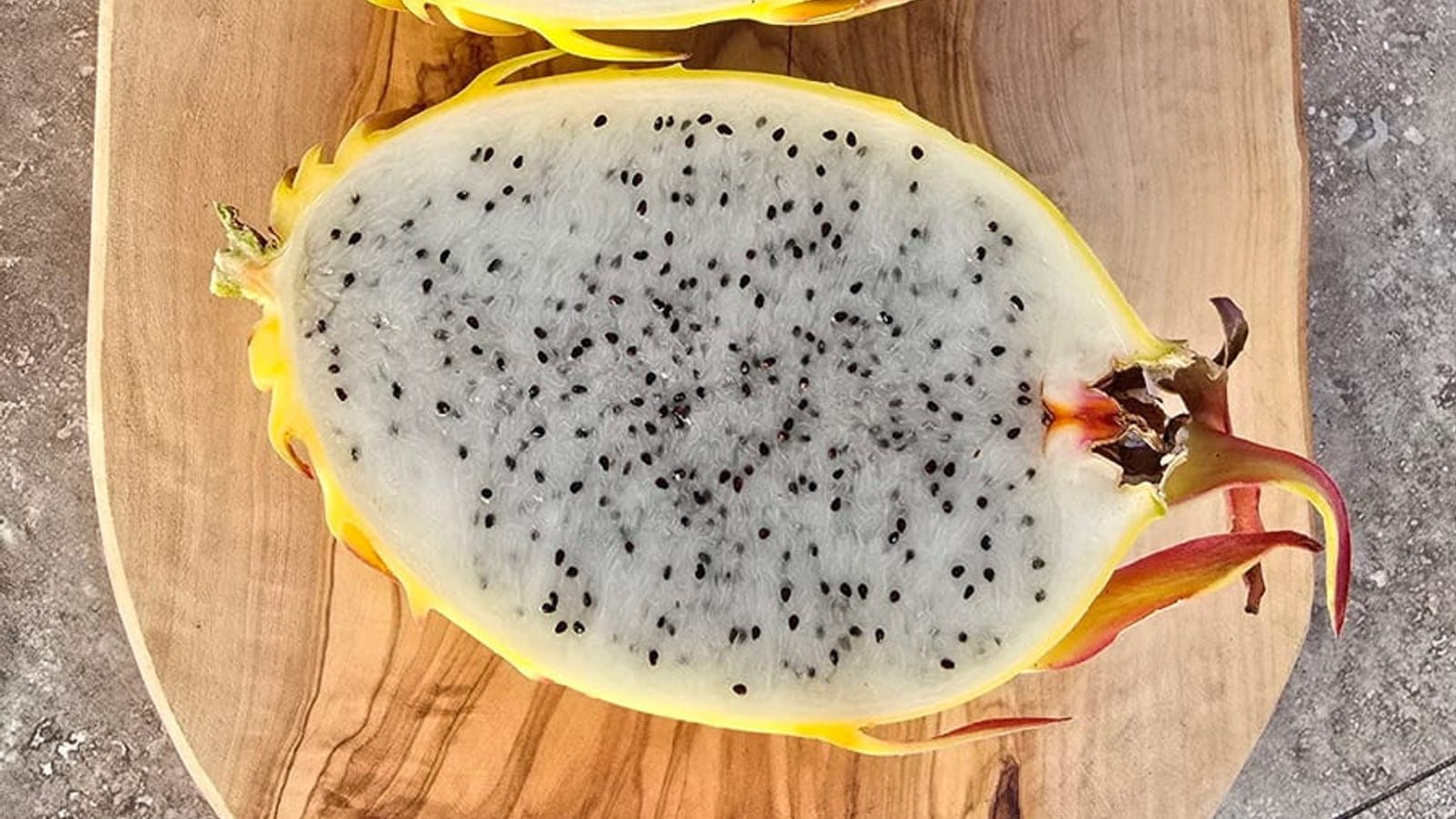
Inside the fruit, the flesh is white with hints of transparency, a trait shared with its sibling clone Yellow Dragon[6]. The eating experience is defined by the seeds. Palora seeds are more substantial and crunchier than those found in other dragon fruit species[6]. This provides a distinct textural contrast to the soft pulp. Be aware that pitaya seed oil acts as a mild laxative, so moderation is wise if you are new to the fruit[2]. The pulp itself is mostly water, with minimal protein or fat, making it a refreshing, low-calorie treat[2].
Our Grading Standard: We evaluate Palora fruit in our own panel, focusing on the balance of sweetness and the crunch of the seeds. Since there is no shop listing for this clone yet, we rely on these internal sensory tests to ensure the cuttings we sell produce fruit that matches the high standards of the parent plant.
Should You Grow Palora?
Growing Palora depends on your patience. You should grow Palora if you want the sweetest white-fleshed fruit on the trellis and you want something that finishes in the cold months when every other white-fleshed neighbour has stopped producing. Palora rewards you with off-season harvests, a feature that makes its commercial potential excellent [3]. But you must accept two realities: the plant will look ragged and ugly in winter, and the fruit takes six months to be worth picking [7]. If you cannot live with a messy trellis in January or a long wait for a single crop, this variety will frustrate you.
Skip Palora if you are looking for your first dragon fruit. Yellow Dragon is difficult for beginners due to its sensitivity to cold and heat and its struggle in full sun [3]. Palora is a more resilient alternative, offering more aggressive growth and better stress handling, but it is still a specialist crop compared to standard red or white varieties [6]. It demands attention to winter protection and a willingness to hand-pollinate during a single-night window. If you want a plant that thrives with minimal intervention, start elsewhere.
What To Grow Instead
If Palora’s timeline or winter behaviour feels like too much work, consider these alternatives we grow at Sky Botanicals. Each offers a different balance of speed, colour, or size.
| Goal | Recommended Variety | Why It Fits |
|---|---|---|
| Red-fleshed speed | Red-fleshed varieties | These types mature much faster than yellow pitayas, avoiding the six-month wait. |
| Colour variety | Various cultivars | Great options if you want visual diversity on the trellis without the spiny rind hassle. |
| Maximum size | Large-fruited varieties | Choose these if you want large fruit volume rather than the specific flavour profile of yellow pitaya. |
| Taste before commitment | Fresh Box | Buy a box of yellow pitaya fruit first. If you do not love the flavour, you will not want to wait six months for a cutting to produce it. |
Palora is a high-reward crop for the experienced grower who values flavour and off-season availability over ease. It is resilient enough to recover from severe cold events, having been recorded surviving 17 F by dying back to the base and rebounding the next year [6]. But that resilience comes with a cost in aesthetics and time. Decide if the sweet, translucent flesh and the ability to harvest when the market is empty are worth the winter mess and the long wait. If they are, Palora is a standout choice. If not, stick to the faster, hardier red or white varieties.
FAQ
How long does it take from flower to fruit? It is a slow process. In Southern California summers, the Colombiana selection (Yellow Dragon) takes 150 to 180 days. In winter conditions, development can stretch to 20 or 22 weeks. A general rule of thumb for growers is to expect a six-month cycle from bloom to harvest. [1]
References
- Yellow Pitahaya (Selenicereus megalanthus Haw.): The Less Known of the Pitahayas (Foods 14:202; review incl. Palora ecotype data), MDPI Foods / PubMed Central PMC11765378 (peer-reviewed) (2025).
- Pitaya (Dragonfruit) Growing in the Florida Home Landscape, HS1068/HS303 (Crane & Balerdi), University of Florida IFAS Extension (2019).
- Dragon fruit variety descriptions including 'Colombiana (Yellow Dragon) (H. megalanthus)': 160 g, 21 Brix, 150-180 days bloom to harvest, November-February harvest, low cold/heat tolerance (captions after Register of New Fruit and Nut Cultivars, HortScience 51(6), 2016), University of California ANR / UC Cooperative Extension San Diego County, Small Farm Program (2017).
- Selenicereus megalanthus (species account: native range, spiny yellow fruit, self-fertile, flowers 32-38 cm, winter minimum 8 C), Wikipedia (secondary; species table and synonyms sourced to POWO/Kew and the cited genome paper) (2026).
- Chromosome-level genome assembly of the autotetraploid yellow pitaya (2n = 4x = 44, 1.79 Gb, 27,246 genes; S. undatus 2n = 22), Genome Biology (peer-reviewed; PMC12326770) (2025).
- Palora - Selenicereus megalanthus product listing (growth, cold history, 14-inch flowers, 40 days bud to flower, half the spines, 2-3x the size, 20 Brix on first fruit), Spicy Exotics (specialist nursery, growing distributor of this clone) (2026).
- Palora Yellow Skin White Flesh product page (self-fertile, commercial in Ecuador, 6 months to ripen once set, ugly-but-resilient in winter), Wallace Ranch Dragon Fruit (2026).
- Palora variety notes (more vigorous and sun-tolerant Yellow Colombiana, wider less wavy branches, paler geometric fruit, stigma buried in anthers, do not use as pollen parent, winter fruiting, honey aftertaste), Dragon Fruit Obsession (long-term grower cultivar archive, Western Australia) (2025).