Cosmic Charlie Dragon Fruit: Sweetness and Parentage
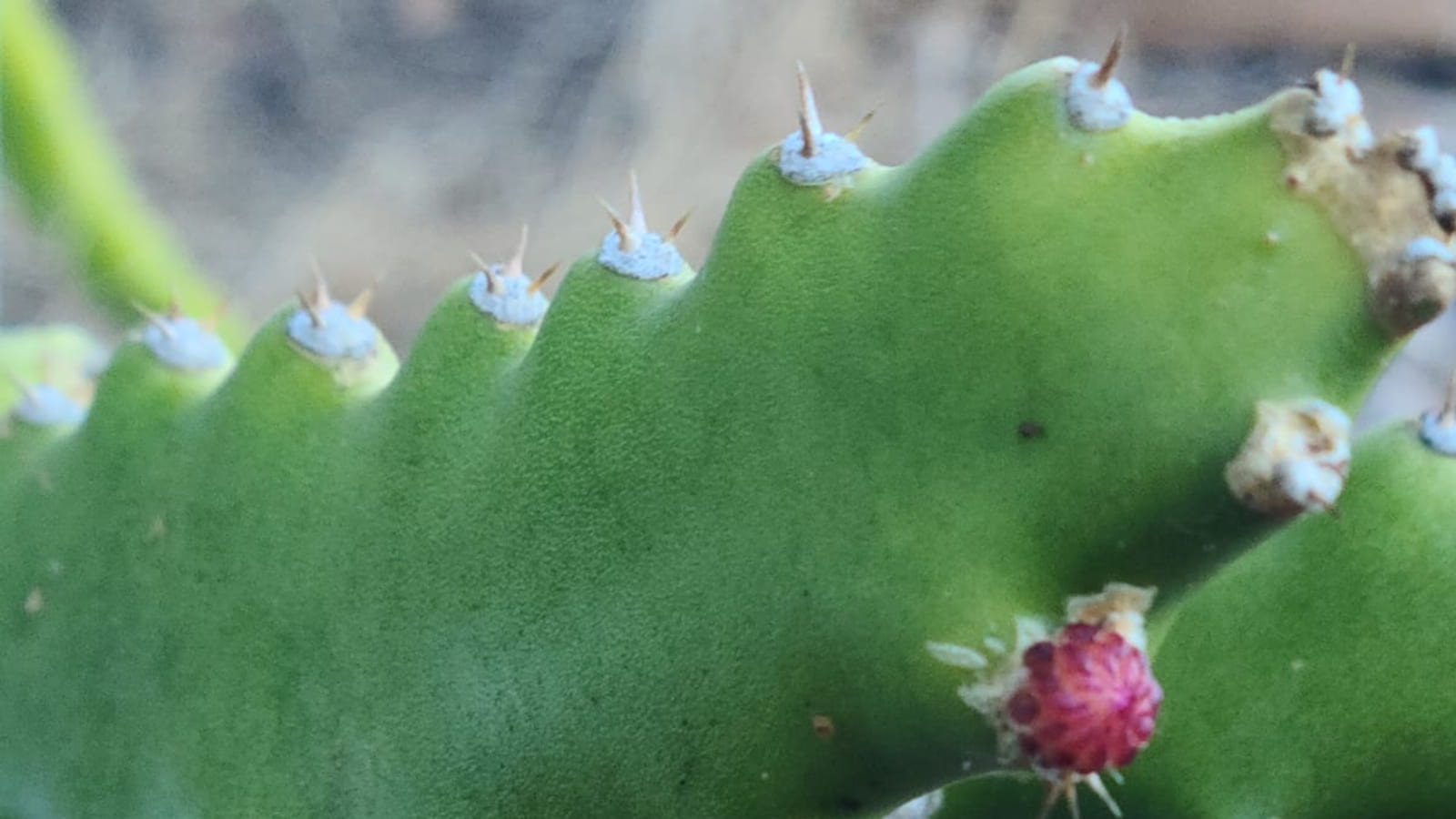
Cosmic Charlie is a red-fleshed dragon fruit grown from the cross of 'Rixford' and 'Ines', the same parents that produced Dark Star. Trade sources identify this selection as Paul Thomson’s 2S, named after the Grateful Dead song. You will see both Hylocereus and Selenicereus on tags because molecular work merged the former into the latter, though they refer to the same plant. We do not currently stock Cosmic Charlie, but our Dark Star cuttings offer the same parentage and deep-red flavor profile. Check our Dark Star page to get started with a proven performer.
Flavour, colour and the real Brix number
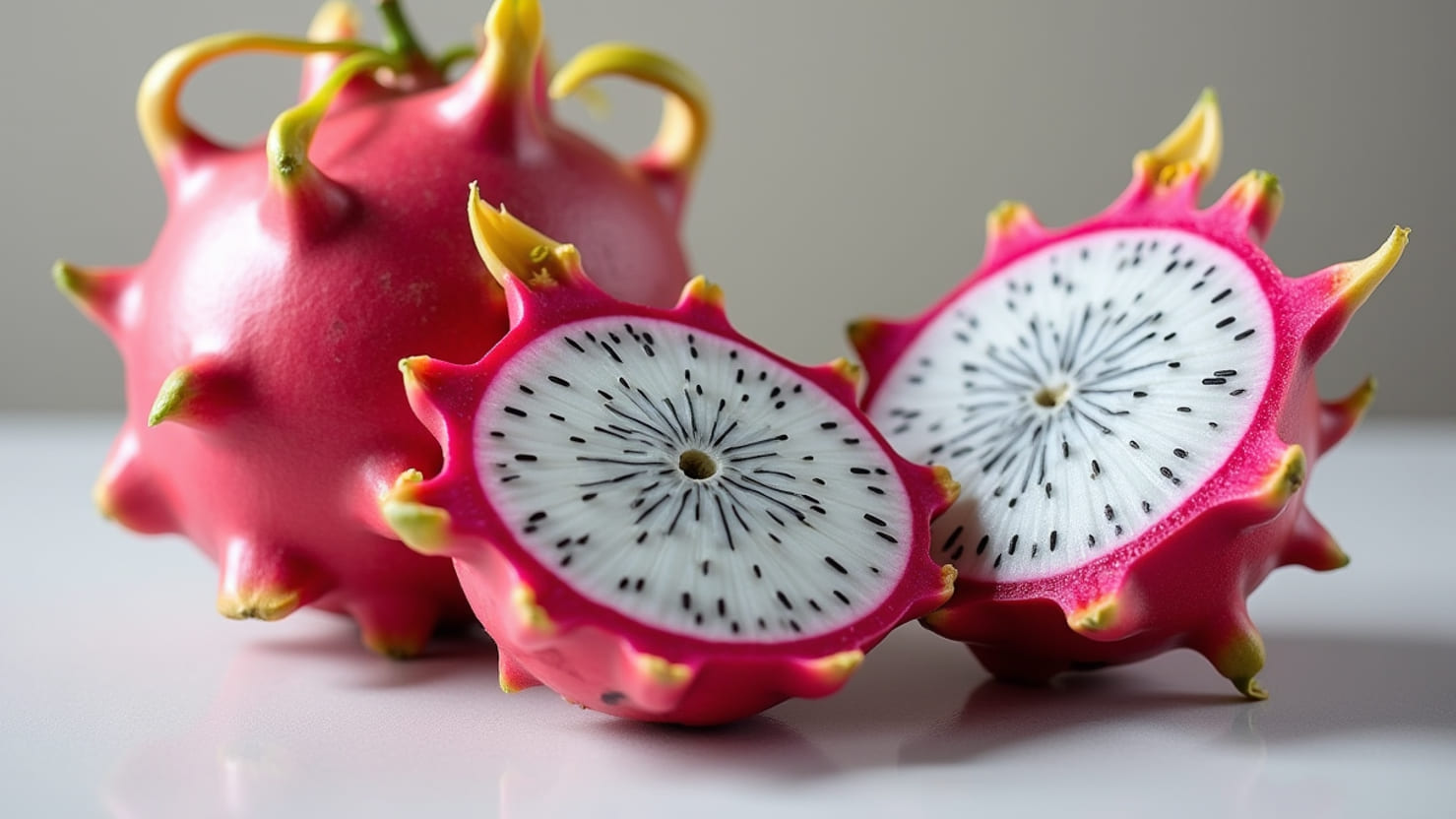
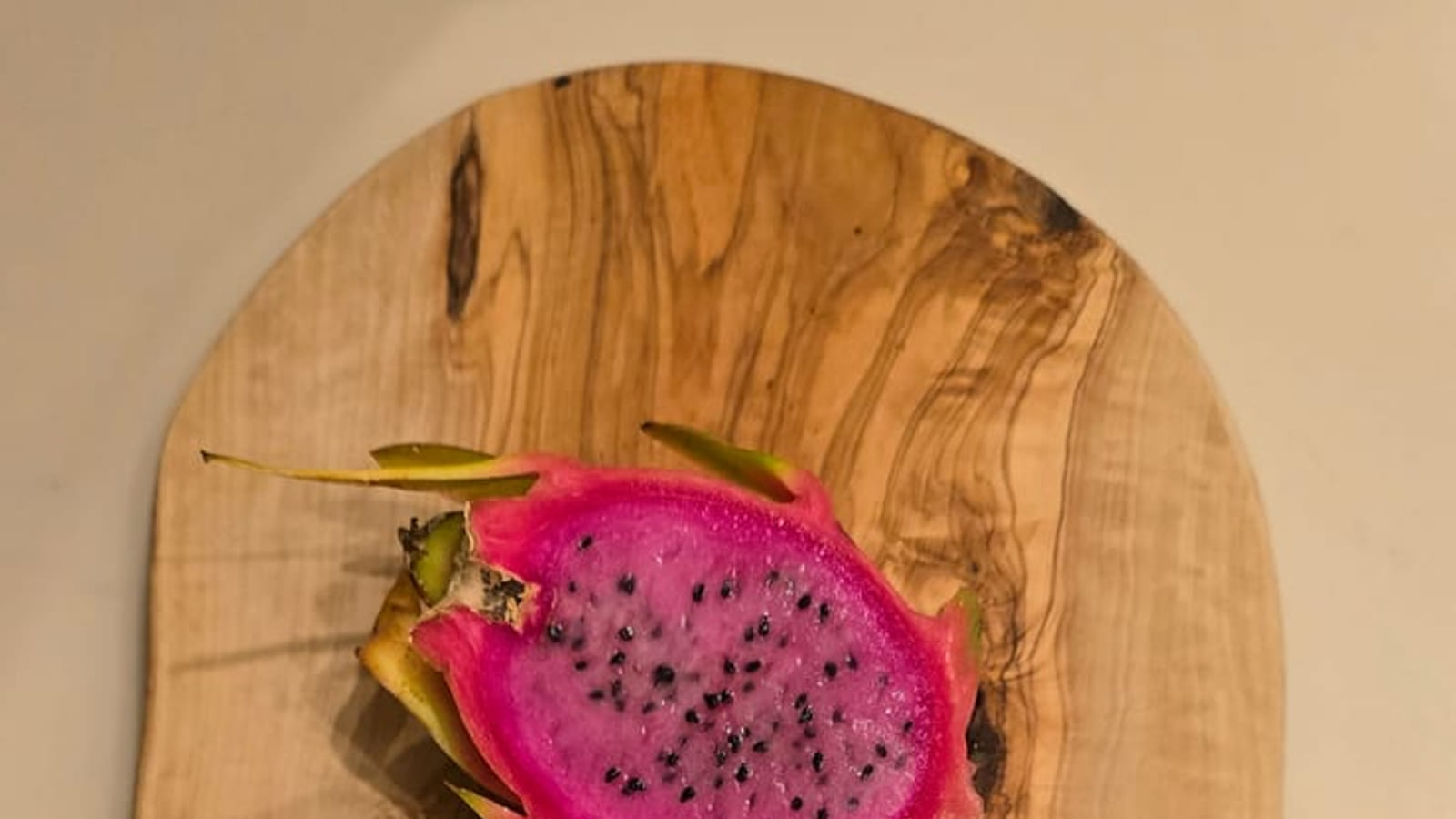
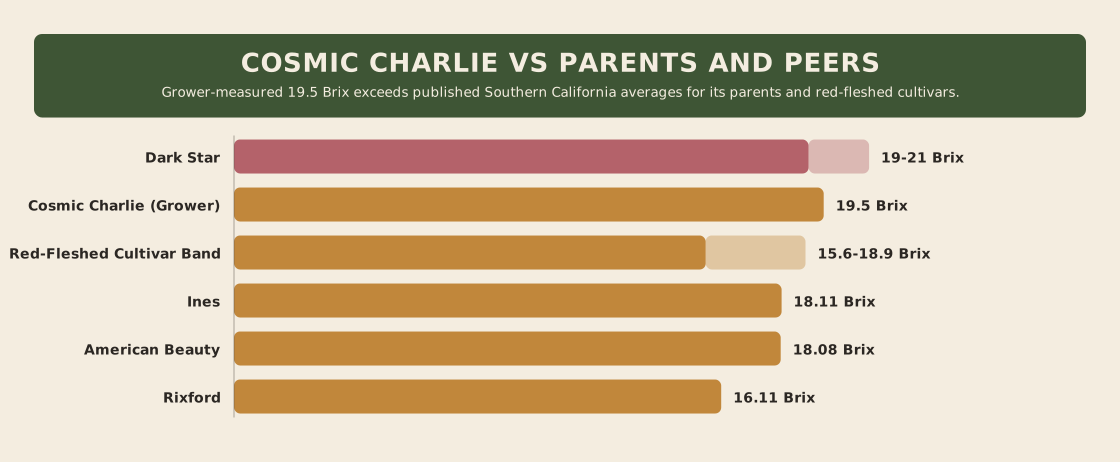
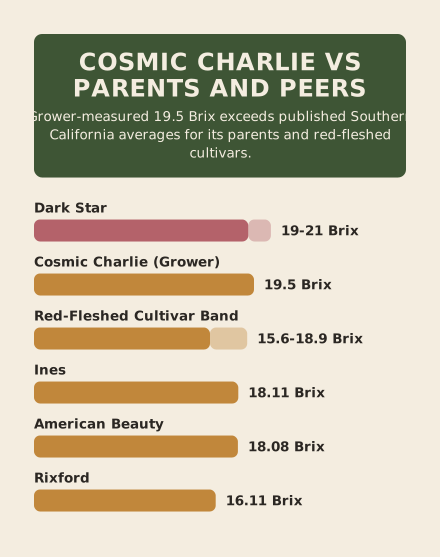
Cut open a ripe Cosmic Charlie and you get deep purple to near-black flesh with a sweet grape or wine-like flavour. The nursery that distributes this selection lists a single measured sweetness value of 19.5 Brix for it. Treat that number as the top end of what we see on the farm, not a fixed varietal constant. Other growers report a range of 16 to 18 Brix, which aligns closely with published data for its parents. The UC ANR Southern California catalogue scores 'Rixford' at 16.11 Brix and 'Ines/Niezel' at 18.11 Brix. Across California-grown red-fleshed pitaya cultivars in that same catalogue, sweetness spans roughly 15.6 to 18.9 Brix. Cosmic Charlie sits comfortably at the upper edge of this genetic potential. Context matters when judging quality. In a Puerto Rico trial of nine dragon fruit cultivars, total soluble solids ranged from 10.0 to 17.8 Brix across genotypes and two harvest cycles. Season, nutrition and cluster position move a variety's numbers as much as its genetics do.
The intense colour is not just for show. It comes from betalain pigments, specifically hydroxyacylated betacyanins and betaxanthins, rather than anthocyanins. These pigments change sharply during development. Betacyanin and betaxanthin content rises through mid-ripening and then declines at full maturity. This means the harvest window governs both colour and flavour. Waiting too long can dull the visual appeal and shift the sugar profile.
Harvest Tip: Do not wait for the skin to turn completely uniform. Check the days from pollination and look for the peak colour intensity in the flesh. The pigment curve peaks before full softness, so picking at the right day window preserves the wine-like notes.
Fruit size and days to harvest
Expect a harvest window of 40 to 45 days from pollination to ripe fruit. This timing aligns with published data for red-fleshed pitaya cultivars in Southern California, which generally ripen within 38 to 48 days of bloom[2]. It also matches a Puerto Rico trial that measured 40.6 to 46.5 days from anthesis to harvest[2]. These figures confirm that Cosmic Charlie follows the standard developmental pace of its genetic group.
Typical fruit weight ranges from 300 to 600 g, or roughly 1 to 1.5 lb[2]. On our vines, hand-pollinated fruit often exceed the lower end of the 300-600 g range. This increase reflects the direct link between seed development and fruit mass. When you manually transfer pollen, you drive seed set, and seed number correlates strongly with final weight. Natural pollination often leaves gaps in seed distribution, resulting in smaller, uneven fruit.
Timing matters for quality. Because Cosmic Charlie blooms in early summer, you can predict harvest dates by marking the pollination day on your calendar. Check the fruit at day 40. Look for peak color intensity rather than waiting for the skin to soften completely, as pigment levels decline after full maturity.
Why Cosmic Charlie will not fruit alone
Cosmic Charlie is self-sterile. It cannot set fruit from its own pollen. You must transfer pollen from a genetically distinct plant of a compatible group. This is not a nursery sales tactic. It is the biological reality of cultivated red-fleshed pitaya. Controlled pollination studies confirm that self-incompatibility is the norm in this crop. Researchers found strong self-incompatibility in Hylocereus polyrhizus and a weakened but real reaction in H. undatus and Selenicereus megalanthus. Major crossability barriers do not exist between these species, but self-pollination fails[6].
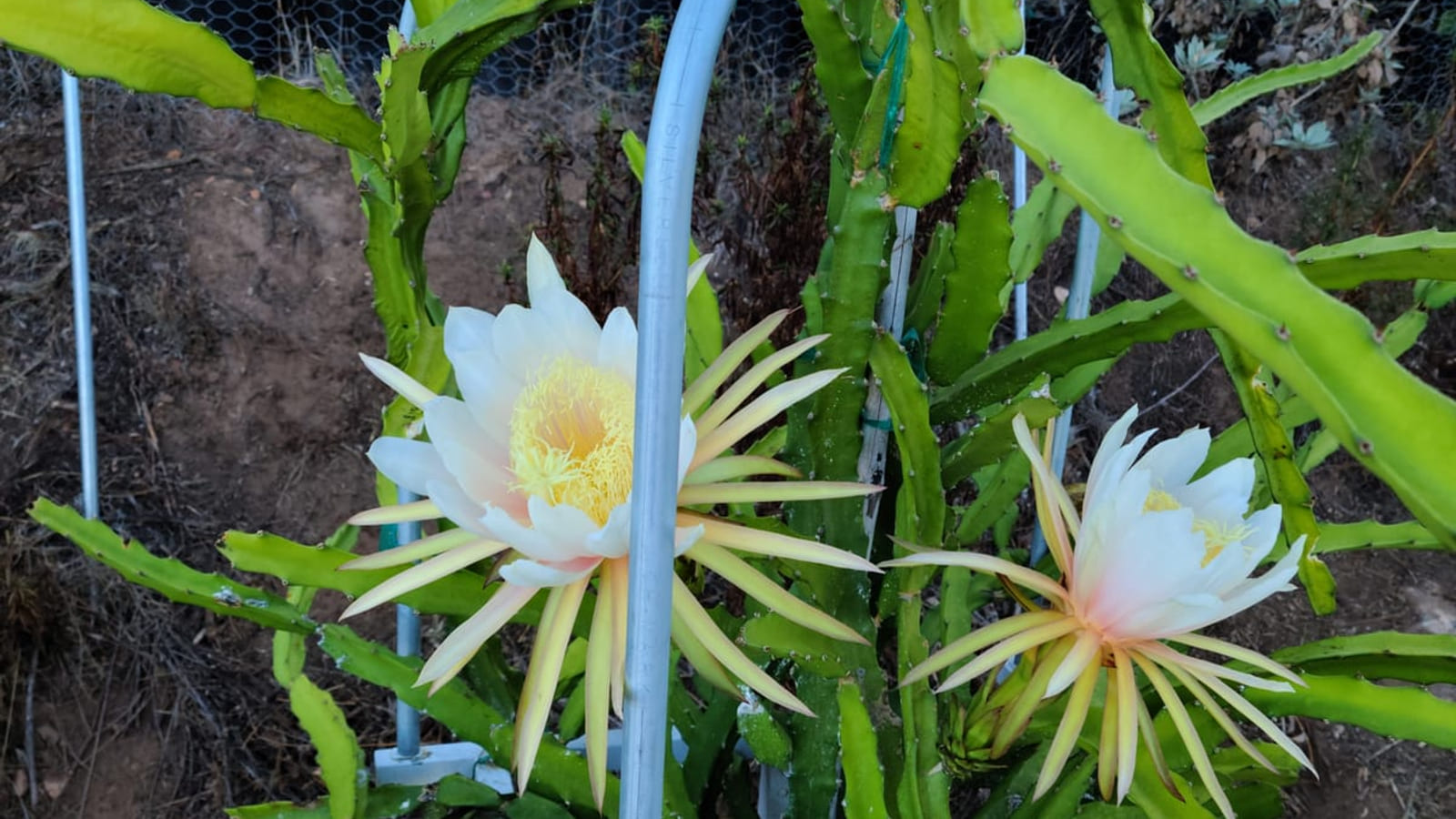
The flowers open at night and close by mid-morning. Daytime insect traffic is too low to move enough pollen. A 2025 Florida trial concluded that hand-pollination is the recommended technique to guarantee fruit set[4]. UF/IFAS extension advice for backyard growers is to plant two or three different genetic types. Moths and bats are the natural nocturnal pollinators, but they are rarely observed visiting. Relying on them alone is unreliable[3].
Pollination method changes fruit weight. Seed number drives fruit mass. Hand-cross-pollinated pitaya set more and heavier fruit because pollination drives seed development, and seed number is directly correlated with fruit weight[4]. In a Spanish greenhouse trial of the self-compatible red pitaya genotype 'Royal Red', bagged flowers set fruit but produced significantly smaller fruit with fewer seeds than brush- or duster-pollinated flowers. Free open-pollinated flowers matched bagged flowers exactly. This shows that casual insect visits move almost no pollen[5].
Genetic distance matters. Pairing Cosmic Charlie with a close relative like Dark Star does not work. Israeli breeding work screened 182 hybrid and backcross plants and recovered only five fully self-compatible hybrids. Self-compatibility in this group is tied to ploidy level, not label similarity. Use an unrelated line like 'American Beauty' as your pollinator.
Choosing a pollinator: the genetic-distance rule
Many growers assume that because two plants look alike or share a genus name, they can pollinate each other. This is a mistake. Compatibility in dragon fruit tracks ploidy and specific cross history, not label similarity. Israeli breeding work screened 182 hybrid and backcross plants and recovered only five fully self-compatible hybrids, all of them tetraploids from one specific cross.[8] Self-compatibility in the group is tied to ploidy level rather than to how similar two cultivars look on a plant tag. For Cosmic Charlie, this means the practical rule is genetic distance, not visual resemblance.
You cannot pair Cosmic Charlie with another seedling from the same parents. Pollinators that share both its parents, such as Purple Haze, Dark Star, and Physical Graffiti, are treated as incompatible.[1] These varieties are siblings, not partners. They carry the same genetic barriers. To get fruit, you need an unrelated line. 'American Beauty' is a recommended partner because it comes from a distinct genetic background.[1] It is a red-fleshed cultivar of Mexican origin that reached California via Florida, bearing excellent-quality fruit with overlapping bloom times.[2]
Metaxenia affects flavor, not just fruit set. The pollen source changes more than whether the flower sets fruit. In a peer-reviewed metaxenia study, pollinating the same red-fleshed pitaya flowers with different pollen sources shifted time to ripening by 5 days to 3 weeks and significantly changed fruit size, pulp dry weight, seed number and total soluble sugars.[7] Choosing your pollinator is a flavor decision as well as a horticultural one.
Because seed number correlates strongly with final weight, the choice of pollen directly impacts the harvest. Hand-cross-pollinated pitaya set more and heavier fruit because pollination drives seed development.[4] If you use a compatible but less vigorous pollen source, you may get fruit, but it might ripen faster or taste different than if you used a robust, unrelated line like American Beauty. Plan your pollinator selection with the same care you give your trellis. The genetic distance between your Cosmic Charlie and its partner determines the quality of every fruit you harvest.
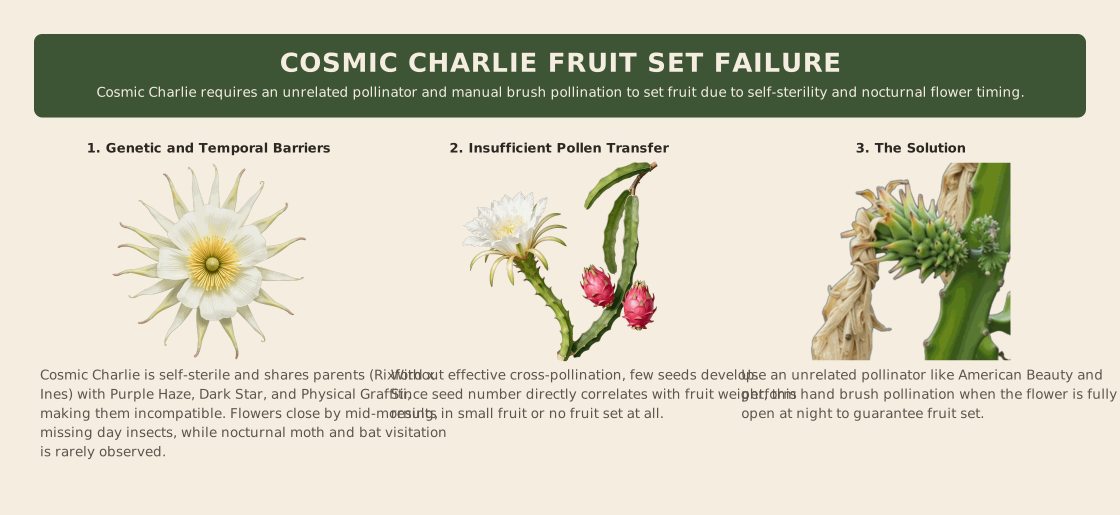
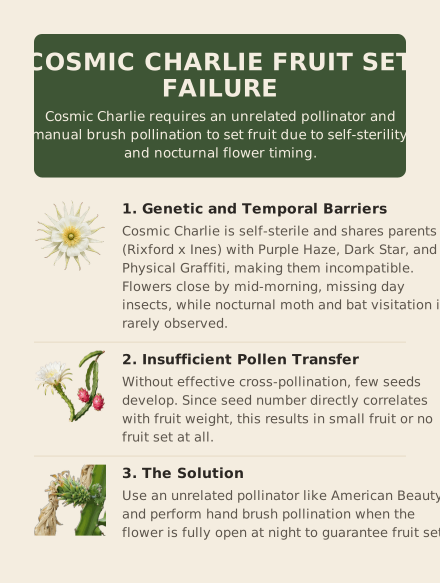
How to hand-pollinate a night-blooming flower
Because Cosmic Charlie flowers open at night and close by mid-morning, you cannot rely on daytime insects to do the work. Moths and bats visit, but they rarely move enough pollen to guarantee a set, so manual transfer is the standard practice for reliable fruit production[4]. The process is simple, but timing is everything. You are working with a narrow window while the flower is turgid and receptive.
Wait until the bloom is fully open. This usually happens after dark. Locate your compatible pollinator variety, such as 'American Beauty', and find a flower that is also fully open. Do not use another Cosmic Charlie or a close relative like Dark Star, as they share the same genetic background and will not trigger fruit set[1].
- Collect the pollen. Use a small, clean paintbrush or a cotton swab. Gently brush the anthers (the male parts) of the pollinator flower. You are looking for a fine, powdery dust. If the anthers are dry and crumbly, the flower is too old. If they are wet and clumped, it is too early.
- Transfer to the stigma. Move your brush to the Cosmic Charlie flower. The stigma is the central, star-shaped structure at the very center of the bloom. It has multiple lobes. Lightly brush the pollen onto every lobe of the stigma. Do not rub hard; you want to deposit the pollen, not damage the tissue.
- Work through the night. Continue this process into the early morning. The flower remains receptive as long as it is turgid. Once the petals begin to wilt or close, the window is shut. If you miss the night, the flower will not set fruit.
- Tag the flower. Immediately after pollinating, attach a small tag or tie a piece of colored string to the flower stem. Write the date on it. This is critical for harvest timing.
- Wait for the set. If successful, the flower will swell at the base within a few days. The petals will dry and fall off, leaving a small green fruit. If the flower shrivels and drops without swelling, the pollination failed.
Why hand-pollination matters for size: Seed number drives fruit weight. Hand-pollination ensures thorough fertilization, leading to more seeds and significantly heavier fruit compared to natural or partial pollination. In trials, manual transfer resulted in larger, more uniform fruit than bagged or open-pollinated flowers[5].
Mark your calendar. You can expect to pick the fruit about six weeks after the date you tagged. This aligns with the 40 to 45 day window typical for red-fleshed pitaya[2]. Check the fruit around day 40 for peak color and flavor, rather than waiting for the skin to turn completely uniform.
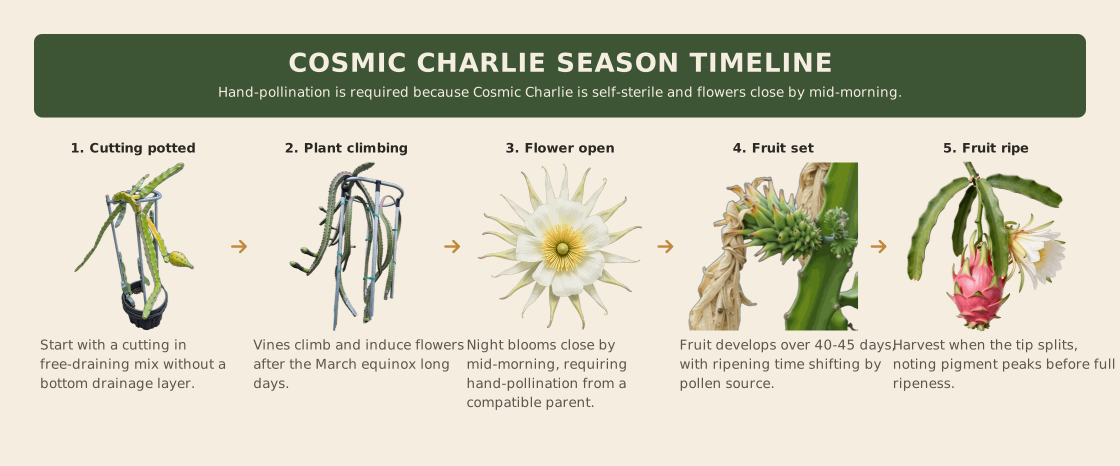
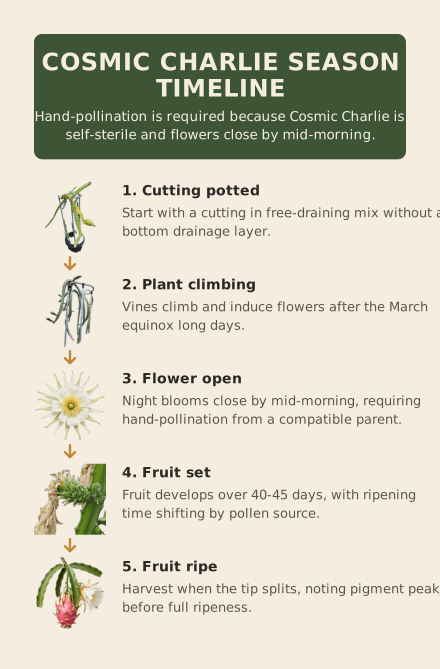
Growing the vine: cutting to first fruit
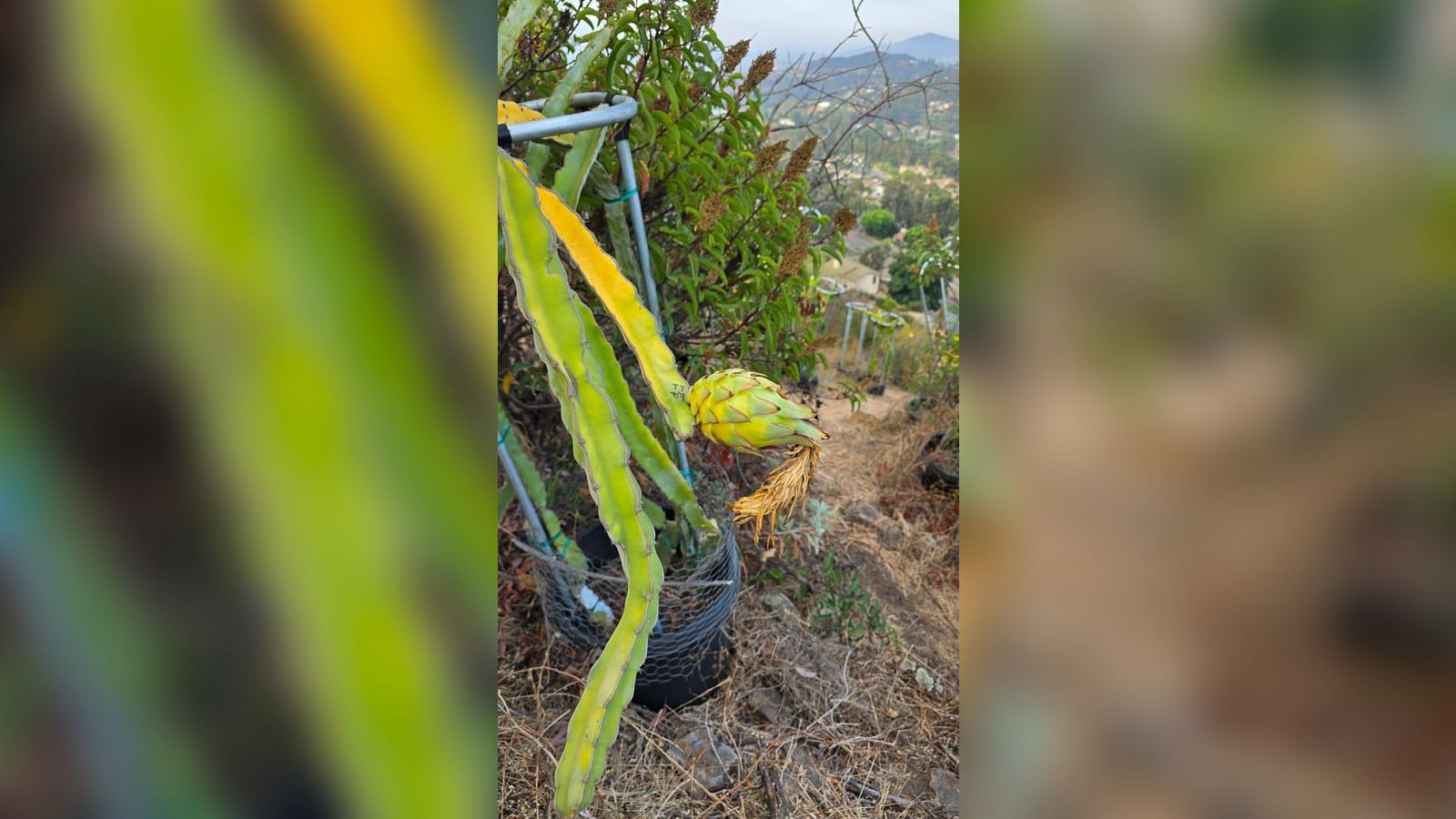
Patience is the primary requirement for Cosmic Charlie. Like many red-fleshed varieties, it establishes more slowly than common white-fleshed types. A cured cutting typically takes four to six months to build a sufficient root system in a pot before it is ready for planting out[3]. Do not mistake this slow start for failure. It is normal behavior for a tri-stem selection. Once established, the plant rewards that wait with longevity and heavy yields.
Meaningful bearing usually begins in year three. By years three or four, a mature plant can carry roughly 100 kg (220 lb) of fruit annually[3]. This is a substantial load. Your support structure must be engineered for it. A trellis needs to handle several hundred pounds of stem weight, not just the fruit[3]. If you are building a new support, err on the side of overbuilding. A planting remains productive for about 20 years, so the initial investment in infrastructure pays off over two decades[3].
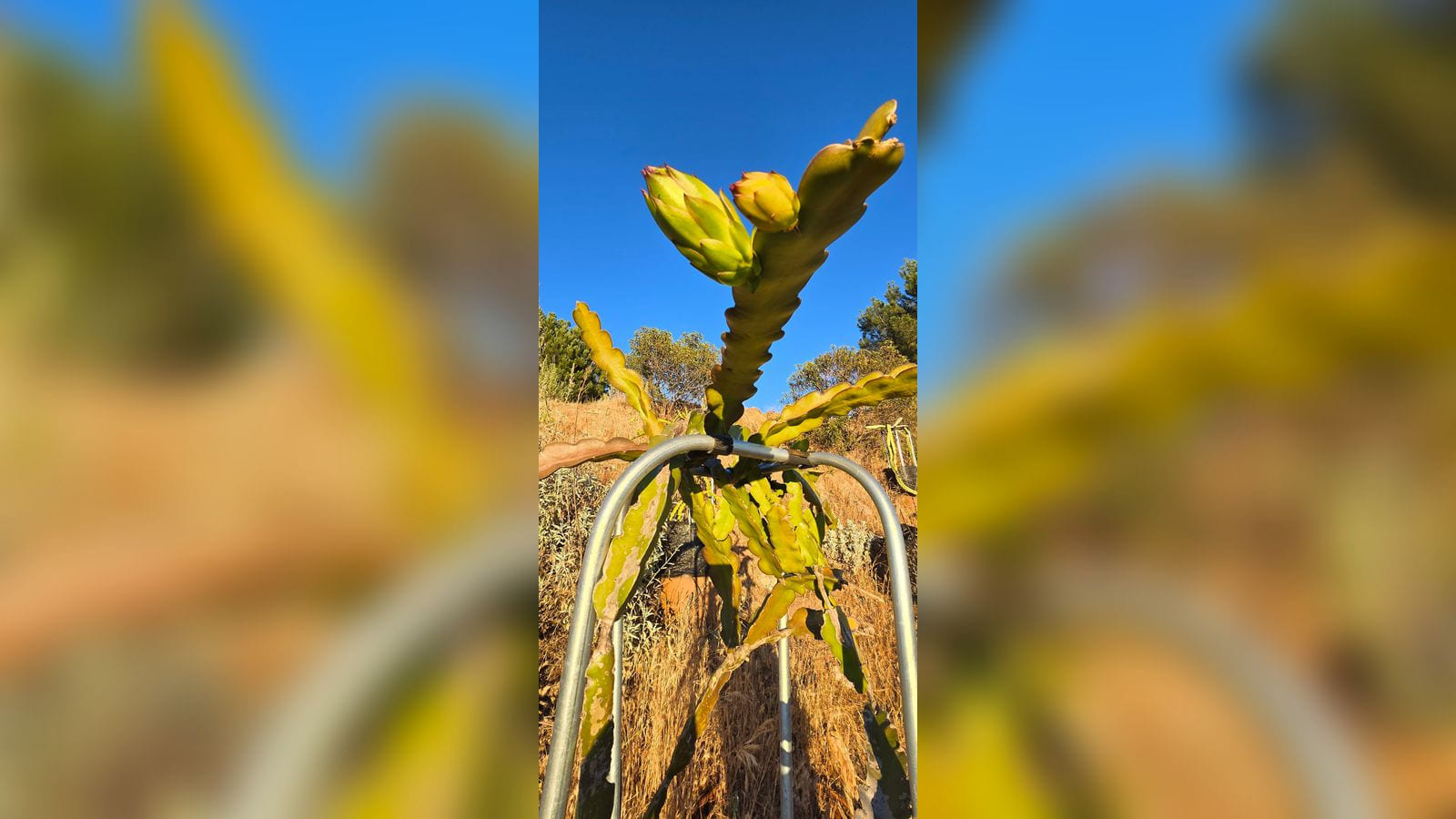
Climate plays a decisive role in when and how well this vine flowers. Cosmic Charlie blooms in the natural long-day season. Floral buds form in two to three waves after the March equinox, but the critical daylength for flower induction is about 12 hours[9]. Bloom reliably appears from early summer onward at 33 degrees north, continuing through October[9].
Water management dictates health as much as light dictates bloom. Established plants require a dry, cool rest period to flower abundantly[3]. They suffer quickly if waterlogged. Root rot is the fastest way to lose a young vine. Regarding cold, Cosmic Charlie is hardy enough to recover from light frost, but freezing exposures of long duration around 31 degrees F (-2 degrees C) cause damage[3]. If you live in a zone with sustained freezes, protect the stems or grow in containers you can move.
Timeline Expectations
Do not expect fruit in year one or two. The first two years are for structural growth. Focus on getting three strong stems to drape over your trellis. The heavy yields described above are a mid-life achievement, not a startup feature.
Troubleshooting: flowers but no fruit
If your Cosmic Charlie vines bloom heavily but produce little to no harvest, the issue is rarely a lack of fertilizer or water. It is almost always a pollination failure. As noted above, this cultivar requires pollen from a genetically distinct partner. If you do not have one nearby, or if you are relying on night-flying insects that rarely visit backyard plantings, the flowers will drop without swelling into fruit. The table below maps common symptoms to their likely causes and practical fixes.
| Symptom | Likely Cause | Fix |
|---|---|---|
| No fruit set at all | Self-sterile plant with no compatible partner, or all nearby vines are Rixford x Ines seedlings (like Dark Star). | Plant an unrelated pollinator like 'American Beauty' or hand-pollinate with pollen from a genetically distinct variety. |
| Small fruit with few seeds | Insufficient pollen transfer. Seed number drives fruit size. | Hand-pollinate thoroughly. Ensure you are using fresh, viable pollen from a compatible source. |
| Fruit stalls or ripens unevenly on the same vine | Metaxenia. The pollen source affects ripening time and sugar content. | Use a consistent, known pollinator source. Do not mix pollen from unrelated varieties if you want uniform harvests. |
| Yellowing or mushy stems | Overwatering or root rot. | Reduce watering. Ensure the soil drains quickly. Check for root-knot nematodes. |
| No flowers | No dry rest period, too much shade, or excessive nitrogen. | Withhold water during the cool season to trigger dormancy. Prune back heavy vegetative growth. |
### The Pollinator Problem Most growers assume that having two dragon fruit plants is enough. It is not. Cosmic Charlie requires pollen from a plant that is not its sibling or close relative. If you have planted Cosmic Charlie alongside Dark Star, Purple Haze, or other Rixford x Ines seedlings, you have planted siblings. They share the same genetic background and cannot cross-pollinate effectively. You need an unrelated line, such as 'American Beauty', which blooms at the same time but carries different genetics. Hand-pollination is the most reliable method. Because the flowers open at night and close by mid-morning, natural pollinators like moths and bats are often absent or inconsistent in residential
References
- Cosmic Charlie dragon fruit - cultivar directory entry, Dragonfruit Wiki (specialist dragon fruit nursery/directory) (2026).
- Pitaya (Dragon Fruit) Cultivars - field day cultivar descriptions with Brix, fruit weight and bloom-to-harvest data for Southern California, University of California Agriculture and Natural Resources / UC Riverside (M. Arpaia) (2017).
- Pitaya, Dragonfruit andrelated Cacti for the Florida Home Landscape (HS303/HS1288), University of Florida IFAS Extension (Crane, Balerdio, Chester) (2023).
- Floral and pollination biology of dragon fruit reveals strategies for enhancing productivity and profitability, Scientific Reports (Nature Portfolio); doi:10.1038/s41598-025-21168-2 (2025).
- Evaluation of Different Procedures to Pollinate Self-Compatible 'Royal Red' Pitaya Under Protected Crops, Plants (MDPI); doi:10.3390/plants14193102 (2025).
- Cytology and mating systems in the climbing cacti Hylocereus and Selenicereus, American Journal of Botany 87(8):1058-1065; Lichtenzveig, Ein-Gil, Bar-Ya'akov, Mizrahi (2000).
- Metaxenia in the vine cacti Hylocereus polyrhizus and Selenicereus spp., Annals of Botany 93:469-472; doi:10.1093/aob/mch055 (2004).
- Selection of interspecific vine cacti hybrids (Hylocereus spp.) for self-compatibility, Plant Breeding 131(5):681-685; Garcia-Aloyo, Bourell, Zienkiewicz, Guerrero-Prieto (2012).
- The Photoperiod-regulated Bud Formation of Red Pitaya (Hylocereus sp.), HortScience 47(8):1063-1067; Hsu, Wang, Lin, Liou, Nakamura, Huang (2012).