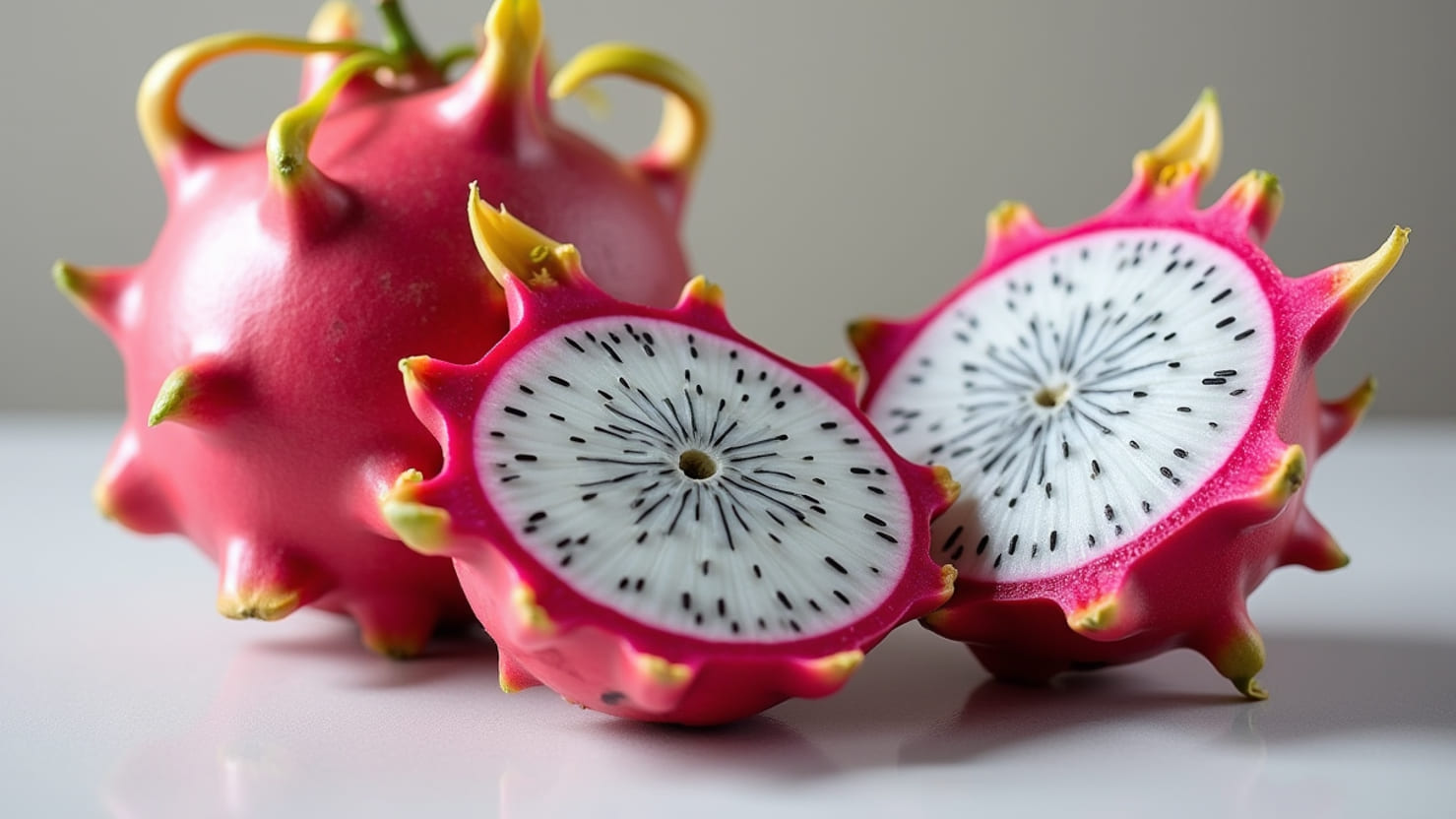
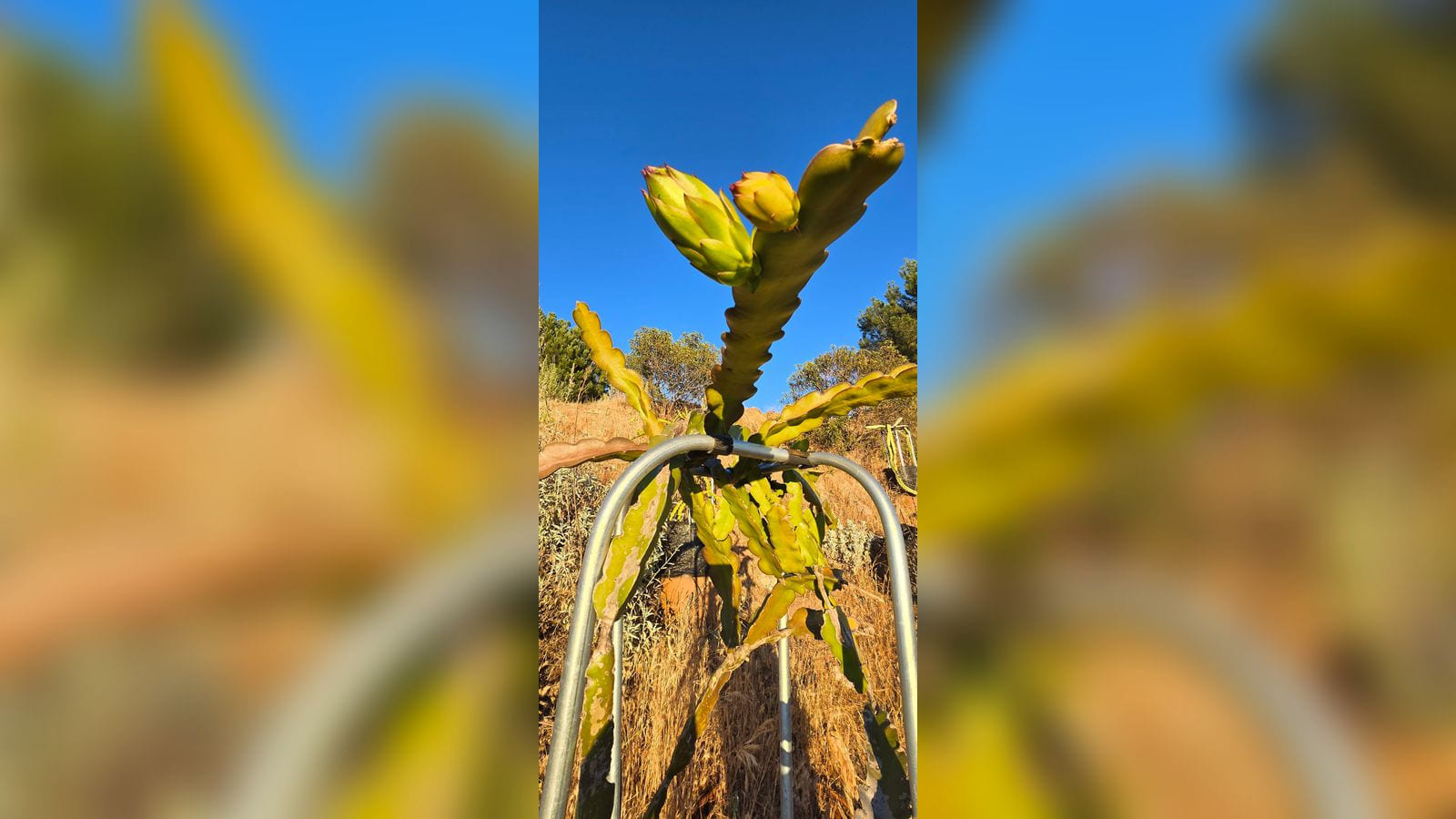
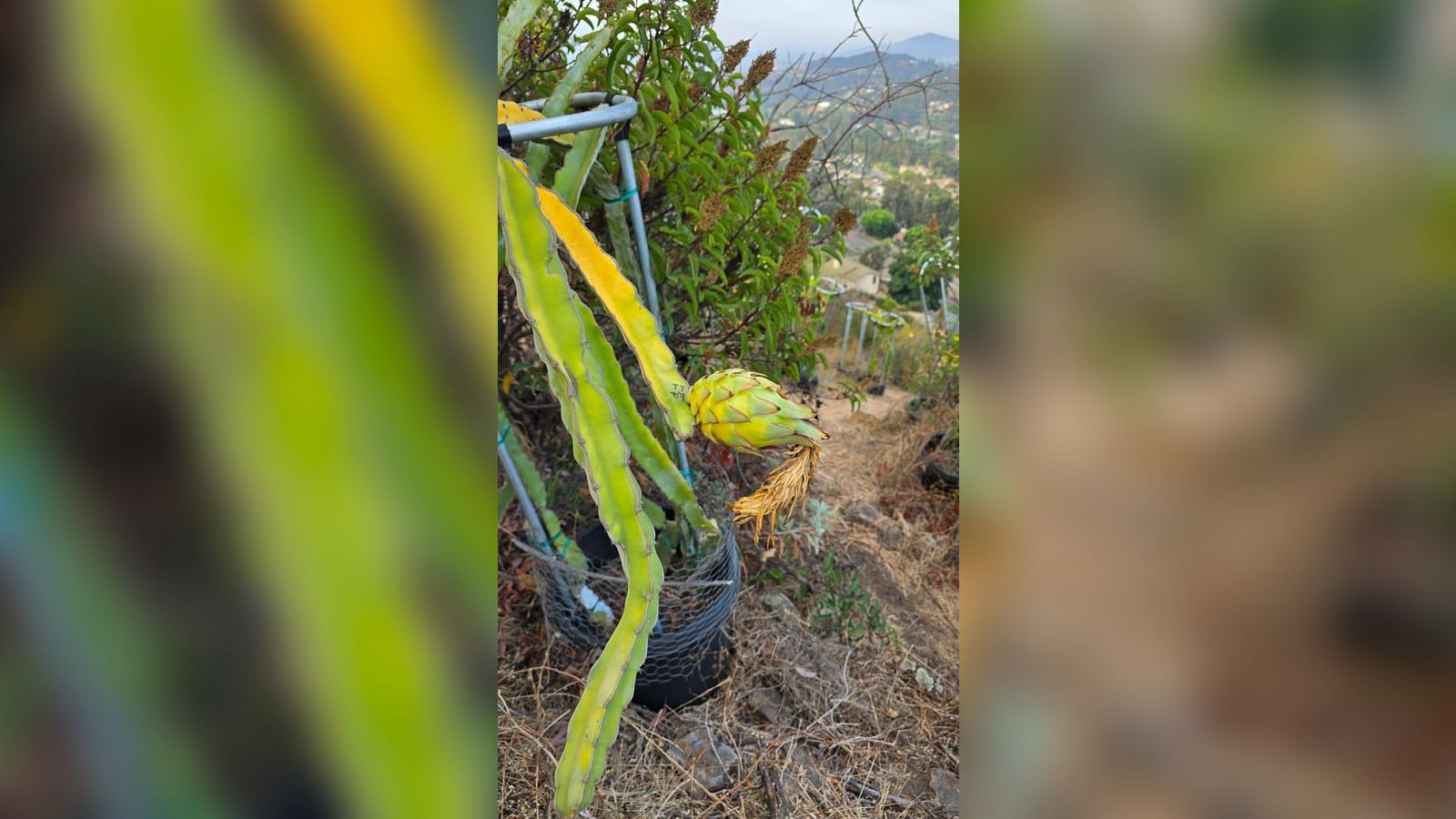
Cotton Candy Dragon Fruit: Sweet Pink Flesh Guide
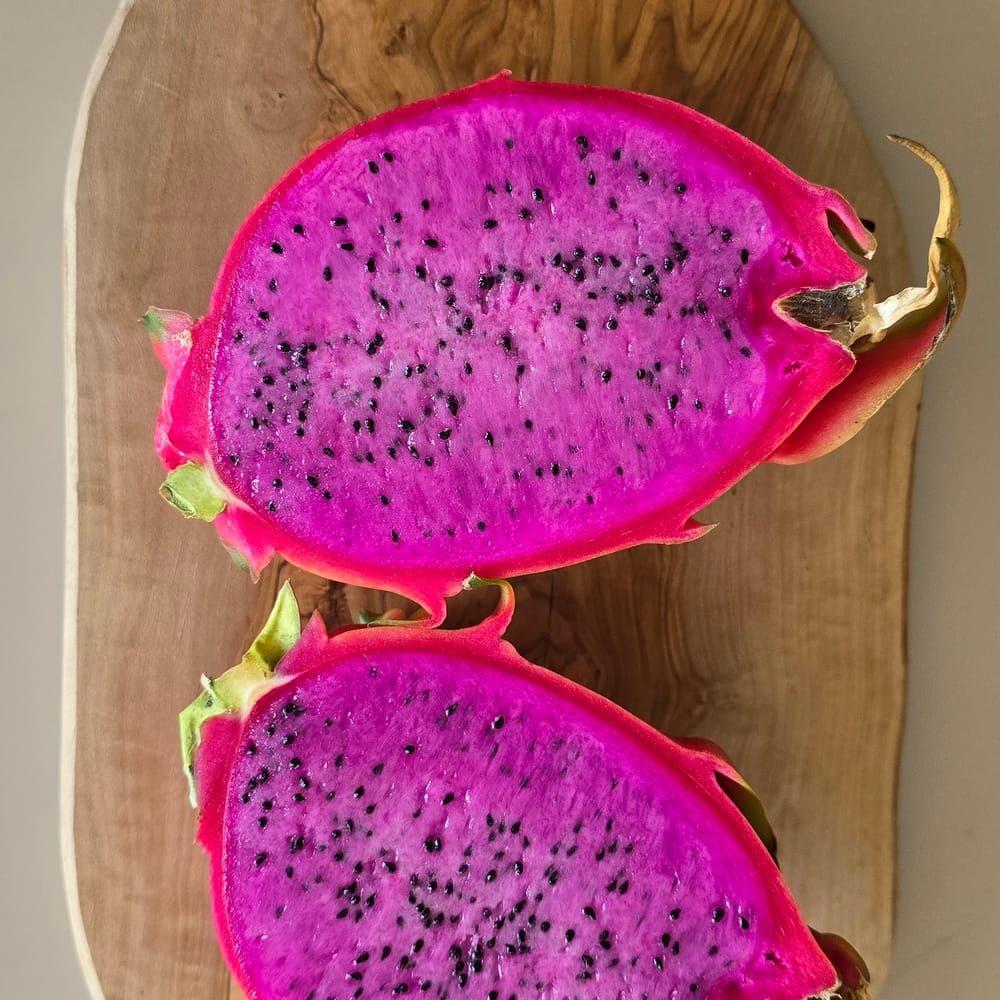
Cotton Candy dragon fruit is a pink-fleshed Don Burnett hybrid of Connie Mayer x G-1 from Southern California, testing 19 to 20+ Brix with spun-sugar and coconut notes. The fruit weighs near 1.5 lb. It is self-sterile, so you need an unrelated pollen parent blooming the same night. We list Cotton Candy and have it in stock. See our available cuttings for current inventory. | Trait | Value | Why it matters | | :--- | :--- | :--- | | Flesh Color | Pale pink to soft magenta | Distinct visual appeal and pigment profile | | Brix | 19 to 20+ | Exceptional sweetness with low acidity | | Fruit Weight | Near 1.5 lb | Substantial harvest size | | Pollination | Self-sterile | Requires cross-pollination for fruit set | | Hardiness | Zones 9b to 11 | Suitable for subtropical climates or containers |
What Cotton Candy Actually Is
Cotton Candy is a hybrid created by Southern California breeder Don Burnett, resulting from a cross between Connie Mayer and G-1 [6]. You may see the breeder’s name spelled Brunett in some cultivar databases, but it refers to the same work [6]. Leewi Farms records the specific cross as Connie Mayer pollinated with G-1 [9]. Donovan Vasta first fruited this selection, which tested at 20 Brix with a notably sweet flavor profile [9].
Cotton Candy belongs to a large sibling family of Connie Mayer x G-1 selections, including Amelie, Celeste, Chantilly Lace, Connie Gee, Kinsley, Marcella, Riona, Queen Daenerys and Stella [6]. This shared lineage explains why so many pink-fleshed names in the trade trace back to the same two parents. Because they are siblings, you cannot use a close relative as a pollen parent; you need an unrelated variety to ensure fruit set. For more on matching compatible parents, see how self-fertile and self-sterile dragon fruit varieties differ.
You will often see conflicting scientific names on nursery tags. Pitaya is a cactus in the family Cactaceae, native to tropical America [1]. UF/IFAS lists the scientific name as Hylocereus, along with other species and hybrids [1]. However, newer botanical work reclassifies these same plants under the genus Selenicereus [1]. This is why one vine can carry two genus names in the trade. Do not worry if your tag says Hylocereus undatus or Selenicereus undatus; they refer to the same plant family. The common name and breeder selection matter more for your care routine than the genus label.
What It Tastes Like, and Why the Middle Is Sweeter
Growers who sell Cotton Candy describe the flavor as sweet tropical with distinct spun-sugar and coconut notes.[7] This profile is the result of specific genetics. Sweetness in pitaya is a genotypic trait, not a function of yield.[3] A multi-genotype study in Frontiers in Plant Science found that high yields often come at the expense of sweetness.[3] Cultivars with contrasting sugar phenotypes differ in sucrose-metabolizing enzyme activity.[3] This explains why two vines in the same bed can taste completely different.[3]
The science behind the candy-sweet taste lies in how the plant handles sugar. High sucrose-synthase cleavage activity drives hexose buildup, resulting in a sweeter fruit.[3] Conversely, elevated sucrose-synthase synthesis diverts carbon away from sugar accumulation.[3] Cotton Candy has the genetic machinery to favor cleavage, allowing sugars to accumulate rather than being consumed for growth. This trait is decoupled from production volume, meaning you do not have to sacrifice flavor for a heavy harvest.
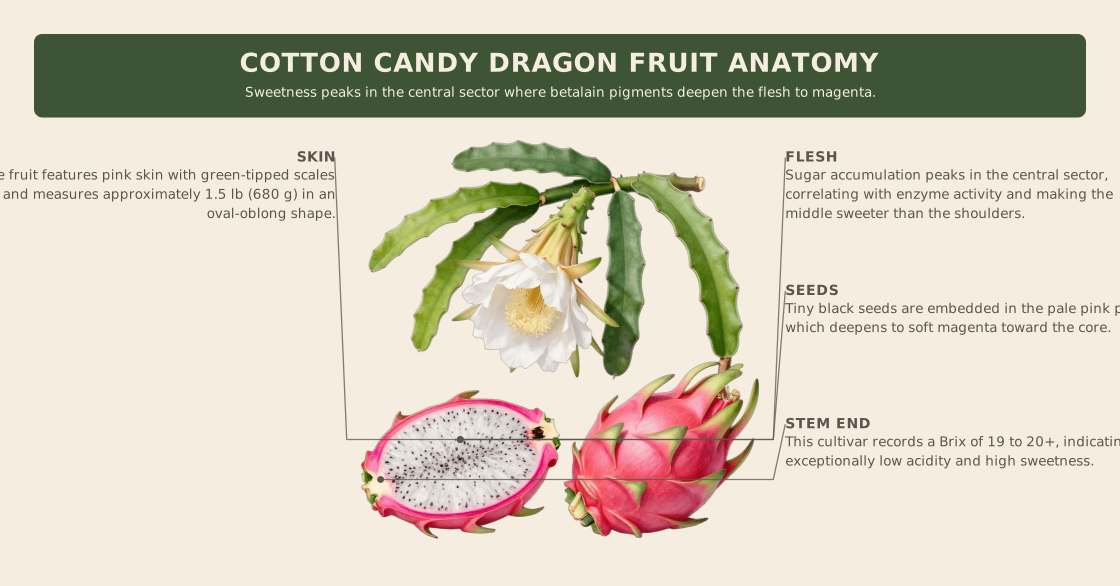
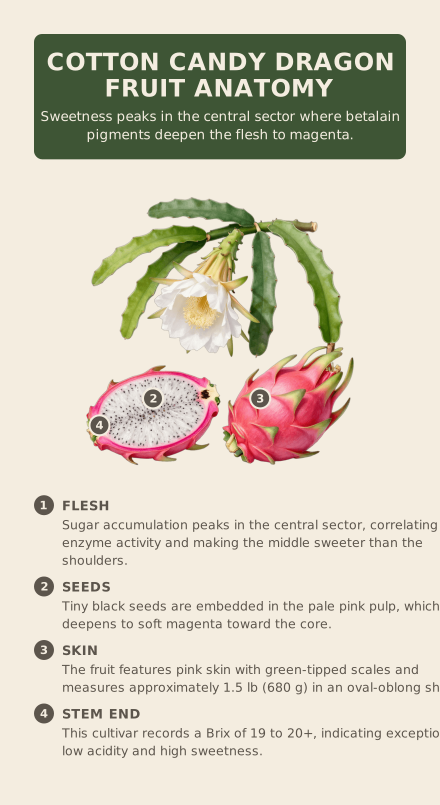
Why the middle tastes better: Sugar accumulation peaks in the central sectors of the fruit.[3] This correlates strongly with enzyme activity.[3] When you cut a Cotton Candy, the core will taste significantly sweeter than the shoulders near the skin.[9] If you are sharing a fruit, save the center for the person who appreciates high Brix.
Brix is the measurement unit for soluble solids, primarily sugars. A reading of 19 to 20+ Brix with exceptionally low acidity reads as candy-sweet rather than tart.[7] Acidity masks sweetness. When acidity is low, the perceived sweetness is direct and unimpeded. This is why Cotton Candy is described as having a "notably sweet" profile.[9]
| Metric | Value | Source |
|---|---|---|
| Brix | 19 to 20+ | San Diego Fruit Farm[7] |
| Brix | ~20.3 | Drogon Dragonfruit[8] |
| Acidity | Exceptionally low | San Diego Fruit Farm[7] |
| Fruit Weight | Near 1.5 lb | Drogon Dragonfruit[8] |
| Flesh Color | Light pink | Drogon Dragonfruit[8] |
Flesh color, average fruit weight, and soluble solids content all varied significantly among genotypes in trials, confirming that the named cultivar is the deciding factor in eating quality.[3] You cannot improve the Brix of a low-sugar variety by adding more fertilizer. You must select the right genetics. Cotton Candy’s lineage from Connie Mayer and G-1 provides the enzymatic profile necessary for this high-sugar, low-acid outcome.[6] If you are unsure how to ensure your vines set fruit to test this flavor, review how self-fertile and self-sterile dragon fruit varieties differ.
Why the Flesh Is Pink
The pale pink blush inside a Cotton Candy fruit is not just a cosmetic trait. It is the visible result of a specific biochemical pipeline. Pitaya pulp is a fleshy berry, and its color is dictated by betalain pigments. Research comparing three fruit types across two Hylocereus species found that the primary route to red or pink pulp involves an increased supply of tyrosine feeding into the betalain pathway.[2] In simpler terms, the plant needs the right raw materials to build the color.
The switch that turns those materials into pigment is controlled by a gene called CYP76AD. This gene acts as the color-breaking step that produces red or colorless pulp, and its activity is regulated by a transcription factor known as WRKY44.[2] In pigmented varieties like Cotton Candy, anthocyanins coexist alongside these betalains. White-fleshed varieties lack this anthocyanin biosynthesis entirely, which is why their pulp remains starkly pale.[2]
Understanding this pathway explains what you see on your vine. A pale pink hue indicates a partial pigment load. As the fruit matures, the plant continues to funnel tyrosine into the pathway, causing the blush to deepen toward magenta. If you grow Cotton Candy in heavy shade, the same clone may look paler at harvest. The plant has less energy to dedicate to pigment production, resulting in a lighter color. This does not mean the fruit is unhealthy or underripe. It simply reflects the environmental limits on the betalain pathway. If you are curious about how other genetic factors influence fruit quality, see how self-fertile and self-sterile dragon fruit varieties differ.
Growing Cotton Candy
Cotton Candy is a vigorous vine. Stems grow long and heavy, so a heavy-duty post or trellis is required.[1] While the plant is hardy in zones 9b to 11, it suffers from frost and prolonged cold, making container growing with indoor overwintering a good option in marginal climates.[7]
The care routine hinges on mimicking its subtropical origins. Optimum growth happens between 65 and 77 F.[1] In triple-digit inland heat, the tender lineage of this hybrid requires filtered afternoon shade to prevent stem sunburn.[7] Young plantings also benefit from about 30 percent shade for the first few months, but do not overdo it. Too much shade leads to low production and poor fruit quality.[1]
Water management is a two-phase game. The plant needs a dry period in winter and early spring to trigger bloom induction.[1] Once flowers appear, switch to steady watering through harvest. Drought during this phase causes poor production.[1]
Substrate choice matters. Cotton Candy is highly sensitive to waterlogging, which can be fatal. Use a porous, fast-draining mix amended with high organic matter or manure.[1]
Pruning is your primary tool for yield control. Cut back one to three times a year, ideally soon after harvest.[1] This induces branching and flowering. Always remove pruned stems from the field and treat cuts with fungicide to prevent stem rot.[1]
| Need | Spec | Note |
|---|---|---|
| Climate | Zones 9b-11 | Optimum 65-77 F. Frost sensitive. |
| Light | Full sun to partial | 30% shade for young plants. Afternoon shade in extreme heat. |
| Water | Dry winter, wet summer | Steady water from flowering to harvest. |
| Soil | Porous, fast-draining | High organic matter. No standing water. |
| Support | Heavy-duty trellis | Stems grow long. |
| Pruning | 1-3 times/year | Soon after harvest. Treat cuts with fungicide. |
Watch for Sunburn: Stem sunburn is common in low humidity or high altitude regions. If you see bleached patches, increase shade coverage immediately.
Pollination: The Part That Decides Whether You Get Fruit
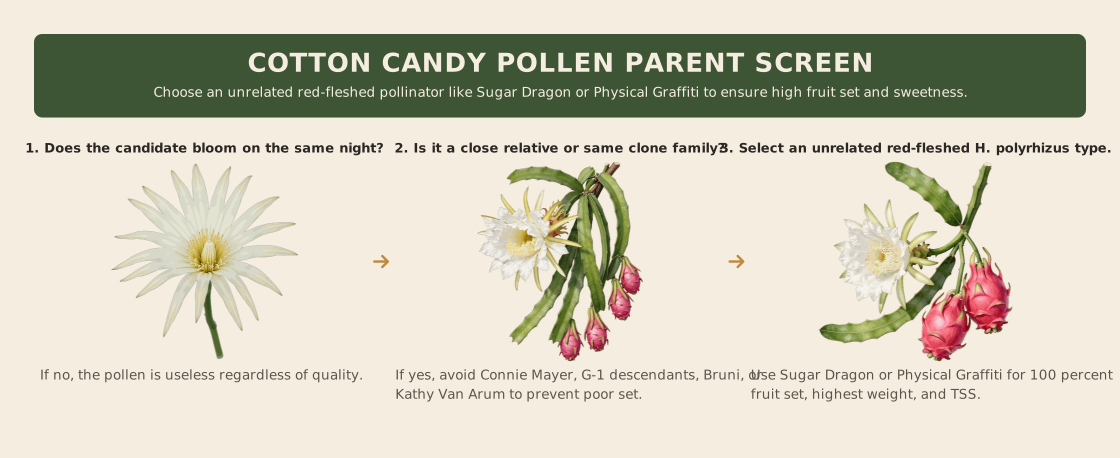
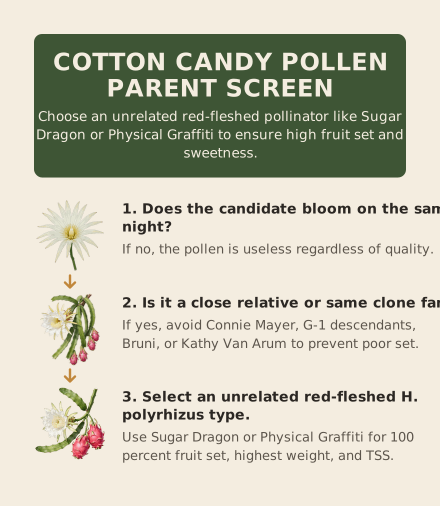
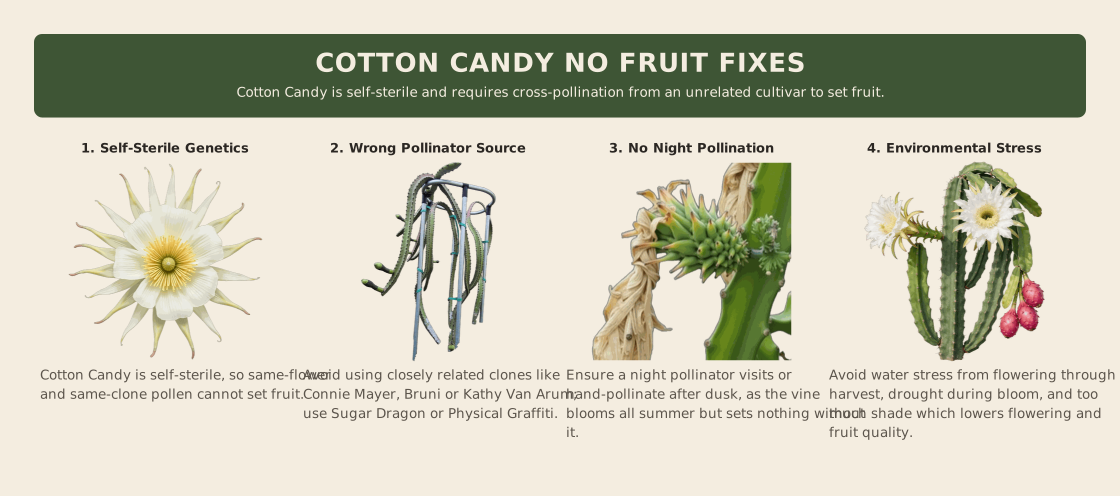
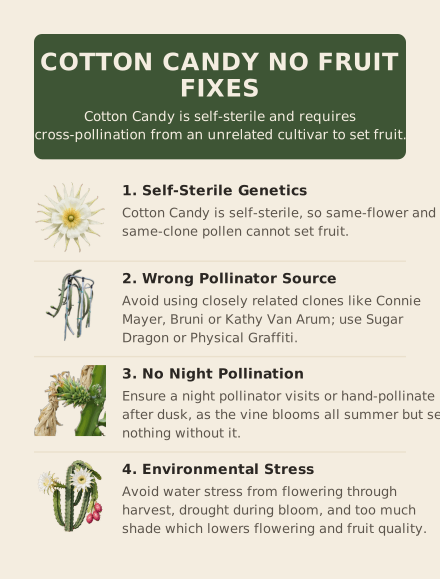
Cotton Candy is self-sterile. Both nurseries that sell it classify it this way, meaning the plant cannot set fruit from its own pollen.[7] While pitaya flowers are hermaphroditic, many nursery cultivars are self-incompatible.[1] You must provide an unrelated pollen parent that blooms on the same night. Without this genetic match, you will see blossoms drop and no fruit form.
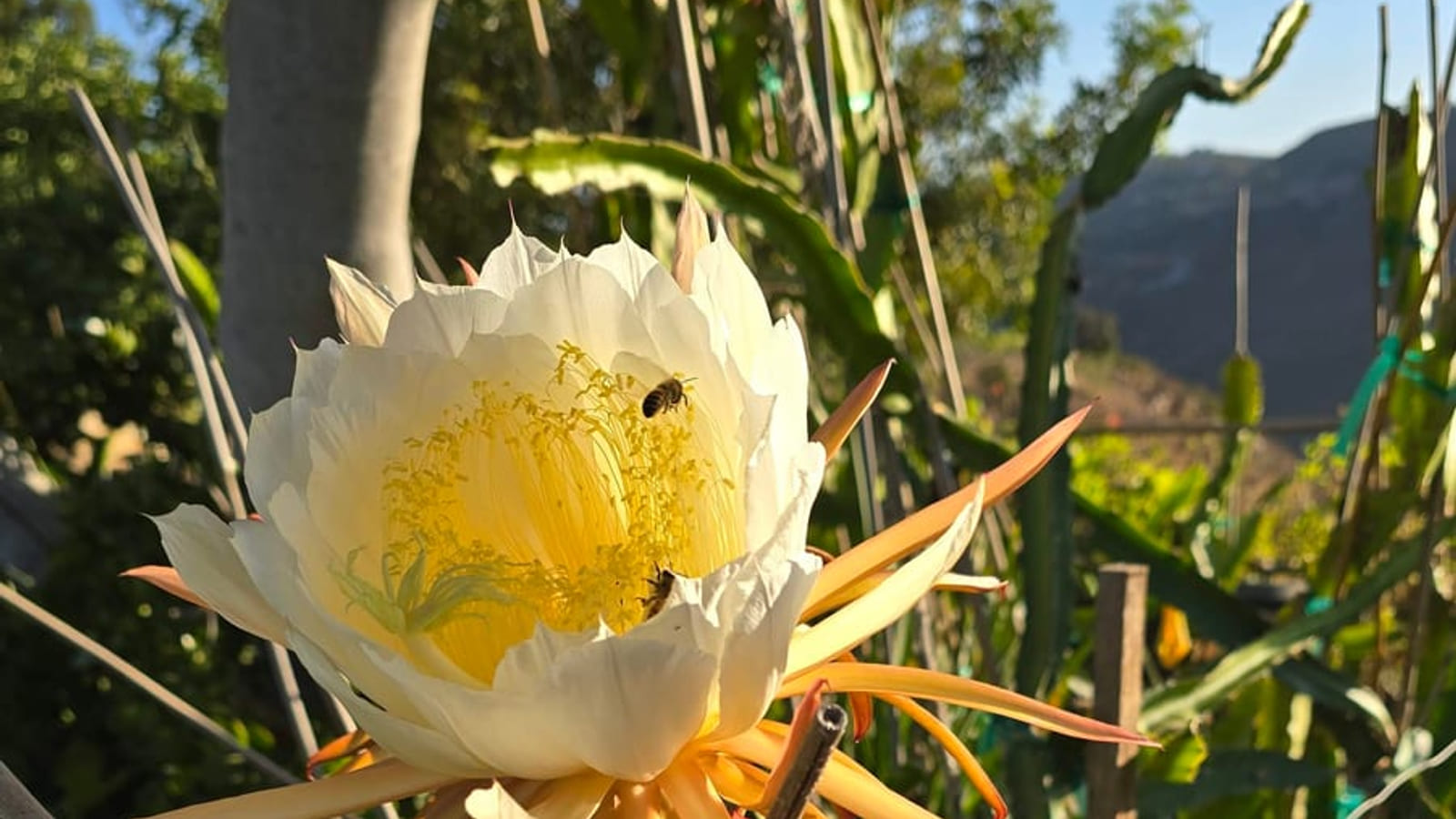
The timing matters as much as the genetics. Cotton Candy flowers open at night, reaching up to 14 inches long and 9 inches wide.[1] Moths and bats are the natural vectors because bees are not active in the dark, though these visits are rarely observed in home gardens.[1] Hand pollination after dusk or in the early morning is the reliable substitute. Transfer pollen or whole stamens from a compatible variety directly onto the stigma.[1]
Choosing the right partner requires care. Because Cotton Candy is a descendant of Connie Mayer, pollen from Connie Mayer, Bruni, or Kathy Van Arum is genetically too similar to work.[7] San Diego Fruit Farm warns against using these close relatives.[7] Instead, they recommend Sugar Dragon and Physical Graffiti as companion pollinators.[7] UF/IFAS advises planting two or three different genetic types to ensure cross-pollination improves fruit set and size.[1]
Research supports pairing pink-fleshed varieties with red-fleshed partners. A 2025 trial on white-fleshed *H. undatus* and pink-fleshed *H. polyrhizus* achieved 100 percent fruit set from hand cross-pollination with pollen from a different cultivar.[5] The highest fruit weight, pulp weight, and total soluble solids came from *H. undatus* flowers pollinated with *H. polyrhizus* pollen.[5] This suggests that mixed plantings with red-fleshed types inside a block of other varieties prevent low fruit weight.[5] For Cotton Candy, this means a red-fleshed unrelated partner is the strongest choice for maximizing both yield and sweetness.
Timing Tip: Since flowers open at night, check your vines after sunset. If you see a fresh bloom, locate a compatible partner flower open at the same time. Use a soft brush or your finger to move pollen from the anthers of the partner to the stigma of the Cotton Candy flower. Repeat this for every bloom you want to keep.
From Cutting to First Fruit
When you order Cotton Candy from us, you receive an unrooted cutting. This is standard for high-value hybrids, meaning the work of rooting is yours to do. Expect a timeline measured in months, not weeks. Do not expect fruit in the first season. The goal in year one is a strong root system and a sturdy canopy.
Start with the cutting itself. We ship segments that are typically 8 to 12 inches long.[7] Before you plant, make a fresh slanted cut at the bottom of the segment. This increases the surface area for rooting and helps shed water. Dust or douse the cut with a fungicide to prevent rot during the healing phase.
Curing is required for unrooted cuttings. Place the treated segment in a dry, shaded spot for 7 to 8 days. This allows the cut end to callous over. If you skip this step and plant immediately, the wet soil will likely cause the cutting to rot before it ever roots. Once the cut is dry and sealed, you are ready to pot.
Plant the cutting in a well-draining mix, keeping the cured end just below the surface. It will take 4 to 6 months in the pot for the plant to build a root system robust enough for transplanting.[1] During this time, keep the soil barely moist. Overwatering is the fastest way to lose a cutting. You will know it is ready to move when you see new green growth emerging from the top.
Timeline Reality Check: A Cotton Candy cutting planted in spring will likely be ready for the garden by late summer or fall. It will then need to establish itself on its support before it has the energy to flower. Plan for a two-year wait for your first meaningful harvest.
Once rooted, move the plant to its permanent location. Dragon fruit vines need heavy support. A sturdy post or trellis is essential because the stems can grow long and heavy. Plant the vine so the top growth is exposed to sunlight, but protect the base from scorching heat if you are in a very hot zone. Water consistently as the plant establishes itself on the support. Follow the pruning and watering schedule outlined in the Growing Cotton Candy section to encourage flowering.
Remember that Cotton Candy is self-sterile. You need an unrelated pollen parent blooming the same night to get fruit. If you are growing Cotton Candy alone, you will need to hand-pollinate using pollen from a compatible variety. See how self-fertile and self-sterile dragon fruit varieties differ to plan your pollination strategy.
Harvest, Storage and the Chilling-Injury Trap
Pitaya is a perishable berry with high water content and a fast respiration rate. Total soluble solids, the sugar-to-acid ratio, vitamins and phenolics all decline as respiration accelerates after harvest.[4]
Harvest only when the fruit is well-colored and fully mature. Cut the peduncle flush to the fruit surface to prevent moisture loss and entry points for rot.[1] If you see yellowing bracts on a fruit you picked green, that is not a defect of the Cotton Candy variety. It is chlorophyllase and peroxidase activity breaking down the green pigment. Scale yellowing typically appears within five days at room temperature, signaling the fruit is past its prime rather than underripe.[4]
The fridge trap. Most home refrigerators run colder than pitaya can tolerate. Cold injury occurs below 5 C.[4] The coldest part of your fridge, usually the back wall or the crisper drawer near the vents, is the wrong home for dragon fruit. Chilling injury manifests as pitting, softening and off-flavors, ruining the sweetness you worked to achieve.
For home growers, UF/IFAS recommends keeping pitaya at room temperature for 4 to 5 days, or storing it in plastic bags in the refrigerator for several weeks.[1] The plastic bag buffers the fruit from direct cold air and maintains humidity, which slows water loss. If you have a wine fridge or a garage that stays above 5 C, that is a better holding spot than the main kitchen fridge.
Commercial operations use controlled atmosphere storage to extend shelf life without freezing the fruit. A combination of 2 kPa O2 plus 5 kPa CO2 at 6 C significantly delays scale yellowing, rot and chlorophyll degradation while maintaining firmness and soluble solids.[4] This specific gas mix and temperature preserve skin color, pH and sugar levels far better than storage at 16 C or 23 C.[4] While you likely do not have a gas-mixing chamber at home, the principle holds: cool, stable, and not too cold.
| Condition | Temperature | Expected Shelf Life |
|---|---|---|
| Room Temperature | Ambient | 4 to 5 days |
| Home Refrigerator | Above 5 C | Several weeks (in plastic bag) |
| Commercial CA Storage | 6 C | Extended (2 kPa O2 / 5 kPa CO2) |
| Cold Injury Zone | Below 5 C | Rapid decline, pitting, softening |
Pre-harvest care matters here too. A cold-stimulation treatment before storage can help maintain metabolic balance and inhibit chilling injury, but that is a commercial technique.[4] For the home grower, the best defense is harvesting at peak maturity and eating the fruit quickly. Cotton Candy’s high Brix and delicate coconut notes are best enjoyed fresh, before respiration has had a chance to degrade the sugars.
Is Cotton Candy Worth the Space
Deciding to plant Cotton Candy depends entirely on what you want from your harvest. This variety demands a specific setup and a financial commitment, but it delivers a flavor profile that few other cultivars can match. Here is the breakdown for three common grower profiles.
The Flavor Seeker with One Trellis
If you have limited space and only one trellis, Cotton Candy is a challenge. It is self-sterile, meaning it cannot set fruit on its own.[7] You must plant a compatible, unrelated pollen parent that blooms on the same night. If you are already growing a self-fertile variety or a different pink-fleshed type, you might have a partner. If not, you are buying two plants to get fruit from one. The payoff is exceptional sweetness, with tests showing 19 to 20+ Brix and distinct spun-sugar notes.[7] But if you cannot accommodate the second plant, you will never taste the fruit.
The Collector Chasing Pink Flesh
For collectors, the pale pink to soft magenta flesh is the primary draw.[7] Cotton Candy is a hybrid from the Connie Mayer x G-1 cross, placing it in a large family of pink-fleshed siblings.[6] The visual appeal is high, and the fruit size is substantial, often weighing near 1.5 lb.[8] However, scarcity keeps cuttings expensive, with prices ranging from $39.99 to $69.99 for unrooted stems.[7] You are paying for the genetics and the color. If you are collecting for aesthetics and have the space for a pollinator, this is a good choice. If you are collecting for ease of fruiting, look elsewhere.
The SouCal Grower with a Frost-Free Yard
If you are in USDA zones 9b to 11, Cotton Candy works well.[7] It thrives in subtropical climates and handles container growing if you provide filtered afternoon shade during triple-digit heat.[7] The main hurdle remains pollination. You need a partner that is not a close sibling like Connie Mayer or Bruni.[7] San Diego Fruit Farm recommends Sugar Dragon or Physical Graffiti as effective companions.[7] If you have the yard space for two vines and the willingness to hand-pollinate at night, the reward is a heavy, candy-sweet harvest.
The Trade-Off: You are buying top-tier sugar and unusual pink flesh. The price is a mandatory pollen partner, no self-set, and high initial cost for cuttings.
Before you commit, check your existing collection for a compatible mate. If you are unsure which varieties work together, read our guide on how self-fertile and self-sterile dragon fruit varieties differ. If the pollination requirement feels like too much work, browse our variety list for self-fertile options that still offer excellent flavor.
References
- Pitaya (Dragonfruit) Growing in the Florida Home Landscape (HS303), UF/IFAS Extension, University of Florida (Crane, Balerdi, Majid) (2019).
- Combined Transcriptome and Metabolome analysis of Pitaya fruit unveiled the mechanisms underlying Peel and pulp color formation, BMC Genomics (Zhou et al.) (2020).
- Sucrose synthase cleavage dominance underpins high-sugar phenotype in pitaya (Hylocereus spp.): a multi-genotype study integrating morphology, spatial sugar profiling, and enzyme activities, Frontiers in Plant Science (Huang, Wu, Peng, Xu, Yang, He) (2026).
- Advances in the Understanding of Postharvest Physiological Changes and the Storage and Preservation of Pitaya, Foods (MDPI), review (Wang, Chen, Luo, Ba) (2024).
- Evaluation of Self-incompatibility on Fruit Set and Yield Parameters of Dragon Fruit (Hylocereus spp.: Fam. Cactaceae), Journal of Advances in Biology & Biotechnology (Reddy, Eswarappa, Anitha, Vijayakumar, Jagadish, Gagan) (2025).
- Cotton Candy Dragon Fruit Cultivar (Connie Mayer x G-1), Dragon Fruit Plants cultivar database (2026).
- Cotton Candy Dragon Fruit Cutting - Pink Flesh Hybrid, San Diego Fruit Farm (2026).
- Cotton Candy - Self-Sterile dragon fruit variety profile, Drogon Dragonfruit (2026).
- Cotton Candy dragon fruit (Connie Mayer x G-1, Don Burnett), Leewi Farms (2026).