Ohana Express Dragon Fruit: Fast, Sweet, Needs Pollinator
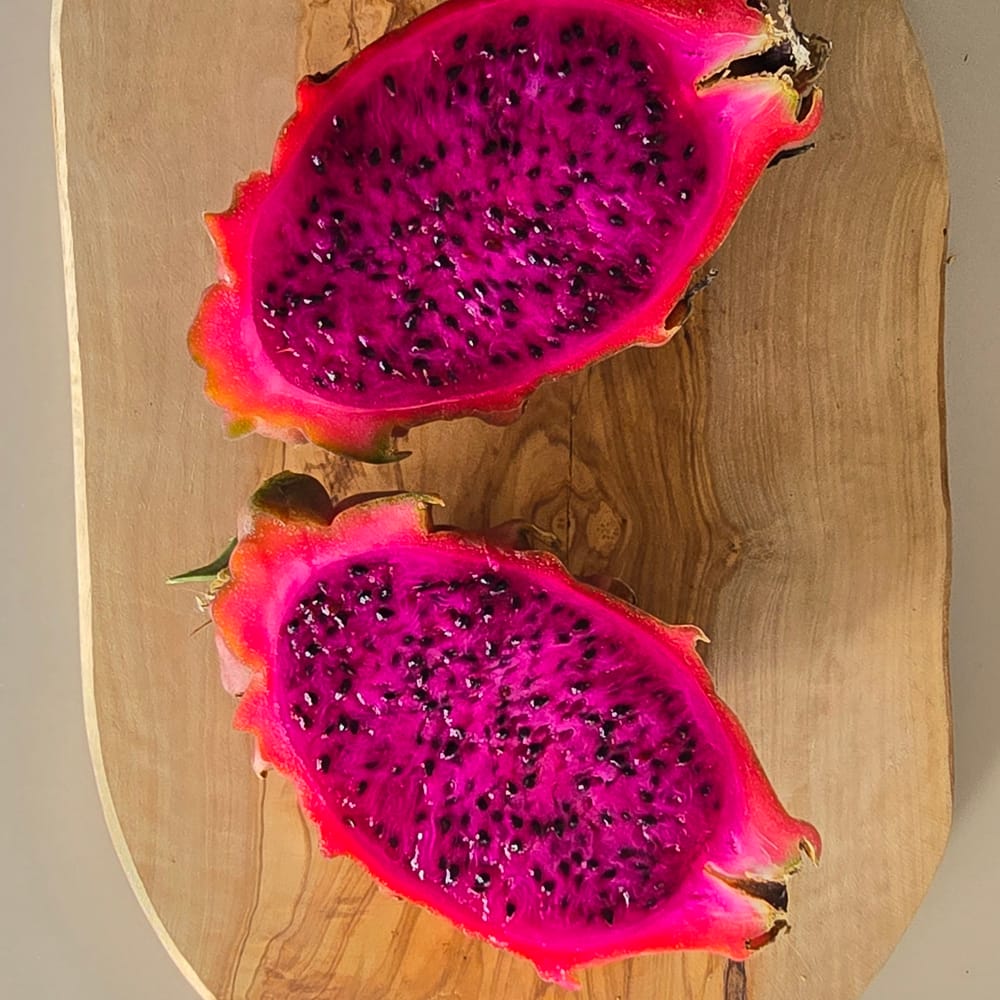
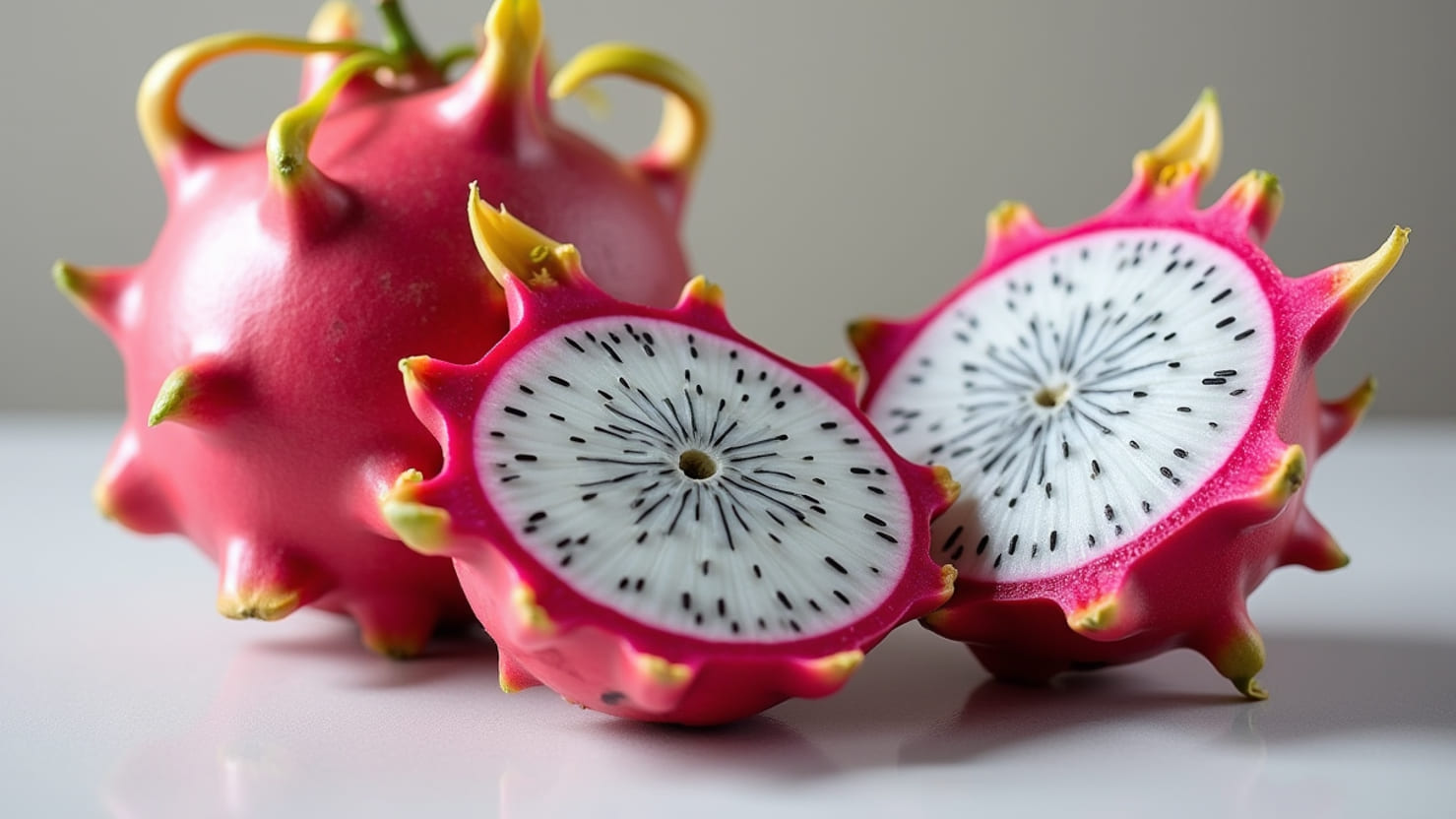
Ohana Express is a fast-fruiting, low-pollen variety that demands cross-pollination for reliable yields. This Hawaiian-named seedling of Desert King produces pink to magenta flesh with red skin and green-tipped fins. Although self-fertile, its minimal pollen means flowers often set poorly without help. Growers report 16 to 18 Brix sweetness, with trials averaging 19. It is the fastest-fruiting cutting Spicy Exotics has grown. Expect 30 to 35 days from bloom to harvest in warm conditions, up to 60 days in cooler trials. Plant it near a different genetic type to boost fruit set and size. See our [Dragon Fruit Pollination Guide] for tips on hand-pollinating low-pollen varieties.
Where It Came From
Ohana Express traces its roots to a specific breeding goal: commercial viability. The variety is a seedling of Desert King, an Israeli hybrid originally carried as selection 4126. That parentage was developed for growers who needed reliable production, and the resulting seedling was propagated in Hawaii. The state’s name stuck, becoming the moniker we use today. Spicy Exotics sourced the cutting directly from a Hawaii grower, bringing this lineage into the nursery trade.
You may encounter conflicting scientific names in older literature. This is a matter of taxonomy, not plant identity. The parent species Hylocereus polyrhizus has been reclassified as Selenicereus monacanthus. It is one of the four cultivated pitaya species, alongside S. undatus, S. costaricensis, and S. megalanthus. Old write-ups use the former name; new ones use the latter. The plant in your garden is the same regardless of which label is on the nursery tag[4].
What the Plant Looks Like
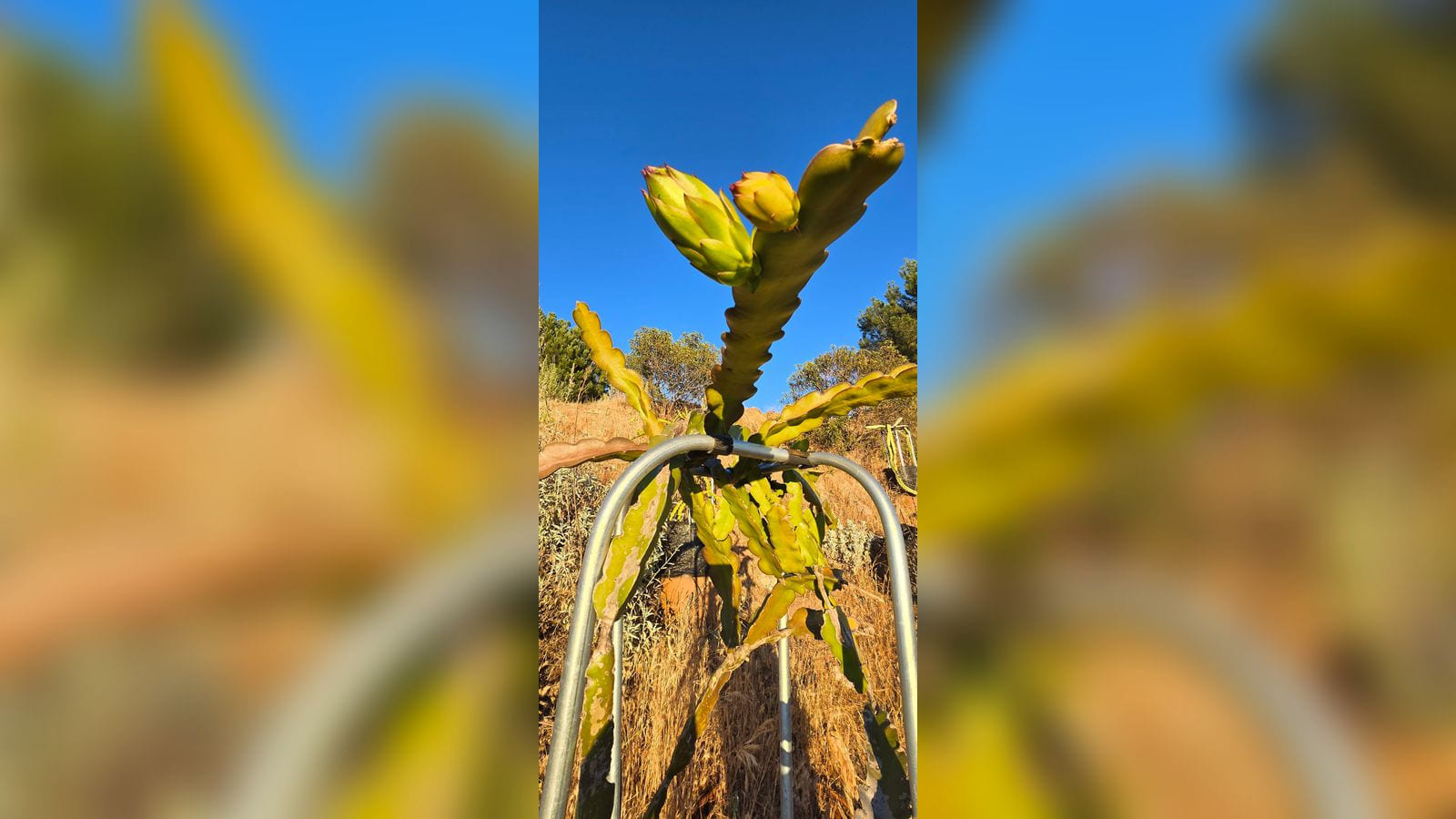
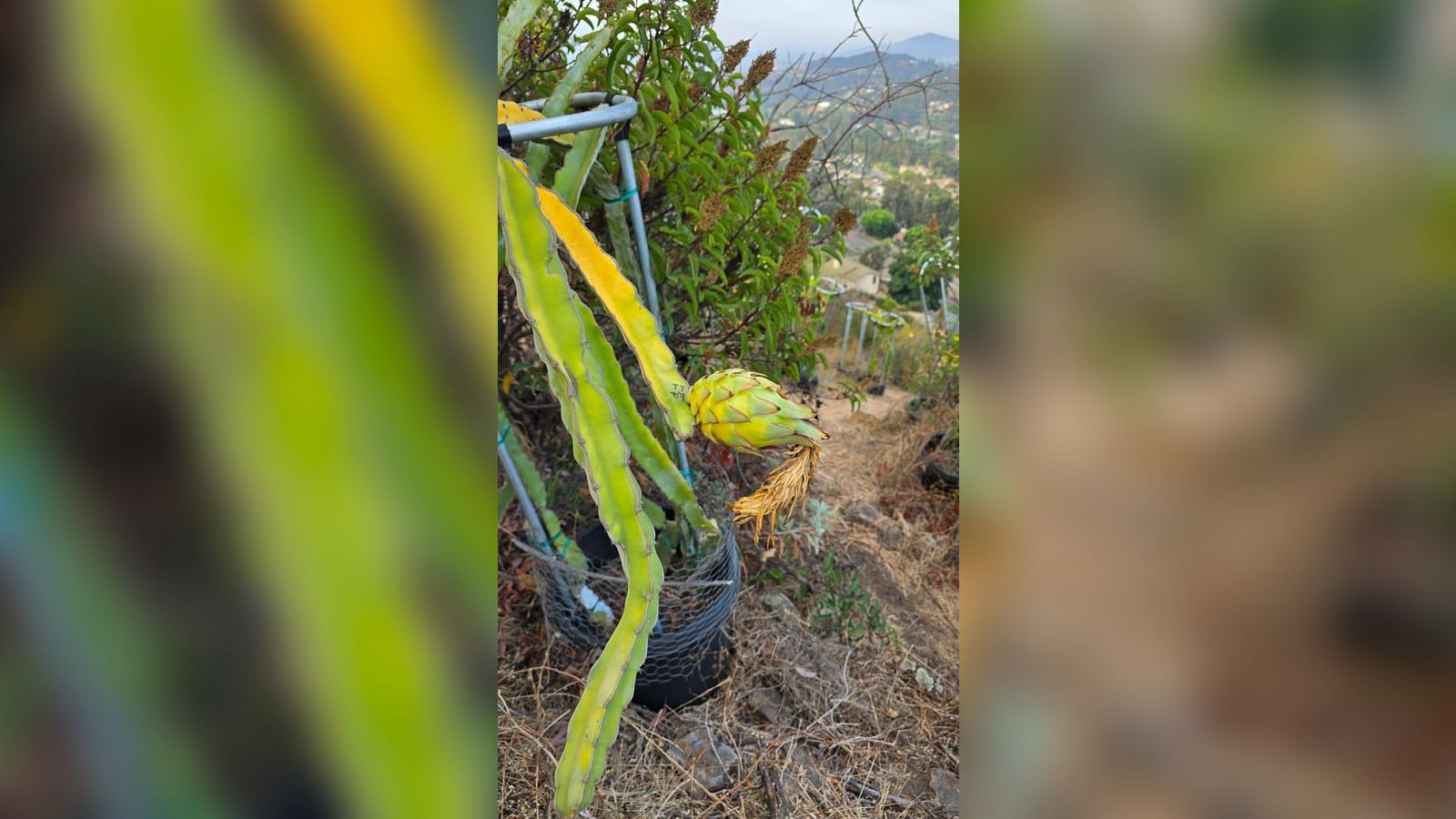
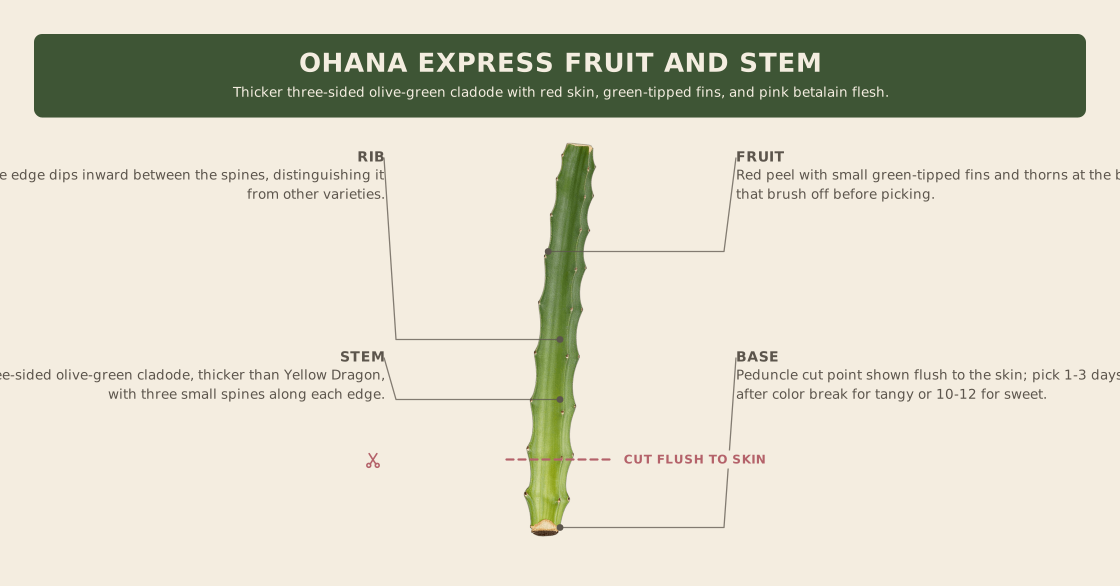
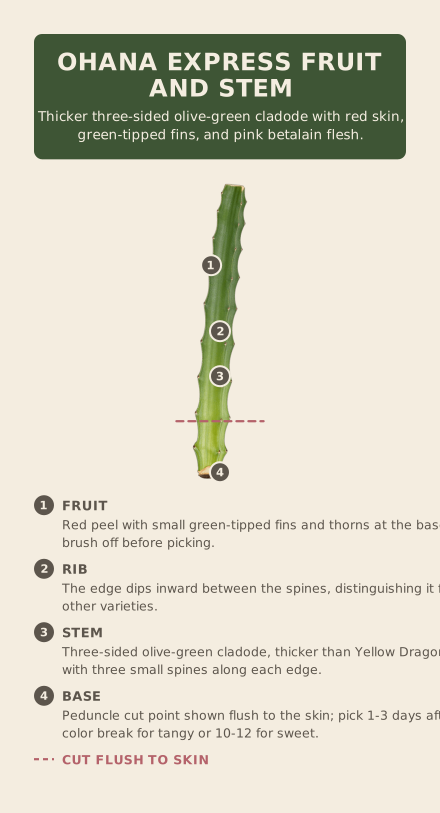
Identifying Ohana Express in the garden is straightforward once you know what to look for. The stems are three-sided and olive green, resembling Yellow Dragon but noticeably thicker. Each edge features three small spines with the edge dipping inward between them, creating a distinct scalloped profile.[1]
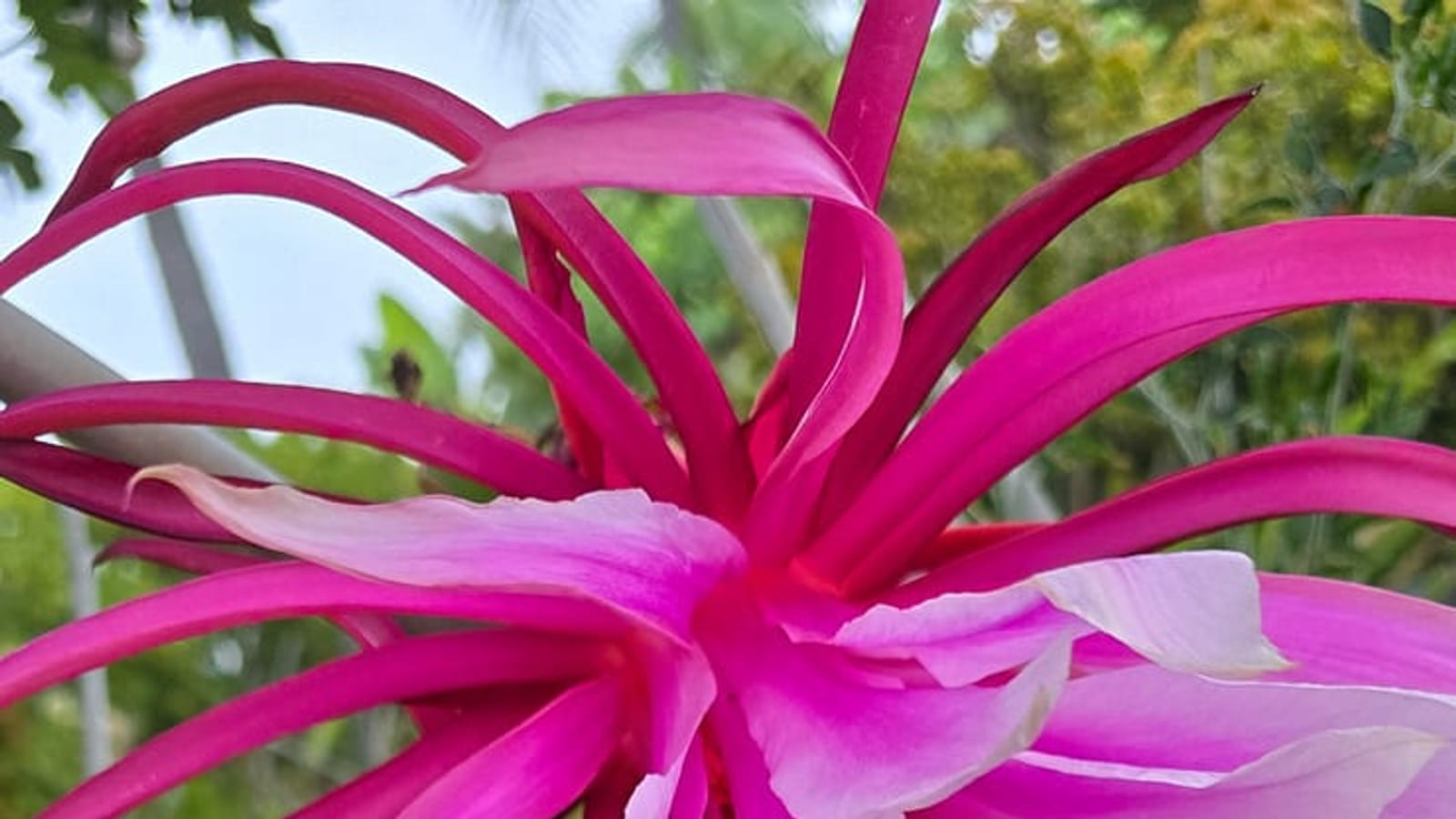
The flowers are large, nocturnal, and fragrant, opening at night to attract moths or bats. They are similar in size to Yellow Dragon blooms, with white and yellow petals on the front and deep-red backs.[1] The fruit itself has red skin with small green-tipped fins. A key identifier is the presence of thorns at the base of the fruit, which can be brushed off before picking.[1]
Use this quick-glance table to match your plant. Note that while the flesh color and sweetness are covered elsewhere, the physical structure is unique to this hybrid lineage.
| Feature | Ohana Express Identification |
|---|---|
| Stems | Three-sided, olive green, thicker than Yellow Dragon, edge dips between three small spines per edge[1] |
| Flowers | Nocturnal, fragrant, large (similar to Yellow Dragon), white/yellow petals, deep-red backs[1] |
| Fruit Skin | Red with small green-tipped fins, thorns at base that brush off[1] |
| Flesh | Pink to magenta |
| Brix | 16-18 (up to 19 in trials) |
| Pollination | Self-fertile but low pollen; cross-pollination recommended |
| First Fruiting | Approximately 10 months from cutting |
Because the thorns at the fruit base can be mistaken for ripeness issues, check our guide on how to tell when dragon fruit is ripe by variety to distinguish natural structural features from harvest signals.
Flavour and Sweetness, With Real Numbers
Ohana Express is a genuinely high-sugar red-flesh type. If you taste a tang, that is acidity, not a lack of sugar. The magenta flesh gets its colour from betalains, a pigment class found only in certain members of the cactus order. These compounds include red-purple betacyanins and yellow betaxanthins, which do not appear in most other plant families.[7]
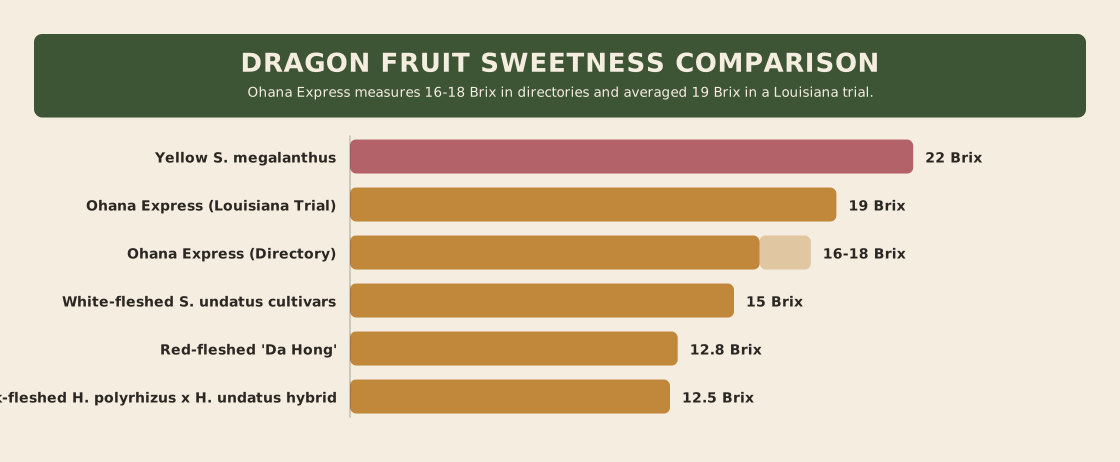
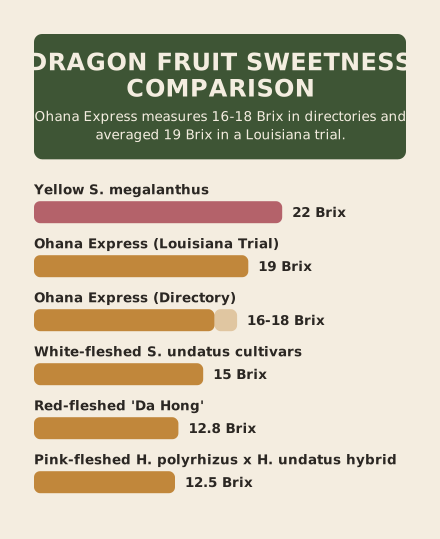
Total soluble solids rise on the vine, typically reaching 12 to 15 Brix depending on the cultivar, though some freshly picked varieties have hit 20 Brix.[6] Ohana Express sits comfortably above the average for red-fleshed types. In a metabolite survey, red-fleshed 'Da Hong' measured 12.8 Brix, and a pink-fleshed hybrid measured 12.5 Brix. The nursery figures for Ohana Express of 16 to 18 Brix, and an average of 19 Brix in a Louisiana trial, place it well ahead of those published benchmarks.[7]
When you compare it to the broader market, Ohana Express occupies a sweet spot between white and yellow pitayas. White-fleshed S. undatus cultivars generally hover around 15 Brix, while commercial yellow S. megalanthus often run about 22 Brix. Ohana Express delivers the sugar punch of a yellow without the mild flavour profile, offering a berry-forward taste that stands out against standard white varieties.[4]
How Fast It Fruits and Bears
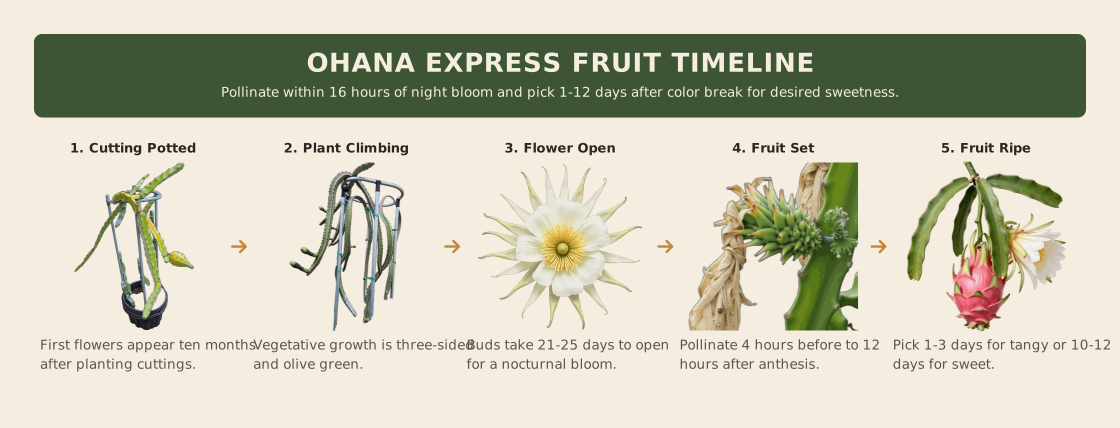
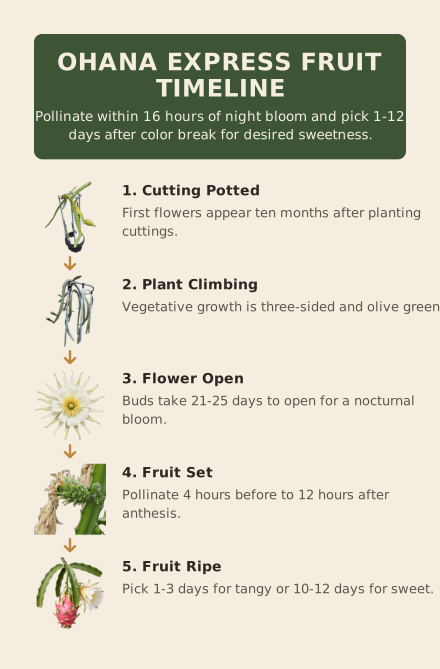
Ohana Express fruits quickly. At Spicy Exotics, it produced its first flowers ten months after the cuttings were planted. The nursery reports this as the fastest cutting to flower that they have grown. For context, yellow pitahaya typically comes into bearing roughly 14 months after transplanting.[6] That four-month gap is significant if you are planning a quick harvest from new stock.
Once the plant is ready to bloom, the timeline moves quickly. Buds take about 21 days to reach full bloom.[1] This is on the faster end of the spectrum, as bud-to-bloom periods across pitahaya types generally range from 10 to 20 days depending on the variety.[6] Because pitaya is a long-day photoperiod species, it flowers in waves when days are longer than nights and temperatures exceed 18 C.[6] You can expect these flushes to align with the warmer, brighter parts of the growing season.
Reconciling the Harvest Window
Growers often see two different figures for bloom-to-harvest time. The Dragon Fruit Directory lists a harvest window of 30 to 35 days after flowering.[5] This aligns with general pitahaya data, where fruit typically ripen 30 to 40 days after pollination.[6] However, in a Louisiana trial, Spicy Exotics recorded a bloom-to-harvest period of 60 days.[1]
Why the difference? Fruit development is temperature-dependent. In peak summer heat, metabolic processes accelerate, pushing harvest to the 30 to 35 day mark. As temperatures fall in autumn, development slows, stretching the timeline toward 60 days. Additionally, Ohana Express is self-fertile but carries minimal pollen.[1] When flowers set fruit using their own limited pollen, the resulting fruit often develop more slowly and remain smaller than those that receive cross-pollination. The 60-day figure reflects this slower, self-set development in a cooler climate trial.
If your fruit lingers on the vine longer than the directory suggests, do not worry. The plant is simply responding to the ambient temperature and the quality of the pollination event. In warmer months with hand-pollinated flowers, expect the faster 30 to 35 day turnaround. In cooler months or with self-set fruit, allow the extra time.
The Hand-Pollination Trick That Fixes Its One Weakness
Ohana Express is self-fertile, but "self-fertile" is a misleading term when the flower carries minimal pollen. You might see a bloom open, wait for the fruit to set, and get nothing. Or you get a fruit that is tiny, misshapen, or drops after a few days. This is a pollen shortage, not a disease. The fix requires timing and a partner plant.
UF/IFAS recommends planting two or three different genetic types in your garden, not just clones of the same variety[3]. For Ohana Express, this means you need a pollen donor. A yellow-fleshed type (like Yellow Dragon or Yellow Palora) or a red-fleshed type with heavy pollen load works well. Do not rely on a second Ohana Express cutting. Two identical plants cannot cross-pollinate each other. They need genetic diversity to trigger full fruit development.
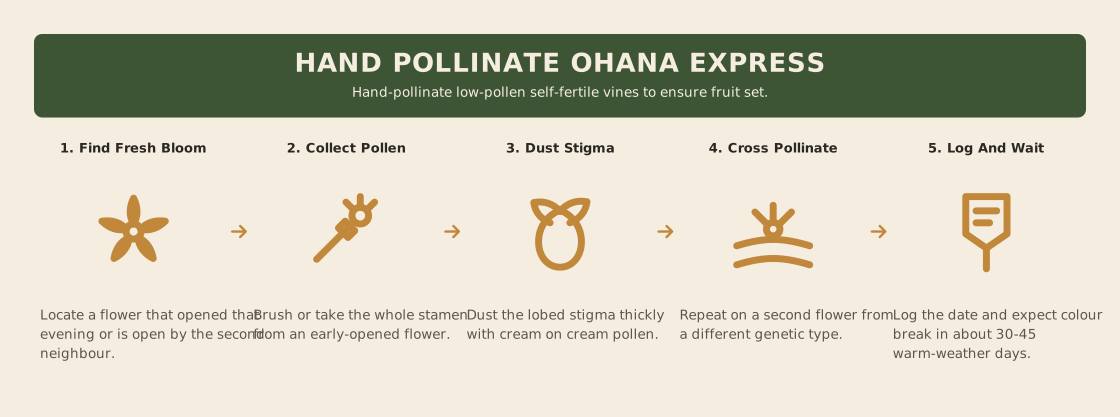
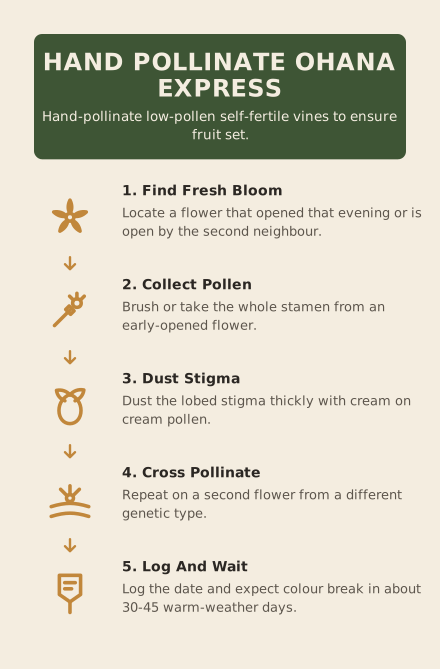
The pollination window is narrow. Research on commercial pitaya mapped pollen viability and stigma receptivity to a period running from four hours before to twelve hours after anthesis[2]. Anthesis is the moment the flower fully opens. For nocturnal blooms like Ohana Express, this happens in the evening. The practical window is early evening, right as the flower opens, or the next morning before the heat dries the stigma. Once the flower closes and wilts, the opportunity is gone.
Here is how to do it. Wait until the flower is fully open and the stigma (the lobed center) is sticky and receptive. Use a soft brush or take a whole stamen (the pollen-bearing part) from a donor flower. Gently brush the stamen against the stigma of the Ohana Express flower. You want to transfer visible yellow pollen onto the lobes. If you are using a brush, dab it into the donor’s anthers first, then swipe it across the Ohana Express stigma. Repeat this for every open flower you want to keep.
Rain disrupts hand pollination. If a heavy rain falls the night you pollinate, the pollen washes away or clumps, causing a pollination deficit that cuts fruit set and size[2]. If rain is forecast, pollinate the night before or skip that wave of blooms. You cannot pollinate a wet flower effectively.
If you are seeing poor results, check this table to diagnose the issue.
| Symptom | Likely Cause | Fix |
|---|---|---|
| Few fruits set | No pollen donor nearby or hand pollination missed | Add a genetically different variety; hand pollinate every bloom |
| Fruit stubby at blossom end | Incomplete pollination of stigma lobes | Ensure you touch all lobes of the stigma with pollen |
| Blooms drop after one night | Rain washed pollen away or stigma was not receptive | Pollinate earlier in the evening; protect from heavy rain |
| Only spring flowers | Insufficient light or temperature fluctuation | Ensure full sun; check for stress from drought or cold |
Hand pollination is not just about getting fruit. It is about getting the right size. Studies show that even self-compatible varieties produce significantly heavier fruit when manually cross-pollinated[2]. For Ohana Express, which is already low-pollen, skipping this step guarantees small, inconsistent harvests. Do the work in the evening, keep a donor plant close, and you will turn a weak setter into a reliable producer.
When to Pick It, and Why the Window Is Two Weeks Wide
Dragon fruit is non-climacteric. Once you cut the stem, the sugar content is locked in. There is no ripening on the counter, no softening that signals sweetness, and no waiting game. What you taste on day one is what you get on day five. This makes the harvest window critical, and for Ohana Express, that window is unusually wide.
Spicy Exotics reports two distinct harvest points depending on your palate. Pick 1 to 3 days after the skin begins turning red for a tangy berry profile with bright acidity. If you prefer a sweeter, flatter flavor with less tartness, leave the fruit on the vine for 10 to 12 days after that initial color break.[1] Both are ripe. Both are edible. The difference is acid balance versus sugar dominance.
- Day 0: Skin begins turning red (color break).
- Day 1-3: Harvest for tangy, berry-forward flavor.
- Day 10-12: Harvest for sweeter, milder flavor.
In Gulf Coast and Florida climates, expect this sequence to play out between June and November.[3] The fruit does not hold indefinitely on the plant. Wait too long past the 12-day mark, and you risk splitting or pest damage.
Handling Ohana Express requires care. The fruit has thorns at the base that can brush off, but the surrounding stems and the fruit itself can still snag. Wear gloves and long sleeves. Use sharp clippers to cut the fruit from the plant. Cut the peduncle flush with the fruit body to prevent a protruding stem that can puncture other fruit or snag in storage.[3]
Post-harvest storage is simple. The fruit keeps for 4 to 5 days at room temperature. For longer storage, place them in plastic bags and refrigerate. They will hold for several weeks under these conditions.[3] Because the flavor does not improve after cutting, refrigeration is purely about texture preservation, not ripening.
Growing It in the Garden or a Pot
Ohana Express thrives in warm, dry conditions that mimic its tropical origins. The plant prefers an optimum temperature band of 18 to 26 C, though it can survive and grow in a wider range of 14 to 32 C.[4] Heat becomes a limiting factor quickly. Once temperatures exceed 28 C, the plant’s ability to take in carbon dioxide at night drops sharply, with each additional degree reducing uptake by 58%.[4] Flowering stops entirely above 38 C.[4] Frost is the biggest threat. Extended exposure to 31 F damages the stems, and temperatures hitting -4 C will kill the plant.[3] This makes Ohana Express a Zone 10 or 11 crop for the ground, or a container plant you move indoors during cold snaps.
Support structure is critical for a plant of this vigor. A mature Ohana Express can carry several hundred pounds of stem weight. UF/IFAS recommends a 4 to 6 inch pressure-treated post topped with a metal or rebar grid cap to hold the canopy.[3] Set the trellis 10 to 15 feet away from other plants and structures to allow for air circulation and growth.[3] Avoid bare wire supports, which can cut into the thick, fleshy stems as they expand.
Water management drives both health and production. The plant requires a dry period in winter and early spring to trigger abundant bloom induction.[3] Once flowers appear, switch to regular watering through harvest. Excess soil moisture during the wet phase invites bacterial and fungal diseases.[3] If you are growing in a pot, skip the gravel layer at the bottom. Fill the container with a single free-draining mix all the way down and ensure it has a clear drainage hole.
Care Specifications at a Glance
| Factor | Requirement | Why It Matters |
|---|---|---|
| Temperature | 18-26 C optimum; 14-32 C workable | Above 28 C, CO2 uptake drops 58% per degree; -4 C kills plants[4] |
| Support | 4-6 in treated post with rebar grid cap | Must hold several hundred pounds of stem weight[3] |
| Spacing | 10-15 ft from structures | Prevents crowding and allows for canopy spread |
| Watering | Dry winter/spring; wet bloom to harvest | Dry period induces bloom; wet period supports fruit fill[3] |
| Potting | No drainage layer; one free-draining mix | Gravel raises water table and causes root rot |
| Yield | ~220 lb/year at 3-4 years old | Planting lasts about 20 productive years[3] |
With proper care, a three to four-year-old plant can produce about 220 lb of fruit per year.[3] A well-maintained planting can remain productive for approximately 20 years.[3] Start with a cured cutting that has callused for 7 to 8 days to prevent rot at the base.[3] Plant it in full sun, though providing about 30% shade for the first few months can help young stems establish without sunburn.
Where It Fits in a Planting Plan
Buy Ohana Express for speed and flavor, not for volume. This selection is a specialist’s choice for growers who want fruit on the vine quickly and are willing to trade size for that early payoff. It is one of the fastest-fruiting cuttings we have grown. That timeline is significantly faster than many common varieties, making it an excellent candidate for a first-year harvest or a succession planting where you need early production to fill gaps in your season.
The trade-off is fruit size. Ohana Express produces smaller fruit compared to jumbo commercial types, a documented weakness that becomes more apparent in the first year[5]. In our Louisiana trials, first-year fruit were notably smaller than those grown in Hawaii, though size improved in years two and three[1]. If your goal is market-weight fruit for wholesale, this is not your primary variety. If your goal is high-Brix pink flesh with a distinct berry acidity for home consumption or niche sales, the size compromise is worth it. The sweetness levels, reported between 16 and 18 Brix, place it well above standard white-fleshed types[5].
Because of its low pollen count, Ohana Express does not fit into a monoculture plan. It requires a partner. Plant it near a genetically different variety to ensure reliable fruit set and to help maximize the size of those smaller fruits. A single cutting of Ohana Express surrounded by clones of itself will frustrate you. A single cutting interplanted with a vigorous, high-pollen variety like a standard white-fleshed or yellow type will perform. This makes it an ideal "accent" plant in a mixed row rather than a standalone block.
Availability Note: Ohana Express is a rarer selection with limited stock. Many nurseries, including ours, enforce a single-cutting-per-customer limit to ensure more growers get access to this lineage. If you are planning a larger planting, order early or plan to propagate your own cuttings from the first successful harvest.
Consider the harvest window when placing this plant. Ohana Express flowers in waves, typically May through September, with fruit ripening 30 to 35 days after flowering[5]. This aligns with the standard red-skinned pitaya season in many regions, such as Florida’s June through November window[3]. Because the fruit is non-climacteric, you must be present to pick it. Do not plant Ohana Express in a hard-to-reach corner of a large property if you cannot check the vines daily during peak season. The two-week harvest window is wide enough for flexibility, but not wide enough for neglect.
Ohana Express fits best in a plan where you value early returns and exceptional flavor over bulk production. It is a high-maintenance, high-reward plant for the discerning grower who understands that its small size is the price of its speed and sweetness. Pair it with a reliable pollinator partner, manage the harvest timing closely, and you will have a standout performer in your collection.
FAQs
Is Ohana Express self-fertile?
Technically, yes. The plant produces hermaphroditic flowers that can set fruit on their own pollen. However, Spicy Exotics records that minimal pollen exists in each flower, causing poor fruit set without help.[1] You should treat it as functionally self-sterile for reliable yields. Hand-pollination or a nearby pollen donor is necessary to get full-sized fruit.
Does it need a pollen donor?
Yes, for commercial-grade results. While self-pollination can occur, UF/IFAS recommends planting two or three different genetic types to boost fruit set and size.[3] Ohana Express is a hybrid of Hylocereus polyrhizus and Selenicereus megalanthus, so it benefits from cross-pollination with a genetically distinct variety.[1] A red-fleshed clone in a two-year study was strictly self-incompatible, while others responded to manual cross-pollination with significantly heavier fruit.[2] Planting a different cultivar nearby ensures you have viable pollen available during the night-blooming window.
How sweet is it in Brix?
Expect 16 to 18 Brix, with trials averaging 19. Spicy Exotics measured an average of 19 Brix in their Louisiana trial.[1] The Dragon Fruit Directory lists a range of 16 to 18 Brix.[5] The sweetness is accompanied by a tangy berry profile, which is acidity, not a lack of sugar.
How long from cutting to fruit?
Approximately ten months. Spicy Exotics reports that first flowers appeared ten months after planting cuttings, making it the fastest-fruiting variety they have grown.[1] This is faster than Yellow Dragon, which typically comes into bearing around 14 months after transplanting.[6] Once blooming, buds take about 21 days to reach full flower, and fruit ripen 30 to 60 days after pollination depending on conditions.[1][5]
Can I grow it in Southern California or a pot?
Yes, with care. Pitaya grows best at 65 to 77°F (18 to 25°C) and is a full-sun crop, though 30% shade is advised for the first few months in high-insolation areas.[3] Southern California fits this temperature band well, but extended exposure below freezing (31°F, -2°C) will damage the plant.[3] In pots, use a free-draining mix all the way down. Ensure the pot has a drainage hole.
Why are my Ohana Express fruits small?
Several factors contribute to small fruit. First, low pollen levels mean self-pollinated fruit often set poorly or remain small. Cross-pollination is required for maximum size.[1] Second, first-year fruit are frequently smaller than those in years two and three, as seen in Spicy Exotics' trials.[1] Third, rain during the pollination window can cause a pollination deficit, cutting fruit set and size.[2] Finally, the variety is known for slightly smaller fruit compared to other commercial types, so some size limitation is genetic.[5]
Key takeaways
- Plant a genetically different pitaya nearby to guarantee fruit set.
- Brush off the thorns at the fruit base before picking; they are a natural structural feature.
- Provide a heavy-duty support structure, as mature vines carry significant weight.
For detailed techniques on managing low-pollen varieties, refer to our Dragon Fruit Pollination Guide.
Ready to grow? Sky Botanicals offers verified Ohana Express cuttings, sourced directly from established growers to ensure genetic purity and vigor.
References
- Ohana Express - H. polyrhizus x S. megalanthus (variety page with Louisiana trial notes), Spicy Exotics (2026).
- Floral and pollination biology of dragon fruit reveals strategies for enhancing productivity through pollination management and reproductive window extension, Scientific Reports (Nature) (2025).
- Pitaya (Dragonfruit) Growing in the Florida Home Landscape, HS1068/HS303 (rev. December 2019), UF/IFAS Extension, University of Florida (2019).
- Pitaya as a New Alternative Crop for Iberian Peninsula: Biology and Edaphoclimatic Requirements, Plants (MDPI) (2023).
- Ohana Express Cultivar - The Dragon Fruit Directory, The Dragon Fruit Directory (Tendra) (2026).
- Yellow Pitahaya (Selenicereus megalanthus Haw.): The Less Known of the Pitahayas, Foods (MDPI) (2025).
- Contribution of anthocyanin pathways to fruit flesh coloration in pitayas, BMC Plant Biology (2021).