Purple Dawn Dragon Fruit: Self-Fertile & Sweet
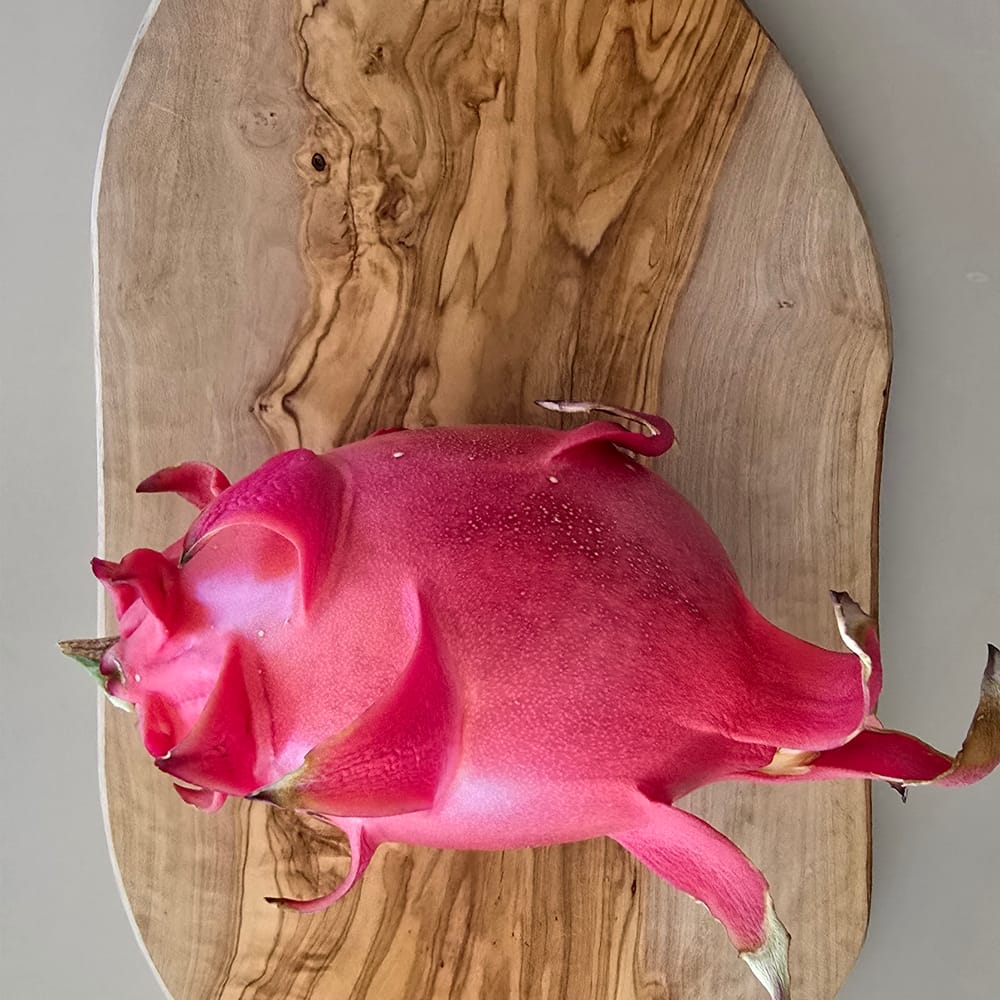
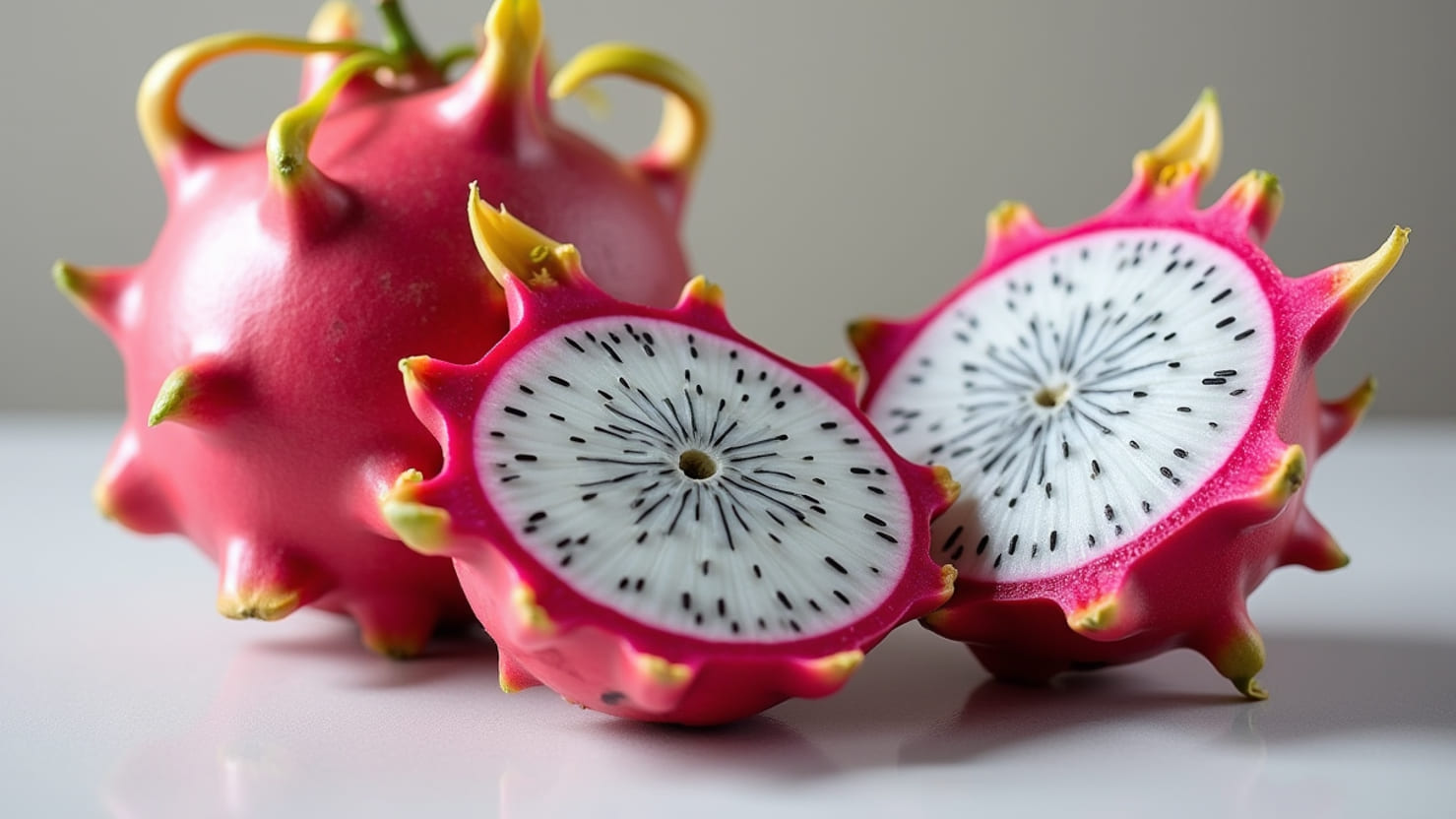
Purple Dawn dragon fruit produces large, sweet purple fruit and sets fruit on its own. This Australian hybrid yields fruit weighing up to 850 grams with rich, jelly-like texture and crunchy seeds. Growers report high sugar content, and the plant features a strong growth habit and reliable fruiting in warm climates. Its white flowers have soft pink and yellow inner tones. Purple Dawn is self-fertile, making it ideal for small gardens. We stock verified cuttings.
For successful cultivation, provide full sun and a sturdy trellis to support heavy stems. Fill pots with one free-draining mix all the way down. Dragon fruit cuttings root quickly and can fruit within months of planting. Visit our dragon fruit care guide for detailed watering and feeding schedules.
Where it came from: the Cactus Fruits Australia breeding line
Purple Dawn is a hybrid developed by Steven Prowse at Cactus Fruits Australia, a breeding program based in South East Queensland. The variety was released in 2022 and is listed in nursery catalogs as CFA Purple Dawn.[5] Its parentage is documented as a cross between two other selections from the same program: Purple Pearl and Dawn's Supreme.[6] Prowse has described the resulting plant as a standout for its combination of large fruit size and sweet, purple flesh.
The breeding line prioritizes commercial viability in warm climates. Growers in the region report that the plant performs reliably under local conditions, producing heavy yields.[5] While some pitaya cultivars require cross-pollination with genetically different types to set good fruit, Purple Dawn is self-fertile.[1]
A note on origin claims: You may see Purple Dawn described elsewhere as a Florida-grown selection. That claim conflicts with the documented Australian parentage and release history. The variety’s traits, including its self-pollinating habit and purple flesh, are tied to its Cactus Fruits Australia lineage.
The plant’s strong growth habit and vigorous fruiting are consistent with its breeding goals. It produces large, heavy fruit that demands sturdy support, a characteristic bred for productivity rather than just ornamental value. The flowers are medium-sized and white, with soft pink and yellow tones in the inner segments, distinguishing them from similar-looking varieties like CFA Purple Heart.[5] These visual and structural traits are verified on the farm before cuttings are sold, ensuring you get the true clone from the Prowse program.
What the fruit tastes like and why the flesh is purple
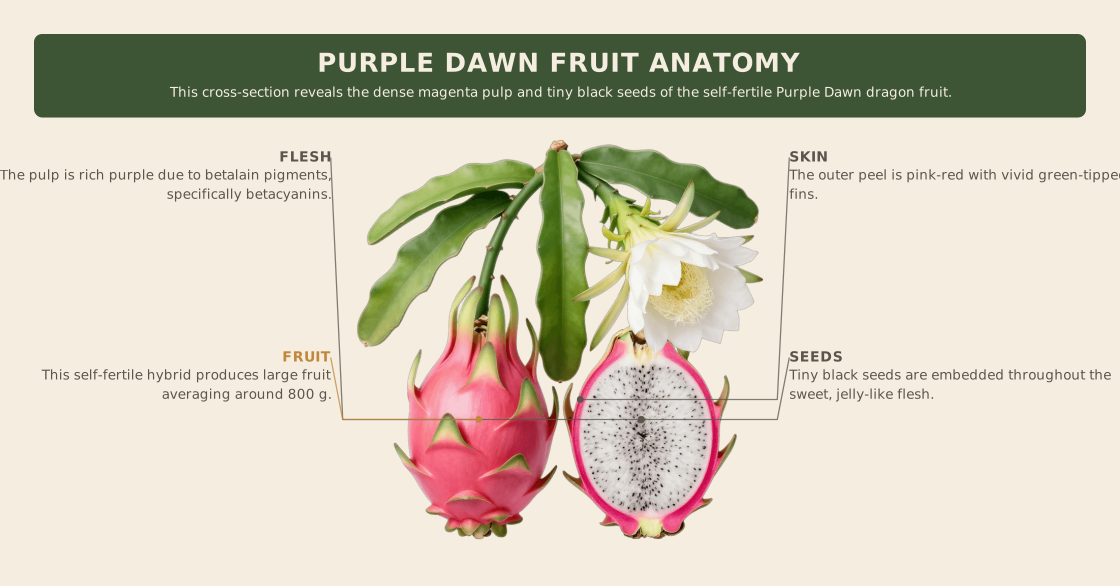
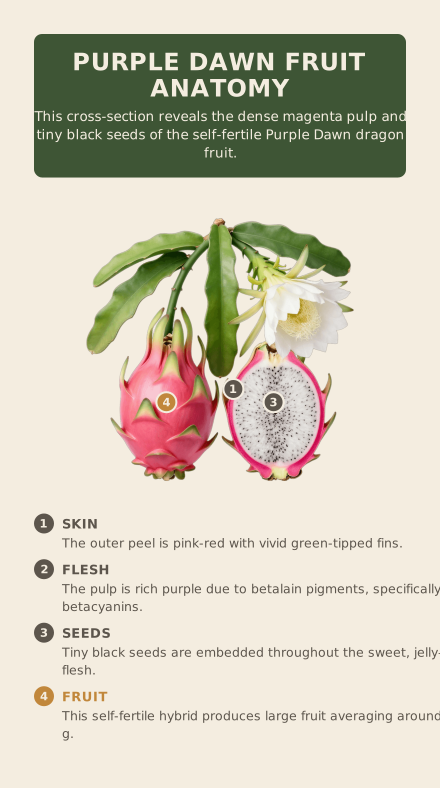
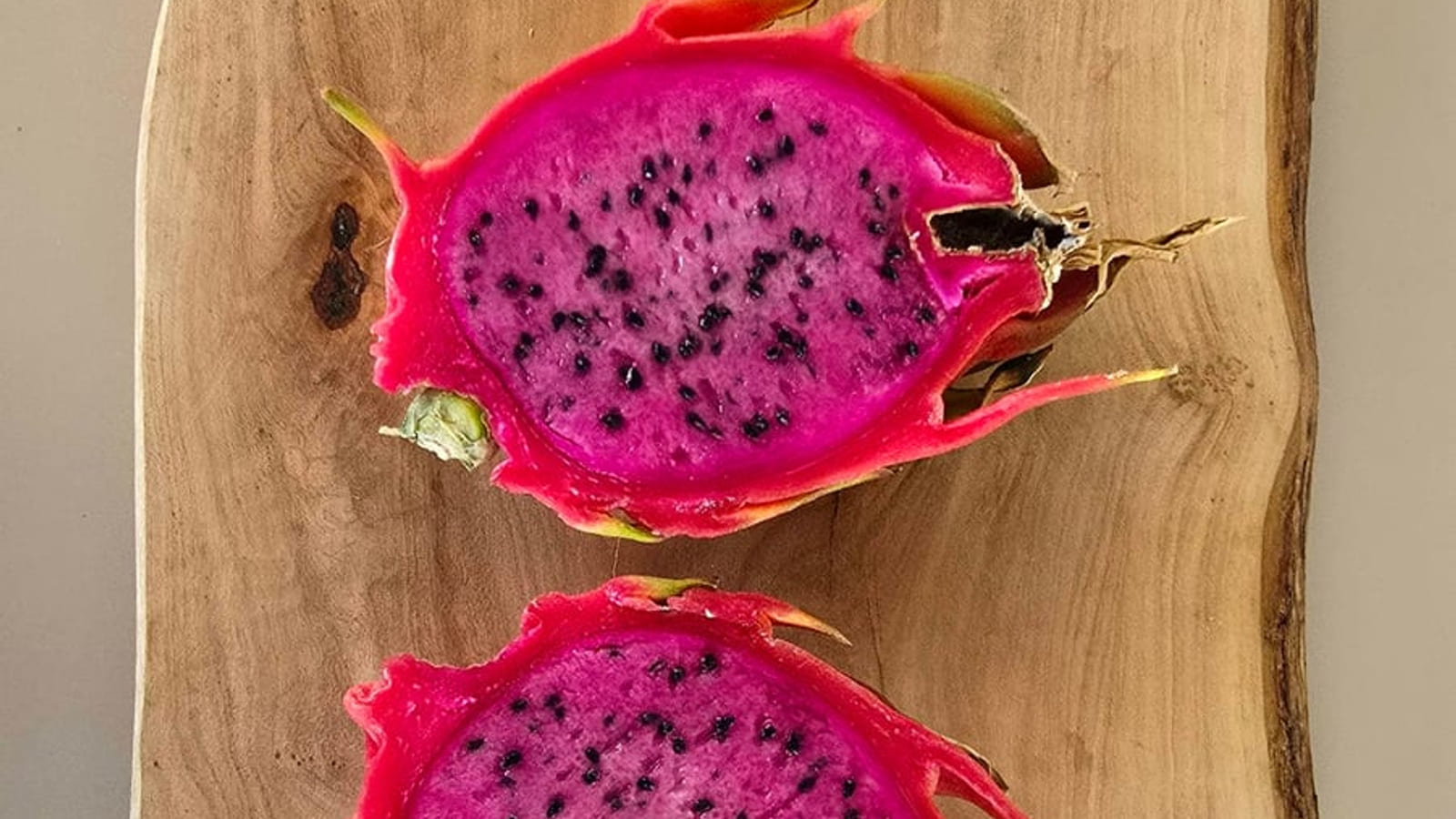
When you slice into a ripe Purple Dawn, the first thing you notice is the color. The flesh is a deep, vivid purple, a hue that signals the presence of betalain pigments, specifically betacyanins. This is the same pigment family responsible for the red in beets and the magenta in prickly pear juice. In pitaya, these compounds are concentrated in the pulp, turning what would otherwise be white flesh into a striking visual display. While the color is beautiful, it is also chemically fragile. Betacyanins degrade when exposed to heat, light, or neutral to alkaline conditions, which is why the vibrant purple can fade if the fruit is cooked or left out too long. For the home gardener, this means the fruit is best enjoyed fresh and raw to preserve both its color and its antioxidant properties.
The flavor is exceptional. Growers and nursery listings consistently describe the taste as super-sweet with a jelly-like texture. The sweetness is not just a subjective claim; refractometer readings from the Cactus Fruits Australia program have measured sugar content at 20 Brix. Most red-fleshed types in university trials landed between 14 and 19 Brix. A 20 Brix reading places Purple Dawn among the sweeter cultivars available, rivaling or exceeding the sweetness of many commercial favorites. The texture complements the sugar, offering a smooth, gelatinous pulp that contrasts with the crunchy, black seeds scattered throughout. This combination of high sweetness and a pleasant, non-grainy mouthfeel makes it a standout choice for fresh eating.
Flavor and Texture Profile
| Attribute | Description |
|---|---|
| Sweetness | High; measured at 20 Brix by growers |
| Texture | Jelly-like, smooth pulp with crunchy seeds |
| Color Stability | Vivid purple, but fades with heat and light exposure |
| Aroma | Subtle, sweet berry notes |
The nutritional profile of red-fleshed pitaya like Purple Dawn also differs from its white-fleshed cousins. While both are hydrating, red-fleshed varieties typically contain slightly more fiber and higher levels of certain minerals like iron and phosphorus. The betalains that give the flesh its color are also potent antioxidants, though their potency diminishes as the pigment breaks down. Eating the fruit fresh ensures you get the full benefit of these compounds. The high water content, roughly 83 percent, makes it a refreshing snack, especially in the warm climates where this variety thrives.
Because the fruit is heavy and sweet, it attracts pests if left on the plant too long. Harvest when the skin is fully colored and the fins begin to dry slightly. The flesh inside will be at peak sweetness and texture. If you are growing in a pot, remember that the plant’s vigor and fruit load require consistent moisture. Instead, use a single, free-draining mix all the way down to ensure the roots stay healthy and the plant can support the development of those large fruits.
Will Purple Dawn set fruit on its own?
Purple Dawn is self-fertile, meaning it does not require a second, genetically different plant nearby to produce fruit. This trait is documented in the variety’s release notes and confirmed by growers in South East Queensland, where the plant performs reliably without complex pollination management.[5] For home gardeners with limited space, this simplifies cultivation significantly. You can grow a single plant on a sturdy trellis and still expect a harvest.
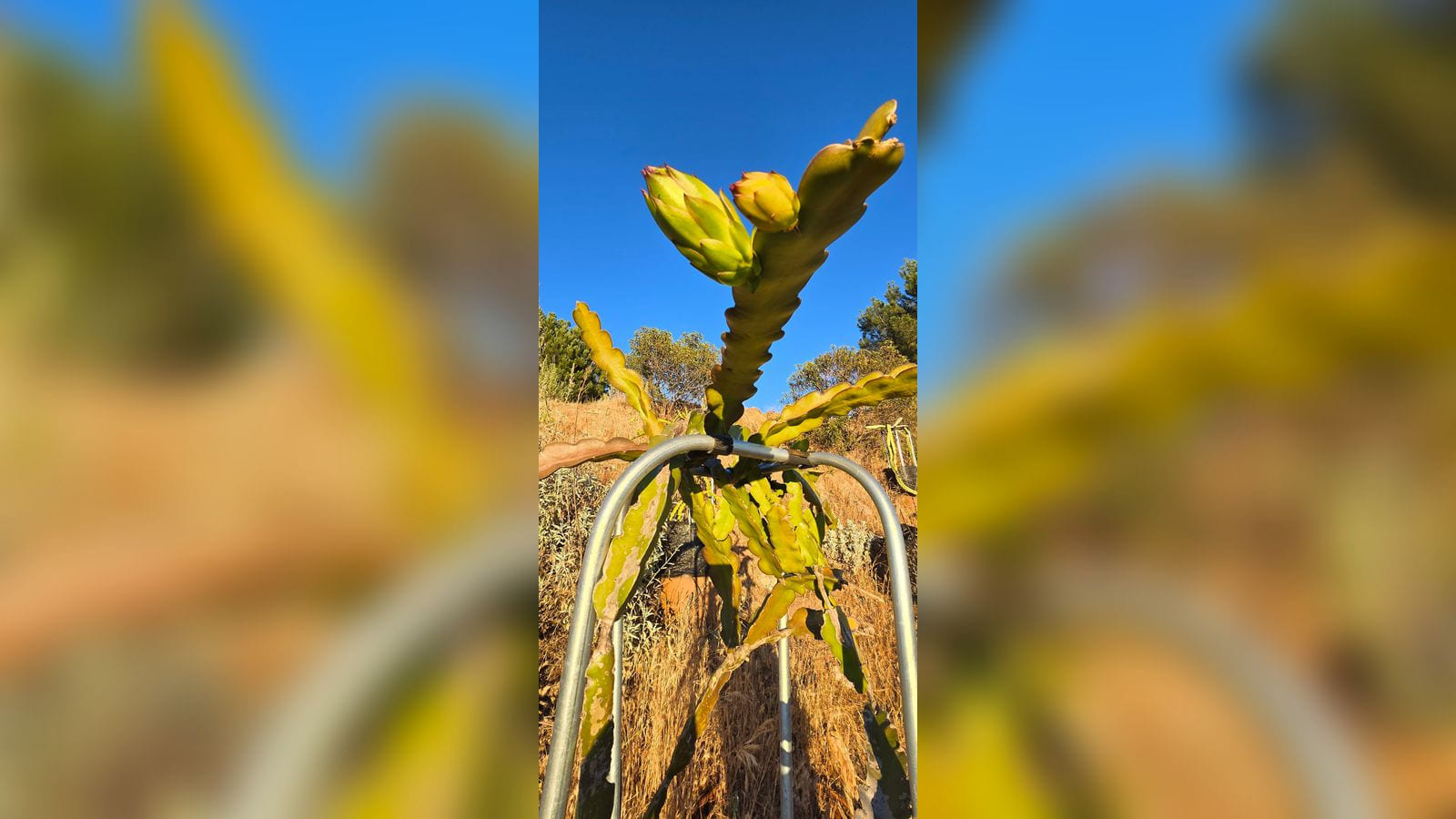
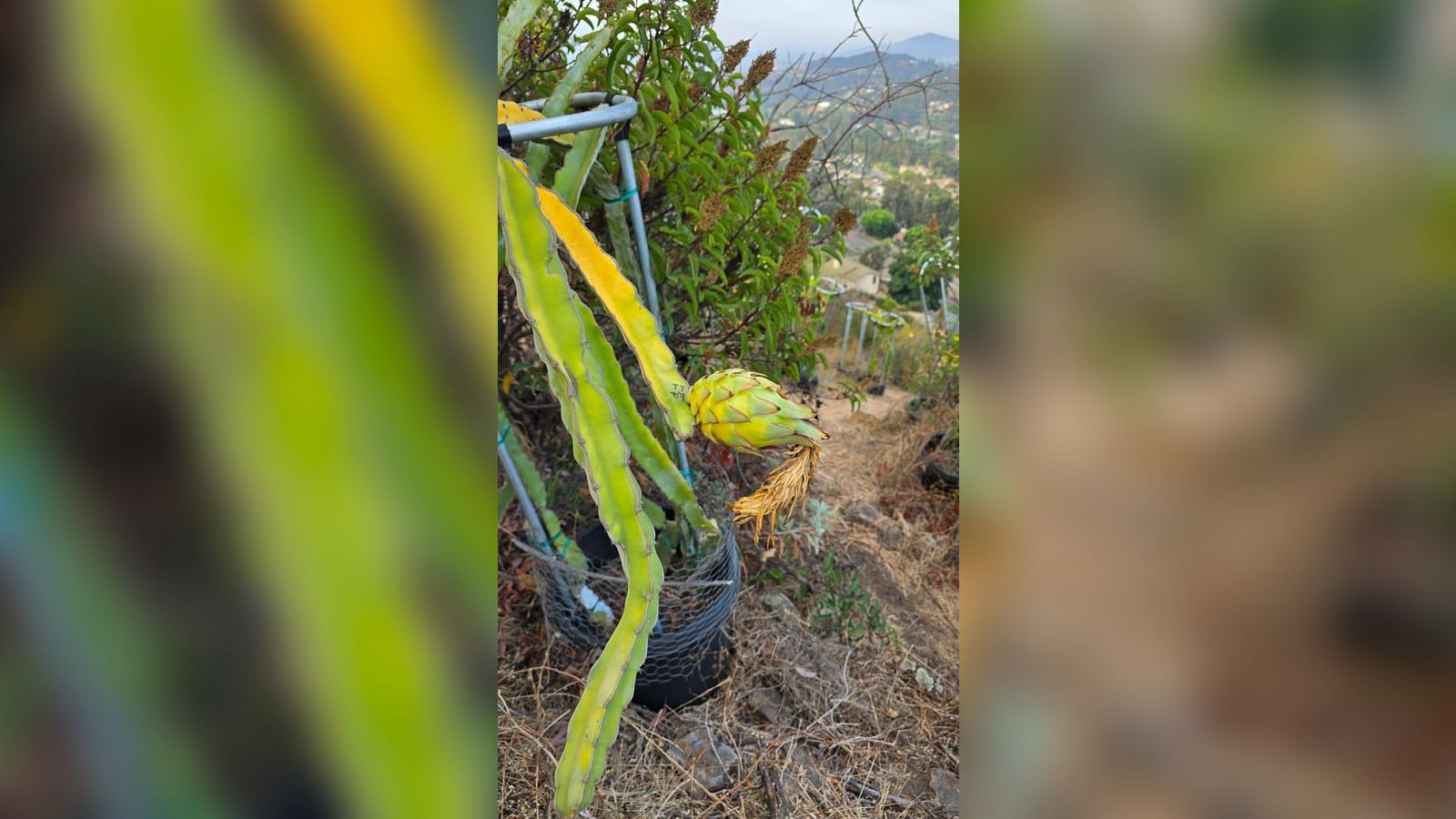
Many pitaya cultivars suffer from self-incompatibility, a condition where pollen from the same flower or clone fails to set fruit. In those cases, nurseries often recommend planting two or three different types to ensure cross-pollination.[1] Purple Dawn bypasses this hurdle. Its flowers, which open at night and feature white petals with soft pink and yellow inner tones, are capable of setting fruit through self-pollination.[5] While bees and other insects may visit flowers that remain open into the morning, you do not need to rely on them or perform hand pollination to get a crop.
Why this matters for small gardens: Self-fertility means you can grow Purple Dawn in a container or a small corner of the yard without worrying about finding a compatible partner variety. The plant’s strong growth habit and vigorous fruiting are bred for productivity, so a single well-supported vine can deliver heavy yields.
While Purple Dawn sets fruit on its own, the size and quality of that fruit are consistent with commercial standards. The Australian listing describes it as a strong commercial-performing variety producing large, sweet fruit weighing up to 850 grams.[5] This is a significant advantage over some partially self-compatible yellow cultivars, where self-pollinated fruit can be much smaller than cross-pollinated fruit.[3] With Purple Dawn, you get the full potential of the plant from a single clone.
In low-insect areas, hand pollination ensures a crop. Dragon fruit flowers open at night, making moths and bats the natural pollinators.[1] Hand pollination done at night or in the early morning is a reliable substitute if you want to ensure every flower sets. But unlike varieties that strictly require cross-pollination, Purple Dawn will set fruit without this extra step.
Climate envelope: can you grow it in Southern California or Florida
Purple Dawn thrives in the warm, frost-free zones typical of both Southern California and Florida. The breeding program in South East Queensland designed this hybrid for reliable commercial performance in warm climates, so it fits naturally into US subtropical gardens. UF/IFAS research confirms that dragon fruit grows best between 68 and 86 F, tolerating brief dips as long as temperatures stay below 100 F.[2] If you live in USDA zones 9b through 11, you have the heat this plant needs to push out heavy, sweet fruit.
Florida growers will find Purple Dawn behaves much like other red-fleshed hybrids in the state. The heat is rarely a limiting factor, though flowering can stall if temperatures consistently exceed 93 F without adequate water.[2] In Southern California, the primary concern is not heat, but cold. While the plant recovers quickly from light freezing, exposure to temperatures below 26 to 29 F causes damage to mature vines.[2] If you are in an inland valley or a high-desert edge where frost is common, you must provide protection or grow in containers that can be moved.
Regional adjustments
| Region | Primary Risk | Management Strategy |
|---|---|---|
| Coastal SoCal | Low temps, wind | Plant near a south-facing wall for thermal mass; shield from constant wind.[2] |
| Inland SoCal | Hard freeze | Use frost cloth or move pots; avoid planting in frost pockets. |
| North Florida | Occasional freeze | Monitor forecasts; cover vines if temps drop below 31 F.[1] |
| South Florida | Heat stress | Ensure deep watering during peak summer to prevent bloom inhibition.[1] |
Wind is a moderate stressor for dragon fruit. In coastal Southern California, constant salt spray and wind can desiccate stems and damage flowers. Plant Purple Dawn at least 15 to 25 feet away from large trees or structures that might create turbulent airflow, and use a sturdy trellis that won’t sway excessively.[1] In Florida, the humidity is generally beneficial, but ensure your soil drains rapidly. The plant tolerates flooding moderately well, but standing water combined with high heat can invite root rot, especially if you have over-watered during the winter dry period.[2]
The main regional difference is the winter dry period. UF/IFAS notes that a dry spell in winter and early spring is required for abundant bloom induction.[1] In Florida, winter rains often prevent this natural dry-down, which can lead to vegetative growth at the expense of flowers. In Southern California, the dry winter helps trigger the bloom cycle naturally. If you are in a wetter Florida zone, consider withholding water for a few weeks in late winter to mimic the dry season, then resume regular feeding as days lengthen. This dry period triggers flowering instead of vegetative growth.
Salinity check: Both regions can have salty water or soil. Purple Dawn is moderately tolerant of soil salinity, but sodium sensitivity is a risk.[3] If you are in a coastal area with high-salt irrigation water, flush your pots or beds regularly with fresh water to prevent salt buildup around the roots.
Planting and the first 12 months
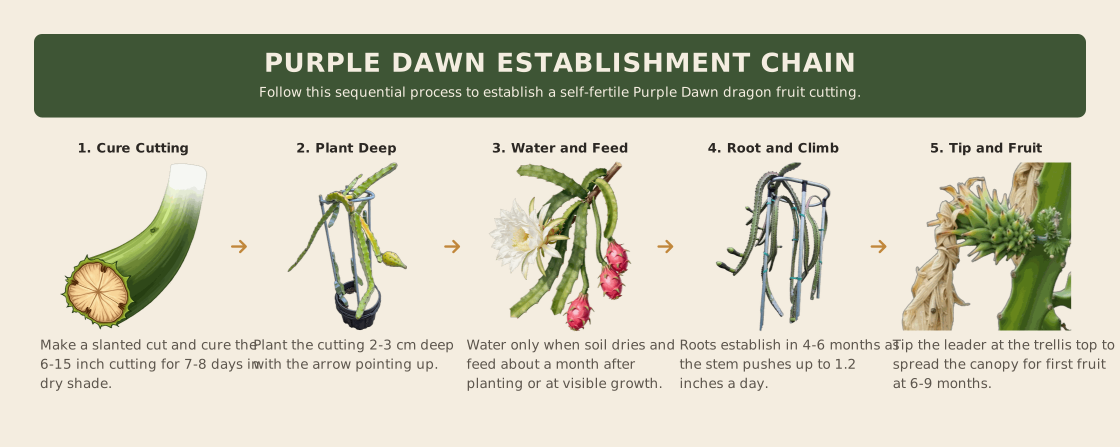
Once you have your cutting, resist the urge to over-engineer the drainage; this is the most common mistake new growers make. Do not put gravel, stones, or pot shards in the bottom of your container. Fill the pot with one free-draining mix all the way down. Ensure the pot has a drainage hole, and that is enough.
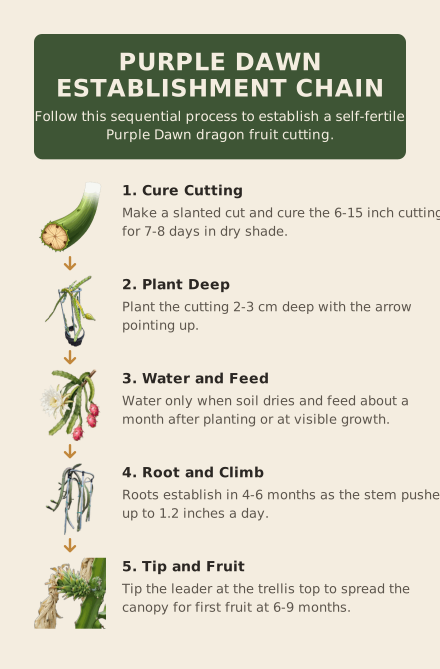
Once planted, patience is your primary tool. A rooted cutting can grow 1.2 inches (3 cm) per day under ideal conditions, but it needs time to establish a root system before it can support that kind of top growth. Expect the plant to spend about 4 to 6 months in the pot building its foundation. Many growers see their first fruit 6 to 9 months after planting, though this depends heavily on your local climate and the vigor of the initial cutting.
Watch the water. Dragon fruit is a cactus, but it is not a desert plant. It has a fairly high water requirement. However, too much water too often causes root rot. Let the top inch of soil dry out before watering again.
Feeding schedule for year one
Fertilizer strategy changes as the plant matures. For the first year, the goal is vegetative growth, not fruit production. Apply 0.25 lb (118 g) of balanced fertilizer per plant every two months. Alongside the synthetic feed, incorporate 4 lb of well-decomposed manure or compost. This organic matter improves soil structure and provides slow-release nutrients.
As you move into years two and three, the plant’s needs shift. Increase the synthetic fertilizer to 0.3 to 0.4 lb (136 to 182 g) per plant every two months. Raise the compost application to 5 lb per application, applied twice a year. From year four onward, split the fertilizer into 3 to 4 applications totaling 0.50 to 0.75 lb (227 to 341 g) per plant. During the warm growing season, consider 4 to 6 minor-element sprays. If your soil is high-pH, chelated iron drenches can prevent chlorosis.
| Year | Synthetic Fertilizer | Compost/Manure |
|---|---|---|
| 1 | 0.25 lb every 2 months | 4 lb |
| 2-3 | 0.3-0.4 lb every 2 months | 5 lb twice a year |
| 4+ | 0.50-0.75 lb split into 3-4 apps | 5 lb twice a year |
Watering and bloom induction
Pitaya requires a dry period in winter and early spring to trigger abundant bloom induction. If you keep the plant constantly wet during these cooler months, you may get lush green growth but few flowers. Once the plant begins flowering, drought periods reduce production. Resume regular watering when you see flower buds forming. This balance between dry rest and wet growth is critical for a heavy-yielding Purple Dawn.
Flowering, fruit sizing and the harvest window
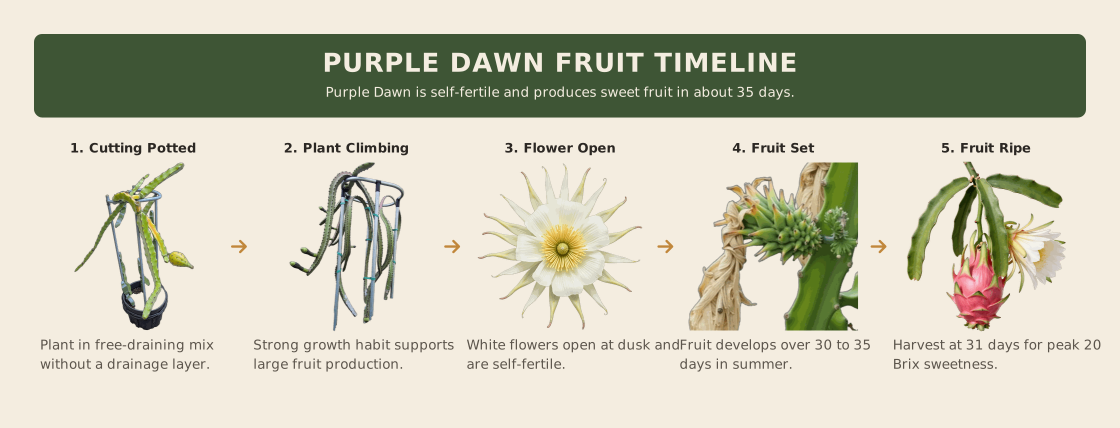
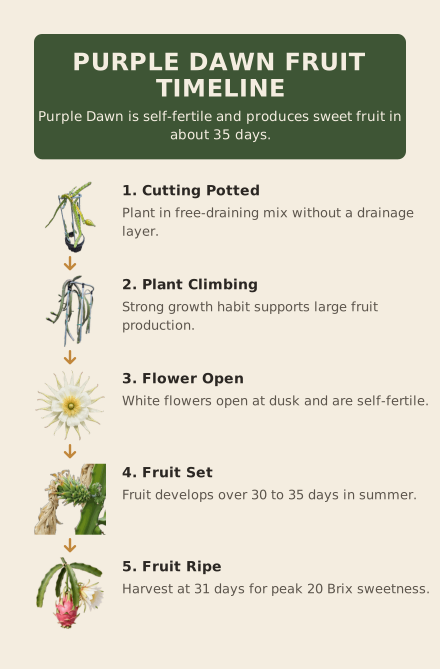
With established roots, the plant enters production. Expect flowers to appear from late spring through early autumn, with the heaviest flush arriving in midsummer. A single flower bud takes 25 to 35 days to reach full opening, or anthesis. After pollination, fruit development typically takes 30 to 35 days in summer heat, though this window stretches out as autumn and winter temperatures drop. Mature plants, particularly those three years or older, can push out more than five distinct flowering peaks in a single summer season. [3]
If you are managing a home garden without a steady stream of nocturnal pollinators, you may need to intervene. For a detailed walkthrough on ensuring good fruit set, see our guide on how to hand-pollinate dragon fruit the night a flower opens.
Watch the calendar and the fruit for harvest cues. Research published in the Journal of Horticultural Sciences tracked red-pulp and white-pulp dragon fruit at seven intervals from 7 to 41 days after flowering. The study concluded that harvesting between 31 and 36 days after flowering yields the best results, with day 31 offering the optimal balance of physico-chemical quality and sensory appeal. [4]
Thorough pollination improves size and uniformity, even in self-fertile plants. In trials involving partially self-compatible yellow cultivars, self-pollinated fruit weighed only 200 to 350 grams, while cross-pollinated fruit on the same plants reached 500 to 850 grams. [3] Although Purple Dawn does not strictly require a second variety to set fruit, vigorous insect activity or careful hand-pollination can help ensure the plant reaches its full size potential.
Harvest tip: Cut the peduncle flush with the fruit surface. Ripe Purple Dawn fruit will keep for 4 to 5 days at room temperature or several weeks in plastic bags in the refrigerator. [1]
Purple Dawn and the names it gets confused with
Similar names cause frequent mix-ups. The most common confusion involves Purple Haze, a variety listed in the UF/IFAS Florida variety table. Purple Haze is a California-selected Hylocereus undatus with dark pink skin, green scales, and dark pink pulp. It produces fruit weighing 1.0 to 2.0 pounds with a sweet grape and kiwi-like flavor. Like Purple Dawn, it does not require cross-pollination and is recommended for home plantings. However, Purple Haze is a distinct cultivar with a different origin and flavor profile than the Australian-bred Purple Dawn.[8]
Another point of confusion arises from inconsistent origin stories. Some US nurseries sell Purple Dawn as a Florida-grown selection, describing it with rich purple flesh, a strong growth habit, and a sweet berry flavor. This claim conflicts with the documented parentage from the Cactus Fruits Australia breeding program, where Steven Prowse crossed Purple Pearl with Dawn’s Supreme. The Australian lineage is verified by multiple sellers and breeder quotes, making the Florida origin claim unverified for the true clone.[8]
Visually, Purple Dawn can be mistaken for CFA Purple Heart, another selection from the same Australian program. Both plants produce large, purple-fleshed fruit and share a similar growth habit. The key difference lies in the flowers. CFA Purple Dawn produces medium-sized, predominantly white flowers with soft pink and yellow tones in the inner segments. While the overall flower shape may resemble CFA Purple Heart from a distance, the internal coloring is clearly different. This floral detail is a reliable way to distinguish the two clones in the garden.
| Feature | Purple Dawn (CFA) | Purple Haze |
|---|---|---|
| Origin | Australia (Cactus Fruits Australia) | California |
| Species | Hybrid | Hylocereus undatus |
| Flesh Color | Rich Purple | Dark Pink |
| Flavor | Sweet, berry-like | Grape and kiwi-like |
| Pollination | Self-fertile | Self-fertile |
When buying cuttings, ask for the specific breeder or program name. True Purple Dawn is listed as CFA Purple Dawn and traces back to the Prowse program. If a seller cannot confirm the Australian parentage, you may be looking at a different purple-fleshed variety or a mislabeled clone. The verified cuttings we stock come directly from the documented lineage, ensuring you get the plant with the high sweetness and self-pollinating habits described in the original release.
Should you grow Purple Dawn
Purple Dawn suits growers with a single trellis who want quality fruit without pollination management. Its self-fertile nature removes the complexity of matching different clones for cross-pollination, a common hurdle for home growers with limited space . You get large, heavy fruit with deep purple flesh and reported sweetness levels that rival top-tier commercial varieties . The plant’s vigorous growth and reliable fruiting in warm climates make it a practical choice for gardens in regions like South East Queensland or similar subtropical zones [8].
Know the trade-offs. While the 20 Brix reading is impressive, it comes from seller measurements rather than independent lab analysis, so actual sweetness may vary slightly depending on your soil and weather [5]. The fruit is large and heavy, demanding a robust support structure that can handle the weight of multiple ripening clusters . If you are in a cooler climate, remember that dragon fruit generally struggles with prolonged exposure to temperatures below 31 F (-2 C), though it recovers quickly from light frost [1]. You must also manage the plant’s vigor; without regular pruning, the dense stems can shade out lower branches and reduce airflow, inviting fungal issues.
Who is this for? Home gardeners in warm, frost-free zones who want premium, colorful fruit with minimal pollination effort. It is ideal for those who prioritize flavor and size over sheer quantity of small fruits.
If you are comparing it to other popular red-fleshed types, Purple Dawn stands out for its combination of size and ease. Unlike some partially self-compatible yellow cultivars that produce small fruit without cross-pollination, Purple Dawn sets large, marketable fruit on its own [3]. However, if you are in a region with very hot summers, note that flowering can be inhibited above 38 C (100 F) [3]. In these conditions, providing afternoon shade or ensuring consistent moisture can help maintain bloom cycles. For most growers in warm climates, its ease and fruit quality make it a worthwhile addition.
References
- Pitaya (Dragonfruit) Growing in the Florida Home Landscape (HS303; Crane and Balerdi; species table, variety table, cultural calendar, pulp nutrient table, climate, propagation, feeding, harvest and storage figures), UF/IFAS Extension, University of Florida (2020).
- Quick Guide to Environmental Factors Impacting Subtropical and Tropical Fruit Crops in Florida (HS1499; Table 5 Dragonfruit-pitaya thresholds: optimum 68-86 F, freeze damage <26-29 F, heat damage >93-104 F, chilling injury at or below 41 F, wind, flood, salinity and drought tolerance), UF/IFAS Extension, University of Florida (Crane, Schaffer, Her, Bayabil, Wasielewski, Fraisse; published 9 February 2026) (2026).
- Pitaya as a New Alternative Crop for the Iberian Peninsula: Biology and Edaphoclimatic Requirements (review; fertility classes SC/SI/PSI, selfed vs crossed fruit size, temperature limits, soil pH, rainfall, bud-to-anthesis 25-35 d, fruit development 30-35 d, flowering peaks, Hylocereus-to-Selenicereus reclassification), Plants 12(18):3212, MDPI, doi 10.3390/plants12183212 (Trindade, Carvalho, Marques, et al.) (2023).
- Maturity determination of red and white pulp dragon fruit (growth and quality sampled at 7, 14, 21, 26, 31, 36 and 41 days after flowering; harvest 31-36 DAF ideal, 31 DAF best physico-chemical and sensory quality), Journal of Horticultural Sciences 17(1), doi 10.24154/jhs.v17i1.1309 (2022).
- CFA Purple Dawn Dragon Fruit (variety listing: new variety 2022, up to 850 g, self-pollinating, Brix 20 measured by the grower, white flower with soft pink and yellow inner segments, resembles CFA Purple Heart at a distance, performs well in South East Queensland), Rare Dragon Fruit (Cactus Fruits Australia selection), Agnes Water, Queensland; undated listing, accessed 2026-10-18 (2026).
- Purple Dawn (product listing: Cactus Fruits Australia explained as the breeding programme led by Steven Prowse, parentage Purple Pearl x Dawns Supreme, 2.2 pounds, Brix 20, self-pollinating, breeder quote on huge size and sweet purple flesh), Leewi Farms (US nursery); undated listing, accessed 2026-10-18 (2026).
- Dawns Purple Dragon Fruit (listing that describes Purple Dawn: extra-large fruit averaging around 800 g, pink-red skin with vivid green fins, rich purple flesh, white flower, self-fertile, Brix 20, jelly-like texture), Rare Dragon Fruit (QLD grower stock); undated listing, accessed 2026-10-18 (2026).
- Purple Dawn Dragon Fruit Plant (nursery listing: claims a Florida-grown selection, rich purple flesh, strong growth habit, sweet berry flavour, smooth texture; also 4-7 day callusing advice), Mayumi Garden (US nursery); undated listing, accessed 2026-10-18 (2026).