Guyute Dragon Fruit: Facts, Flavor, and Where to Buy
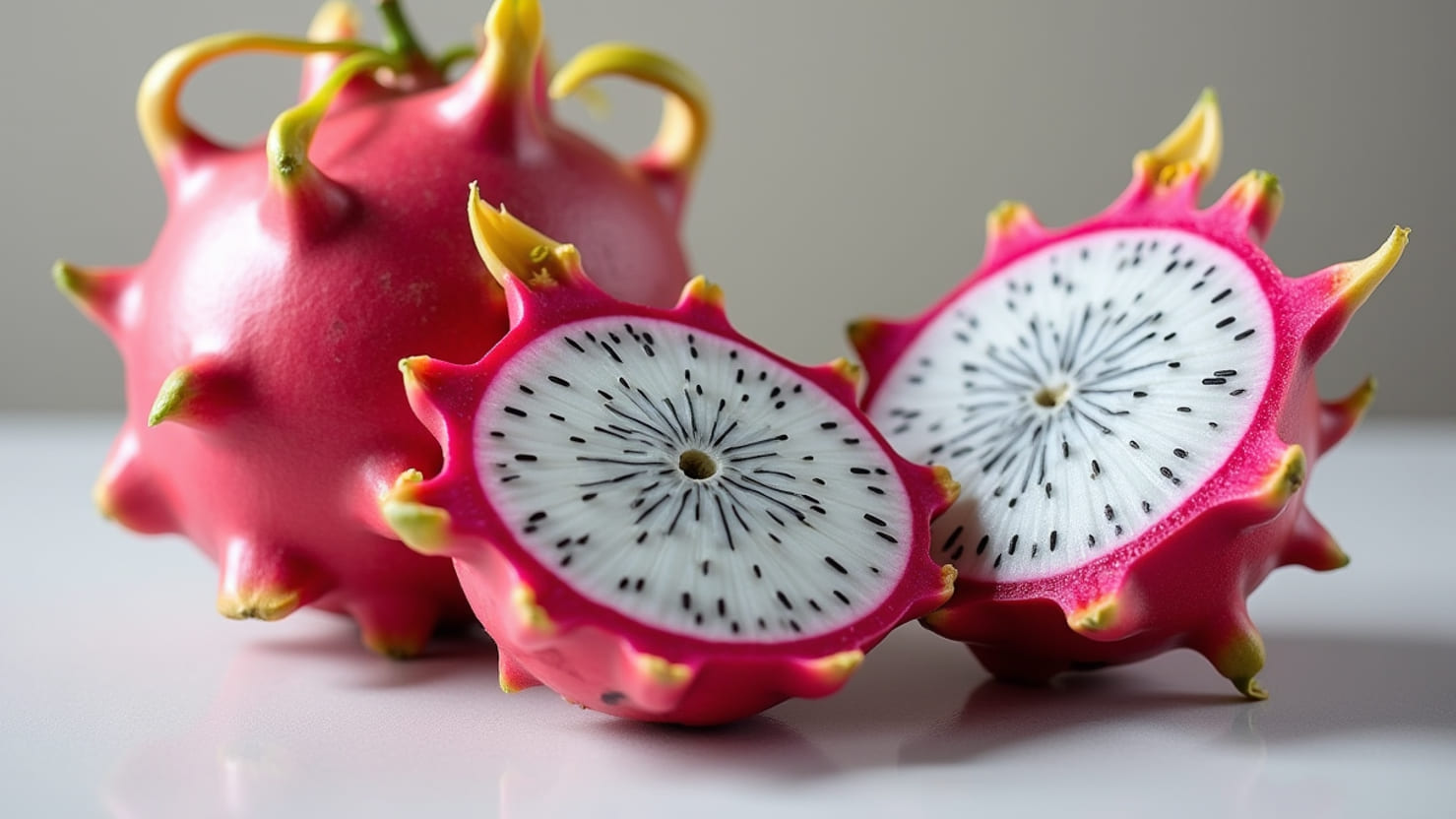
Guyute is a named cultivar of Selenicereus undatus (often still labeled Hylocereus undatus). Trade listings cite Central American origin. It produces medium fruit, typically 0.5 to 1.0 lb, with pink-to-red skin and crisp, mild sweet flesh. Trade sources report sweetness around 14.5 Brix. Both nurseries that stock it describe Guyute as self-pollinating, though species-level science shows white-fleshed flowers are built to discourage selfing, so cross-pollination often boosts size and set. The cultivar-level details here come from trade listings, while the biology below is species-level.
Guyute is a known variety, but we do not currently have a live SKU for it. Check [Pine Island Nursery] or [Rare Dragon Fruit] for availability, or explore our [white-fleshed dragon fruit cuttings] for other proven performers.
Naming: Guyute, Hylocereus and Selenicereus
If you buy a Guyute cutting and the label reads Hylocereus undatus, you are not holding a different plant. You are holding a plant with an outdated name. Nearly every US dragon fruit nursery still prints Hylocereus on their tags, even though the scientific community moved on years ago. This naming lag creates confusion, but it does not change the biology of the vine in your hands.
The accepted scientific name for the species Guyute belongs to is Selenicereus undatus. The global taxonomic backbones agree on this. The GBIF backbone resolves Hylocereus undatus directly to Selenicereus undatus as an exact match at the species rank within the cactus family, Cactaceae.[2] So, whether your tag says Hylocereus, Cereus, or Selenicereus, the plant is the same species.
The history of this name is a straight line of reclassification. Botanists have moved this plant between three genera over two centuries. The table below shows the accepted name and its synonyms as they appear in the taxonomic record.
| Year | Scientific Name | Status |
|---|---|---|
| 1830 | Cereus undatus | Original description |
| 1918 | Hylocereus undatus | Long-standing synonym |
| 2017 | Selenicereus undatus | Accepted name |
The current accepted combination, Selenicereus undatus (Haw.) D.R.Hunt, was published in 2017. It lists Cereus undatus Haw. (1830) and Hylocereus undatus (Haw.) Britton & Rose (1918) as synonyms.[1] This shift happened because genetic studies showed that the old genus Hylocereus did not form a distinct evolutionary group separate from Selenicereus.
For Guyute specifically, the trade listings and the Florida-linked cultivar table provide the practical data you need. The University of Florida’s Growables site lists Guyute with the following traits:
| Attribute | Guyute Data |
|---|---|
| Origin | Central America |
| Pollination | No need for cross pollination |
| Fruit Weight | 0.5-1.0 lb |
| Appearance | Pink peel, green scales, white pulp |
| Flavor | Sweet |
These entries confirm that Guyute is a named cultivar within the Selenicereus undatus species. The origin entry is nursery provenance rather than a published cultivar description, and the table was last updated in March 2021.[9] Pine Island Nursery, one of the few sources stocking it, catalogues it as 'GUYUTE Dragon Fruit, HYLOCEREUS UNDATUS'.[10] This mismatch between the old label and the new science is common. Do not let it worry you. The plant’s behavior, growth habit, and fruiting potential are defined by its genetics, not the Latin name on the tag.
Where it came from and why it keeps appearing
Guyute is not a released cultivar with a published trial record. It is one of many selections introduced through the nursery trade. The species behind it, Selenicereus undatus, is native from Mexico to Honduras and stands as the most cultivated pitaya species globally, with massive commercial production in Vietnam and China.[12] Because the crop is still described in scientific literature as being 'in the phase of domestication', new named clones appear constantly.[12] This ongoing selection process explains why you see new names on tags every season. They are often distinct genetic lines that have not yet been formally registered or trialed in peer-reviewed journals.
For Guyute specifically, the paper trail is thin. The only sustained descriptions come from two specialist nurseries and a Florida-linked cultivar table. No peer-reviewed trial of Guyute exists.[9] The Florida table, which lists the plant’s Central American origin and self-pollinating claim, was first published in 2014 and last updated in March 2021.[9] This means the name was circulating in trade well before the September 2023 date quoted by one Australian retailer.[9] That retailer’s date marks their market introduction, not the plant’s discovery or release.
Read the dates, not just the names. A recent "introduced" date on a nursery website often reflects when that specific shop started selling the cutting, not when the variety was created or first identified. If a name appears in older databases or tables, the plant has been in the trade for years.
Understanding this context helps you manage expectations. Guyute is a real, growing plant with verified traits in the hands of growers who stock it. However, its performance data comes from commercial observation rather than controlled academic study. This is common for dragon fruit. The species is still being actively bred and selected, so the line between a "clone" and a "cultivar" remains blurry in the nursery trade.
The fruit: size, sugars, eating quality
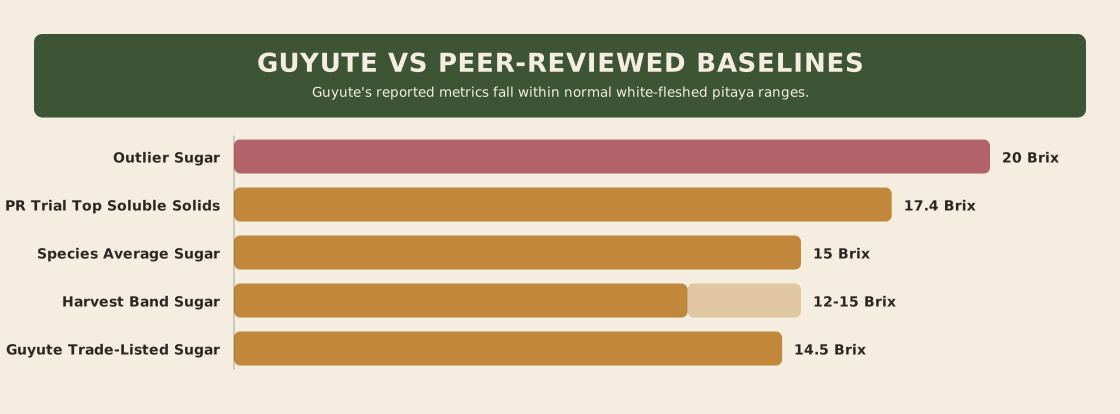
Guyute produces a solid, ordinary-to-good white pitaya. It is not a sugar outlier or a record-breaker, but it is a reliable performer for the home garden. The trade listings describe a medium fruit, typically 0.5 to 1.0 lb, with crisp, mild sweet flesh and pink-to-red skin. One Australian retailer reports an average weight of around 500 g and a sweetness of about 14.5 Brix, noting that the fruit is best enjoyed chilled.[11] While these numbers sound impressive in isolation, they sit squarely within the normal range for the species. No lab has measured this specific clone in a controlled trial, so we must look at the broader data to understand what you are actually getting.
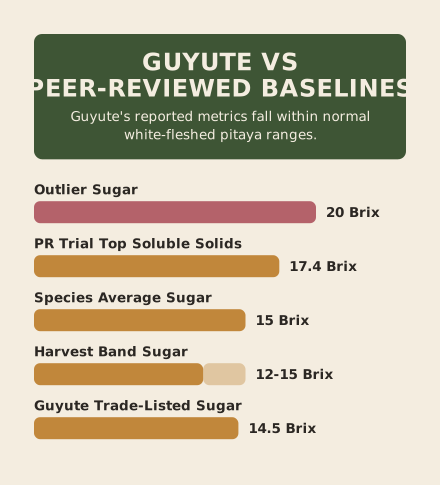
When you compare Guyute’s claimed specs against measured cultivar-trial values, the picture becomes clearer. The 14.5 Brix figure is right on the crop baseline. Total soluble solids content across Selenicereus undatus cultivars generally hovers around 15 Brix, with white-fleshed pitaya typically landing in a 12-15 Brix band at harvest.[4] Some individual cultivars can reach as high as 20 Brix, but Guyute is not one of those exceptional outliers. In a USDA-ARS-linked trial in Puerto Rico, the highest-weight white cultivars averaged 346.3 g, and top performers in soluble solids reached 17.4%.[5] Guyute’s reported ~500 g and ~14.5 Brix place it in the middle of the pack: a decent, standard white dragon fruit.
| Metric | Guyute (Trade Claims) | Species Baseline / Trial Data |
|---|---|---|
| Weight | 0.5-1.0 lb (approx. 225-450 g) | Top white cultivars avg 346.3 g; species range 0.5-3 lb |
| Sweetness | ~14.5 Brix | Named white cultivars in trials cluster 13-17 Brix |
| Flesh | White, crisp, mild sweet | White, crisp, mild sweet (standard for S. undatus) |
| Best Use | Chilled, fresh | Chilled, fresh (high water content) |
Stop trying to ripen fruit on the counter. Pitaya is non-climacteric. This means ripeness for eating is tied entirely to ripeness at cutting. Soluble solids rise on the tree to 12-15 Brix while acidity and firmness fall, but a picked Guyute will not sweeten further once it is in your kitchen.[8] Cut the fruit based on peel color and firmness, not on how it smells or feels after sitting on the counter for a few days. If it is not sweet on the vine, it will not be sweet in your bowl.
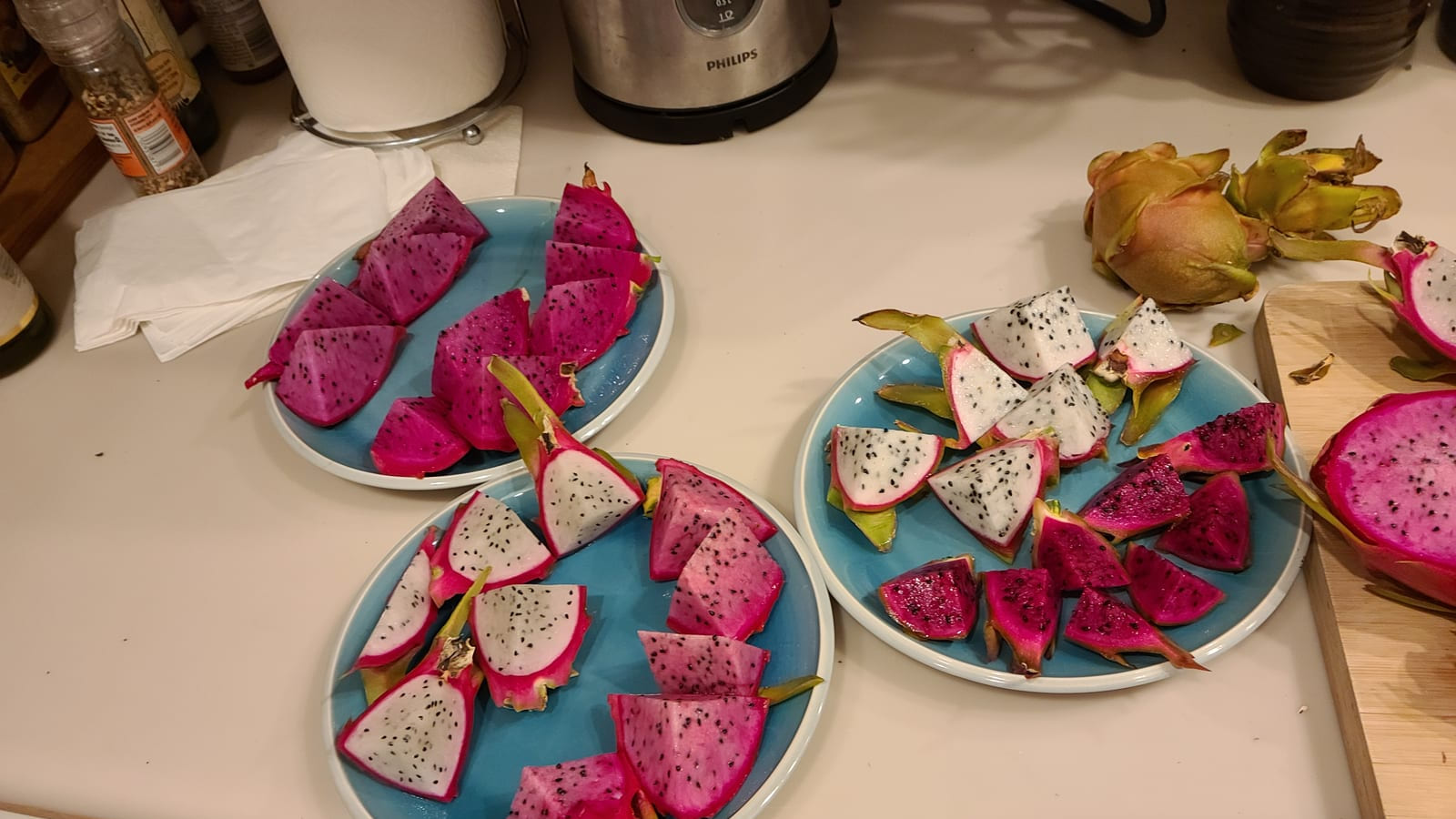
The flesh is crisp and refreshing, with a mild sweetness that appeals to a broad audience. It lacks the intense, complex sugar profile of some red-fleshed varieties or the high-acid punch of certain yellow pitayas. This makes Guyute an excellent choice for salads, smoothies, or simply eating fresh with a spoon. The high water content, typical of S. undatus pulp, makes it hydrating and light.[3] Guyute delivers the mild, crisp flavor typical of white pitaya.
"Self-pollinating" is a claim
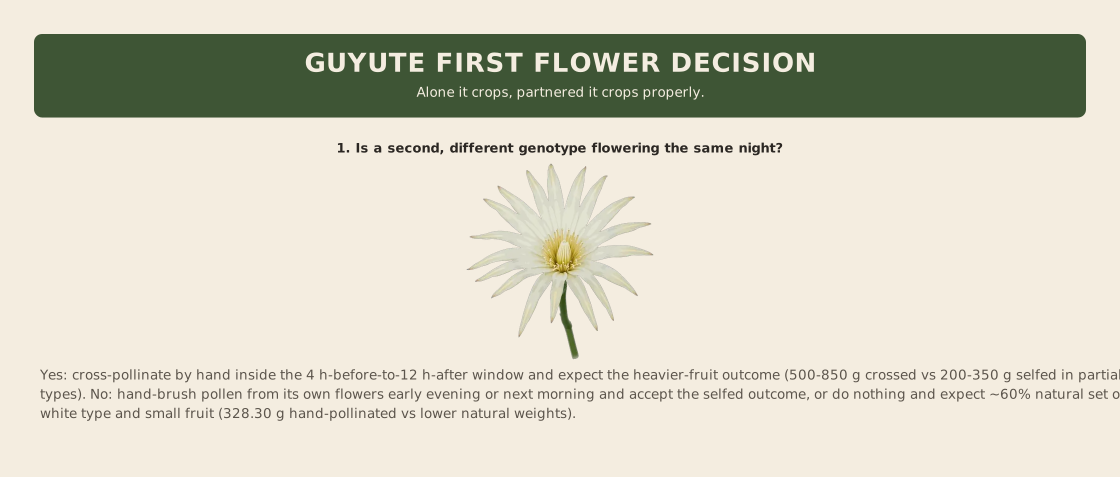
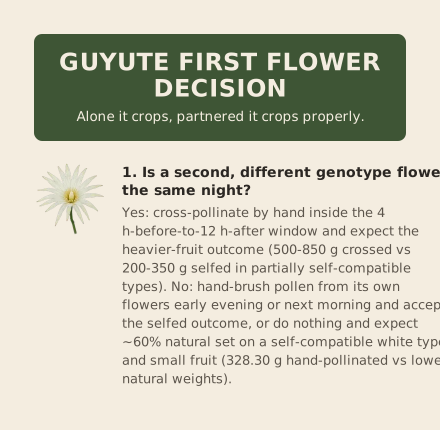
White-fleshed Selenicereus undatus flowers are physically built to discourage selfing. The stamens are shorter than the style, creating a height difference of at least 2 cm, so pollen does not land on the stigma naturally[4]. This contrasts sharply with yellow pitaya (S. megalanthus), where anthers and stigma sit at the same height, allowing that species to self-pollinate far more readily[4]. While Guyute is marketed as self-fertile, extension guidance warns that self-fertility is cultivar-specific and poorly documented, recommending you plant two or three different genetic types to ensure cross-pollination improves both fruit set and size[3].
Do not confuse "self-pollinating" with "self-sufficient." A two-year study of a commercial white-fleshed S. undatus clone found that while the plant was self-compatible, manual cross-pollination still significantly increased fruit weight[7]. The study noted that delayed selfing (autogamy) occurring about 14 hours after anthesis is insufficient for commercial-grade fruit[7]. In a subtropical trial, the self-compatible white cultivar 'White Jaina' set 60.00% of flowers under natural pollination, but hand pollination produced the heaviest fruit at 328.30 g[6]. For partially self-compatible types, selfed fruit often weigh 200-350 g, whereas cross-pollinated fruit from the same plants reach 500-850 g[4].
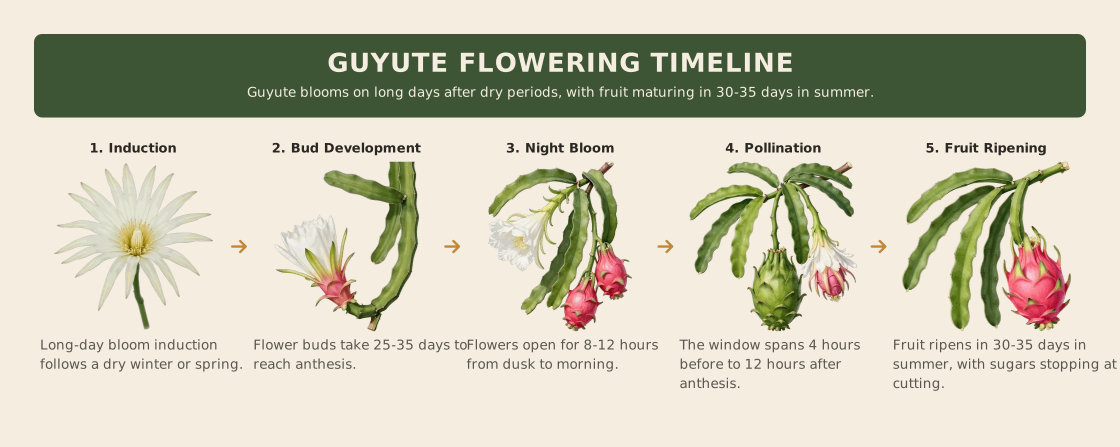
You have a narrow window. Pitaya flowers open for a single night, lasting 8 to 12 hours from dusk until the next morning[4]. Pollen viability and stigma receptivity are synchronized over a broad period from 4 hours before to 12 hours after anthesis, meaning you must target pollination in the early evening or the morning[7]. A casual midday brush will miss the mark entirely. For a deeper look at timing and technique, see our guide to dragon fruit pollination.
Verdict for the buyer: Plant Guyute as a self-fertile convenience variety if you want a simple setup. However, expect bigger, heavier fruit if you provide a partner plant or use a hand brush. The data shows that even self-compatible clones benefit from cross-pollination.
Growing Guyute: climate, water, soil, trellis
Guyute behaves like a tropical vine, not a desert cactus. It thrives in humid, warm conditions but has strict limits on temperature and moisture. If you are in inland valleys with hot summers, you face two distinct challenges: July heat that can shut down flowering, and winter frost that can kill the plant.
| Factor | Optimal Range | Survivable Range | Critical Limit |
|---|---|---|---|
| Temperature | 18-26 C | 14-32 C avg | Flowering stops >38 C; Death at -4 C |
| Photosynthesis | 30 C day / 20 C night | Collapses at 42 C / 32 C | Net CO2 uptake drops sharply >28 C |
| Rainfall | 1730-2540 mm (native) | 500-700 mm tolerated | Excess moisture causes rot/abscission |
| Soil pH | 5.5-6.5 | Well-drained sandy loam | High sodium/salinity damage |
### Heat and Frost Management
In inland valleys, July temperatures often exceed 38 C. At this point, Guyute stops flowering. The plant survives, but it does not produce. Above 28 C, every additional degree cuts nightly net CO2 uptake by 58% and early-morning uptake by 30%[4]. Peak photosynthesis happens at a 30 C day and 20 C night. If your summer nights stay above 32 C, photosynthesis essentially collapses[4]. Keep roots moist to mitigate heat stress. The plant tolerates up to 40 C if the soil is moist, but dry heat at 38 C+ is a flowering killer.
Frost is the harder limit. Guyute is hardy only in USDA zones 10a-11b[4]. Damage begins at -2 C, and -4 C is lethal[4]. In inland Southern California, frost pockets are common. If you are outside zone 10b, you must grow Guyute in a pot and move it to a greenhouse or protected area when frost threatens. Do not leave it exposed to a -2 C night.
### Water and Soil Strategy
Guyute comes from regions with 1730-2540 mm of annual rain, but it tolerates as little as 500-700 mm[4]. The key is timing, not just volume. A dry period in winter and early spring triggers bloom induction[3]. Once flowering begins in late spring, drought costs production. You must water periodically from flowering through harvest[3].
Soil must be well-drained sandy loam rich in organic matter, with a pH of 5.5-6.5[4]. Pitaya is sensitive to salinity, especially sodium[4]. Excessive soil moisture or heavy rain drives floral abscission, fruit rot, and fungal disease[4].
Potting rule: Do not put gravel, stones, pot shards or any 'drainage layer' in the bottom of a pot. It raises the perched water table and keeps the mix above it wetter. Fill the pot with one free-draining mix all the way down, and use a pot with a drainage hole.
### Trellis and Support
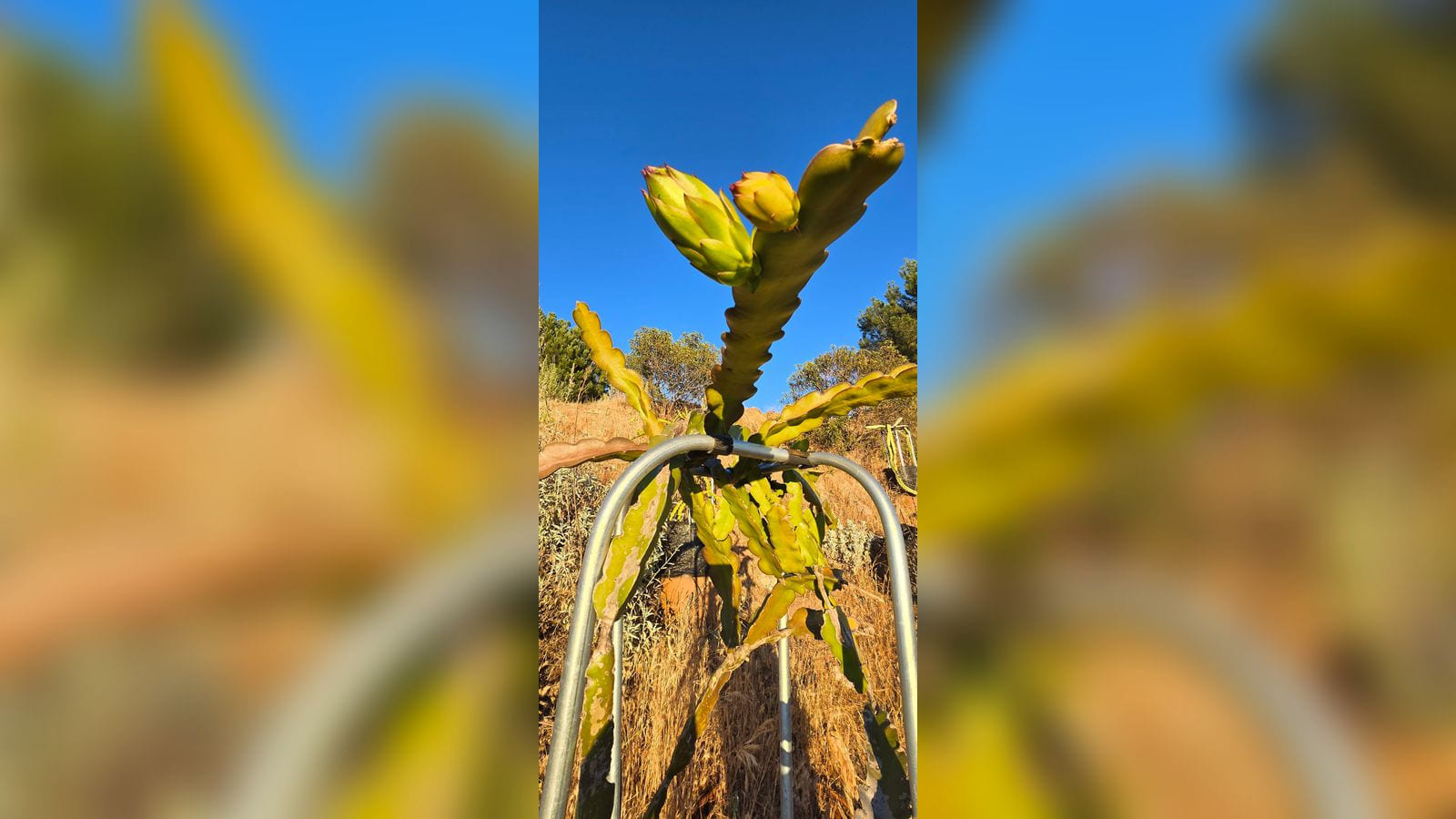
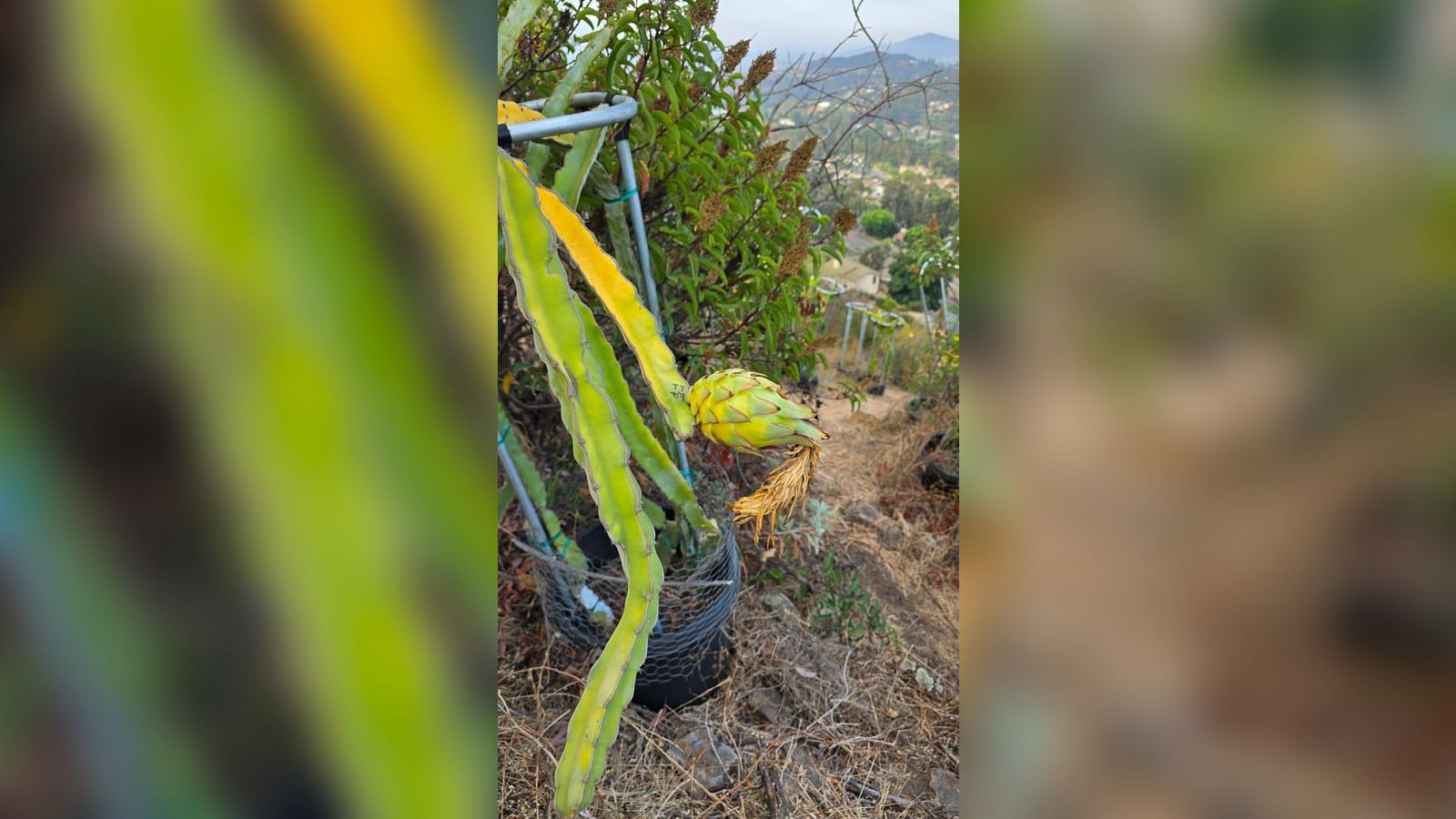
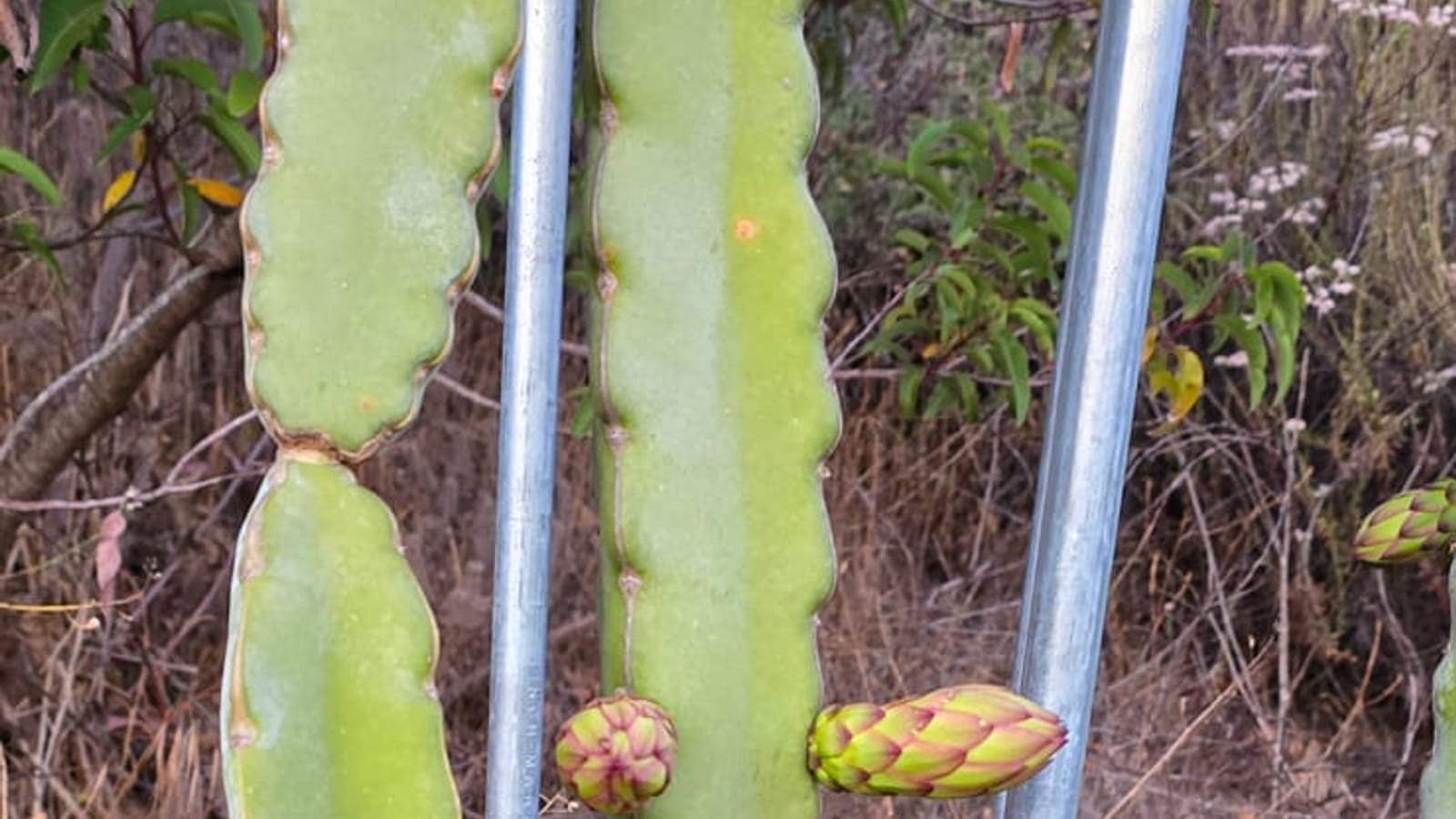
Guyute is a climbing vine. Flowers emerge from axillary buds on the cladode edges where the spines sit[3]. This means the plant needs a heavy support structure to hold the weight of the branches and fruit. A single post or a T-bar trellis works best. Tie the main stem to the post and strip laterals until it reaches the top. Then, cut the tip to force branches that drape over the support. Prune again soon after harvest to remove old stems and encourage new flowering branches. Without a strong trellis, the cladodes will break under the weight of the fruit.
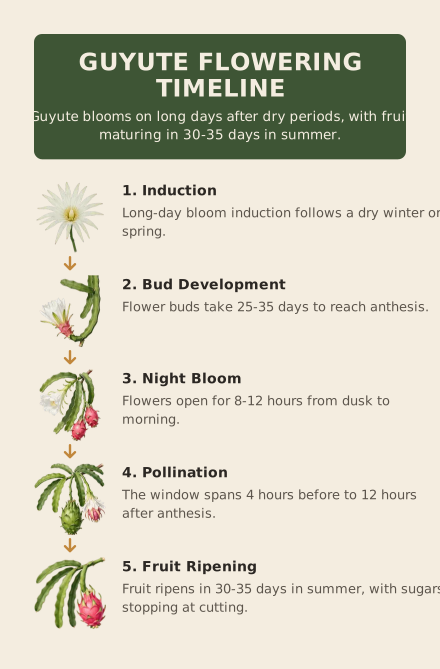
Bud to harvest: a Guyute season, timed
Wave 1: Late Spring
Trigger: Long days and warming nights.
Event: First floral buds emerge from cladode edges. [3]
Duration: 25-35 days for bud development before anthesis. [4]
The Single Night
Event: Flowers open at dusk and close by morning. [4]
Window: 8-12 hours total. Hot days may shorten this; cool/cloudy days may extend it until midday. [4]
Action: Pollinate in early evening or morning for best set. [7]
Wave 2-5+: Summer to Early Autumn
Pattern: Flowering comes in repeated waves. [4]
Age Factor: Three-year-old plants can produce more than five distinct peaks in a single summer. [4]
Development: 30-35 days from flower to ripe fruit in warm summer weather. [4]
Wave 6+: Cool Autumn
Shift: Fruit development slows as temperatures drop. [4]
Timing: Expect longer than 35 days for ripening in mid-autumn and early winter. [4]
Harvest Cue: Watch peel color and firmness, not just the calendar. [8]
Cutting to crop: propagation, establishment and pruning
Starting Guyute from a cutting is the fastest route to fruit. Select a healthy stem segment between 15 and 38 cm long and make a slanted cut at the base. Treat the wound with fungicide and let the cutting cure in the shade for 7 to 8 days. This drying period seals the cut and prevents rot when you plant it. Once cured, place the cutting in a pot with a free-draining mix. See the potting rule above for details on avoiding perched water tables.
Rooting takes patience. Expect 4 to 6 months for a cutting to establish a solid root system in a pot. Once established, Guyute grows quickly, with stems extending up to 3 cm per day under good conditions. This rapid growth is why you can expect fruit much sooner than with seedlings. Many cuttings produce their first fruit 6 to 9 months after planting. In contrast, growing from seed can take up to 7 years, and the resulting plant may not match the parent’s traits. For a home grower, the cutting is the only practical choice.
Training the vine is essential for structure and yield. Tie the main stem to your trellis post and strip any side shoots (laterals) that appear below the top. This directs all energy into vertical growth. When the stem reaches the top of the support, cut the tip. This forces the plant to branch out, creating the canopy that will bear fruit. Train these new branches along the trellis arms. Keep the vine tied securely to prevent wind damage.
Pruning after harvest is critical for the next season. Once you pick the fruit, prune the plant again. Remove the stems that bore fruit and clear all cuttings from the area. This pruning stimulates new branching and triggers the formation of fresh flowering stems. Without this step, the plant may become leggy and less productive. Regular pruning keeps the vine manageable and encourages consistent cycles.
Watch the weather. Heavy rain during flowering can cause floral abscission, where buds drop before setting fruit. Wet conditions also increase the risk of fruit rot. If you grow Guyute in a rainy climate, ensure excellent air circulation and consider overhead protection during bloom.
Yield reality and who should actually buy Guyute
Dragon fruit yield is not a fixed number you can bank on. It is heavily dependent on the specific genetics of the plant you choose. To understand where Guyute fits, look at the data from a USDA-ARS-linked trial in Puerto Rico that tested twelve different cultivars. The results were stark. The four best white-fleshed types (N97-17, N97-20, N97-22, NOI-13) averaged 17,002 kg/ha. In the same trial, 'Cosmic Charlie' averaged only 25.1 kg/ha.[5] That is a difference of nearly three orders of magnitude. Wrong clones can grow vigorously but yield little.
There is no published cultivar trial for Guyute specifically, so we cannot place it on that graph with certainty. However, we can look at the honest comparison band for white pitayas. In that same Puerto Rico trial, the highest-weight cultivars averaged 346.3 g per fruit, and soluble solids for several types hit 17.4%.[5] Guyute is marketed at roughly 500 g and 14.5 Brix. This places it squarely within the normal range for named white cultivars in real trials, which cluster around 300-400 g and 13-17 Brix. It is a competent performer, but it is not an outlier.
As noted in the self-pollination section, partial self-compatibility often results in smaller fruit. If you plant Guyute as a lone specimen, expect the lower end of its size potential. If you plant it with a partner, you are likely to see the larger, market-grade fruit the trade listings promise.
Buyer Profile: The Mixed Planting
Guyute is an excellent choice for a mixed planting where you want a dependable, mild, white-fleshed variety. It is a solid replacement for a failing Vietnamese White if you want a clone that is known to set fruit without a mandatory partner, though a partner still helps size. It fits the home gardener who wants a reliable crop without chasing record-breaking metrics.
Who Should Skip Guyute
If you are chasing record Brix or record fruit weight, Guyute is a weak fit. The trial data shows that other named white cultivars have proven higher yields and heavier fruit in controlled settings. Buy a trial-proven type if your goal is maximum commercial output or extreme sweetness.
Guyute is a reliable, middle-of-the-road choice. It is not the highest yielder in the trial data, but it is not the lowest. It sits in the middle of the pack for white pitayas. For a home grower, that reliability is often worth more than the potential for a record-breaking harvest that might never materialize due to pollination issues or climate stress.
Availability, partners and next steps
Guyute sits on our known-variety list, but we do not currently list a live Guyute SKU for sale. We do not currently stock Guyute. If you want this specific clone, join the waitlist or contact us directly to ask about future propagation runs. In the meantime, you can secure the genetic partners that make a lone Guyute plant perform better.
White-fleshed pitaya flowers are biologically designed to discourage self-pollination, so cross-pollination often boosts fruit size and set even when a nursery claims a variety is self-fertile.[4] Planting two or three different genetic types is standard extension guidance to improve yields.[3] We recommend pairing Guyute with a same-night polleniser. Our in-stock candidates for this role are American Beauty, Asunta 3, and Bahamut. These varieties flower on the same nocturnal schedule, ensuring pollen is available when Guyute blooms.
If you are looking for other white-fleshed companions or pollen sources, note that Albino Ocamponis, Asunta 5, and Box Of Fresh are currently out of stock. We restock these periodically, so check back or join their specific waitlists. For a broader view of which varieties flower together and how to manage pollination, see our pollination guide and the varieties chart.
For those growing in containers, our pot-culture guide covers the specific soil mixes and watering rhythms needed to keep roots healthy without perched water tables. Remember that pitaya is sensitive to excessive soil moisture, which drives floral abscission and fruit rot.[4] A free-draining mix in a pot with a drainage hole is essential.
Quick check: Before ordering a companion, verify its flowering window matches Guyute’s. All white-fleshed S. undatus types bloom at night, but slight timing shifts can reduce cross-pollination success. Our pollination guide details how to hand-pollinate if natural vectors are insufficient.
Frequently asked questions
Does Guyute self-pollinate?
Trade listings describe Guyute as self-pollinating, and the University of Florida’s Growables site notes it has no need for cross-pollination.[9] However, species-level biology shows white-fleshed flowers are built to discourage selfing, with stamens shorter than the style.[4] While Guyute may set some fruit alone, cross-pollination with a different genetic type typically increases fruit weight and set.[7]
How fast does Guyute fruit from a cutting?
Pitaya cuttings root in 4 to 6 months in pots.[3] Many plants produce fruit 6 to 9 months after planting.[3] This timeline applies to Guyute as it is a Selenicereus undatus cultivar, though individual establishment rates vary with care and climate.
Can I grow it in zone 9 in a pot?
Yes. Pitaya is hardy only in USDA zones 10a-11b, so in zone 9, it must be grown in a pot and moved indoors or into a greenhouse during frost events.[4] Frost kills it. Pot culture allows you to control the environment and protect the vine from cold snaps.
Why is my Guyute fruit small?
Small fruit often results from partial self-compatibility. Self-pollinated white-fleshed cultivars can set fruit weighing 200 to 350 g, whereas cross-pollinated fruit from the same plants can reach 500 to 850 g.[4] If your Guyute is growing alone, it may be relying on delayed selfing, which is insufficient for commercial-grade size.[7] Adding a same-night polleniser and hand-pollinating can significantly improve fruit weight.
References
- Selenicereus undatus - NCBI Taxonomy browser record 176265 (synonyms Cereus undatus Haw. 1830, Hylocereus undatus (Haw.) Britton & Rose 1918; Selenicereus undatus (Haw.) D.R.Hunt 2017), NCBI / National Library of Medicine (US NIH) (2026).
- Selenicereus undatus (Haw.) D.R.Hunt - GBIF backbone species 10334868 (Hylocereus undatus resolves as a synonym), Global Biodiversity Information Facility (2026).
- Pitaya (Dragonfruit) Growing in the Florida Home Landscape (HS303 / MG226, Crane & Balerdi), UF/IFAS Extension EDIS, doi:10.32473/edis-hs303-2005 (2024).
- Pitaya as a New Alternative Crop for Iberian Peninsula: Biology and Edaphoclimatic Requirements, Plants 12(18):3212, MDPI (Univ. do Algarve); PMC10537634 (2023).
- Yield and Fruit Quality Traits of Dragon Fruit Cultivars Grown in Puerto Rico, HortTechnology 30(6):803-808 (Goenaga, Marrero Soto & Perez, USDA-ARS Mayaguez) (2020).
- Determination of the effects of bumblebee (Bombus terrestris), hand, and natural pollination on fruit set, yield, and quality in pitaya (Hylocereus spp.) cultivation under subtropical conditions, BMC Plant Biology 26:999 (Akdeniz Univ.); PMC13251243 (2026).
- Reproductive phenology, pollination modes and floral biology of white-fleshed dragon fruit (Selenicereus undatus) under subtropical conditions, Scientific Reports (Nature Portfolio) (2025).
- Yellow Pitahaya (Selenicereus megalanthus Haw.): The Less Known of the Pitahayas - fruit ripening and non-climacteric quality attributes, Foods 14(2):202, MDPI (Univ. Miguel Hernandez); PMC11765378 (2025).
- Pitaya Species and Named Varieties (cultivar table incl. Guyute: Central America, 0.5-1.0 lb, pink/green peel, white pulp, sweet, no cross needed, recommended), Growables / Lynette Boggs (UF-linked tropical fruit extension site) (2021).
- Guyute Dragon Fruit - Hylocereus undatus (variety page: 0.75-1.0 lb, self-pollinating, sweet, excellent chilled), Pine Island Nursery, Miami FL (2026).
- GUYUTE dragon fruit - Hylocereus undatus (introduced Sept 2023, Central America, self-pollinating, ~500 g medium fruit, Brix ~14.5), Rare Dragon Fruit, Queensland AU (2026).
- Selenicereus undatus (Belle-Of-The-Night, White-fleshed Pitahaya) - Extension Gardener Plant Toolbox (native Mexico to Honduras, zones 10a-11b, fruit 0.5-3 lb, 5-6 harvest cycles), NC State University Cooperative Extension (2026).